(corrected)
EUREKA
VOL
1
CONTENTS
New
Translation of the first five chapters of the Apocalypse 1
CHAPTER 1
THE SOURCE FROM
WHICH THE APOCALYPSE EMANATED: ITS
PURPOSE: THE
SYMBOLIZATION OF THE MYSTERY OF
GODLINESS: THE
MANNER OF THE COMING OF THE SPIRIT
MAN PROCLAIMED: SYMBOLIC
VISION OF THE MAN, AND THE
MYSTERY OF THE SEVEN STARS
AND LIGHTSTANDS,
REVEALED.
SECTION 1
1. The Title 9
2. Who are the Servants of God 16
3. New Testament use of the word apocalypse” 27
4. When the Apocalypse was written 36
5. The Apocalypse Rooted in the Prophets 41
a. The Stone and the Mountain 58
b. The Seven-Branched Lampstand and Olive Trees 60
c. The Harlot and the Ephah 67
d. The Four Spirits of the Heavens 74
e. The two Mountains of Brass 76
SECTION II
|
|
New Translation of the first five chapters of the Apocalypse
SECT/ON II
The Mystery of Godliness apocalypsed in Symbol
I. Of Deity before Manifestation in Flesh 89
2. Deity Manifested in Flesh 98
3. Deity Manifested in Spirit 106
4. Symbolization of Deity in Spirit 111
5. The Blessed 115
SECTION II
The Salutation
1 “Church” 118
2 Ecclesia 119
3 The Seven Ecclesias 123
4 For Ever and Ever 125
1. The Son of
Man in the midst of the Seven Lightstands 153
2. “I was in
Spirit” 157
3. “In the
Lord’s Day 158
4. The Seven
Golden Lightstands and Seven Stars 161
5. “The Son of
Man” 166
6. “Clothed to
the Feet 169
7. The Golden
Zone 170
8. His Head and
Hairs 173
9. His Eyes as
a Flame of Fire 173
10.“His Feet like unto Fine Brass 174
11.“His Voice as of the Sound of Many Waters” 181
12.“Out of His Mouth a Sharp Two-Edged Sword 183
13.“His Aspect as the Sun 185
14.The Amen 187
CHAPTER II
EPISTLE TO THE FOUR ANGEL-STARS OF THE ECCLESIAS IN
EPHESUS, SMYRNA, PERGAMOS~
AND THYATIRA.
SECTION I
To
The Angel of the Ephesian Ecciesia.
1. The Angels
of the Ecclesias 190
2. False
Apostles 192
3. The
Nikolaitanes 197
4. “He that
hath an Ear, let him hear! 204
5. “To him that
Overcomes 205
6. “The Wood of
the Life 207
7. “The
Paradise of the Deity 209
SECTION II
To the Angel of the Ecclesia of the Smyrneans 219
1. Jews
of the Satan’s Synagogue 222
2. “The
Synagogue of the Satan 230
3. The
Satan and Demons 234
4. TheDiabolos, or Devil 241
5. “Ten Days’ “Tribulation 253
a. C. Pliny to Trajan 254
b. Trajan to Pliny 255
6. Day for a
Year 257
7. The Second
Death 261
SECTION 111
To
the Angel of the Ecclesia in Pergamos
1. Topography
of Pergamos 265
2. The
Throne of the Satan 267
3. “The
Place the Satan inhabits 268
4. “My
Name” 275
5. “My
Faith” 284
6. Antipas 286
7. The
Balaamites 288
8. The
Hidden Manna 309
9. A
White Pebble 314
SECTION IV
To
the Angel of the Ecclesia among Thyatirans.
1. Topography of
Thyatira 317
2. Origin of
the Ecclesia in Thyatira 318
3. The Woman
Jezebel 323
4. The Depths
of the Satan as they Speak 334
5. The Reward
Promised 343
6. The Morning
Star 348
SARDIS~
PHILADELPHIA, AND LAODICEA.
SECTION 1
To the Angel (‘)f the Ecciesia in Sardis 351
1. “Walk
with me in White” 356
2. “They
are Worthy” 357
3. The
Book of Life 360
4. The
Life of the Lamb 364
5. “Confess his
Name” 368
6. “His Name” 371
CONTENTS
SECTION 11
To
the Angel of the Ecciesia in Philadelphia
I. The
Holy and True 373
2. The
Key of the House of David 375
3. The
Hour of Trial 38(1
4. The
Patient Waiting 384
5. 1 Come Quickly 385
6. Coronal
Wreath 386
7. Pillar
in the Temple 389
8. “My
New Name 395
9. The
Name of the City Written 399
10.A Clerical Exposition 400
SECTION lI
To the Angel of the Ecclesia of the Laodiceans
I. Topography
of Laodicea 401
2. The
Amen 402
3. The
Witness Faithful and True 404
4. The
Beginning of the Creation of the Deity 405
5. “1
know thy Works 408
6. “l am
about to vomit thee out of my Mouth 409
7. The
Counsel of Spirit 413
8. 1
have stood at the Door, and I knock 414
9. The
Promise to the Victor 415
SECTION IV
The
Seven Ecclesias typical of the Complete and Manifold development of the
Apostacy 419
Apostolic state of Christendom 427
1. Ephesian
State 432
2. Smyrnean
State 433
3. The
Pergarnian State 436
4. Thyatiran
State 439
5. Sardian
State 443
6. Philadelphian
State 446
7. Laodicean
State 449
NEW TRANSLATION
OF THE FIRST
FIVE APOCALYPSE
CHAP.
1:1. A REVELATION of Jesus Anointed which the Deity committed to him to exhibit
to his servants things which must be speedily accomplished: and he indicated
them by sign having sent bv his
messenger to his servant John. 2. Who testified the word of the Deity and the
testimony of Jesus Anointed, and whatsoever things he saw 3. Blessed he that
knows accurately, and they who give heed to the words of the prophecy. and
observe narrowly the things which have been written in it’. for the time is
near.
THE SALUTATION
4. JOHN to the Seven Ecclesias which tire
in the Asia joy to you and peace from THE WHO IS and WHO WAS and WHO IS
COMING;.. and from the SEVEN SPIRITS which is before His throne, 5. And from
Jesus Anointed, the Faithful Witness, the Chief born from among the dead, and
the Prince of the kings of the earth: to him having loved us and washed us from
our sins in his blood, 6. And made us kings and priests for the Deity even our
Father: to Him be the glory and the supremacy during the AIONS of the Aions. Amen. ______________
Vision Of The Son Of Man In The
Lord’s Day
7. BEHOLD he is coming with the Clouds.
and every eye shall see him. and whosoever pierced him and all the tribes of
the earth shall wail before him. Yea
verily; so let it be.
8. I am the Alpha and the Omega. beginning
and ending, saith the Lord Who Is and Who Was and Who is coming. the
Omnipotent.
Pg
2 NEW
TRANSLATI0N
9.
I, John, both your brother and joint partaker in the tribulation. and in the kingdom
and waiting for Jesus Anointed, was in the isle called Patmos on account of the
word of the Deity, and on account of the testimony of Jesus Anointed.
10.
I was in spirit in the Lord’s Day; and I heard behind me a loud voice as of a
trumpet, 1 1. Saying, I am the Alpha and the Omega, the First and the Last, and
what thou beholdest write for a scroll, and send it to the Seven Ecclesias
which are in Asia—to Ephesus, and to Smyrna, and to Pergamos. and to Thyatira,
and to Sardis, and to Philadelphia, and to Laodicea.
12.
And 1 turned to see the voice which spake with me; and having turned I saw
Seven Golden Lightstands,13. And in the midst of the seven lightstands I saw
like to a Son of man invested to the feet, and compassed about the breast with
a Golden Zone; 13. And his head and the hairs white as it were wool, white as
snow: and his eyes as a fame of fire; 1.5. And his feet like to incandescent
brass, as if they hall been glowing in a furnace: and his voice as a sound of
many waters; 16. And having in his right hand Seven Stars; and out of his mouth
a sharp double-edged longsword proceedeth and his aspect as the sun shineth in
his strength.
17.
And when I saw him, fell at his feet as dead. And he laid his right hand upon
me, saying, to me, Fear not! I am the First and the Last 1X. And the Living
One: and I was dead, and behold I am living for the Aions of the Aions; Amen:
and I have the keys of the Invisible and of Death. 19. Write the things thou
hast seen, and the things which are, and the things which shall come to pass
after these.
20.
The mystery of the Seven Stars which thou sawest at my right hand, and the
Seven Lightstands which are golden, is this. the Seven Stars are the Angels of
the Seven Ecclesias; and the Seven Lightstands which thou sawest are Seven
Ecclesias.
EPISTLES TO
THE ECCLESIAS
1. The Ephesian
CHAP.
2:1. To the Angel of the Ephesian ecclesia write; These things saith he who
holds the Seven Stars in his right hand walking in the midst of the seven
lightstands which are golden. 2. I have known thy works. and thy labor. and
thine awaiting, and that thou art not able to endure wicked men; and hast tried
them who assert that they are Apostles, but are not, and has found them liars;
3. And thou hast suffered, and hast patient endurance, and thou hast labored on
account of my Name, and hast not tired out.
4.
But have against thee that thou hast forsaken thy first love. 5. Remember then
from whence thou hast fallen, and change thy mind, and do the first works; but
if not, I come to thee speedily. and I will remove thy lightstand out of its
place, except thou change thy mind.
6
But thou hast this, that thou hatest the works of the Nikolaitans, which I also
hate. 7. He that hath an ear let him hearken to what the Spirit saith to the
pg3
ecclesias.
To him that overcomes, to him I will give to eat of the Wood of the Life which
is in the midst of the Paradise of the Deity.
2. To the Smymean
8.
AND to the Angel of the ecclesia of the Smyrneans write; These things saith the
First and the Last, who was dead and lived; 9. I have known thy works, and the
tribulation and the poverty; though thou art rich and the blasphemy of those
who say that they themselves are Jews, and are not, but a Synagogue of the
Satan.
10.
Fear not the things which thou shalt suffer. Behold the Diabolos* will
cast
of you into Prison that ye may be tempted; and ye will have a tribulation of
ten days. Be faithful until death, and I will give to thee the coronal wreath
of
the life.
11.
He that hath an ear let him hearken to what the Spirit saith to the
ecclesias;
he who overcomes shall not be injured by the Second death.
3. To the Pergamian
12.
AND to the Angel of the ecclesia in Pergamos write; These things saith he
having the sharp double-edged longsword; 13. I have observed thy works and
where thou dwellest, in which place is the throne of the Satan; but thou
holdest fast my name, and deniedst not my faith even in the days in which
Antipas was my faithful witness, who was put to death with you where the Satan
sojourns.
14.
But I have against thee a few things, that thou hast there men holding
the
teaching of Balaam, who instructed Balak to cast a stumblingblock before the
sons of Israel. to eat idol-sacrifices and to fornicate. 15. So hast thou also
men holding the teaching of the Nikolaitans, which thing I hate.
16.
Change thy mind, but if not, I come to thee speedily. and I will fight
against
them with the longsword of my mouth.
17.
He having an ear let him hearken to what the Spirit saith to the ecclesias. To
him that overcometh, I will give to him to eat of the manna that hath been
hidden; and I will give to him a white pebble. and upon the pebble a New Name
that hath been engraved, which no one knew except the receiver.
4. To the Thyatiran
I8.
AND to the Angel of the ecclesia among Thyatirans write; These things saith the
Son of the Deity, having his eyes like a flame of fire, and his feet like to
incandescent brass;
19.
I have known thy works, and thy love, and service, and faith. and endurance;
and that thy works, even the last. are more than the first.
*Diabolos.
ecclesia, aion. Satan; are not translated but transferred for interpretation in
The Exposition
4 NEW
TRANSLATION
20. But I have a few things against thee,
because thou permittest the woman Jezebel, who calleth herself a prophetess, to
teach and to seduce my servants to fornicate, and to eat idol-sacrifices. 21.
And I gave her time that she might heartily turn from her prostitution; but she
turned not. 22. Behold I cast her into a bed, and them committing adultery with
her into great tribulation, unless they may have heartily turned from their
works. 23. And I will slay her children with death; and all the ecclesias shall
know that I am he that searcheth reins and hearts; and I will give to you, to
each one, according to your works.
24. But I say to you, and to the rest among
the Thyatirans, as many as do not hold this teaching, and who acknowledged not
the depths of the Satan as they speak; I will cast upon you no other burden.
25. Moreover that which ye have, hold fast to
the time that I may have come. 26. And he that overcometh, and keepeth my
appointments to an end, I will give to him dominion over the nations; 27. And
he shall govern them with an iron sceptre: (as the potter’s clay-vessels it is
breaking to pieces) as also I have received from my Father. 28. And I will give
to him the Morning Star.
29. He that hath an ear let him hearken to
what the Spirit saith to the ecclesias.
5.
To the Sardian
1. ALSO to the Angel of the ecclesia in
Sardis write: These things saith he having the Seven Spirits of the Deity and
the Seven Stars: I have known thy works, that thou hast the name that thou
livest, but thou art dead. 2. Become thou vigilant, and strengthen the things
remaining which are about to die: for I have not found thy works perfected in
the sight of the Deity.
3. Be mindful therefore what thou hast
received and heard, and strictly keep it, and be changed. If then thou have not
been vigilant, I shall be come upon thee as a thief, and thou mayest not at all
have known at what hour I shall be come upon thee.
4. Thou hast a few names even in Sardis
which have not defiled their garments: and they shall walk with me in white
robes, because they are worthy.
5. The victor, he shall be clothed in
white garments; and I will not at all obliterate his name from the scroll of
the life, and I will openly confess his name in the presence of my Father, and
in the presence of his angels.
6. He that hath an ear let him hearken to
what the Spirit saith to the ecclesias.
6.
To the Philadelphian
7. ALSO
to the Angel of the ecclesia in Philadelphia write; These things saith the Holy
One, the True One, he having the key of
David, opening and no one shutteth, and he shuts and no one openeth. ~. I have
observed thy works; behold I have placed before thee a door, which has been
opened, and no one is able to shut it; because thou hast a little strength, and
hast kept my word, and hast not denied my name.
9. Behold I give up out of the Synagogue
of the Satan them who say that they are Jews, yet are not, but do lie; behold I
will cause them that they come and have prostrated themselves before thy feet,
and that they may have known that I have loved thee.
10.
Seeing that thou hast kept the word of my awaiting, I also will keep thee from
the hour of the trial being about to come upon the whole habitable to prove
them who dwell upon the earth.
II. Behold I come quickly; hold fast what
thou hast that no one may have seized upon thy coronal wreath.
I2.
The victor, I will make him a pillar in the temple of my Deity, and he shall
not at all go away out more; and I will write upon him the name of my Deity and
the name of the City of my Deity, the New Jerusalem, which descendeth out of
the heaven from my Deity, even my New Name.
13. He having an ear to hear let him hearken
to what the Spirit saith to the ecclesias.
7.
To the Laodicean
14. ALSO to the Angel of the ecclesia of
Laodiceans write; These things sayith the Amen, the Witness faithful and true,
the Beginning of the creation ~ the Deity. 15.1 have known thy works, that thou
art neither cold nor hot. Would that thou wert cold or hot! 16. Thus because
thou art lukewarm, and neither cold nor hot, I am about to vomit thee out of my
mouth.
17. Because thou sayest, I am rich, and have
abounded in wealth, and have iced of nothing, and hast not known that thou art
the wretched, and pitiable, and poor. and blind, and naked one. 18. I counsel
thee to buy from me gold which has been refined by fire that thou mayest be rich;
and white garments that thou mayest be clothed, and that the shame of thy
nakedness may not be apparent; and anoint thine eyes with salve that thou
mayest see. 19. Whomsoever I love I
discipline and admonish; be zealous therefore, and change.
20 Behold I have stood at the door, and I knock;
if any one may hear my VOICE. and open the door, I will enter in to him, and
will sup with him, and he with me.
21. The victor, I will give to him to sit
with me in my throne as I also vanquished, and sat with my Father in his
throne.
22.
He that hath an ear let him hearken to what the Spirit saith to the ecclesias.
Vision of the Thrones, the Elders, and the Living Ones
CHAP.
4:1. AFTER these things I looked, and behold a door opened in the heaven, and that
first voice which I heard as of a trumpet speaking with me,
Page6 NEW
TRANSLATION
saying, “Ascend hither, and I will
exhibit to thee things which must come to
pass after these.”
2. And immediately I was in spirit: and
behold a THRONE was established in the heaven, and upon the throne one sitting.
3. And the one sitting was in appearance like to a jasper and sardine stone:
and a rainbow circled about the throne in appearance like to an emerald.
4. And circling about the throne were twenty-four
thrones: and upon the thrones I saw the twenty and four Elders sitting, having
been invested with white garments; and they had upon their heads golden
coronets.
5 And out of the throne proceed
lightnings and thunders and voices: and seven lamps of fire burning before the
throne, which are the Seven Spirits of the Deity.
6. And before the throne a translucent
sea, like to crystal. And in the midst of the throne and in the circle of the
throne four Living Ones being full of eyes before and behind.
7. And the first living one was like to a
lion; and the second living one like to a calf; and the third living one having
the face like to a man; and the fourth living one like to an eagle flying. 8 And the four living ones, one by itself,
had each six wings circling about it; and within they were full of eyes, and
they have no intermission day and night, saying, Holy, Holy, Holy, Lord, the
Omnipotent Deity, who was and who is, and who is coming.
9. And when the living ones shall give
glory, and honor, and thanks to the one sitting upon the throne, who liveth for
the Aions of the Aions, 10. The twenty and four Elders fall before the one
sitting upon the throne, and they do homage to him who liveth for the Aions of
the Aions, and they cast their coronets before the throne saying. 11. Worthy
art thou, 0 Lord, to receive the glory, and the honor and the power; because
thou createdst all things. and on account of thy will they exist, and were
created.
The lamb, the Elders, and the Living Ones Indicated
CHAP.
.5:1. AND I saw at the right of him sitting upon the throne a SCROLL, which had
been written within and on the back, sealed up with
SEVEN SEALS.
2. And I saw a mighty angel heralding with
a loud voice, “Who is worthy to unroll the scroll, ,and to loose the seals
thereof?” 3. But no one in the heaven, nor upon the earth, nor under the earth,
was able to unroll the scroll, nor to see it. 4. And I shed many tears, because
no one was found worthy to unroll and read the scroll, nor to see it.
5. But one of the elders saith to me, Weep
not; behold the LION who is of the Tribe of Judah, THE ROOT OF DAVID, hath
prevailed to unroll the scroll, and to loose the seven seals thereof.
6.
And
I saw, and behold in the midst of the throne, and of the four living ones, and
in the midst ol the elders, a LAMB standing as if it had been slain. having
Seven horns .and Seven Eyes, which ,are the SEVEN SPIRITS of the Deity sent
forth into all the earth 7. And he went and received the scroll from the right
of him sitting upon the throne.
7.
Page
7
8. And when he received the scroll, the
four Living Ones and the twenty-four Elders cast themselves down before the
Lamb, having each one harps, and golden censers full of perfumes, which are the
prayers of THE SAINTS
9. And they sing a NEW SONG, saying,
“Thou
art worthy to receive the scroll,
and
to undo the seals thereof;
For
thou wast slain, and with thy blood,
The
price hast purchased us for God
From
every people, tribe, race, tongue,
And
mad’st us kings and priests t’ our God.
And we
shall reign the earth upon.”
11. And I beheld, and heard a voice of many
angels circled about the throne, and of the living ones, and of the elders: and
the number of them was ten thousands of ten thousands and thousands of
thousands, 12. Saying with a loud voice,
“The
Lamb that hath been put to death,
The
power, riches, wisdom, strength
And
honor, glory, blessing too
Is
worthy to receive.
13. And every created thing that is in the
heaven, and things which are in tI~e e,irth. and underneath the earth. and upon
the sea, even all the things in them. I heard saving,
“To
him that sitteth on the throne
And
to the Lamb the blessing be,
The
honor, glory and the pow’r,
The
Aions of the Aions for!
EXPOSITION OF THE APOCALYPSE.
CHAPTER I.
THE SOURCE FROM WICH THE APOCALYPSE EMANATED; ITS PURPOSE
THE SYMBOLIZATION OF
THE MYSTERY OF GODLIINESS; THE MANNER
OF THE COMING OF THE
SPIRIT-MAN PROCLIAIMED; SYMBOLIC VISION
OF
THE MAN. AND THE MYSTERY OF THE SEVEN STARS AND LIGHTSTAND REVEALED.
SECTION!.
I. The Title
A
revelation of Jesus Anointed which the Diety committed to him to exhibit to his
servants things which must be speedly accomplished “---Apox 1:1 ~ ~ I
I
AHOKAJTIVIA
Apokalupsis, is the first word of the last book of the New Testament in Greek.
The book is, therefore. in that language styled. Apokalupsis. But this name is
not restricted to the original. It is very often employed in speaking and
writing as the title, or name. of the book in the English; although it is not
so designated in the common Version. It
is styled in this “The Revelation” which, indeed. expresses the truth; for the
hook is a revelation, and one specially imparted: but still, the name is objectionable.
inasmuch as it is only a very small part of revelation; nevertheless small as
it is. a most important, and highly interesting. portion thereof. To distinguish it, there-fore, from
revelation in general. many are accustomed to anglicize the Greek name. and to
style it THE APOCALYPSE. For this reason. which appears sufficient, I have
concluded to adopt it also; so that the reader of this volume will understand.
that when “the Apocalpyse” is named. that book of scripture is meant. which in
the English Version is called “The
Revelation of St John The Divine”
Though
published by “special command of the Most High and Mighty Prince. James, by the
Grace of God, King of Great Britain, France. and Ireland; and Defender of the
Faith;” and “appointed to be read in Churches” ~ -the reader must not suppose
that the words “The Revelation of St John the Divine”, are the divinely
authorized inscription. The Holy Spirit
does not speak in this style, even of an apostle. It is only The Apostacy,. so conspicuously exhibited in The
Page
10
Apocalypse,
that confers titles upon the Fishermen of Galilee, and their brethren, to give
them sanctity and respectability in the estimation of the kings and princes of
the world. The Apostasy uses the words
“saint” and “divine” as applicable only to “Christians,” who have attained
sanctimonious preeminence among their fellows; and who are skilled in
“divinity,” and have received ordination, and a license to preach. But these words are not so used in scripture.
Saint is there applied to all that are separated, or made holy, by the blood of
the covenant; as it is written, “Gather my saints together unto me: those that have made a covenant with me by
sacrifice” Psal. 50 : 5 : “having their
hearts sprinkled from an evil conscience (by the blood of sprinkling, Heb. 12 :
24) and their bodies washed with pure water”
Heb. 10:22. The sprinkling
of heart, and the washing of body, are common to all in Christ, whether
apostles, prophets, evangelists, pastors, teachers, or private persons. In apostolic times, these were all saints, or
“the faithful in Christ Jesus”-
l
Cor. 1 :2 ; Col. I : 2. There was then no canonization of obedient believing
men and women into saints: all who believed and obeyed “the truth as it is in
Jesus,” in that obedience became saints and children of the Most High.
The apostle John had no titles. He was neither “Saint John” nor “John the Divine.” He was one of the saints in Christ Jesus; but not “Saint,” as an ecclesiastical title of honor and distinction. He might as well have been styled king John or Priest John; for he was not only a saint, but a king and a priest for God. Ecclesiastical titles are of the pride of life, and not of God. They are assumptions of lordship over the saints; and strictly forbidden by their Prince. “Ye are all brethren; and the greater of you shall be servant” Matt. 23 : 8, II. This is the spirit of Christ, who, although the Teacher, and Lord, was as one who served. The reverse of this is the spirit of Antichrist. Wherever, therefore, men professing to be Christians, exalt themselves, or allow themselves to be exalted, to high ecclesiastical estate, there is “the mark of the beast.” and there “the number of his name.” All this sort of thing was repudiated with contempt by the apostles, after they were converted and became as little children Matt. 18 : 3. “Be of the same mind towards one another; not minding high things, but being conducted with the despised” Rom. 12 : 16. This was the doctrine they inculcated, and practised; and in so doing, though dead, still speak reprehending the unhallowed ambition of those who pretend to have succeeded them in all but their penury and woe I Cor. 15 :19 2 Ep. II 2l-28.
The
apostle John is the only one upon whom the Apostasy’ has conferred the title of
“the Divine.” Paul, James, Peter, and
Jude are termed simply apostles, or messengers; while the messenger John is, as
an especial honor, erected into ho theologos, the Theologian, or “Divine “Was
it imagined that he was Professor of Divinity in a Theological Seminary at
Jerusalem; or, was it because he has narrated the discourses of Jesus on the
relations of the Father and the Son, which are not found in the other
testimonies? Whatever may have been the
reason, it must of necessity be infinitely puerile. None of the apostles had
any thing to do with what King James’s flatterers and courtiers call
“divinity,” or “theology,” but to condemn it as a corruption of “the faith once
delivered to the saints.” They denounced it as “profane, and old wives’
fables;” and its professors as “seducing spirits” and “demons,” “unruly and
vain talkers, and deceivers.” Paul the
Divine, Peter the Divine, or John the Divine, are epithets that desecrate the
renown of the noble men whose names are thus entitled. John had no divine
pretensions over Peter and Paul. James, Peter, and John were “pillars,” and
Paul was not a whit behind them; for He that wrought effectually in Peter, was
also mighty in him. They made no ostentatious display of their names; and in
themselves claimed to be no more than weak earthen vessels, in whose feebleness
and frailty the glory and power of God became more strikingly manifest. The
Holy Spirit was the holy oil of their earthen lamps. By it they were guided
into all the truth; and the light which shone around them was of that
anointing, not of them.
“The
Revelation of Saint John the Divine” is a spurious title. The real inscription
is contained in the first words of the book-Apokalupsis !esou Christou,
REVELATION OF JESUS ANOINTED.
The
contents of the book did not come to John direct from God. They emanated from
Him “who dwells in light,” who had hitherto reserved them in his own power-Acts
1 : 7. Till this emanation they were
sealed up, and “known to no man, no not the angels in heaven, NOR THE SON, but
the Father” ~ Mark 13 : 32. Jesus affirmed this want of knowledge with reference
to his apocalypse. “Watch ye therefore,” he continued; “for ye know not when
the master of the house cometh, at even, or at midnight, or at the cockcrowing,
or in the morning; lest coming suddenly he find you sleeping.”
This
universal ignorance of “the Times and Seasons” is the subject of one of the
scenes of this book. In chap. 5 : I The Apocalypse is represented as a book in
the right hand of God completely sealed up. When John saw the book, he heard a
loud voice inquiring, “Who is worthy to unroll the scroll, and to loose its
seals?” But no man or angel came forward. “And no man,” says John, “in the
heaven, nor upon the earth, nor under the earth, was able to unroll the scroll,
nor to
Page12
see
it.” John was exceedingly distressed at this. The words and the book that
Daniel had been commanded to shut up and seal ( ch. 12: 4, 9) no man in the
heaven, earth, or grave, was found worthy or able to open. Therefore John wept
exceedingly. “I wept much,” says he, “because no man was found worthy to unroll
and read the scroll, nor to see it.”
The
book remained thus concealed with God until the time of John’s residence in the
Isle of Patmos. He was there, he tells us, “on account of the word of God, and
the testimony of Jesus Christ.” He was in tribulation, and doubtless “wept
much,” both on account of his sufferings, and his inability to say “how long to
the end of the times” Dan. 12 : 6, 8 : when the Lord Jesus should appear in his
kingdom
9.
Rut. at this crisis, a Messenger reached his place of exile, whom he styles
“one of the elders,” a constituent of the symbolic twenty-four, ch. 4 : 4 ; 5 :
8. 9and said to him. “Weep not: Behold, the Lion of the Tribe of Judah, the
Root of David. hath prevailed to unroll the scroll, and to loose its seais”5 :
5.
Thus
“Jesus of Nazareth, the King of the Jews,” is brought before the reader as the
only personage from among the dead, or among the living, who could open the
words and unseal the mystery of God, as he hath declared the glad tidings to
his servants the prophets—it) : 7. That mystery required the cutting asunder a
covenant for the covering of iniquity; and for causing to come in a
righteousness of Aions—Dan. 9:24. In other words, “Messiah the Prince” had to
be cut off; and so to be made a covenant of, according to the saying, “I will
give thee for a covenant of the people”—Isai. 42 : 6 ; 4’$ : 8. Until this were
accomplished no practical solution could be given of the end. Had the Second
Adam failed to establish his worthiness, like the first, John’s weeping would never
have been assuaged. But Jesus did “prevail.” for, though in all points tempted
as we are, according to the likeness of his nature to ours, yet he did not sin.
Though a Son, he learned obedience by the things which he suffered. He was made
perfect through sufferings, having been obedient unto death. He kept his body
under, triumphing over its lusts; and, though sorely tried, he yielded not, but
evolved a character that was holy, harmless, undefiled, and separate from
sinners—Heb. 2 : 1(), 14, 1(7 ;4: 1515 : 2, 7-9 ;7 : 26. When he died, he was
delivered from death, and now lives for evermore. Death hath no more dominion
over him. For he had power to lay down his life, and to take it up again; a
commandment which he had received of the Father. This he did; and in so doing,
abolished the power of death, having led captivity captive, and brought to
light the life and incorruptibility of the gospel of the kingdom—Psal. 68 : 18,
Eph. 4: 8; 1Tim. 1:10.
Having
established his worthiness in this moral conflict with the world and the flesh,
God accepted him as the most excellent of all the intelligences of his
universe, and in consequence gave to him what no one else possessed, namely,
power to unroll the scroll and to loose its seals. The Apocalypse is therefore styled,
“A Revelation of Jesus Anointed ~ which the Deity committed to him. “ NOW,
Jesus Anointed is Power, or Spirit, manifested in flesh, and justified in
Spirit l Tim. 3 16 : or, “Made of the seed of David according to flesh; and
constituted Son of God in power, according to spirit of holiness, out of a
resurrection of dead ones” Rom. 1 : 3, 4 : and therefore styled “the Lord the
Spirit.” or “a life-imparting Spirit”—l Cor. 15 : 45 ; 2 Cor. 3 : 17, 18. Here
are Spirit and Flesh. The Spirit is THEOS, or Deity; the Flesh was the Son of
Mary, and named Jesus; and when anointed with Spirit again at his resurrection,
became Jesus Christ, or the Anointed Jesus. This anointing was his begettal of
spirit by which he became Spirit; as he said to Nicodemus, “that which is born
of the Spirit is spirit”—John i : 6. The Eternal Spirit, then, imparted to
Jesus, after his glorification, the times, and seasons, and mode. and
circumstances of his reappearance upon earth; all of which constituted a
revelation such as he had not yet been the subject of. It is a revelation of
Jesus Christ very unlike the revelation of the man of sorrows acquainted with
grief. this was a revelation of the Son promised to Israel and David’s house,
~~s a helpless babe, born in a stable and cradled in a manager; as a fugitive
in the earth, escaping from the sword of power; as a mechanic, laboring at the
bench for his daily bread; as a preacher of righteousness, denouncing the
hypocrisy and blasphemy of the clergy; and calling upon the people to renounce
the traditions of their blind guides; and to become enlightened in the wisdom
from above; as a man persecuted for righteousness’ sake by the pious and the
powerful of the Church and State; as a man accused of blasphemy, sorcery, and
perversion of the people; as an alleged enemy to God, and a traitor to king’s
reigning by his grace; as a man, in fine, adjudged “guilty of death, and worthy
only of being “numbered with transgressors, and ignominiously executed with
thieves. Such was the revelation of “Messiah the Prince” in Heaven’s gift of
him “for a Covenant of the People,” which has now for many centuries been
presented to the nations in New testament history, and memorialized in the
ecclesiasticism of the Beast.
“Messiah
the Prince,” or High Priest, was “cut off,” or covenanted, ris the spirit had
revealed to Daniel. But before he died, he cried with a loud voice, in the
words of Psal. 37 : I., saying, Aili, Aili, “My strength, my strength. why hast
thou forsaken me!” Before he
Page
14
had
uttered this exclamation, the Holy Spirit, which had descended upon him from
the Habitation of Light and Power, in the form of a dove, and rested upon him,
from the time of his immersion in the Jordan, had been withdrawn. The
Father-Spirit had evacuated the son of David’s daughter, who is styled, in the
Songs of Zion. “the Handmaid of Jehovah, Psal. 116 16. The Son was, therefore,
left without strength or power, and consequently without God. Still he was
suspended to the tree a living man; a man crucified through weakness (2 Cor. 13
: 4), and dying of his own volition in obedience to God. But after the
God-Power had forsaken him, and before he committed his life to the Father in
breathing his last, there was an interval in which, after the example of
Abraham at the typical confirmation of the covenant, “a horror of great
darkness fell upon him”(Gen. 15 : 12); “for there was darkness over all the
land until the ninth hour.” In this darkness he cried aloud; and drank the
bitterness of gall and vinegar; and again cried with a loud voice; and the deep
sleep fell upon him from which he did not awake until the early dawn of the
third day.
In
this death-state the Son of David was prevailed against by the Little Horn of
Daniel’s Fourth Beast; and a prisoner of captivity. In this crisis he was
neither God nor Spirit: but as testified concerning him in Psal. 22 : 6, “A
worm and no man;” poured out like water; bones all out of joint; heart like
wax, melted in the midst of the bowels. Strength dried up like a potsherd;
tongue cleaving to the jaws; lying in the dust of death- vers. 14, 15. But
things were only to remain thus for a short space. The man Jesus, who had left
behind him a character which the Father-Spirit acknowledged as His own, had
been too excellent and admirable a person to be abandoned to the power of the
enemy. The corpse rested, waiting to become the basis, or hypostatis of a of a new revelation—a new, or further,
revelation of Spirit. The Father-Spirit had been manifesting himself for three
years and a half, terminating at the crucifixion, in word and deed; teaching
great truths, and working mighty wonders and signs which Omnipotence alone
could operate; this was Spirit-revelation through Mary’s Son” Power manifested
in flesh.” but a Spirit-revelation was to be given to the BODY REPAIRED(a body
thou repairedst for me Heb. 10 : 5. A breach had been made in it. Its “loins
were filled with a loathsome disease: and there was no soundness in its flesh”
Psal. 38 : 7. This was its condition while prostrate and hidden in the noisome
pit (Ps. 40 : 2) beneath the turf. But though sealed up in Joseph’s cave, it
was not concealed from the Father-Spirit, who had so recently forsaken i;.
Walls, and seals, and soldiers, could not bar out the Spirit from the Body he
was about to repair for future manifestations.
Page
15
Hence
the Spirit in David represents the Son as saying, “My body was not concealed
from thee when I was made in the secret place;
I was embroidered in the under parts of the earth. Thine eyes saw my
imperfect substance: and in thy book all of them were written as to the days
they were fashioned. when there was not one among them.”
Psal.
139 : 15·
The
body was repaired, and in its being freed from the loathsomeness
of
death. it was created a Spiritual Body with all the embroidery of spirit “it
was sown in corruption,” though “not permitted to see corruption:’. It was:
raised in incorruptibility: it was sown in dishonor, it was raised in glory; it
was sown in weakness. it was raised in power it was sown a soul-body, it was
raised a spirit-body.” incorruptible, glorious, and powerful: egeneto ho
eschatos Adam eis pneuma, the last Adam was made into
spirit; he was freed from all those
qualities of body which make our human nature inferior to the nature of angels;
and acquired new ones, by which the nature he now rejoices in is so intimately
combined with the Father-Spirit, that what is affirmed of the one is true also
of the other. according to what is written in John 10 : 30,38.
“ I
and the Father are One “ the Father is in me, and I in him.” “Ihis is the true
Theos. and the Aion-Life.” 1 John 5 : 20, and therefore he is styled by Paul.
“the Lord, the Spirit.” imparting life. 1 Cor 15:42-45
Now,
though the world has: witnessed the revelation which Light and Power gave to
David’s Son in the days of his psychical, or soul-body, commonly styled “his
flesh;” it has never seen the apocalypse predetermined and recorded for
manifestation through the pneumatical or spirit-body, begotten from among the
dead. This revelation has been imparted to the glorified Jesus, to the
once-dead body now anointed with spirit with which the Deity has sealed him.”
John 6 27. “A revelation of Jesus anointed which God gave to him;” not to be
held as a secret with himself, which no other intelligences should know, until
the
things
revealed should burst upon the world, and take even the saints at unawares.
This was not the purpose for which it was given to him; simply, as it were, to
make the Son equal in knowledge with the Father. and more intelligent than the
angels in heaven. It was given to him as .’The Head of the Body the Ecclesia;
the Beginning, the first begotten from among the dead. that he might be among
all preeminent; for it pleased that in him all the fullness should dwell.
Col.
1 18. He was to be the depository of wisdom. knowledge, and power for the heirs
of the world. The apocalypse of his future was given to him for their benefit,
that they might know the things which must be accomplished speedily. The
inscription therefore reads, “A Revelation of Jesus
Page
16
anointed
which God gave to him to show his servants things which must come to pass
speedily.” The revelation was only intended for these. It was not communicated for the information
of the wicked; for it had long before been noted in the scriptures of‘ truth
that “None of the wicked should understand.” Dan. 12 : 10. “To the wicked. God
saith, What hast thou to do to declare my statutes, or that thou shouldest take
my covenant in thy mouth? Seeing thou hatest instruction, and castest my words
behind thee.” Psal. 50 : 16, 17.
Who
are the Servants of God
From
this testimony: we learn that “the wicked”” are a larger class than is
generally supposed. They are not restricted to murderers. drunkards. thieves.
and the licentious. The wicked are to a great extent very pious and religious
people. They have “a zeal of God. but not according to knowledge.” Being
ignorant of God’s righteousness. they go about with great diligence and at
enormous cost, to establish their own righteousness. not having submitted to
God’s. They compass sea and land to make proselytes: they make long prayers.
sing with sweetest music the praises of him they profess to worship The world
is full of their piety: for it is fashionable to be religious. or rather to
“profess religion:” so that Christianity is thought to be habited in “fine
linen. purple. silk. and scarlet:” to walk in silver sandals: and to be
“adorned with pearls and precious stones.” Apoc. I8 : 12. But. be this as it may.
there is a characteristic of wickedness which no, sect. party. name. or
denomination, regarded as “orthodox.” can repudiate as inapplicable to itself.
That characteristic is. “THOU CASTEST MY WORDS BEHIND THEE” Saith God, No man.
sect. or party. can offer a greater insult to Jehovah than this; for it is
testified. that He hath magnified his word above all the attributes of his
name; Psal. 138 2 ;and it was foretold in commendation of Messiah, that when he
should be revealed, he would “magnify the law and make it honorable.” Isai. 42
21. “1 came not,” said he. “to destroy the law and the prophets. but to
fulfill; for the heaven and earth may pass away. but not one jot or tittle
shall pass from the law, till all be fulfilled.” He continually impressed upon
his hearers the necessity of believing the words of God. and of doing his
commands: and never ceased to make the “obedience of faith” the test of men’s
devotion and affection for him. “If ye love me,” saith he, “keep my
commandments:” and “ye are my friends if ye do whatsoever I command you,” for
“love is the fulfilling of the law.”
Now
these are principles which no sophistry or reasoning can set aside. They are as
true to-day as when they fell from the lips of him who gave utterance to the
words of God.” “My words,” saith he. “are spirit and life;” and Moses has
testified, saying, that whosoever would not hearken unto Jehovah’s words which
he should speak in his name, He would require it of him.” Deut. Is 15-19. The
reader may profess to believe that Jesus of Nazareth is he to whom Moses
referred; for. Jesus said, “He wrote concerning me.” But does the reader know
what the Father commanded the prophet like unto Moses to speak in his name? If
he know it, does he believe it? And if he believe the things spoken, has he
obeyed them? To believe and do is the only evidence a man can give that he does
not cast Jehovah’s words behind him. “ Why call ye me Lord, Lord, and do not the things which I
say” Hear this. ye bishops, priests, and ministers! Hear this, all ye eloquent
“divines.” and leaders of the people! All ye scribes, Pharisees, and
hypocrites. whose garb. grimace. and tone, are the counterfeit of wool to
disguise the ravening wolf! Hear this, all ye zealots of the world religious;
this question is for you who call Jesus, Lord. and do not the things which he
says! Deny not the truth of the indictment; for your “names and denominations,
in their creeds, institutions, and practices, are standing memorials of your
guilt. Do ye know what the glad tidings were Jesus was anointed to preach to
the poor’ Do ye know what that kingdom was whose gospel he announced? What was
that acceptable year of Jehovah he proclaimed? Can ye define that righteousness
of God attested by the law and the prophets. he exhorted men to seek with the
kingdom’! Do ye consent to his words, appointing men to believe the gospel he
preached, and to be immersed, that they may be saved? Do ye not rather make
void all this by your traditions, teaching for doctrines the commandments of
men? To believe and do, ye practically repudiate, in affirming the salvation of
those who neither know. believe, nor obey. Now He whom ye call Lord, testifies
against you. saving, “He that receiveth not my words, the word that I have
spoken. the same shall condemn him in the last day.” “The gospel of the
kingdom” is “the word of the kingdom,” which he sowed in his field. BY faith in
this word men will be justified; without it, they will be condemned; for the
words of Jesus are, “He that believeth not shall be condemned.”
Now,
it is notorious, 0 ye clergy of all orders and degrees, that ye do not consent
to “the truth as it is in Jesus;” but that. ye substitute all sorts of
foolishness in its place. Ye blaspheme “the name of the Father, and of the Son,
and of the Holy Spirit,” by invoking it in the rhantism of babes, who, you
teach, are by that absurdity engrafted into the body of Christ. This is taking
the name, “the Glorious and Fearful Name.” Jehovah-Elohim, in vain. That name
is holy and reverend, and He hath commanded, saying, “Thou shall not take the
name of
Page
18
Jehovah
thine Elohim in vain; for Jehovah will not hold him guiltless that taketh his
name in vain”—Exod. 20 : 7. And surely it is an egregious vanity, in view of
the testimony, “that without faith it is impossible to please God; for he that
cometh to him. must believe that he is, and that he is the rewarder of them
that “diligently seek him”—to bring a puling babe to a pint basin. incapable of
faith. ignorant of any thing called God, and a diligent seeker only of its
mother’s breast! And this ye do, and many other abominations too, 0 ye
Destroyers of the people. Hear, then, what Paul, whom ye style “the Great
Apostle to the Gentiles,” hath declared to your confusion. In 1 Tim. 6 : 3, he
says. “If any man teach otherwise, and consent not to wholesome words. the
words of our Lord Jesus Christ. and to the teaching which is according to
godliness; he has been besmoked, knowing nothing. but doting about questions
and strifes of words, whereof cometh envy. strife. railings. evil surmisings,
perverse disputings of men of corrupt minds,
and
destitute of the truth, supposing that gain is godliness: from such withdraw
thyself.”
It
is manifest, then, from these premises, that the pious zealots of the names and
denominations of Gentile Christianity, together with their professional guides.
are all of the same category. Though very respectable and orderly members of
society. they are besmoked know-nothings, and wicked, not consenting to the
words of Jesus, but casting his words behind them, and denouncing them as
“heresy.” The revelation before us, “which the Deity gave to him,” was not for
them. It was for “his servants;” and the spiritual guides” of the people are
not his servants. This is the reason why there is no interpretation of THE
APOCALYPSE extant, written by “a theologian” or “divine,” that has any claim to
consideration or respect as a scriptural exegesis of the book. Though learned
in mythology and the dead languages, in history ancient and modern, in general literature
and science, they are not learned in Moses and the Prophets, and the teaching
of Jesus and the Apostles. “The fear of Jehovah,” as taught by these, “is the
beginning of wisdom;” and this commencement they have not made. No man can
interpret the Apocalypse in harmony with the prophetic writings, who believes
that Abraham, Isaac, Jacob, and David, are now inheriting the promises
covenanted to them;or that the inheritance covenanted is beyond the skies. An
occupant of an episcopal throne in the State Church of any nation, cannot
interpret the book, not being able to see that his own church is one of the
daughters of the hlother of Harlots, and that he himself is one of “the
merchants of the earth,” whose merchandise is of tithes, bodies, and the souls of
men. He that denies the personal reappearance of Jesus Christ upon Mount
Olivet, who affirms that he is now sitting upon the throne of David; and that
consequently there will be no rebuilding of David’s dwelling-place, or
reestablishment of his throne in Zion: he that denies the restoration of the
twelve tribes of Israel to their native land; maintains that they are for ever
outcasts; and that no kingdom will be restored to them—cannot “read the book,
nor see it.” Believers in a “past millennium” are literally shut up and sealed.
and totally destitute of all spiritual perception. In short, the grand
prerequisite for an expositor of this wonderful little book is, that he
understand the gospel of the kingdom as exhibited in the prophets; the
preaching of Jesus as the Christ; and the revelation of the master!. as set
forth by the apostles. He must have a comprehensive understanding of the
Scriptures from Genesis to Jude; for the light shining from all these
testimonies converges upon the apocalyptic page, those crises, as a mirror,
reflect the kingdom promised to the saints.
“The
Apocalypse of Jesus Christ” is then for the servants of’ God:-for those who
believe the Gospel of the Kingdom it exhibits; and have been “washed from their
sins in his blood,” in being baptized into his name. “Know ye not,” says Paul,
“that to whom ye yield yourselves servants. to obey, his servants ye are to
whom ye obey; whether of SIN unto death. or of OBEDIENCE Unto righteousness?”
Here are two masters; the first. the Lord of the world, the last, the ruling
principle of Jehovah’s people. “Sin is the transgression of law;” and because
this is the natural tendency of our nature, “sin” is sometimes used for “the
flesh.” He. therefore, that serves his own lusts, “the lust of the flesh, the
lust of the eye, and the pride of life,” which not only constitute the man, but
the world, or aggregate of such, is Sins servant or slave. Such a man, be he
“priest,” clergyman,” “minister,” or “layman,” serves sin unto death. Being of
the world he speaks of the world. and the world hears him--1 John 4 5. He is
essentially a man- pleaser, who holds men’s persons in admiration for the sake
of advantage; and therefore cannot be the servant of Christ—Gal. 1 : 10 ;Jude
16. The thinking that characterizes such is termed “the thinking of the flesh.”
What they think and give expression to is palatable to those who do not know
the Scriptures, which is a great cause of error in the world. Their thoughts
and reasonings are at issue with the thoughts and ways of God; and therefore,
the thinking of the flesh is said to be at enmity with God, not subject to his
law, neither indeed can be-Rom. 8 7. When a clergy-man or layman thinks on God
and his purposes; on what would be pleasing to him; on his own destiny or that
of nations and the earth; and judges of these, not according to what is written
in the Bible, but according to what
appears to him to be “the fitness of things,” and according to the institutes
of theological schools and seminaries: such thinking and judgment is the
thinking of Sin, and inevitably at variance with the mind of
page
20
Christ. Sin reigns in his thoughts, in his flesh, and
in his ways. He is Sin’s servant, and though a slave, being free from
righteousness, he serves him with delight.
Paul
reminds the Saints in Rome that they were all the servants of sin once; but
thanks God in their behalf, that they had been freed from sin, and were now the
servants of righteousness, “having obeyed from the heart A FORM OF TEACHING, ,
into which they were delivered”---Rom. 6 17. They obeyed a form teaching which
emancipated, liberated, or set them free, from the lordship of Sin. This was
Paul’s mission—to invite men to a change masters. He addressed himself to free
men and slaves, all of whom, whatever their political or social position, were
in bondage to the devil or sin. He did not invite slaves to abscond from their
fleshly owners; on the contrary, he told men to remain in the several callings
of life in which they were when they first heard the truth. “Let every man,”
says he, “abide in the same calling wherein he was called. Art thou called,
being a slave? Care not for it; but if thou mayest be made free, use it
rather.” As if he had said, “Social or political liberty is a small matter in
view of what men are called, or invited to, by the gospel of the kingdom. My
mission is to “open men’s eyes, to turn them from darkness [of mind] to light,
and from the power of Satan unto God. that they may receive forgiveness of sins
and inheritance among the sanctified by faith [which leads] into Jesus” Acts 26
: 18. He invited Sin’s servants to become Jehovah’s servants upon the principle
of purchase; so that, in addressing those who had abandoned the synagogue and
temple for the house of Christ, he says to them. “Ye are bought with a price.
They were “not their own, being bought bodily and spiritually; “therefore,”
said he, “glorify God with your body and with your. spirit which are God’s Cor.
7 23 ; 6 19, 20. When a man s body and spirit become another’s property, all property
in himself is surrendered to the purchaser. All that he used to call his before
he was sold, is transferred to his owner; and, if allowed to retain it, he must
use it as the steward of his lord.
Redemption
is release for a ransom. All who become God’s servants are therefore released
from a former lord by purchase. The purchaser is Jehovah; and the price, or
ransom, paid, the precious blood of the flesh through which the Anointing
Spirit was manifested. It is therefore styled, “the precious blood of Christ:”
as it is written in the words of Peter to his brethren, saying, “Ye were not
redeemed with corruptible things, as silver and gold, from your vain conduct
paternally delivered; but with the precious blood of Christ, as of’ a Lamb
without spot and without blemish” l Epist. I : 18. If this Christ-lamb had
Page21
not
been slain. the fifth and sixth verses of the first chapter of the Apocalypse
could not have been written; the “New Song” of chap. 5 :9, 10, could never have
been sung; the 144,000 could never have been sealed. the robes of the saints,
the palm-bearers of ch. 7 : 9-14, could never have been washed white in blood;
there would have been no Altar, no worshippers thereat, nor souls underneath it
in death—ch. II : 1 ;6:9;and there would have been no “fine linen, clean and
white,” to clothe the body guards of “the King of kings”—ch. 19 8, 14. All
these parts of the Apocalypse are based on the slaying of the Christ-Lamb as
the redemption price of the servants of God.
SATAN
took the price of release. In the day of his power he valued the blood at
thirty pieces of silver. In this was fulfilled the saying of the prophet, “They
weighed for my price thirty pieces of silver: and cast it unto the potter: a
goodly price that I was prized at of them” Zech. II : 12. 13. The life being
purchased for this amount of blood
money. Satan nailed the Christ-Lamb to the tree; and poured out his life
with a spear. Jesus entered no protest against the arrangement.
On
the contrary, he lovingly laid down his life for the sake of those who have
died under the law of Moses. walking in the steps of Abraham’s faith. and for
them also, who should afterwards become Abraham’s children by adoption through
himself. With the first class, as a man. he had no personal acquaintance; with
the last, comprehending multitudes of his contemporaries, his acquaintance cost
him his life. Unknown by the one. and condemned and persecuted by the other, he
nevertheless laid down his life to purchase their release from the bondage of
Sin and Death...I am, said he, “the good shepherd. The good shepherd giveth his
life for the sheep; and I lay down my life for them of myself. No man taketh it from me. I have power to
lay it down. and I have power to take it again”—Jno. 10. He regarded this as
the greatest evidence of love; for, as Paul reasons, “Scarcely for a righteous
man will one die: yet perhaps for a good man some would even dare to die. But
God commendcth his love toward us, in that while we were yet sinners, Christ
died for us.” Well, therefore, may it be said “Unto him that loved us, to him
be glory and dominion for the Aions of the Aions”—ch. 1 : 5, 6.
The
“servants of God, sealed in their foreheads,” are represented by the square of
12; so that their measurement is 144 cubits, and their numerical representation
144,000 Apoc. 7 3, 4
This
square is the sum of all released from bondage to Satan. consequent upon their
obeying the form of teaching delivered unto them. The releasing them. of course, is an affair
of the ages, seeing that the redeemed do not belong to one and the same nation
and generation
Page22
Jesus
died and rose again for the release of these—his sheep scattered among the
nations and generations of centuries. In the providence of God, “the Form of
Teaching” is brought before them; and being of his sheep, they discern in the
teaching the Great Shepherd’s voice, and follow it John 10 : 26, 27 : and as he
said to Paul at Corinth, “Be not afraid, but speak, and hold not thy peace; for
I am with thee, and no man shall set on thee to hurt thee: for I have much
people in this city”—Acts 18 : 10. After this encouraging admonition, Paul
continued speaking in Corinth a year and six months, for the manifestation of
this people. They heard; they believed; and they were baptized. They believed
“the teaching,” and “obeyed the form.” The teaching was the Gospel of the
Apocalypse of the Lord Jesus Christ. He tells us that “Christ sent him to
preach the gospel; which is the power of God for salvation to every one
believing; for therein is the righteousness of God revealed from faith to
faith: as it is written, The just shall live by faith” l Cor. I : 17 ; Rom. 1 :
16, 17. In preaching this, he says, “I came declaring the testimony of God;”
and “speaking the hidden wisdom of God in a mystery, which had been hid from
the Aions and the Generations, but NOW is made manifest to his Saints. to whom
God would make known what is the riches of the glory of this mystery among the
Gentiles; which is Christ in you, the hope of glory” I Cor. 2.1, 7, Col. 1 :
26, 27.
In
the teaching. he taught them “the things concerning the Kingdom of God, and the
Name of Jesus Christ;” so that, as the result of his instruction, they came to
be “washed, sanctified, and justified in the name of the Lord Jesus, and in the
Spirit of God”—l Cor. 6. 11 and to wait for his Apocalypse ch. 1 : 7. Here was
a form of teaching or doctrine presented
to them in the formula of the name. He told them about the kingdom and glory to
be apocalypsed when the hour should arrive for Jesus Christ to hurl Satan,
their master, like lightning from the heaven. His testimony to this effect was
confirmed among them by “the demonstration of Spirit and power, that their
faith might stand in the power of God” l Cor. 1 : 6 ; 2 : 4, 5. Having convinced
them of this, he invited them to a cooperation with Jesus in the overthrow of
Satan, and in the government of the nations when Satan should be cast into the
abyss, and shut up, and sealed, so that he could deceive them no more Apoc. 20
: 2, 3. But, at the same time, he taught them that that government which was to
succeed Satan’s, was to be a pure, indestructible, divine, and righteous
dominion, and that consequently, flesh and blood, or mortals, and the
unrighteous, could not possibly have any share in it—I Cor. 6 : 9 ; 15 : 50.
This declaration, attested by the Spirit, brought up the inquiry, What does God
require
page
23
a
believer of his promises to do that he may become righteous, and capable of inheriting
them? In other words, What must he do to become the subject of the
righteousness of God? Of that righteousness, which Paul says is “witnessed by
the law and the prophets?” The answer to all who believe the promises, and that
Jesus is the Anointed Son of Jehovah, in whose crucified flesh sin was
condemned; and that he rose from the dead for the justification of all given to
him for brethren by the Father: the answer to such is, Do what Peter commanded
the same class to do in Acts 2 : 38. Do what is prescribed in Acts 3 : 19. Do
what the Samaritans did in Acts 8 : 12, 16. Do what the Cushite officer did in
Acts 8 : 38, 39. Do what Paul himself did in Acts 9 18 : 22 : 16. Do what Peter
commanded the devout Gentiles to do in Acts 10 : 48. Do what was prescribed to
the Philippian household in Acts 16 : 33. Do what the Corinthians did in Acts
18 : 8 .-for they all did the same thing. They believed the same teaching, and
“obeyed the same ‘:form.” in conformity with the command to “be baptized into
the name of Jehovah.”
In
becoming thus enlightened and obedient they became “the servants of God”
purchased from Satan at the price of blood sold to him for thirty pieces of
silver. By right of purchase, God calls upon all the purchased in Satan’s
household to leave his service, and come over to him. “The Lord knoweth them
that are his.” This is the seal of his foundation2 Tim. 2 : 19 ; and he sent
out his trumpeters to make proclamation, and to invite his own to present
heirship of the kingdom and eternal glory, for which he has purchased them of
the enemy-- 1 Thess. 2 : 12 ; 2 Epist. 1 : 5 ; James 2 : 5. “He that receiveth
the testimony of. Jesus hath set to his seal that God is true”-Jno. 3 : 33. He
endorses understandingly all that God hath done. He rejoices in the purchase,
or redemption, refuses any longer to serve sin, and sings, “Unto him that loved
us, and redeemed us to God by his blood out of every kindred, and tongue, and
people, and nation, and washed us therein from our sins, and hath made us kings
and priests for God and his Father to him be glory and dominion for the Aions
of the Aions” Apoc. I : 5, 6;5:9.
These
immersed believers of the exceeding great and precious promises covenanted to
the fathers, and confirmed in Jesus, the Minister of the Circumcision (Rom. 15
: 8) by obeying the form of teaching were brought into a patient waiting for
what they believed in and hoped for. In writing to some of them at Corinth,
Paul says, that they came behind in no gift, “waiting for the coming of the
Lord, the Anointed Jesus” I Cor. I : 7. Thus it reads in the English Version;
but in the original “the coming” is expressed by THE Apocalypse
Page
24.
.
They waited for the Apocalypse of Jehovah, the Anointed Jesus. For the
information of the mere English reader we may remark that apocalupsis is
derived from a verb which signifies “to uncover, bring to light what was
hidden.” The noun, therefore, signifies a disclosure, a revelation. The subject
of the disclosure may be ideas, persons, or events. In the sense of new ideas
being put into the mind with enlightening effect, apokalupsis is used in Luke 2
: 32, where Simeon, speaking by the Holy Spirit of the future of the child
Jesus he then held in his arms, styled him “A light for an apocalypse of
nations, and a glory of Jehovah’s people Israel.” In this text, it clearly
signifies illumination. That is, that at some period of the history of the
nations, Jesus would be, at one and the same time, a light and a glory to them
and Israel. Moses says by the Spirit harninu, govim, ammo, “Rejoice, ye
nations, his people;” but Paul, quoting from the Septuagint, says “with his
people.” Either way answers to the truth; for when the nations are caused to
rejoice, they will have previously become Jehovah’s people (Zech. 2 : 11 )and will
also rejoice with Israel and the Saints. Now, when this shall be the order of
the day, the nations will have been apocalypse by him who will be “the glory of
Israel.” He will be a light in Zion in the midst of the nations, confounding
the moon, and putting the sun of the former heavens to shame.
He
will be “a light for an apocalypse of nations.” The nature of this apocalypse
may be discerned from a few testimonies of the prophets “In Zion,” says Isaiah,
“shall Jehovah of armies make unto all people a feast. And in this mountain he
will destroy the face of the covering cast over all people, and the veil that
is spread over all nations. He will swallow up death in victory; and Jehovah
Elohim will wipe away tears from off all faces; and the rebuke of his people
shall he take away from off all the earth: for Jehovah hath spoken it”25 : 6.
The veil or covering the prophet speaks of here, is that “strong delusion” to
which Paul alludes in 2 Thes. 2 : 1 I, where he predicted the present moral
condition of the nations under the Man of Sin, or Satan of the Apocalypse, 12 ;
20. The nations of “Christendom” are all under the veil. God sent the truth
among them; but Paul says, “they received not the love of the truth, that they
might be saved. And for this cause,” he continues, “God shall send them Strong
DELUSION, that they should believe a lie; that they all might be condemned who
believe not the truth, but have pleasure in unrighteousness.” Here is their sin
and punishment. They corrupted the truth, and the corruption waxed strong in
them; and deluded them into the belief of A LIE or system of falsehood. By this
the nations of “Christendom” are overspread as by a covering .
Page 25
No
nation is exempt from the delusion. The most enlightened believe “THE Lie” in
common with the least. Greekism, Romanism, and Protestantism. in all their-
“NAMES AND Denomination are elements of the Strong Delusion. They all pretend
to be Christianity; while in reality They are only abominable, and badly
executed counterfeits.
Delusion
and delirium have a near and intimate relationship; and the stronger the
delusion the more intense the delirium. In the Apocalypse, therefore, when the
“strong delusion,” in its effects upon the nations of “Christendom,” comes to
be signified or represented, they are described as having been “made drunk,”
and as being drunk. “The inhabitants of the earth,” said the Angel to John,
“have been made drunk with the wine of the Great Harlot’s fornication”—Apoc.
17:2; 18 : 3. The last text declares that “all nations” are intoxicated. The
drunkenness is, therefore, not restricted to the Greek and Latin communions:
but comprehends all Protestant nations as well. They are all deceived by Satan,
by whose energy, and deceivableness of unrighteousness the soul-merchants of
the earth have been able to establish themselves as the spiritual guides of the
people. Blind, intensely blind and intoxicated, they are leading the blind and
reeling multitudes into an unfathomable abyss; and they themselves are rapidly
approaching that universal bankruptcy, when their commerce in souls will be
extinguished “and no man will buy their merchandise any more.” The days of the
schools, colleges, seminaries, and ecclesiastical establishments ol‘ the
nations are numbered; and the end of their theological craft decreed. They are
weighed in the balances and found wanting-wanting in the knowledge of “the
truth as it is in Jesus.” Though they boast of the light and glory of our
century; and are upon such admirable terms with themselves as the people of the
Lord, basking in the sunshine of his favor and delight; the Scriptures denounce
their pretensions, and resolve them into the grossest darkness, sensuality, and
wickedness And this is unquestionably true. No other conclusion can be come to
in view of what the Spirit saith. Speaking by Isaiah he declare!, that if any
one do not speak according to Moses and the Prophets he is a dark body—ch. 8:
20. “There is no light in him.” Now, it is notorious, that the professors of
the theological institutions of all sects. and the clerical, or ministerial,
orders of all denominations, are grossly ignorant of the Old Testament
writings. In presuming, therefore, to preach from, or to explain the New, it is
utterly impossible for them to speak according to Moses and the Prophets. A man
cannot Speak in accordance with what he knows little or nothing about. The
testimony therefore, convicts them of utter incompetency. It declares them to
be utterly without light: which is equivalent to saying that they
26 .
are
in gross darkness. And, this being the condition of the ecclesiastics, how
awfully dark must the people they call the “laity” be! “Like priest, like
people,”—darkness added to darkness until it becomes Egyptian, or darkness to
be felt.
If
the nations were enlightened the Apocalypse of the Anointed Jesus would be
unnecessary. He comes because of the darkness of the world. He comes as a
light, as the Day Star, to illuminate the nations. He does not come because
they are enlightened. If his coming be postponed to this, he never will come;
for instead of a knowledge of the truth increasing among them, the darkness is
intensifying day by day.
Now
that the Lord comes while darkness reigns, is manifest from the following
testimony: Isaiah informs us, that “the Redeemer shall come to Zion, and unto
them that turn from transgression in Jacob;” and that then she shall “arise and
shine; because her Light is come, and the glory of Jehovah is risen upon her.”
He then tells us the reason why Jehovah, or the Anointed One, comes to shine
upon her; and the following is the reason: “Because darkness shall cover the
earth and gross darkness the people.” This is the mental, or intellectual and
moral, condition of clergy and people, Gentiles and Jews, at the epoch when
Christ comes as “A Light for their apocalypse.”
Such
is, and such will continue to be, the spiritual condition of the world until
then. But when they have been apocalypsed, or illuminated, the change will be
glorious. “The earth” will then “be full of the knowledge of Jehovah as the
waters cover the sea,” even as God had sworn to Moses—Numb. 1·1 : 21 ; Isaiah
11 : C) ; Hab. 2 : 14. Then “Many people shall go and say, Come ye, and let us
go up to the mountain (or kingdom) of Jehovah, and to the house of the Elohim of
Jacob: and he will teach us of his ways, and we will walk in his paths: for out
of Zion shall go forth the law, and the word of Jehovah from Jerusalem. And he
shall rule among the nations, and he shall punish many peoples; and” in
consequence of that rebuke, “they shall beat their swords into ploughshares and
their spears into pruning-hooks; nation shall not lift up sword against nation,
neither shall they learn war any more.”
Having
spoken peace to the nations, and being established in his glory, the day of
Jehovah’s exaltation will have been apocalypsed, or revealed—that day in which,
it is testified, “Jehovah alone shall be exalted”-Isaiah 2 ]0, 11, 16, 17 “At
that time they shall call Jerusalem the throne of Jehovah; and all the nations
shall be gathered unto it, to THE NAME OF JEHOVAH, to Jerusalem: neither shall
they walk any more after the imagination of their evil heart”—Jer. 3 17. This
is a very plain testimony. Jerusalem is to become the throne of a government
Page
27
which
is to have universal dominion; and that when it exists, the nations will have
abandoned the strong delusion, or “imagination,” by which they are now
deceived. The occupation of the “Reverend Divines” of “Christendom” will then
be gone. All names and denominations of blasphemy ending in ism will then be
abolished; and they will be all as clean swept away as was the old world by the
flood. What a glorious riddance for the world! The “seducing spirits,” “the
demons.” “the captivators of silly women laden with sins,” the “transformed ministers
of Satan,” teachers heaped up to themselves after their Own lusts to tickle
their itching ears: men of corrupt minds, who speak lies in hypocrisy; unruly
and vain talkers and deceivers, and destitute of the truth, supposing that gain
is godliness—these, with all their old wives’ fables and traditions, will all
have been precipitated as Satan, with lightning velocity from the heavens, into
the promiscuous confusion of the bottomless abyss. No clergyman will then
venture to lift up his voice to sermonize the people; for “It shall come to
pass that when any shall yet prophesy (or preach), then his father and his
mother that begat him shall say unto him, Thou shalt not live; for thou
speakest lies in the name of Jehovah; and they shall thrust him through when he
prophesieth And it shall come to pass in that day, that the prophets (or
preachers) shall be ashamed every one of his vision when he hath prophesied
neither shall they wear hair garments to deceive”—Zech. I3 : 3. 4. If the
ecclesiastics were to be dealt with upon this principle at the present time,
not a soul of them would escape death upon the spot; for it is their craft to
“speak lies in the name of Jehovah,” and to wear peculiar garments for
professional deceit. The world that now fawns upon and flatters their vanity,
and glorifies their foolishness, will then curse their memorial. In that day of
affliction to the Apostasy, it is testified, that “the Gentiles shall come unto
Jehovah from the ends of the earth, and shall say: Surely our fathers have
inherited lies, vanity, and things wherein there is no profit”—Jer. 16 : 19.
This is what they will say of Episcopalianism, Presbyterianism, Lutheranism,
Methodism. Congregationalism, Universalism, Mormonism, Millerism, Campbellism,
Romanism, Greekism, &c. ,&c. ,&c. ,--all false, vain, and
unprofitable. This is their true character; for they make up the
ecclesiasticism of the nations; and how is it possible for drunken nations,
overspread with strong delusion as a thick veil, to hew out for themselves cisterns
capable of holding water from the fountain of life?
The
New Testament Use of the Word Apocalypse
The
word apokalupsis is used eighteen times in the New Testament. The first place
where it occurs is that we have just been considering; the
28
last
is in Rev. 1 : I ,as the Apocalypse of Jesus Christ which the Deity committed
to him to show to his servants things which must come to pass speedily”. Here
the apocalypse is an exhibition of things to be transacted subsequently to the
communication of it; and when we look into it we find its signs, scenes, and so
forth, all tending to, or terminating in, the personal manifestation of Jesus
Christ before the nations, the overthrow of their dominions, and the victory of
his Brethren, the Saints, over the grave, and over the Satanism of”Christendom”
in Church and State in whatever form they may be found. Hence the Apocalypse
exhibits what the testimonies already adduced predict without a symbol, God has
determined shall come to pass in the Anointed Jesus shining as “a Light for an
apocalypse of nations.”
The
apostle Paul uses the noun apocalupsis thirteen times in his writings: and the
verb apocalupto also thirteen. In Rom. 2 .5. he uses it in relation to a
manifestation of judgment, “in a day of wrath
and apocalypse Of God’s righteous judgment.” This is a day yet future;
because in it. Paul says, the glory, honor, incorruptibility and life of the
Aion will be rendered to the righteous: and indignation and wrath to “those who
obey not the truth.” It is “a Day of Wrath and ApocaIypse” hence, whatever
constitutes the apocalypse is to be looked for in a time of trouble.” as Daniel
terms it: or “a day of affliction.” in the words of‘ Jeremiah. They may cry
“Peace and Safety:” but there will be neither in the Day- of Apocalypse: but
rather “sudden destruction as travail upon a woman with child”
1
Thess. 5 : 3.
In
Rom. 8 :19. he uses the noun in reference to the disclosure of, the Sons of God
to the view of the nations, from which they are at present concealed. The Sons
of god are to be apocalypsed, and glory is to be apocalypsed in them, as well
as Jesus their Elder Brother. “I reckon,” says Paul, “that the sufferings of
the present time are not comparable with the future glory to be apocalypsed in
us. For the earnest hope of the creature is looking for the apocalypse of the
sons of God. “ In the English version this Is rendered by “the manifestation
of, the sons of God.” The meaning is this: Mankind are divided by Scripture
into Two Classes the Serpent and his seed: and the Woman and her seed
Gen.
3 : 15. As early as the times before the flood, the former were styled simply
“men;” the latter, “the sons of God “Gen. 6:12. By the flood, “men” were swept
from the earth which they had filled with violence: and their apostasy was
extinguished with them: that is, “the earth was corrupt: For all flesh had
corrupted God’s Way upon the earth” Gen. 6 1 i, 12. They had set up a corrupted
way of worshipping God, which constituted an apostasy, or departure from the
Original Way instituted in Eden. This did not suit their evil nature; therefore
Page 29
they
altered it to please; and under its inspiration filled the habitable with their
abominations. Only one small family protested against this apostasy; a family
of eight persons, all that were left on earth of the Sons of God among the
living. These were saved by the earth’s baptism. While the apostasy, in all its
ecclesiastical, civil, and social relations, was torn up by the roots, and
swept away.
Sons
of God is a title conferred upon certain descendants of Adam, which places them
in the same class of intelligences as the Angels. These are also styled “Sons
of God” and Stars of the Dawn,” or “Morning Stars”-Job 28 : 7. We do not mean
to say that the Sons of God, called in Scripture angels, or messengers, and
Gods, are now mortal and corruptible, and weak of mind and body as we are; they
have passed through this state, and now occupy a state beyond it, in which they
are incorruptible, immortal, glorious, powerful, wise, and of spirit-corporeality.
In their former state they were Sons of God subject to evil as we; in their
present, they are sons subject only to good. Men are invited to the same
destiny. They are invited now to enter-Jehovah’s family, and to become his sons
and daughters, with the promise of hereafter being promoted to a physical
equality with the angels Thus it is written, in 2 Cor. 6 17, “Come out from
among them, and be ye separate, saith Jehovah, and touch not the unclean: and
will receive you, and will be a Father unto you, and ye shall he my Sons and
Daughters, saith Jehovah Ail-Shaddai”
But
he not only gives men invitation to become his children, but he gives them
power also. Thus the Jehovah-Spirit came to his own land (ta idia) but his own
people (hoi idioi) the Jews, received him not. Nevertheless, as many as
received him, to them gave he power to become children of God, to them
believing into his name, who are born not of bloods, nor of the will of the
flesh, nor of the will of man, but of God” Jno 1: 11-13. Here the fleshly
principle is repudiated. “The flesh profits nothing.” No man is a Son of God,
because he is descended from “Adam Son of God-Luke 3: 38 but Adam’s sons become
Sons of God by adoption through His Name. They must believe the promises covenanted;
believe in Jesus, as the Jehovah Spirit manifested in flesh, made a
sin-offering, justified in spirit, for the justification of believers: and be
immersed into the Name, that they may be the subject of the repentance and the
remission of sins which are offered in that name: and communicable only to such
in putting on the name according to divine prescription. The power of becoming
a son of God consists in obeying the form of teaching apostolically delivered.
In putting on Christ the Son of God by eminence,
a man becomes a son of God. Addressing the sons of God in Galatia, Paul says:
“In
30
Jesus
anointed ye are all sons of God through the faith: for as many of you as were immersed
into the Anointed have pur on the Anointed. And if ye be the Anointed’s, then
ye are the seed of Abraham, and Heirs according to the promise”—ch. 3 : 26-29.
When a son of Adam is thus adopted into Abraham’s family, he is a son of
Abraham because he is in Jesus who was his descendant according to the flesh.
He is in God the Father,--and in the Son, by constitution; and Christ dwells in
him by faith that works by love, and purifies the heart” Eph. 3 : 17, 1Thess. 1
: 1. This step being assured, what follows is of course. “If children,” says
Paul, “then heirs, HEIRS OF GOD, and joint heirs with Christ; if so be that we
suffer with him, that we may also be GLORIFIED TOGETHER
This
contemporary glorification of Jesus and his brethren of the Abrahamic Family is
the subject matter of their apocalypse; and points to their development as sons
of God. This occurs “’In the resurrection,” an Aion-period in which the sons of
God obtain their new nature, or materiality. Mentally, that is, as to mind,
disposition, and character, or as we might say, spiritually, and
constitutionally, they are sons of God; but as to the flesh, they are, on this
side the resurrection, still the children of Adam. They are flesh and blood,
but they do not walk after, or according to, its impulses; living a life of
self denial, being led by the spirit, in being led by the truth understood,
believed: and affectionately obeyed, as it is written: “As many as are led by
the Spirit of God, they are the sons of God.” But, to be sons of God in the
full import of the title, they must put off the Old Adam, in respect to body as
well as to conduct and intelligence. They must become sons of God bodily as
well as spiritually. They are waiting for this namely, “for the adoption, the
redemption of their body.” Jesus referred to this in his argument with the
Sadducees, saying: “They who shall be accounted worthy to obtain that Aion, and
the resurrection which is from among the dead, cannot die any more; for they
are equal to angels, and are sons of God, being sons of the resurrection”—Luke
20 : 35, 36.
Now
hear what John says upon this subject in 1 John. 3 1, 2. “Behold,” says he,
“what great love the Father hath bestowed upon us, that we should be styled
sons of God! Because the world does not know him, therefore it does not know
us. Beloved, we are now sons of God, though it doth not yet appear what we
shall be: nevertheless we know that when he shall appear, we shall be like him,
for we shall see him as he is. And every one having this hope in him purifies
himself as he is pure.”
From
this testimony, then, it is clear, that the Sons of God are not yet
apocalypsed, or manifested. Therefore, the world does not know them,
Page31
though,
if it have an opinion in the matter, and were invited to point them out, it
would certainly judge, that if God had any sons among men, they were those whom
it recognizes as the “Ambassadors of Jesus Christ.” and the “successors of the
Apostles,” together with the pious of their flocks. BY the world, we mean what
is called, or what rather is self-styled, “the Religious World,” made up of all
members and supporters of the ecclesiasticism of what they call “Christendom.”
But this world knows not the Father, how therefore can it know the sons.
Neither can it know them before their apocalypse; for the testimonies by which
they are defined they will not trouble themselves to understand. No man is led
by the Spirit qf’ God who is not led by an intelligent belief of’ the truth.
This truth the world and its soul-merchants do not know. They are therefore not
led by it; and are consequently according to Paul. not the Sons of God. “They
are of the world; therefore speak they of the world; and the world heareth
them.” By this rule it is easy to perceive that the world’s judgment is wrong.
They whom the world hears are not of God. He never sent them, nor were they
ever adopted into his Abrahamic Family. If they were God’s sons the world would
not listen to them; but would hate and persecute them. They profess to admit
that the apostles were of God; but they pay no regard to what they teach. Their
whole ministry is spent in falsifying and destroying their doctrine. “Be
mindful,” says Peter, “of the words which were spoken before by the Holy
Prophets, and of the commandments of us the Apostles of the Lord and
Saviour”--2 Pet. 3 : 2. But Peter may as well speak to a post as to the
ecclesiastics of the world. They only care for him and his words so far as they
can turn them into cash. or make them available for the preservation of vested
interests. They have long ceased to hear both prophets and apostles, as any one
may know who will take the trouble to compare their traditions and practices
with the commandments and testimonies of God. “He that knoweth God heareth us,
“ says John; “he that is not of God heareth not us. Hereby know we the Spirit
of the Truth, and the Spirit of the Delusion.
After
so plain a declaration as the foregoing, is it possible to admit that the
Religious World and its rulers are of God; and worship him in spirit and in
truth? That the Spirit of the Truth is formative of their Systems? Or that its
worshippers are his sons? Nay, verily, its formaive spirit is that of
Antichrist, which is discerned in their “love of the world, and of the things
which are in the world;” a love, which is earnestly deprecated by the apostles
of Christ. “If any man love the world, the love of the Father is not in him;”
but are not the people’s spiritual guides devoted to the world? Are they not
the world’s hired
32
servants?
Are they not them whom the world delights to honor? Are not their flocks
perfect incarnations of “all that is in the world, the lust of the flesh, and
the lust of the eyes, and the pride of life?” All of which the apostle
testifies “is not of the Father, but is of the world”-
Jno.
2 : 15, 16. The affirmative to these inquiries is alone admissible: and the
apostolic principles clearly determine that the ecclesiastical system, in its
totality of names, denominations, churches, reverend orders, institutions, and
worshippers, is of the Devil, and not of God. We therefore verily believe, that
when the reality of things is vindicated in the apocalypse of the Sons of God;
when his glory shall be apocalypsed in them; and when the Captain of their
salvation as “a Light for an apocalypse of nations,” shall appear we believe
that when this shall come to pass, He will say to the flocks and shepherds of
the religious world, as he said to the same class in Judea, “Ye are of your
father the Devil, and the lusts of your father ye will to do. He was a
manslayer from the beginning, and stood nor in the truth, because truth is not
in him. When he speaks a lie, he speaks of his own things; for he is a liar and
the father of it.” “He that is of God heareth God’s words; but because ye are
not of God, therefore ye hear them not.” If we are to judge a tree by its
fruits, what other conclusion is it possible to come to? The pious of the world
are adepts in all the lusts of the flesh; they do not stand in the truth, which
is an offense to them; when they speak, they lie against the truth, and speak
of their own conceits; they do not hear, or believe and obey, the words of God;
and therefore the conclusion is inevitable that they are not of God; and
therefore of necessity of the Devil.
This
is also manifest from another consideration. if the ecclesiasticism of
Christendom were the worship of God in spirit and in truth, the poor in this
world, rich in faith, would be the notables, revered and beloved by the rich;
who would rejoice in emptying themselves of their glory and honor, that they
might be exalted in due time. But the reverse of this is the fact. Mammon
reigns in Church as well as State; and the members of the one are the ambitious
and brawling politicians of the other. All this is of the flesh, or Sin
Incarnate, which is the Devil. Now the mission of Jesus is to destroy the
Devil, and the works of the Devil Heb. 2 : 14 ; 1 Jno. 3 : 8 : and we have
already seen, that the Gentiles are to come to him after his apocalypse, and to
confess that what they now cherish is only lies, vanity, and unprofitable. They
will then acknowledge that their denominations are works of the Devil, and as
such they will rejoice in their abolition, and glorify their destroyer. The
whole system now existing is a monster iniquity, which only awaits the
“apocalypse of the Sons of God” for its disruption, and utter annihilation
Page
33
Another
place in Paul’s writings where he uses this noun in a notable manner is in 2
Thes. 1 : 7. He there tells his persecuted brethren that God will recompense to
them “a rest with us (Paul, Sylvanus, and Timothy) in the apocalypse of the
Lord Jesus from heaven, with angels of his power, in fire of flame, inflicting
vengeance on those who know not God, and who obey not the gospel of our Lord
Jesus Anointed; who shall suffer punishment, Aion-destruction, from the
presence of the Lord, and from the glory of his might, when he shall come to be
glorified with his Saints, and to be admired with all the believers in that
dav.”
In
the next chapter, ver. 8, he informs the reader that a certain power would
exist, contemporary with the apocalypse of that day, which should he wasted and
destroyed. He styled it THE LAWLESS ONE, “whom,” says he. “the Lord shall
consume by the spirit of his mouth, and destroy by the manifestation of his
presence.”
In
writing to the faithful, Peter also directs their attention to “the Apocalypse
ot‘ Jesus Christ” as the time when their faith should be “found unto praise and
honor and glory.” He exhorts them to “hope to the end for the grace that is to
be brought in the apocalypse of Jesus Christ” and in a third place of the same
epistle he says, “Rejoice, inasmuch as ye are partakers of Christ’s sufferings;
that in the apocalypse of His Glory. ye may be glad also, leaping for joy”—l Pet.
1 : 7, 13; -4::13
It
must be evident, then, to all who have examined the testimonies adduced, that
apocalypse in the New Testament use of the word, is not used indefinitely or
vaguely, importing merely a disclosure or uncovering of ideas previously concealed:
but that it has a special and appropriated signification doctrinal meaning
peculiar to itself: teaching,
I.
The introduction of A Day styled the Day of Apocalypse,
2 The manifestation in that day of A Light for
the Apocalypse of Nations
3.
The inflicting of vengeance and punishment on the lawless and disobedient in
that day,
4.
The personal appearance of Jesus Christ, as the Light of the Day of wrath and
Apocalypse
5.
The manifestations of the Sons of God by resurrection from among the dead, and glorification with Jesus
Christ—the Apocalypse of Salvation in the last time.
For
the things indicated in these points, the believers who received their
enlightenment through the personal labors of the Apostiles; waited and
earnestly longed: as they have also, who in succeeding ages and generations
have instructed in the truth by their writings in
Page
34
connection
with those of Moses and the Prophets. With believers of this class the question
uppermost in their minds has ever been, “0 Lord, how long? How long, 0 Elohim,
shall the adversary reproach? Shall the enemy despise thy name for ever?” “How
long, 0 Jehovah; wilt thou hide thyself for ever?” “Return, 0 Jehovah, how
long? How long are thy servants to wait for thy return?” “How long, 0 Jehovah,
how long shall the wicked exult?”-Psal. 74 :10 ; 89 : 46 ; 90 :13 ; 94 : 3.
Isaiah
had a vision of the Adon, the I SHALL BE of armies, sitting upon his throne, at
a time when the whole earth shall be full of his glory. “Mine eyes,” says he,
“have seen the King, the Jehovah of armies!” At the same time he heard a
declaration announcing a punishment to be inflicted upon the tribes of Israel,
because they would not understand and perceive the truth in the day of the
King’s visitation. Fatness of heart, heaviness of ears, and blindness were to
come upon them, as at this day. So long as it continued, the earth’s fullness
of glory would be deferred. The prophet
was greatly afflicted at this, and exclaimed, “Woe is me! For I am cut off;
because I am a man of unclean lips, and I dwell in the midst of a people of
unclean lips.” Then, said I, Adon, how long?-Chap. 6.
Over
200 years afterwards the same inquiry was made in the hearing of Daniel, and in
effect by Daniel himself. The long night of Israel’s darkness foreseen by Isaiah
to come upon them after the rejection of Jehovah’s Messenger, who was to go and
say to them, “Ye hear in hearing, but do not understand; and ye see in seeing,
but do not perceive”-Mat. 13 : 13-is characterized in Daniel by the absence of
sacrifice, the desolation of the land, and the dispersion and oppression of the
nation-ch. 8 : 11-13, 24 ; 9 : 26, 27 ; 12 : 7. It had been revealed to Daniel,
that a powerful and indestructible kingdom should be set up by the God of
heaven, which should consume and destroy every thing that stood up against it;
that the Son of man and the Saints should possess it, with dominion over the
whole earth; and that then power should be restored to the Hebrew nation, which
should never again be broken: but before all this could begin to come to pass,
he saw a long period of affliction would obtain. It was therefore desired to
know when it should terminate; as terminate it must before the glory can be
apocalypsed or revealed. “How long,” then it was asked, “shall the Little Horn
of the Goat practice and prosper against the Holy Land and the Host of Israel?”
for this’ is in effect the question of the thirteenth verse. How long till the
arrival of the period when the Holy shall be avenged nitzdaik kodesh?.
The
answer to this question only bringing the inquirer to the period in which the
vengeance is to be developed, it was still desired to know further
Page
35
“How
long to the end of the wonders” to be developed in “the time of the end?” The answer
was by the specification of a period, and an event. “For a time, times, and a
half.” This is the duration of the period constituting the latter portion of
what Jesus Christ terms “the times of the Gentiles,” during which Jerusalem and
the Saints were to be trodden under foot-Luke 21: 24: and symbolized in the
Apocalypse by “the Court which is without the Temple, given to the Gentiles for
forty and two months”-ch. 11 : 2. The event that marks the end of the period is
THE RESTORATION OF ISRAEL, which is thus expressed, “When he (Michael the Great
Prince that liveth for the Aion) shall have finished the scattering of the
power of the Holy People, all these times shall be finished.”
But
still the question admitted of repetition. True, in the time of the end. and at
that crisis of it, when the King of the North, as the Imperial Horn of the
Grecian Goat, shall be broken with an end of power, by Michael in standing up
to deliver Israel, “the time, times, and a half’ shall conclude: but then, “How
long,” said Daniel, “to the end of these?”
They shall end at the delivering of Israel: but how many years from
Daniel’s time shall it be to that redemption?
The
rejoinder, which Daniel received to the question, “How long to the end of
these?” is remarkable. He was not informed how long. He was told instead to
“go:” and the reason given for telling him to depart in ignorance of the end of
the times, was that “the words were sealed up and closed till the time of the
end.” The words of a book sealed up and closed could not be read. Daniel
declares that he did not understand. He did not understand the times of the
winding up of the visions he had seen. He did not understand when the Stone
would smite Nebuchadnezzar’s Image; nor when the Saints would break the power
of the Little Horn, and take the dominion under the whole heaven; he did not
understand when, or in what year of the world’s age, Michael should deliver
Israel, and raise the dead. “I heard,” says he, “but I understood not:” the
answer to the question, “How long?” was still deferred.
Daniel,
however, did not depart in despair. He was told that the Daily Sacrifice should
be taken away to make room for a desolating abomination, or power, which should
prosper for 1290 years; and that 45 years after that period should close, “many
of them that sleep in the dust of the earth should awake to the life of the
Olahm or Aion;” and that then he should arise to his inheritance.
The
Apocalypse revives this ancient question in ch. 6 : 10. In this place, those in
Christ slain for the word of God, and for the testimony they held, being many,
are represented as crying with a loud voice, saying” how long O Despotes holy and true, dost thou not judge
and
36
avenge
our blood on them that dwell upon the earth?” In answer to this appeal, they
were told that they must rest yet a little while:” and in the eighteenth
chapter we find the little while, in its allegorical allusion, fulfilled in the
avenging of the Saints upon the Apostasy in the judgment of the Great Harlot by
whom all the nations have been intoxicated and deceived.
From
what has been hitherto presented. we presume that the reader will have
discerned that the great question generated in the minds of those who believed
the gospel preached by the apostles. was. “What are the times and the
seasons: and what are the signs
indicative of the appearing of Jesus Christ in his kingclon7 and glory” The
Apocalypse, we would remark. was communicated for the purpose of imparting
information to the servants of God in relation to the times. seasons. and
signs, which till then were reserved with the Father. Being herein revealed, they are expected to
study it. that they may be able to discern the signs of the times as they
arrive that when the great crisis comes, they may not be taken by surprise. To
assist them in this is the object of this volume, which we commend to their
Scriptural and critical examination as we proceed.
2.
When the Apocalypse was written.
Concerning,
the time when the Apocalypse was written there have been various opinions among
the learned. Irenaeus who flourished
ecclesiastically A.D. 169 that is about seventy years after the death of the
apostle John, is said to have introduced an opinion that the Apocalypse was
written in the reign of the Roman emperor Domitian brother to Titus who
destroyed Jerusalem. and who occupied the throne of the Caesars from A.D. 80 to
A.D. 96 when he was assassinated. John being the only apostle living at the
time Irenaeus supposes it to have been written of course makes the Apocalypse
the last of the sacred writings. Sir Isaac Newton does not fall in with
Irenaeus’ opinion. He says that he might perhaps have heard from Polycarp. who
in ecclesiastical style is called “his master.” that he had received the
Apocalypse from John with whom it is said he was personally acquainted, about
the time of Domitian’s death: or that
John might himself at that time have made a new publication of it from whence
Ircuacus might imagine it was then newly written.” But as John had no copyright
in the Apocalypse this supposition is not to be entertained. When he received it. he sent it to the seven
Ecclesias of Asia Minor. “which would multiply copies to the fullest extent
without any further cooperation of the apostle in the publication Eusebius in his Chronicle and Ecclesiastical
History adopts the opinion otf
Irenacus This may strengthen it. Not that
Page
37
Eusebius
is any personal authority in the matter, having lived remoter from .John’s
day than Irenaeus, (he “flourished” in
the latter part of the third. and beginning of the fourth centuries.) but.
being a historian of his owns and preceding times, he would, it is presumable.
adopt the opinion most generally received among the Christians of his own day.
But he is thought to have invalidated the truth of it by conjoining the
banishment of John into Patmos with the
deaths of Peter and Paul. in his Evangelical Demonatrations. Paul is said to have been beheaded at Rome
A.D 65: others say A.D. 67. From his own
writings. we may conclude that he was alive on the eve of the destruction of
Jerusalem; but there is no indisputable evidence in them that he was really
contemporary with that calamity and
succeeding times. Speaking of the approaching abolition of Mosaic Constitution
of things, the casting down of the host of heaven. of the stars and of the
truth to the ground and the suppression of the daily sacrifice by the little
Horn of the Goat: he says in Heb. 8 : 13 that having been made out of date or
antiquated by the confirmation of the New Covenant promised in Jeremiah, it was
eggits aphanismou, nigh of vanishing away. He was therefore living, iii,4, the
time of the great destruction when he wrote the letter to the Hebrews. But from
I Thess. 2 : 16 we may conclude that he lived so nigh to it as to witness its
beginning, and perhaps its end. In writing to the faithful in Thessalonica, he
says concerning the Jews, “who both killed the Lord Jesus, and their own
prophets, and chased us out (ekdioxantonfrom dioken to pursue, or chase, and ek
out of, or from) and please not God, and are hostile to all men, forbidding us
to speak to the Gentiles that they may be saved, to the filling up of their
sins continually:” he says of them, “But the wrath came (aoristically) upon
them to the end, “ ephthase eis telos. If this be accepted as the true
rendering, it would indicate that the Jewish State had been destroyed, and that
Paul was living after the destruction, contrary to the traditions of
ecclesiastical writers. But if the aorist is taken indefinitely, it may he read
“comes upon. The Jews had chased the surviving apostles out of Judea, by which
they escaped the terrible calamities that were about to fall upon Jerusalem,
where they generally resided -Acts 8 : 1. John and Paul were no more to be
found in Judea; and Peter writes from Babylon I Pet. 5 :13 ; but died before
the siege. How long Paul may have lived after THE END there is no reliable
testimony to determine. Eusebius says that John was sent to Patmos at the time
of Peter and Paul’s death. It may have been so; and John may have been an exile
in Patmos for many years after being sent thither. There is no evidence to show
how long he was an exile; or in what year of his sojourn in Patmos the
Apocalypse was “indicated by sign” to him.
Tradition
Page38
says
he was there in the reign of Domitian, and his own testimony, that while there
he saw and heard in vision what is related.
Tertullian.
who is contemporary with Irenaeus, and Pseudo-Prochorus. say that John was
banished by Nero to Patmos. Arethas. in the beginning of his commentary, quotes
the opinion of Irenaeus from Eusebius. but does not follow it: but afterwards
affirms that the Apocalypse was written before the destruction of Jerusalem:
and that former commentators had expounded the Sixth Seal of that destruction! Upon this we may remark. that he who would
make such an exposition can have no opinion worthy of any regard.
The tradition of the Syrian
Christians preserved in the title of the Syriac Version. is thought to agree
with the opinion that the Apocalypse was written before the destruction of
Jerusalem. The title is this. ’ The Revelation which was made to John the Evangelist By God
in the island Patmos, into which he was banished by Nero the Caesar” Nero
reigned before the fall of the city. he succeeded
to Claudius in A.D. 54. or A.C. 57. which are equivalent: and continued to A.D.
68. or A.C. 71 a reign of 14 years. The temple was demolished A.D. 71 or A. C.
74. The Syriac title only testifies to
the banishment of John: the Apocalypse may not have been written for several
years after.
It
may be objected in relation to the text in Thessalonians, that a different
rendering may be put upon it without constraint, which would leave it
undetermined whether Paul lived after the destruction or not. The words may be
translated. “The wrath has come upon them for an end;” or cause upon them to,
or unto. an end. The verb efiliase is the first aorist, and may be rendered by
the past or by the indefinite present, which partakes both of the now and the
hereafter. “The wrath cometh upon them to an end,” predicted by the prophets,
Jesus in Matt. 24 :14, and the apostles. But as they were “hostile to all men,”
it is likely that the wrath was outpouring, and that the Jews and Romans were
in actual war; and that “the ending” so often proclaimed in their discourses,
was witnessed by some of the apostles.
There
is a little presumptive evidence in the Apocalypse itself that it was written
after the death of perhaps all the apostles except John. The apostles, who were
also prophets and saints, are invited to rejoice over the subversion of Rome
and its institutions and dominion, in the judgment; because in her their blood
was found. That is, Rome had put to death apostles and prophets, as well as
Jerusalem, which was destroyed for the same offense. There would have been
something incongruous in the view of John’s contemporaries who received the
Apocalypse, to have read in ch. 18 : 20, 24, a charge of murdering apostles, if
all the apostles slain had been put to death by the Jewish Power which the
Romans were employed to destroy.
.Page
39
But
some commentators are tenacious of the opinion that the Apocalypse was written
before the destruction of Jerusalem because, as it would seem, they desire to
dispose of its difficulties more summarily than can be effected upon a contrary
supposition. If it were not written till after Jerusalem was destroyed what is
to be done with the sealing ~ if the thousands of Israel in the seventh
chapter: with the predicted treading of the Holy City under foot of the
Gentiles of the eleventh chapter: with that temple and altar mentioned in the
first verse of the same.? It is found most convenient to cast all these things
into the fiery furnace of that destruction, and so to consume them out of the
way. But it really matters not whether it be assumed to be written before. or
after that event. The interpretation is in no way affected. The destruction of
Jerusalem with its times and circumstances cannot be accommodated so as to
interpret what is written in the Apocalypse about a city.” a “temple” and
“altar,” a “court,” a “Jerusalem.” and so forth these are symbols and represent
something else than what the words stand for in common, or historical
discourse.
The
result of Sir Isaac Newton’s investigation in relation to the time when the
Apocalypse was written may not be
unacceptable to the reader we shall quote it therefore from his Observations
“ Seeing that Peter and .John.” says he
“were apostles of the circumcision it seems to me that they stayed with their
churches in Judea and Syria till the Romans made war upon their nation that is
till the twelfth year of Nero that the then followed the main body of their
flying churches into Asia and that Peter
went thence by Corinth to Rome: that the Roman empire looked upon those
churches as enemies, because Jews by birth: and therefore. to prevent
insurrections, secured the leaders, and
banished John into Patmos. It seems also
probable to me that the Apocalypse was there composed, and that soon after the
Epistle to the Hebrews, and those of Peter were written to these churches, with
reference to this prophecy as what they were particularly concerned in. For it
appears by these epistles that they were written in times of general affliction
and tribulation under the heathens, and by consequence when thc Empire made war
upon the Jews; for till then the heathens and at peace with the Christian Jews, as well as
with the rest. The Epistle to the Hebrews
, since it mentions Timothy as related to those Hebrews must have been written to them after their flight into
Asia where Timothy ~ as a bishop: and by consequence after the war began the
Hebrews in Judea being strangers to Timothy. Peter seems also to call
Rome. Babylon as well with respect to
the war made upon Judea and the approaching captivity like that under old
Babylon. as with respect to that name in the Apocalypse: and in writing
to the strangers scattered throughout
Pontus
40
Galatia,
Cappadocia, Asia, and Bithynia, he seems to intimate that they were the strangers
newly scattered by the Roman wars,’ for those were the only strangers there
belonging to his care.
He
thinks that this account of things agrees best with history, duly
rectified, We do not think, however,
that a rectification is possible. The Ecclesiastical Writers of the period
succeeding the times of the New Testament are not reliable. They all belonged to that class of men who
set up for successors of the apostles with clerical authority; and where facts
were wanting, did not hesitate to substitute conjecture. For our own part, we
rely upon nothing ecclesiastical outside the Old and New Testaments. What they testify we believe; but whereon
they are silent, we have no faith. Peter
may refer to Rome in using Babylon; but there is no evidence that he certainly
does. If by Babylon he do indeed mean Rome, it favors the supposition that the
Apocalypse was written before his decease; because this is the only Scripture
extant in which Rome is certainly comprehended in the name. Chrysostom’s
testimony somewhat confirms my view of the passage in Thessalonians. He says
“that the apostles continued long in Judea, and that then, being driven out by
the Jews, they went to the Gentiles. This dispersion was in the first year of
the Jewish war, when the Jews, as Josephus tells us, began to be tumultuous and
violent in all places. For all agree that the apostles were dispersed into
several regions at once; and Origen has set down the time, telling us that in
the beginning of the Judaic war the apostles and disciples were scattered into
all nations.”
In
conclusion, then, upon this point. I remark that, though the strongest evidence
is for A.D. 96 yet it cannot be said with certainty in what year the Apocalypse
was written. Irenacus says it was written towards the end of Domitian’s
reign. It testifies for itself that it
was written at some time during John’s sojourn in Patmos; but owing to the
unreliable character of the testimony of the post-apostolic writers as it has
come down to 115 through the polluted and corrupting channels of Greek and
Latin Orthodoxies, we cannot say when John’s banishment occurred, how many
years it continued, whether it began at the death of Peter and Paul, or before
it, or during the Judaic war, or after the destruction of Jerusalem, or shortly’,
before the assassination of Pomitian. It may have been at any one of these
times. and it may not. It would, indeed, satisfy curiosity to know, but that is
all. The knowledge of these particular times does not at all affect the
interpretation. This is independent of the Anno Domini of John’s exile. It was communicated to him
after his removal from Judea from some cause; and subsequently to his going to
Patmos on account of the word of God and the testimony, of Jesus Christ, where
also he sojourned in tribulation and endurance. This
Page
41
is
all he considered necessary for the reader to know, and therefore with this
scanty information we shall endeavor to be satisfied.
3.
Apocalypse Rooted in the Prophets.
In
treating of the causes which operated the rapid progress of the gospel in the
first two hundred years of our era the historian of the “Decline and Fall of
the Roman Empire thus expresses himself with reference to the great subject
matter of the Apocalypse. The ancient
and popular doctrine of the Millennium
says Gibbon was intimately
connected with the second coming of Christ
As the works of creation had been finished in six days, their duration,
in their present state. ,according to a tradition which was attributed to the
prophet Elijah, was fixed to six thousand years. By the same analogy it was
inferred that this long period of labor and contention, which was now almost
elapsed (as they supposed) would be succeeded by a joyful Sabbath of a thousand
years; and that Christ, with the triumphant band of the Saints and the elect
who had escaped death or who had been miraculously’, revived would reign upon earth till the time appointed for
the last and general resurrection. So pleasing
was this hope to the minds of believers that the New Jerusalem, the seat
of this blissful kingdom was quickly ,adorned
with all the gayest colors of the imagination A felicity consisting only of pure and
spiritual pleasure would have appeared too refined for its inhabitants, ~ who
were still supposed to possess their human nature and senses. A garden not Eden
with the amusements of pastoral life no longer suited to the advanced state of
society which prevailed under the Roman Empire
A city, is therefore erected of gold and precious stones, and a
supernatural plenty of corn and wine was bestowed on the adjacent
territory, in the free enjoyment of
whose spontaneous productions the happy and benevolent people was never to he
restrained by any jealous laws of exclusive property The assurance of such a millennium was carefully
inculcated by, a succession of
fathers from Justin Martyr and Irenaeus who conversed with
the immediate disciples of the apostles. down to Lactantius who was preceptor
lithe son of Constantine though it might
not be universally received it appears to have been the reigning sentiment of
the orthodox believers and it seems so well adapted to the desires and
apprehensions of man kind it must have contributed in a very considerable
degree to the progress of the Christian faith
But when the edifice of the church was almost completed, the temporary
support was laid aside The doctrine of
Christ’s reign upon the earth was at first treated as a profound allegory, was
considered by degrees as a doubtful and useless opinion, and was at length
rejected as the absurd invention of heresy and fanaticism. A
Page
42
mysterious
prophecy (the Apocalypse) which still forms a part of the sacred canon, but
which was thought to favor the exploded
sentiment has very narrowly escaped the proscription of THE CHURCH.”
This
is the impartial testimony of a man who was well acquainted with the literature
of the times contemporary with, and immediately succeeding, those of the
apostles; and who conceived that the propagators of Christianity were deceived,
and of such low morality that they did not hesitate to invent and promulgate
lies to gain their ends. This was doubtless the case with the Babel builders of
what Gibbon calls “the church;” but it is a gross calumny when insinuated
against those “servants of God” to whom the Apocalypse was “sent.” Gibbon’s testimony, however, is important and
useful in this:
1.That
it proves that the nearer we approach to the times of the Apostles, the
stronger and more universal was the belief of the Apocalyptic teaching
concerning the Millennium, and reign of Christ and the Saints upon the earth;
2. That
it was well adapted to the desires and apprehensions of mankind;
3. That
so long as it continued the reigning sentiment, the faith rapidly progressed;
4. That
when the edifice erecting by the Sons of Balaam and Jezebel was almost
completed, the doctrine of Christ’s reign began to be abandoned;
5. That
when they had completed the Apostasy, the doctrine was repudiated as heresy and
fanaticism; and
6. That
the Apocalypse itself had a narrow escape of being expelled from the canon of
inspiration.
But
here we beg leave to remark, that the doctrine of Messiah’s reign with the
Saints on earth for a long season did not originate with the Apocalypse. It is the burden of all the prophets from Moses
to Malachi. Moses teaches that the seed of Abraham shall be a great nation;
that that nation with Abraham and his Seed, the prophet like to him, shall
possess the Holy Land for ever; that all nations shall be blessed in them; and
that then the whole earth shall be full of Jehovah’s glory. This is the future
state which Moses preached as the gospel to Israel. Nor was the preaching
confined to him. The proclamation was amplified in all the prophets. The “Songs of Jehovah” are full of it. Isaiah
announced it in glowing terms, and tells us that in vision he saw the King upon
his throne, who is to reign in righteousness, on Mount Sion and in Jerusalem
gloriously in the presence of his Ancients, or Saints, whose death shall be
swallowed up in victory ~ ch. 6 : 1-5 ; 32 : I ; 24 : 23
25
: 8. Jeremiah testifies to the same effect, telling us that Jehovah
Page
43
will
raise up to David a Righteous Branch; that this man shall be King of Israel,
reigning and prospering, and executing judgment and justice in the earth: that
in his days Judah shall be saved, and Israel and Jerusalem shall dwell safely;
that He shall be for the righteousness of the nation: that then Jerusalem shall
be called the Throne of Jehovah, that all nations shall be concentred to it as
the throne of empire; and that they shall all be enlightened, and blessed in
their king, who shall be called “The God of the Whole Earth” ch. 3 : 17 ; 23 :
5, 6 33 :5: lsai. 54 : 5.
The
Apocalypse in Ezekiel.
Ezekiel
prophesies that the Dry Tree of Israel, which now bears no fruit shall be made
to flourish in the mountain of the heights of Israel; where it shall shoot
forth boughs, and bear fruit; and that under its branching foliage shall dwell
all fowl of every wing-ch. 17 : 22-24. He tells us concerning that epoch, that
the kingdom of Israel shall be given to a man of low station whose right it is;
that he shall be a Plant of Renown; that he shall be a David; that he shall be
Prince, or High Priest of Israel for an Aion; that he shall be immortal; that
the Holy land ‘shall be as the Garden of Eden, or Paradise; that the twelve
tribes of Israel shall be a united
nation, and form one kingdom in the land; that a magnificent temple shall be
built in Jerusalem differing from that of
Solomon; that the Dead Sea shall be healed, and become as productive of
fish as the Mediterranean; and that from the time of the establishment of these
things, the old name of the city shall be abolished ~ that it shall no longer
be Jeru, ~ they shall see,” shalaim, “peace;” but Yahweh-shammah HE WHO SHALL BE IS THERE - ch.
21 : 26, 27 ; 34 2~, 23 ; 37 : 25, 22 ; 36 : 35 ; 47 : 8-10 ; 48 : 35.
The
Apocalypse in Daniel.
DANIEL
foretold the establishment of a kingdom which shall be a great military power
in its beginning, and of perpetual continuance: that it should conquer all
kingdoms extant in the Latter Days; that until then “the Kingdom of Men” would
bear rule over all the earth ~ until seven times, 2520 years, should be
completed; which is the age of Nebuchadnezzar’s Image from the first year of
his reign, B.C. 608.. That these two
kingdoms, the Kingdom of God and the Kingdom of Men, should be antagonist
kingdoms in all their elements and principles; that till the end of a period of
1260 years, the Kingdom of Men should “prevail against the Saints,” or Heirs of
the Kingdom of God; that it should also destroy the power of the Jews, and rule
over Palestine to the end of that period; that when this end should arrive, the
power of God
Page
44
should
be Apocalypsed, or revealed, in the person of Michael, the Prince of princes,
who shall appear to deliver Israel, and awake the dead; that in effecting this
deliverance, the thrones, or kingdoms of this world, shall be cast down, and
the Kingdom of Men transferred to the Saints, who shall possess it under the
whole heaven ad-ahbnah, “during an Aion or Millennium, we-ad ahlam ahlrnayah
“even for the Aion of the Aions,” or “a season and a time” ch. 2 : 44; 4 : 15, 16 : 24
7 21,22,25 ; 12 :t.2,;7: 9, 1~, 27, 12.
The Apocalypse in Hosea.
HOSEA
declares that Judah shall be saved by Jehovah their Elohim: that is. by
Messiah; that in the countries where it is now said to them, “Ye are not the
people of Jehovah.” there they’ shall be called. “the sons of the living God.” He says also, that at that time .Judah and
Israel shall become a united nation. and agree to place themselves under One
Chief; that he shall betroth the nation to himself for the Aion; that they
shall hear Jezreel; that he shall be a David; and that this shall come to pass
in the Latter Days: and that these, the days of their national resurrection
shall be “in the third day” after their being rent and removed out of his
sight. This can only mean during a third
period of a thousand years’. The present year of Ephraim’s rending and dispersion
is 2588, which is synchronical with that of our era 1861-
eh.
I : 7. 10, 11:2 : 19.22 : 3 : 4.5: 5 : 14. 15 : 6 : 2
The Apocalypse in Joel.
JOEL, though brief, is very explicit and coincident with the above After predicting terrible calamities upon Israel and their country by the lions of Assyria and others, he consoles the nation with the assurance that after the Gentiles had filled up the measure of their abominations, Jehovah will be jealous for his land and will pity his people; and that they shall no more be made a reproach among the nations. He predicted that Jehovah will do great things. at which the children of Zion shall be glad, and that they shall rejoice in Jehovah, their Elohim. or Christ: that he would give them the latter rain of the Spirit. as on Pentecost. of the first month; and the former rain htzdohkah, on account of righteousness. in the seventh month, which is also the first of the civil year. That in this period there shall be restoration and that henceforth Jehovah’s people shall never be ashamed. He foretold that between the two Spirit-Rain periods. Zion’s Sun should be turned into darkness, and the Moon of her ecclesiastical heavens into blood before the great and terrible Day of Jehovah should he apocalypsed, or revealed, upon Israel’s enemies; whose destruction shall proceed from Mount Zion and Jerusalem
Page 45
in which shall be deliverance for the remnant
whom Jehovah ‘shall call. He further makes known that in the days of the
Restoration of Judah and Jerusalem, Jehovah will gather all national armies
into the valley of Jehoshaphat or Armageddon and there contend with them in
battle for the possession of the Holy Land
that on the eve of this contest a proclamation shall be made among the
nations stirring them up to the war which in the Apocalypse is styled the war
of that great day of God Almighty “ that at this epoch of restoration Jehovah
shall lead down his warriors to the conflict in the valley of judgment that the
harvest-sickle, and the vintage press shall then do their work’ that Jehovah as
the Lion of the Tribe of Judah shall roar out of Zion and utter his voice from
Jerusalem and shake the heavens and the earth of the non-Jewish world whose Sun
and Moon shall be darkened and the shining of their stars shall be destroyed;
that when this is consummated .. Jerusalem shall be holy and no strangers or
enemy shall pass through her any more
That the land shall be as Paradise
flowing with wine and milk being so rich
in vines and pasturage fountains and running streams and to crown the whole
Joel testifies with Ezekiel. Jeremiah,
and Isaiah that Jehovah then dwells in Zion, the place of rest and city of the
Great King ch I : 6 ; 2 : 18. 19. 23.
34.26,.3l. 32 : 3 : I. 2. 9. 11-18 ,20 21
The Apocalypse in Amos
The Apocalypse in
Haggai
HAGGAI
prophesied about a century after Zephaniah; and was contemporary with
Zechariah, and the rebuilding of the Temple after the return from Babylon. He stirred
the people up to finish it. Zerubbabel son of David, and ancestor of Joseph the
husband of Mary, and of Mary and Jesus, was Governor of Judah under the
Persians; and Joshua, the son of Josedech, high priest. These were “men of
sign;” that is men representative of ONE, who shall afterwards himself occupy,
at one and the same time the position of Governor and High Priest of the
nation. Zerubbabel and Joshua are so regarded both by Haggai and Zechariah. In
reference to the apocalypse of the Holy One they typified. Jehovah says in
Haggai, “Yet once, it is a little while, and I will shake the heavens, and the
earth, and the sea, and the dry; and I will shake all nations, and that to be
desired of all nations they shall come (~asl bahu, 3 p. plur.), and I will fill
this house with glory. And this “Yet once more,” says Paul, “signifieth the
removing of those things which may be shaken as of things that are constituted,
that those things which cannot be shaken may remain.” The heavens and earth
shaken in the Babylonian desolation were shaken “once more” in the Roman. But
the time approaches when the heavens, earth, sea, and dry land of the Gentile
world are also to be convulsed.
Therefore Jehovah commanded Haggai to speak to Zerubbabel and say. “1
will
Page
54 .
shake
the heavens and the earth: and 1 will overthrow the thrones of kingdoms, and I
will destroy the strength of the kingdoms of the nations; and I will overthrow
the chariots, and those that ride in them; and the horses and their riders shall
come down, every one by the sword of his brother. In that day, saith Jehovah of
armies, 1 will take thee, 0 Zerubbabel, my servant, son of Shealtiel, and will
make thee as a signet; for I have chosen thee, saith Jehovah of armies”—ch. 2 :
6, 7, 21-23. Now as these things did not come to pass in the lifetime of
Zerubbabel, he was either a representative of his descendant the Son of Mary
who shall be the ensign; or he must be raised from the dead if it is to be
personally accomplished in him. Whichever alternative may be accepted, this is
certain, that Zerubbabel is to be a living man when the shaking of the nations
predicted shall come to pass. The prophecy then, relates to our future, and
will be found hereafter to have been incorporated in some of the scenes of the
Apocalypse.
The Apocalypse in Zechariah.
The
next prophet in the order of the Old Testament is ZECHARIAH; a book which, like
all the proceeding, is intimately connected with the Apocalypse of the Anointed
Jesus. Zechariah was contemporary with Zerubbabel Joshua the High Priest, and
Haggai, and prophesied about 520 years before the birth of Jesus.
Like
John in Patmos, Zechariah had a Vision of Horses of divers colors—red horses,
bay horses, and pale horses ranged behind a Man upon a red horse, standing
among myrtle-trees. The branches of myrtle-trees were used in the construction
of booths under which Israel dwelt in celebrating the Feast of Tabernacles. In
their rebelliousness the Jews are regarded as briers and thorns; but in
restoration, because of righteousness, they are olive branches, pine-branches,
myrtle-branches, and palm-branches. When, therefore, it is prophesied in Isaiah
55 : 13, “Instead of the thorn shall come up the fir-tree, and instead of the
brier shall come up the myrtle-tree: and it shall be to Jehovah for a name, for
an Aion-memorial that shall not be cut off;” and in Ch. 41 19, “I will plant in
the wilderness the cedar, the shittah-tree, and the myrtle, and the olive-tree:
I will set in the desert the fir-tree, the pine, and the box-tree together;
that they may see, and know, and consider, and understand together, that the
hand of Jehovah hath done this, and the Holy One of Israel (Christ) hath
created it:” when these things are declared, it not only imports that the land previously
desolate shall become like Eden, the Garden of Jehovah (Ezek. 36 : 35), but
that all its inhabitants in Messiah’s Olahm, the Millennial Aion, shall be
Page
55
trees
of righteousness, the planting of Jehovah, that he might be Glorified”—Isai. 61
: 3.
These
considerations fix the time of Zechariah’s
horses are rest,-at the Feast of Tabernacles first ensuing, when the
Holy One of Israel, the Man on the Red Horse, shall have completed his
conquests, and shall be Prince of Peace in the midst of Israel. He and his
cavalry march to and fro through the earth with blood, signified by redness,
famine by the bay, and pestilence by the pale or whitish, until the earth is
reduced to submission, and obtains rest from these calamities. This vision is
reproduced in the Apocalypse, only on a more extended scale; but with the same
result.
“Thus
saith Jehovah of armies,” who, as Moses saith, “is a Man of War” and “a Jealous
Power,” “I am jealous for Jerusalem and for Zion with great jealousy. And I am
very sore displeased with the nations at ease; for I was but a little
displeased, and they helped toward the affliction.” Now, if this were the state
of Jehovah’s mind in the days of Zechariah, what must be the intensity of his
jealousy for .Jerusalem and Zion at this day! The Chaldeans destroyed
Jerusalem, and burned the temple, and overturned the kingdom and throne of
David; and he punished the Chaldean Babylon with the loss of empire, and a
conversion into heaps of ruins as at this day. The Roman nations followed in their
steps; and have aggravated the affliction and their own guilt, by great cruelty
towards Israel, and slaughters, or rather torments inflicted upon the brethren
of Jesus, the Saints. The Little Horn Babylon. therefore, of our times, will be
subjected to a more terrible vengeance than hitherto experienced by any power,
or confederacy of powers, hostile to the Jews.
The
decree of Jehovah concerning Jerusalem and Zion hath gone forth; and he
commanded Zechariah to proclaim it, saying, “Thus saith Jehovah of armies, My
cities through prosperity shall yet be spread abroad; and Jehovah shall yet
comfort Zion, and shall yet choose Jerusalem.” But how shall this come to pass?
In
reference to this inquiry the prophet is introduced to another scene—the
visions of the Four Horns, and of the Four Carpenters or artificers. He is told
that the Horns represent the powers by which Judah, Israel, and Jerusalem are
scattered: answering to the Lion, the Hear the Leopard, and the Fourth Beast of
Daniel; whose oppression has so completely scattered the power of Judah, “that
no man doth lift up his head.” And in this prostrate condition the Jews and
Jerusalem must remain until the “Four Carpenters” are apocalypsed or revealed
for the work assigned them. This work the prophet says, is to terrify the
horns; to make them afraid; to cast out the horns of the nations,
Page
56
which
lift up their horn, or power, over the land of Judah to scatter it. No such
power, with such a mission, has appeared since the days of the prophet: on the
contrary, all the powers that have arisen have been Gentile, and ambitious of
exclusive sovereignty over Jerusalem and Judea, as at this day. These “Four
Carpenters” are, therefore, not Gentile, but of Jewish nationality; and are yet
to be apocalypsed, or revealed. We may here say in passing, that they are the
Brethren of the Carpenters Son; the squadrons of the Man in the midst of the
myrtle-trees, the Seraphim of Isaiah; the Four Cherubim of Ezekiel; and the
Four Living Ones of the Apocalypse.
These
are they by whom the Horns of the Gentiles are to be broken. and the Holy Land
and City are to be avenged, and Zion comforted. But the prophet and his friends
would, doubtless, delight to know “the times and seasons” when Jerusalem should
be exalted to the dignity of “Jehovah’s throne” Jer. 3 : 17. Might this happen
in Zechariah’s day; or when Ezekiel’s 430 years were expired during which Judah
and Israel were to eat defiled bread among the Gentiles (4 : 4-6, 13); or were
there any times measured off ‘that must expire before the work of the Four
Carpenters could be commenced?
To
afford them some idea of the fact in relation to this matter another vision was
granted to the prophet. He saw a man with a measuring line in his hand, who
told him he was going to measure the length and breadth of Jerusalem. He saw by
this that there were measurements, and that the fortunes of the city were not
abandoned to accident or caprice. He was told what the line of Jerusalem’s
humiliation extended to; but he was not informed of the number of the years
that humiliation should continue. He could not discern from what he saw,
whether the treading of Jerusalem under foot by the Gentiles should terminate
in A.D. 35, when the apostles inquired if the kingdom should then be restored
again to Israel; or in A.D. 1864-8, to which we look with earnest expectation.
Zechariah was told what the line was for but he was not informed of the details
of the measurements. These details were reserved by the Father, to be
communicated afterwards to the Anointed Jesus, that he might send and “indicate
them by sign, “ represent them symbolically, to his servant John. The
apocalypse, however, to which the “measuring line” extended, was communicated
to Zechariah. He was told these words, “Jerusalem shall be inhabited as towns
without walls, for the multitude of men and cattle therein:” and the reason
given why it should be so secure in such a country was, “Because, saith
Jehovah, I will be unto her a Wall of Fire (the Jasper-wall of Apoc. 21 : 12,
14, 18) round about her, and will be the Glory (the Jasperstone, clear as
crystal ver. II) in the midst of her.”
Page
57
He
perceived from this, as we may also perceive, that Jehovah would appear in
Jerusalem at the end of the measuring line. He found also, by attending to the
words spoken, that when he should be therein apocalypsed or unveiled, he will
make a proclamation to the Israelites dwelling in the countries north of
Jerusalem, called “the Land of the North,” the territory under the dominion of
Gog, the then Head of the Little Horn Babylon of our future. The Israelites
dwelling in this Babylon Confederacy of Greeks and Latins are thus addressed in
the proclamation stirring them up to war, “Ho! ho! Come forth and escape from
the land of the north, saith Jehovah; for I have spread you abroad as the four
winds of the heavens. Deliver thyself, 0 Zion, that dwellest with the daughter
of Babylon.” Here is a call upon the Jews to rise against the governments of
the nations, and doubtless because those governments will not regard the
proclamation of the Apoc. 14 : 6, 7. Zion, thus appealed to. will respond to
the invitation; and in concert with the Four Carpenters (the resurrected saints
and the true believers living at the time of‘ the proclamation) proceed to break in pieces and consume the
power of the nations. These are to be spoiled and subjugated by their tyrants.
the Jews; and after that the glory will be apocalypsed. Things will proceed
very much upon ordinary principles before the public; only those who carry on the
insurrection, or revolution, will know the reality of things. This is the
import of the words spoken to Zechariah in connection with the call upon Zion
to “arise and thresh the nations”-Mic. ·1 : 13. “After the glory he sent me
unto the nations which spoiled you; for he that toucheth you toucheth the apple
of Jehovah’s eye.” For behold, I will shake my hand upon them, and they shall
be a spoil to their servants; and ye shall know that Jehovah of armies hath
sent me,” the Christ. “After the glory” is apocalypsed in Jerusalem, in other
words, after Messiah effects his entrance into Jerusalem, the ‘work begins that
is to result in removing the veil from the mind of Israel “ith respect to
Jesus; in their restoration to Palestine; in the subjugation of the nations;
and their subsequent enlightenment.
When
this work is accomplished the apocalyptic millenary is Introduced, in which the
things expressed in the following words of Zacharriah became the order of the
times: “Sing and rejoice, 0 daughter of Zion; for, lo! I come and I will dwell
in the midst of thee, sayth Jehovah; and many nations shall be joined to
Jehovah in that day (the Day of Christ), and shall be my people; and I will
dwell in the midst of thee; and thou shalt know that Jehovah of armies sent me
(Jesus) unto thee. And Jehovah shall inherit Judah, his portion in the Holy
Land, and shall choose Jerusalem again. Be at rest, 0 all flesh, from before
Jehovah; for he is risen up from the habitation of his holiness”—ch. 7
Page58
The
mind of the prophet having been thus fixed upon Him who is to deliver Israel,
and to rule over them in Jerusalem, becomes the subject of a vision in which is
brought before him the Apocalyptic Stone, the Jasper and Sardine Stone, with
Seven Eyes, the Head Stone, whose graving is of Jehovah; and which being laid
before Joshua and Zerubbabel, men of sign, is representative of the Divine
Governor and High Priest of the house of David. He sees Joshua, the High Priest
of the Restoration, angelized, and clothed in filthy garments. That is, he
represents the Christ, in the capacity of Jehovah’s Messenger, “the Angel of
the Covenant,” clothed with “the flesh of sin,” in which, Paul tells us,
“dwells no good thing.” While Joshua was in these filthy garments, Zechariah
sees the Adversary at his right-hand; that is, in power, standing to resist
him. This represents the resistance of power that would be brought to bear
against the Christ in the days of his flesh. But that the Adversary should not
finally prevail is indicated by the words of Jehovah to the Adversary, saying,
“Jehovah shall restrain thee, 0 Satan; even Jehovah that hath chosen Jerusalem
shall restrain thee: Is not this a brand plucked out of the fire?” That is,
that although the Adversary that possessed Jerusalem might resist the High
Priest of the Order of Melchizedec, and wound him in the heel, He shall,
nevertheless, wrest Jerusalem from his grasp, and restrain, or bind him, as is
apocalyptically represented in ch. 20 : 1-3.
While
Zechariah was beholding, he saw the garments of Joshua, the High Priest,
changed; and was instructed that the action represented the putting away of
iniquity which the priest is supposed to bear. In this we see, by the light of
New Testament, the change of nature, or body, in relation to the Christ,
“whom,” says Paul, “we know henceforth no more after the flesh.” He was
crucified in “flesh of sin;” and then sin was “condemned in the flesh.” But
when he rose again he became spirit-body, called by Paul pneumu hugiosunes,
spirit of holiness-Rom. 1 : 4. He is now the Angel-High Priest of Jehovah, no
longer oppressed with our filthy nature, but “clothed in a garment white as
snow” (Dan. 7 : 9) reaching to the foot (Apoc. 1 : 13): and the words of
Jehovah are now addressed to him, saying, “If thou wilt walk in my ways, and if
thou wilt keep my charge, then thou shalt also judge my house (rule my
kingdom), and shalt also keep my courts (be High Priest of Israel), and 1 will
give thee places to walk among those that stand by,” the Angel Princes, or Elohim,
we read of in Daniel.
The Stone and the Mountain.
But
there was yet another incident beheld by Zechariah. He saw Joshua and his
associate priests, whom he styles “men of sign,” as were
Page
59
Isaiah
and the children Jehovah had given him--8 : 18 ; Heb. 2: 13. HE saw A STONE
laid before Joshua, upon which were Seven Eyes, which are declared to be the
Eyes of Jehovah; therefore that Stone represented Jehovah the High Priest; the
servant of his Father Jehovah, and named the BRANCH. Concerning this Stone, the
reader can consult the following texts:--Ps. 118 : 22 ; Isai. 28 : 16 ; 8 : 14
; Gen. 49 : 24, Dan. 2 : 34. This Stone is Jehovah’s signet, the inscription
upon which is “HOLINESS TO JEHOVAH” an engraving inwrought by the workmanship
of Jehovah himself, as Zechariah was informed; and through which he will remove
the iniquity of the land of Israel in one day; upon which every man therein
shall call to his neighbor under the vine and under the fig-tree, emblems of
the kingdom of the heavens.
But
the mission of the Stone is not exclusively to take away the iniquity of
Israel. He has to level the “Great Mountain,” which, at his apocalypse, will be
found “destroying the earth.” The Chaldean Babylonish empire is styled by
Jeremiah “the destroying mountain which destroyed all the earth”--51 : 25.
Zerubbabel was contemporary with it, but it did not become a plain before him;
he died without witnessing such a result. Nevertheless, it is written, “Who art
thou, 0 Great mountain? Before Zerubbabel thou shalt become a plain; and he
shall bring forth the Head Stone with shoutings of Grace, grace unto it.” Here,
then, is a work still to be accomplished. A great mountain to be leveled in the
presence of Zerubbabel; and consequently, to he leveled after his resurrection,
when he shall have awakened out of his sleep: for then, as we have seen in
Haggai, “Jehovah will shake the heavens and the earth, and overthrow the throne
of kingdoms, and destroy the strength of the kingdoms of the nations.” These
make up the great mountains to be leveled, or abolished, as symbolized in Apoc.
16:20.
The
Four Carpenters, of which Zerubbabel is an element, are “to cast out the horns
of the Gentiles;” and are therefore to level this great political mountain. Now
the resurrection of the dead is as necessary for their development as for his.
This being so, their resurrection is dramatically foreshadowed by Zechariah,
another constituent of the Four, being awaked by the Angel. He says, “The angel
that talked with me came again, and waked me, as a man that is wakened out of
his sleep”—c. 4 : 1. This is the resurrection of the prophet; so that what he
saw after he awoke is to be referred to the time after the resurrection for its
accomplishment.
Page
60
The Seven-Branched Lampstand and Olive-Trees.
Now
being awake, he saw a Seven-Branched Lampstand of gold, standing between Two
Olive-Trees, a branch from each tree connected with the lampstand by a golden
pipe, making Two Branches and Two Golden Pipes, through which pipes the golden
oil was transmitted from the Branches to the bowl of the lampstand for the
supply of the Seven Lamps. The prophet was told, that these Seven” are the Eyes
of Jehovah, which run to and fro through the whole earth, as the horsemen in the
myrtle grove are said to do: and that the Olive Branches are the Two Anointed
Ones that stand beside the Adon, or Lord, of the whole earth.
By
the light of the New Testament we are able to arrive at an understanding of
this enigma, which symbolically represents the nature and character of the
power destined to “establish and make Jerusalem a praise in the earth.” The
symbol as a whole is an apparatus of brightness; and the Golden Oil In
combustion upon the seven burners, styled in the Apoc. 4 : 5, “Seven lamps of
fire burning before the throne,” is the Spirit of God, which, in its sevenfold
distribution, is styled in Apoc. 5 : 6, “Seven Eyes, which are the Seven
Spirits of God sent forth Into all the earth.” Hence, what is accomplished “in
all the earth,” namely, the leveling of the great Babylonish mountain, and the
bringing forth the Head Stone to lordship over the whole earth, as the word of
Jehovah says to Zerubbabel, is “Not by army, nor by power, but by my Spirit, saith Jehovah of armies;” that is,
the effectuation of these results by such means alone as one nation employs to
overturn the power of another, in which it’s success depends upon numbers,
discipline, artillery, and so forth, courageously and scientifically applied,
is impossible. Jerusalem will never attain to her destined exaltation as
Jehovah’s throne, by the mere prowess and strategy of an Alexander or a
Napoleon. It is to be accomplished by “Zerubbabel,” in whose hand is the plumb
line, which distinguishes him as the Builder of David’s tabernacle—of “the City
which hath foundations, whose builder and maker is God”-Heb. 11 : 10. “By my
Spirit,” saith Jehovah, “it shall be done, even by those Seven Eye-Lamps of
Jehovah.
But
shall this post-resurrectional work be performed by Jehovah’s Spirit unclothed;
by pure naked spirit, as a psychologist would prevail over a subject—by
afflation, and a simple exercise of will? The answer from the testimony before
us is, by no means. “That which is born of the Spirit is Spirit” Jno. 3 : 6~
Abraham, Isaac, Jacob, Joshua the High Priest, Zerubbabel, and all the
prophets, which includes Jesus and the Apostles, together with many from the
east, west
Page
61
north,
and south (Luke 13 28-30) will be born of the Spirit in the resurrection, and
will therefore be -Spirit”—pneuma hagiosunes, as Jesus is now, isuggeloi, as
angels, “walking among those that stand by’ “when He (Jesus) shall appear,”
says John, “we shall be like him; for we shall see him as he is”—l Ep. 3 2. By
Spirit in organic manifestation the face of the world shall be changed, and
Jerusalem shall be made to shine; for “Her Righteousness (Jer. 23 5, 6 3?
15-17) shall go forth as Brightness; and her Salvation (that which effects her
deliverance) as a Lamp that burneth”—Isai. 62 : 1.
Now
the Organic Manifestation is represented by the Lampstand, with its Bowl on the
top, and Seven Pipes projecting from it, and terminating in Seven Burners; by
the Two Olive-Trees, Two Branches of the same and Two Golden Pipes passing from
the branches to the Bowl. We are told that the Seven Burnings are the Eyes of
Jehovah, which leads to the conclusion that the Lampstand, with its Bowl and
Pipes. is representative of Jehovah as manifested in David’s Son and his
brethren. This conclusion is ratified by Psal. 132 17, “There (in Zion. ver.
13) 1 will make to spring a Horn for David; I have prepared A LAMP for my
anointed.” David was Jehovah’s anointed; and David’s Son and Lord. Jesus, is
the Lamp Stem, and the Lamp Bowl, or- Reservoir, of the Anointing Spirit, which
is thence distributed to the Seven Burners.
“Ye
are the Branches,” said Jesus to his disciples; “and severed from me ye can do
nothing.” This is true, whether Jesus be regarded as a Vine, or as a
Seven-Branched Lampstand. The branches of the Olive-Trees are connected with
the Bowl by the two golden tubes, which makes them thus Branches of the Lamp.
The Olive-Trees represent Israel after the flesh, and Israel after the Spirit,
in their post-resurrectional relation to the Lamp of David’s house. “The
iniquity of that land being taken away in one day” (Zech. 3 9) then, says
Jehovah, “I will be as the dew unto Israel; he shall blossom as the lily and
strike forth his roots as Lebanon. His branches shall spread, and his beauty
shall be as the Olive-Tree, and his smell as Lebanon. They that dwell under his
shadow shall return; they shall revive as the corn, and blossom as the vine;
the scent thereof shall be as the wine of Lebanon. Ephraim shall say. What have
to do any more with idols? I have heard. and observed him; I am like a green
fir tree. From me (O Ephraim)) is thy fruit found. Who is wise, and he shall
understand these things Prudent, and he shall know them? For the ways of Jehovah are right, and the
just shall walk in them; but the transgressors shall fall therein” Hosea 14:
5-9. Here, then, Is one olive-tree Israel in post-resurrectional relation to
the Lamp of
Page
62
David’s
house; the other olive-tree is the Wild Olive-Tree also in its
post-resurrectional relation to the same. In Rom. 11 : 17, Paul tells us that
the Gentiles are represented by this tree. Thus we are left without doubt as to
the two olive-trees.
But
Zechariah saw something more in detail than the Two Trees and Lamp. He saw also
“two olive-branches,” and “two golden tubes.” By these branches and tubes a
connection was established between the Lamp-bowl and the two trees. The golden
colored olive-oil is exuded from the two branches through the golden tubes into
the Lamp-bowl, from which it is combusted through the Seven Burners, for the
illumination of all the nations of the earth, then “blessed in Abraham and his
Mystical Seed,” which is the Christ and all in Him.
Zechariah
was told that these two branches represented the Anointed Ones, or Sons of Oil,
standing before the RULER (Adon) of all the earth. In other words, these two
branches represent the Saints, who are separated, first, from the Israelitish
Olive-Tree; and secondly, from the Gentile Olive-Tree, by nature wild. The Two
Branches are not to be confounded with the Two Trees. These are not the
Anointed Ones, but only the nationalities whence the Two Branches are
developed. These two branches stand before the Ruler of all the earth. They
rule with him as Kings and Priests, being all anointed with the Holy Spirit
from the throne of the Invisible Father. They are his eyes, hands, body, and
feet, in the subjugation and government of the world. He fills them with his
spirit; in fact, they are His spirit corporealized—condensed, if we may so
speak, into a multitude of living, incorruptible, and intelligent personages:
“That which is born of the Spirit Is SPIRIT”-the multitudinous Spirit-Man.
These
symbols, then, seen by Zechariah after he was waked up by the angel out of his
typical sleep, are representative oft he Spirit of Jehovah; that is, of that
Spirit’s manifestation in the resurrected Sons of God, who are spirits. Let me
simplify this idea, if possible, yet more. When a true believer dies, he falls
asleep in Christ. He corrupts; and when the process of decomposition is
complete, he is reduced to dust, which is all that remains of his former self.
Nevertheless, he reappears, his restored consciousness claims his former self
as his. The dust to which he is reduced is at once the debris of his former,
and the nucleus of his future, self. In reference to this nucleus, or detritus
of the animal body sown into the grave, Paul says in 1 Cor. 15 : 53, “it is
necessary that this corruptible put on incorruptibility, and this mortal put on
deathlessness.” This putting on, he tells us in Rom. 8 : 11, is effected by the
Spirit of Him who raised up Jesus from among the dead. The Spirit operates upon
the dust of the former man, and fashions it into a new man, after
Page
63
the
image of Jesus as he now is. Being formed, the formation is caused to live. In
commencing life again at this epoch, this renewed man is said to be “waked as a
man that is wakened out of his sleep.” At this awaking, he is as Adam was
before he fell; because, having been pardoned, or justified from all sin by an
obedient faith, perfect In kind and degree, in his former lifetime; and after
that, “walked worthy of God” to the end thereof; in the resurrection he is
awakened as a man without sin. Being thus renewed, he is still in the image of
the earthy Adam, but before he fell. But he is not always to continue in this
image; for Paul says, “As we bear (ephoresamen, 1 aor.) the image of the
earthly, we shall also bear the image of the heavenly.” A change must,
therefore take place; as a change must have been operated upon the first Adam
in order to transform him from “a living soul” or animal, into an incorruptible
and deathless creature, or SPIRIT. In his case, this would have resulted from
eating of the Tree of the Lives in Paradise, if he had been permitted. Through
that appointed medium, the Eternal Spirit, self-named Jehovah, would have
changed the body of his lower estate, “in a moment, in the twinkling of an
eye,” into a like form with that which Jesus now possesses, and the Saints are
hereafter to possess. But transgression prevented this, and postponed the
spiritualization of the Adamic Nature until the resurrection era, in which,
instead of two persons only becoming spirits, a multitude of their descendants,
numerous as the stars of heaven, will bear the image of the heavenly, who is
“the Lord the Spirit.”
The
dead saints being awakened to renewed bodily existence, they are prepared for
bodily change. “This corruptible must put on incorruptibility; and this mortal,
immortality;” but at what precise moment, or point of time, after being brought
up out of their graves the saints shall be immortalized, does not appear to be
explicitly revealed. This is certain,--those who are among the dead will be
awakened first; and afterwards the saints among the living will be, “together
with them.” exalted to the Aerial, where the Ruler will have appeared. This
“together with them” indicates to my mind, that the saints from among the dead
and the living will be simultaneously exalted to dominion. and therefore
immortalized in the same epoch; the saints among the living must wait for their
glorification, till the saints are awaked from among the dead; but how long it
will be from the awakening to the immortalization of the whole body, does not
distinctly appear. I say, exaltation to dominion, and therefore immortalization,
because “flesh and blood cannot inherit the kingdom of God.” Now, the “meeting
the Lord in the· Air,” as Paul expresses it, is in the style of Daniel, “the
Saints possessing the kingdom and dominion, and the greatness of the
Page64
kingdom
under the whole heaven; which they cannot do until immortalized, or flesh and
blood be changed into spirit. Neither will this dominion be possessed till it
is conquered; for, it is a great mountain that has to be reduced in the
presence of Zerubbabd to a plain. This reduction, I apprehend, occurs before
the saints are glorified, and after their resurrection; so that several years
may intervene after the awaking from death to the shining as the sun in the
kingdom.
This
seems to be indicated in Zech. 14: 5 ; there he says, “Jehovah my Elohim, all
the saints shall come with thee. And it shall be in that day there shall not be
brightness, the splendid ones drawing in. And it shall be one day that shall be
made known by Jehovah, neither a day nor a night; but it shall be at the time
of evening, there shall be brightness.” From this we learn that the Eternal
Spirit, or Jehovah and the saints will be in the midst of mankind in a period
called “the time of evening,” or Daniel’s “time of the end;” but that when here
they will not therefore be in their brightness, after the example of Moses
face, and that of Jesus when transfigured. To shine out thus, would be
incompatible with the work to be performed upon the nations, and upon Israel;
which is to be conducted on the principle of faith and judgment. This will
require that mankind at large should have to deal with the saints as if they
were contending against ordinary men. They must “walk by faith and not by
sight;” and they must come to know the power of the saints, be feeling the
sharpness of the two-edged sword to be placed in their hands for judicial
purposes. When the Saints shall have “executed the judgment written,” the
“moment” of the Evening Time will have arrived for them to draw themselves in
no longer, and “brightness” will be displayed; and thenceforth they will be
resplendent in glory as well as immortal.
“In
a moment we shall be all changed,” says Paul. The judgments of the last trumpet
being exhausted, Jehovah’s changed ones enter into their glory. But the judgments
must first be finished; and while these are smoking from the glory of the
Eternal Spirit, and from his power, “no man can enter into the temple, till the
seven plagues of the Seven Angels be finished” Apoc. 15 8. To enter into that
temple is to rest from labor in glory. The epoch comes then. at the end of the
Seventh Seal; at the end of judgment; and consequently not at the instant of
awakening from death.
To
be in glory is to have eaten of “the Wood of Life,” when quickened, and to
enter into the peaceful and glorious rest of the Millennium. This is the
consummation. As the leaves and branches feed upon the sap that circulates
through the vessels of the tree; so do the saints, as the Leaves of the Wood,
feed upon the Spirit, which will circulate
Page
65
t
hrough
the Two Branches of the Two Olive-Trees; through the leaves of which branches
the spirit will breathe its healing influences upon the nations.
The
Lamp and Olive-Trees, then, are an organization of spirit manifested in the
Saints and nations of the earth blessed in Abraham and his seed, after the
resurrection—the Spirit in full evening tide manifestation. The symbol does not
exhibit the details of spiritualization spoken of above, and occurrent between
the waking up of the saints, and the establishment of blessedness in all
nations consequent upon their enlightenment. The Eternal Spirit, or Jehovah, is
to do everything;-but through what organization? By his spirit through the Two
Olive Branches, or Jesus and His Brethren, as represented in the visions of the
Apocalypse. If this be understood, the connection between the question and
answer in Zech. 4 : 5, 6, will be
readily perceived. The angel asked the prophet, if he knew what the Lamp and
Olive-Trees signified? He replied, “No, my Lord.” The angel said no more about
them at that time; but proceeded to remark saying, “This is the Lord of Jehovah
unto Zerubbabel, saying, Not by power, nor by strength, but By My SPIRIT, saith
Jehovah of armies. That is, as indicated in the seventh verse, there will exist
contemporary with the resurrection, when Zerubbabel shall stand up again, “a
great mountain” in the political world, which is to be reduced to “a plain. “
But that this will not result by the power and strength of Israel under any
organization they might constitute; for at that crisis their power and strength
will have been utterly scattered; but it shall be accomplished by Jehovah’s
Spirit, which will raise Zerubbabel and his companions from among the dead, to
be the captains of Israel together with the living believers; and will be the
strength and power energizing them all to the complete reduction of the Great
Political Mountain of the Gentiles to the level of a summer threshing-floor:
even to cause to go forth the Head, or Chief Stone, with shoutings of “Grace,
grace unto him!”
In
the vision we have been considering, the prophet contemplated a great crisis,
which may be termed, the fall of GENTILE DOMINION, and the full establishment of’
THE KINGDOM OF GOD. Such is the future catastrophe of the vision of the Great
Mountain, and the Lamp and O1ive-Trees. But the vision had not revealed to him
any particulars concerning the mountain. Contemporary with his own times, the
great Gentile dominion that dominated Jerusalem and Judah, and all the rest of
“the Earth” from India to Ethiopia, being one hundred and twenty-
Page
66
seven
provinces, under the three presidencies, or “ribs in the mouth, and between the
teeth of it” (Dan. 7 : 5), was that of THE BEAR Under the dynasty of Darius the
Persian. Zechariah knew from Daniel that this was not the “Great Mountain” to
be destroyed before Zerubbabel; but by the Leopard-power that would succeed it.
He also knew from Jeremiah, and the history of his own times, that the Lion,
standing upon its feet, with a man’s heart, was not the constitution of the
Mountain Power under which it is to “become a plain before Zerubbabel.” This
Lion-manifestation of the great mountain had passed away before Zerubbabel had
become Governor of Jerusalem. Jehovah had said concerning the Chaldean Babylon
that had done evil to Zion in the days of Jeremiah, “Behold, 1 am against thee,
0 destroying mountain, saith Jehovah, which destroyest all the earth; and I
will stretch out mine hand upon thee, and roll thee down from the rocks, and
will make thee a Burnt Mountain. And they shall not take of thee a stone for a
corner, nor a stone for foundations; but thou shalt be desolations of an Olahm,
saith Jehovah”-Jer. 51 : 25, 26. In this decree was the sentence, which has,
been practically illustrated for the past 2400 years. From the capture of
Babylon by Cyrus, the Chaldeans and their city began to decline, until the two
have ceased to have any more existence racially, politically, or architecturally,
than if they had never been. The site of the old city of Nimrod on the
Euphrates is literally “a burnt mountain mound of ruins made by fire; and a
type of the dominion peculiar to the Chaldee race and dynasty, in all the
countries where they formerly ruled in power and great glory. Architecturally,
a stone of the ruins has not been taken for the corner and foundations of any
new edifices; nor has a Chaldean, by his own prowess, nor by the voice of a
people, been made the corner, or foundation stone of a new political
institution. This is what has not been for 2400 years; and the prophecy decrees
the continuance of the same condition without limit, in saying to the Burnt
Mountain, “desolations of an Olahm shalt thou be, saith Jehovah”-an Olahm,
which began with the building of Babel, and ended with the fall of Belshazzar,
Lucifer Son of the Dawn, who was hurled from the heavens by Jehovah’s
“sanctified ones,” the Medes and Persians, under Cyrus his Anointed Shepherd.
Isai. 13 ; 14 ;44 : 28 ;45 : 14.
Many
of Zechariah and Haggai’s countrymen, who had witnessed the destruction of
Jerusalem and the temple of Solomon by the Chaldeans, had lived to see the fall
of Nebuchadnezzar’s dynasty, and the completion of the new temple, which was
finished shortly after Zechariah had the vision of the Lamp and Olive-Trees
Hag. 2 : 3. They knew that the Burnt Mountain was among the things of the past;
and that Zerubbabel had had nothing to do with its burning, and its downfall
Page
67
from
the rocks: what, then, could the eternal spirit mean by the “Great Mountain” he
apostrophired, as destined to become a plain before Zerubbabel after his
resurrection from among the dead? It was not the Chaldean nor the Bear, nor the
Leopard; for they saw by Daniel that all these were removed by conquest in the
ordinary way. What else could it be then, but that fourth Beast dominion which
is to be destroyed by the Saints? To this, then, Zechariah’s attention was
turned. The dominion was “diverse” from all that preceded it. “it spoke great
words against the Most High, and wore out the Saints of the Most High Ones, and
thought to change times and laws.” This was a very peculiar dominion; and it
was judged proper to give the prophet and his readers some idea of its origin;
of the original of its peculiarity. Hence, the prophecy of the “FLYING ROLL~~
and “THE EPHAH.”
The Harlot of the
Ephah.
In
Zech. 5 1; the prophet tells us that he “turned.” In doing this, he occupied an
altered position, which caused him to face new objects.
The
Lamp and Trees were behind him; and on lifting up his eyes, and looking he
beheld “a roll twenty cubits long. and ten cubits broad.
On this roll a curse
was inscribed; it is, therefore, styled “the curse. The
flying
of the roll indicated its progress, which became coextensive with the whole
earth. The angel’s words express this. In telling the prophet what it
signified, he said, “This is the curse that goeth forth over the face of all
the earth:” not of all the globe; but of “all
the earth” in the sense of the phrase as it is used in Dan. 2 : 39 ;4 :
22. In these places, the dominion of Nebuchadnezzar is said to extend ·’to the
end of the earth;” and the brazen kingdom of the Greeks to “hear rule over all
the earth:” the extent, however, of these two dominions was unequal; and
neither of them included the countries now known as China, Burmah, Central
India, Russia, Germany, Italy, Spain, France, Belgium, the British Isles, and
other countries. We need not, therefore. look: for something coextensive with the
globe as the significancy of the symbol: but coextensive with that section of
it over which the subject of the symbol prevails. This is “all the earth” in
relation to it though of very limited extent in regard to the globe at large.
The
roll contained cursing on both sides upon certain criminals desig-
nated
as thieves and perjurers. These were not common criminals; but “the prophets
that steal ,My Words. saith Jehovah every: one from his neighbor and use their
tongues, and say “He .Saith” Jer. 23 30. These prophets were not only thieves,
but also swearers they invoked the name of the Lord falsely. “Both the prophet
and the priest were
Page68
profane;
yea, in my house have I found their wickedness, saith Jehovah.” This was the
moral condition of the leaders of the Jews who caused them to err, and brought
the Chaldean desolation upon them, from which a remnant had just been saved.
The roll, therefore, which Zechariah saw, related not to the past, but to the
future; when the prophets and priests in Jehovah’s house should become thieves
and swearers falsely by his name. In due time the curses of the roll would be
brought forth upon them to their utter destruction-“they shall be consumed,
together with the timber and stones of their house” ~ Zech. 5 : 4.
The
resemblance of these ecclesiastical thieves and false invokers of Jehovah’s
name is an “Ephah going forth. “ It is the measure of their wickedness, which,
when filled up, would cause them to be brought forth from their land, as their
fathers were. “This ephah is their resemblance over all the earth.” But their
wickedness which filled the measure is personified by a Woman, who is confined
within the measure by a leaden weight, indicative of their being destined for
the furnace of Jehovah’s anger, which should blow upon them like fire, and melt
them as lead Ezek. 22:18-22. A measure of wickedness subjected to the melting
fury of Jehovah inscribed upon the sides of the roll is the signification of
the Talent of Lead, the Woman, the Ephah, and the Roll. But, in order to show
whose wickedness is contained within the ephah, Ezekiel’s Two Women are
attached by the Spirit to the ephah. They were seen by Zechariah “lifting up
the ephah, between the earth and the heavens;” that is, exalting wickedness to
high places. These women are Aholah, or Samaria, and Aholibah, or
Jerusalem-Ezek. 23 : 4, 5 ; the two capitals put representatively for the
nation. At a future period of their history, Zechariah saw them in vision
“going forth, “ and “carrying the ephah,” or measure of their wickedness, with
them into the land of the enemy, that rends them with its “great iron teeth” ~
the land of their captivity, where they build for their wickedness “a house
which should be established upon its own foundation;” ~a house destined, with
its occupants, to be consumed “to the timber and stones thereof.”
The
two women are represented with wings, like the wings of a stork. Moses classed
the stork with unclean birds; so that for them to have such wings, shows that
they were lewd, or unclean, women or communities. The stork is also a bird of
passage, migrating from one country to another, at an appointed time; hence the
women-bearers of the ephah being storklike in their means of flight, were to
migrate at an appointed time from the land of their uncleanness. The last
feature of the symbol to be named is that “the wind was in their wings.” Wind
is air in motion. When birds fly the air fills their wings, and eddies
Page
69
into
them, so as to waft them onwards in the course of flight. The wings of the two
women
indicate that they were fugitive; and being stork-like, as we have said, that
they were unclean and migratory. But
wings are of no use without air to fill them; and no bird can pass through the
air without setting it in motion, or producing wind. A bird could not fly in
vacuum. Hence these unclean, and fugitively migratory communities must be
propelled by wind. What is “wind” in relation to such? “Terrors,” says Job,
“pursue my soul as the wind”-30 : 15. In Jer. 4:11-13, the coming in of an army
swiftly and fiercely, destroying all before them, is expressed by a dry wind,
and a full wind. Thus, “It shall be said to this people and to Jerusalem, A dry
wind of the high places in the wilderness toward the daughter of my people, not
to fan, nor to cleanse: even ~ a full wind from those places shall come unto
me. Now also will I give sentence
against them. Behold, he (the Destroyer
of the Gentiles) shall come up as clouds, and his chariots as a whirlwind: his
horses are swifter than eagles. Woe unto us! for we are spoiled.” This was the
kind of wind that was in the storklike wings of the two ephah-bearing women.
They were borne on the wings of the wind, into the land of the spoiler.
Here,
then, in the vision of the Roll Flying, and the Ephah, was a symbolical
representation to Zechariah of a captivity of Jerusalem and Samaria, in a
period of judgment subsequently to his time. Hence, in searching out the
meaning of the vision, we have to consult the history of the Jews posterior to
the times of the prophet, and to ask of it this question What going forth” or
captivity, on account of wickedness, has happened to Judah, since her return
from the seventy years in Babylon? The only answer that history gives, and
therefore the only answer that can be given, is, the going forth, “compelled by
that dry and full-destroying wind which swept over the land as a whirlwind when
the legions of the LITTLE HORN OF THE GOAT came from the eastern frontiers of
the empire; and planted their Eagles before the walls of Jerusalem, under
VESPASIAN and TITUS.* It was the
prophecy of Daniel in ch. 8:9-12, 23-25 ; 9 : 26, 27, symbolically reproduced
before the mind of Zechariah; and embodied by the Lord Jesus in his
denunciations of the ecclesiastical thieves and perjurers, who “filled up the
measure” or EPHAH “of their fathers” in crucifying him, in rejecting and
perverting the glad tidings of Jehovah’s Kingdom and Name; and in imprisoning,
banishing, and killing the apostles whom he sent to them: so that upon
Jerusalem and Samaria, with all that adhered to their wickedness, per-
~Titus
was Adored by the EASfERN LEGIONS, which under his command had recently
achieved the conquest of Judea.
“Gibbon”, vol. I p. 37.
Page70
sonified in the Apocalypse as “that woman. Jezebel. who styles herself a prophetess, teaching and seducing the Lord’s servants to commit fornication, and to eat things sacrificed to idols”- ch. 2 20 upon her came all the righteous blood shed upon the land. from the blood of righteous Abel even to the blood of Zechariah, son of Barachus whom they slew in the siege between the temple and the altar all came upon this generation ~ Matt. 23 : 32-36.
But
the wind in their wings was not to fan nor to cleanse but to spoil, and send
the women and their wickedness of the ephah forth from the land they had
defiled. That “wicked generation” was as a man exorcised of an unclean spirit:
but afterwards repossessed of one seven times more wicked. John the Baptist had
ministered to all Jerusalem and all Judea, and all the region round about
Jerusalem.” the immersion of repentance, on the confession of their sins. and
many of the Pharisees and Sadducees even came to be baptized Matt. 3
5-7. This was a great national
repentance: a casting out of the unclean spirit an emptying, sweeping. and
garnishing of the house of .Judah. which now waited for the manifestation of
the King of Israel whom John proclaimed to be in their midst though unknown to
him and them. But when their attention was directed to Jesus of Nazareth. the
Son of Mary, ~ -who was claimed by a voice from heaven and designated by the
descending Spirit in dovelike form. as Son of God they “saw no form nor comeliness: no beauty
in him that they should desire him” This national feeling of disappointment was
aggravated by the rulers whose hypocrisy he unveiled and denounced the old
spirit of evil sevenfold increased, effected its entrance into the house of.
Judah and dwelt there. Under its inspiration, Jesus was despised and rejected:
they hid their faces from him, and esteemed him not. They oppressed and
alfl1icted him: and though he had borne their griefs. and carried their
sorrows, healing their diseases; yet they scourged, imprisoned, and
ignominiously crucified him between thieves-Isai. 53. Thus Jerusalem, that
killed the prophets, and stoned those that were sent unto her when she had
added to her crimes the death of Jesus, and the iniquity of the subsequent
forty years, had attained to the consummation of transgression: and nothing
remained but for “her house to be left to her desolate.” So that, though the
first of that generation was bad enough, its last condition was worse. In the green tree they had crucified the Holy
and the Just One: in the dry, there was no abomination they eschewed. the ephah
was filled, and the lead for the furnace rested upon it. to be melted when the
fire should be kindled in Zion. But before the fire was kindled, Jerusalem and
Samaria had received the word of the lord
Acts X : 14 : 5 2X : 6 : 7 they
did not how-
Page
71
ever,
long continue faithful; but began to steal the words, and to swear falsely by
the name of the Lord. They began to teach contrary to the wholesome words of
the Lord Jesus; and to assume authority in rivalry of the apostles themselves.
They were opposed to the glad tidings of the kingdom being preached to any but
Jews; but not being able to prevent it, they contended that all Gentiles ought
to be circumcised, and to keep the law of Moses, as well as to believe the
gospel and be baptized, or they could not be saved-I Thess. 2 : 16 ; Acts 15 :
1-5.
These
Judaizers were particularly troublesome to the apostles. They commended
themselves and gloried after the flesh, saying that they were Hebrews, and
Israelites, and the seed of Abraham, and apostles, and ministers of Christ-2
Cor. 10 :12 ; 11:13, 18, 22. But Paul says that they were false apostles,
deceitful workers, and ministers of Satan, who perverted the truth, and
preached another Jesus, another Spirit, and another Gospel; and that therefore
they were accursed-Gal. 1 : 6-9 2 : 4 ; 4 : 17 ; 6 : 42. These accursed
Judaizers were indefatigable in exalting themselves to the exclusion of Paul
and the other apostles. Peter, James, John, and Jude are very hot against them
in their epistles; and in the letters to the seven ecclesias, they are
denounced as pretended apostles, Nikolaitans, the Synagogue of Satan, holders
of the doctrine of Balaam, Jezebel the pseudo-prophetess, Satan, liars, and so
forth. They were evil men and seducers, deceiving and being deceived; having
forsaken the right way; and therefore “cursed children.” These were the “false
prophets” that Jesus predicted would arise, and deceive many. The effect of
their teaching was to cause the spread of iniquity in all the cities of the
land; and because of this the love of the many became cold; and the
congregations in Judea became as apostate as the faithless generation whose
carcasses fell in the wilderness. Jerusalem and Samaria had again earned for
themselves the character of Ezekiel’s Aholah and Aholibah, two women of lewd
and treacherous demeanor. The Judaizers had corrupted them, and nothing
remained but for them to be brought forth from the land with judgment,
according “to the curse,” or Roll in flight.
When
the Apostasy in Judea was fully matured, the Ephah contained the Woman under
the Talent of Lead; and when the Mosaic Law and institutions had vanished away
as the result of the desolation of the Temple, all that were not slain or
imprisoned, became sojourners in the lands of the Little Horn of the Goat. This
national dispersion of the Jews was the flight of the two women into the
countries of the Fourth Beast dominion, then pagan. In their flight, the Judaic
Apostasy from the Christian Faith was not left in Judea. to grow up into a
papacy there. But having been formed and
organized in that country. and
Page
72
propagated
from that centre, it was expelled from thence, and driven by the national
calamity, the wind in the storklike wings of the two women, out of Canaan, that
“they might build for her a house in the land of Shinar.”
This
saying connects the Judaic Apostasy with the Babylon of the Apocalypse-that
“they,” the Harlot-Judaizers of Judea and Samaria, “might build for her,” the
Wickedness, or Falsehood, ~ rishah, systematized by them, and symbolized by the
Ephah, Woman, and Lead, they bore with them in their flight, “a house,” or
kingdom, “in the land of Shinar,” into which they were expelled. The house of
Judah, in which Christianity was born and nourished, and transformed by “false
brethren” into a system of falsehood, had been demolished. If this had not come
to pass, they would, doubtless, in process of time, have got the upper hand in
the Jewish State; and have built for their Harlot of the Ephah a kingdom in the
native land of Christianity. But the demolition of Judah’s Commonwealth, and
the dispersion of all Jewish communities from Judea and Samaria, compelled the
adherents of the Harlot of the Ephah, or Jezebel the Prophetess, to build for
her a house in some other region than the Holy Land. This other region is
styled in Zech. 5:11,~ eretz Shinar.
This phrase is as symbolical, or representative, as the ephah, the woman, the
lead, and so forth; and consequently is no more to be interpreted of the Shinar
where Nimrod flourished, and his contemporaries built the Tower of Babel, than
that “Ephah” is to be interpreted of three pecks and three pints; or the woman
therein, of a literal woman shut up in a three-peck measure under a cover of
lead. The literal and typical land of Shinar was that country into which Aholah
and Aholibah had gone forth, because of profanity and falsehood against the
Mosaic Law; and from which they had returned before Zechariah saw the vision of
the Harlot of the Ephah. That was the Shinar of the past the Shinar of the Chaldeo-Babylonian
Olahm, beginning with Nimrod and ending with Belshazzar. The Chaldeans, the rod
of chastisement in Jehovah’s hand, had blindly punished Judah and her
companions for their apostasy from Moses; and had afterwards been punished in
turn for their own crimes by the Medes and Persians. Thus, the Chaldeans being
set aside, Judah and the nations entered upon a new cycle. The judgment on
Jerusalem by Nebuchadnezzar, and the judgment on Babylon by Cyrus, had avenged
the past. A new era was now commenced, as indicated in Jehovah’s words by
Haggai, saying, “Consider, now, from this day and forward; from the four and
twentieth of the ninth month from the day that the foundation of Jehovah’s temple was laid, consider. Is the
seed yet in the barn? As yet the vine, and the fig-tree, and the pomegranate,
and the olive-tree have
Page
73
not
brought forth: from this day will I bless”-ch. 2 :19. Judah was thus invited to
faithfulness, and consequent blessedness. Nevertheless, Jehovah, foreseeing
that, when Messiah should appear among them, and cause that system of truth to
be proclaimed, which was the great burden of the Law and the Prophets, they
would become more wickedly apostate even by sevenfold than when carried off the
land to Babylon,-revealed it to Zechariah in the vision of the Harlot of the
Ephah, who should dwell in a future Shinar, antitypical in its relations to
Judah and her Apostasy from Jehovah to the Shinar of the past.
The
word Shinar is derived from the nouns sham, a tooth, and ar, an enemy; it
means, therefore, Enemy’s Tooth; as Shinab signifies Father’s Tooth. Hence the
phrase eret: Shinar, means “the Land of the Enemys’ Tooth.” This was a very appropriate
appellation for the region into which the Harlot of the Ephah was to be
transplanted; and to acquire a house set up upon the foundation of her own
wickedness. The Fourth Beast of Daniel’s vision. the beast of the “GREAT IRON
TEETH,” had been a wind in the storklike wings of the two women by whom the
Harlot of the Ephah was carried forth; and the testimony of the Apocalypse. as
we have already seen, reveals her subsequent existence with all the impudence
of a harlot and pretended prophetess, in the midst of the Seven Ecclesias of
Asia Minor. This was a province of the dominion of the Great Iron Teeth; the
enemy of Jews by nature, and of Jews by grace; in other words. the land of the
enemy’s tooth, or Shinar’s land, where “Babylon the Great” was to be built up
for Jezebel, the Harlot of the Ephah. by those “who say they are Jews, and are
not, but do lie, and are of the Synagogue of Satan”-Apoc. 2 : 9 ; 3 : 9-the two
women that carry the Ephah.
When
John was in Patmos, the Judaic Apostasy as leaven was leavening the. whole
lump. It was on this account that the
seven letters were written to Ephesus, Smyrna, Pergamos, Thyatira, Sardis,
Philadelphia, and Laodicea. It was an
era of contending elements, from which a new civil and ecclesiastical order of
things was to “be established, and set upon her own foundation in the land of
the Great Iron Teeth.” At the epoch of the Apocalypse, the Iron Teeth were a
pagan power; and ready to rend all that were not pagans. The Jews were divided
between the Synagogue and the Church; and though the former boasted in Moses
and the latter in Jesus the Iron Teeth regarded them all as Jews and was the
enemy of both. But in John’s day, the Jews of the Church were divisible into
two classes; first those who were Jews inwardly without regard to flesh: and
secondly those who said they were Jews but were liars. The first class were in
scriptural fellowship with the apostle but rapidly falling into the minority:
so
Page
74
that
in Sardis, for example, only “a few names” remained undefiled. It was the
second class of Jews that constituted the great majority of those who passed current
by the name of Christian. It was these who labored indefatigably in building a
house for the Harlot of the Ephah. They became a powerful political faction in
the land of the enemy; and having found a warrior to their mind in Constantine,
they placed themselves under his leadership; and in A.D.324, became the sole
ruling power “in the land of Shinar” as defined.
The
twelfth chapter of the Apocalypse opens with the exhibition of Jezebel the
Prophetess, tricked out with the paraphernalia of royalty---not the royalty of
the Kingdom of God, but the royalty of “the Twelve Caesars.” In this chapter,
the two classes of Jews are necessarily comprehended in the same symbol until
the birth of the Man-Child, after which a separation ensues; or rather, is
symbolically manifested. Those who are Jews inwardly are represented by the
fugitive woman, a persecuted community, defended by “the earth,” and nourished
in the wilderness for 1260 years. But the Jezebel faction, commonly styled
“Catholic,” and “Holy Catholic Church,” had become the Harlot of the State. Her
palace was built in the land of the enemy’s tooth; for the Fourth Beast
dominion had become her habitation to dwell in.
But
she was not content to be subject to the civil power. She aimed to be THE
STATE; and the State she at length became.
Her growth was rapid, and her power became supreme over the Kings of the
earth. She is brought out in this relation in Apoc. 17 and 18. There she is
seen in her house or kingdom, as the Great Harlot, ruling over many peoples,
multitudes, nations, and their Kings; drunk with the blood of the saints, and
with the blood of the witnesses of Jesus; and saying, “I sit queen, and am not
bereft, and sorrow can not at all behold.” Such is the Harlot of the Ephah in
the apocalyptic manifestation of Zechariah’s vision. She is a ruling element in
that “Great Mountain” which is to become a plain before Zerubbabel, according
to the vision of the Lamp and Olive Branches ~ the Anointed Ones that stand
before the Ruler of all the earth.
The Four Spirits of
the Heavens
Having
beheld the Harlot of the Ephah keeping house in the land of Shinar, the prophet
again informs us, in chap. 6: 1, that he “turned” “I turned,” says he, “and
lifted up mine eyes, and looked.” This indicates that his attention was
directed to new objects, which he describes in the following words:” I looked,
and behold Four Chariots going forth from between two of the mountains; and the
mountains were mountains of brass. In the first
Page 75
chariot
red horses, and in the second chariot black horses; and in the third chariot
white horses; and in the fourth chariot spotted horses, and fleet. Then I
responded and said to the angel speaking with me, What are these, my lord? And
the angel replied and said to me, These are the Four Spirits of the Heavens
going forth from standing by the Ruler of all the earth. The black horses which
are in that are going forth to the land of the north, and the white went forth
to follow them; and the spotted went forth to the land of the south. And the
fleet ones went forth; and they asked to go for to run to and fro through the
earth: and he said. Go, run to and fro through the earth! So they ran to and
fro in the earth.
“Then
he proclaimed to me, and spake unto me saying, Behold, those going forth to the
land of the north have caused my Spirit to rest in the land of the north.”
Here
is an amplification of the vision of the Two Olive Branches, or Anointed Ones,
that stand by the Ruler of all the earth. The reader will perceive that the Two
Branches and the Four Chariots and their Horses all relate to the same agents,
by comparing Zech. 4 : 14 with ch. 6 : 5. In these places they are all said to
“stand by the Ruler of all the earth.” In both these chapters they are
represented as symbols of Jehovah’s Spirit-“These,” the chariots and horses,
said the angel, “are the Four Spirits of the Heavens going forth from standing
by the Ruler of all the earth.” In the first passage they are in the standing
position; in the last, they are in motion from thence, on their appointed
mission.
These
four chariots are the cherubim of glory, which constitute the Chariot of
Jehovah. In speaking of the four-faced figures with wings outstretched over the
Mercy Seat of the Ark in the Most Holy Place, David styles them in 1 Chron. 28
: 18, “the Chariot of the Cherubim.” The Spirit of Jehovah rested in the form
of a cloud between and upon their wings, from the dedication of Solomon’s
temple until the Glory took its departure in the days of Ezekiel, and shortly
before its destruction by the Chaldeans. Alluding to this cherubic incumbency
of the Spirit, David says in Psal. 80 :1, “0 Shepherd of Israel inhabiting the
Cherubim, shine forth. Before Ephraim and Benjamin and Manasseh arouse thy
might, and come for salvation to us. 0 Mighty Ones (Elohim), turn us, and cause
to shine thy Faces, and we shall be saved.” The Cherubim were the typical
throne of Jehovah in Jerusalem, before which the High Priest presented himself
on the occasion of the annual covering of the sins of the nation.
In the first and tenth chapters of his prophecy, Ezekiel
shows what they typify or represent. Let the reader peruse these chapters in
connection with Apoc. 4 and 5 ; and he will find that the cherubim are
Page 76
representative
of the Spirit corporealized and manifested in the Saints, the Elohim of Israel
~ the One Eternal Spirit in multitudinous manifestation. “Whithersoever the
Spirit was to go, they went;” “they ran and returned as a flash of lightning;”
“and the noise of their wings like the noise of great waters, as the voice of
Mighty Ones in their going, the voice of speech, as the noise of a camp.”
Zechariah’s
Four Chariots are identical with these. They represent the resurrected saints
in the execution of the judgment written, Ps. 149. There are ‘four” of them,
because there were four faces to the typical golden cherubim of the Ark of the
Covenant in the temple; and “four living creatures” in Ezekiel’s vision; and
“four living creatures” in the Apocalypse; and the reason why there are four, and
not three or five, is because in the military Organization of Israel the twelve
tribes were set off into four camps; the Camp of Judah, the Camp of Reuben, the
Camp of Ephraim, and the Camp of Dan. The standard of Judah’s camp of host, was
a Lion; that of Reuben, a Man; that of Ephraim, an Ox; and that of Dan, an
Eagle; and the faces of these four were united in the Two Cherubim of the Most
Holy Place; and become the Elohim Faces of the Eternal Spirit, self-named
Jehovah, which stood by the Ruler of all the earth, while he dwelt in them
anterior to the Babylonian captivity.
Now,
as the Saints, without regard to the accident of their fleshly descent, are all
Israelites by adoption through Christ, their organization is based on that of
the twelve tribes; so that they come thereby to be represented by the standards
of Israel’s camps. In vision, the four camps of the Saints, constituting,
nevertheless, one encampment, occupy the position of the four camps of Israel
in the wilderness~Judah on the east side; Reuben on the south; Ephraim on the
west; and Dan on the north. For this
reason, Zechariah’s Four Chariots are termed “the Four Winds,” or Spirits, “of
the Heavens;” and in their New Jerusalem symbolization, the Saints’ city is
said to “lie four square.”
The Two Mountains of
Brass.
Zechariah
saw the four cherubic chariots going forth from between Two Mountains of Brass.
This metal connects these mountains, or dominions, with the brazen part of
Nebuchadnezzar’s Image, the Body and Thighs; and with the “Claw’s of Brass”
pertaining to the Fourth Beast; and the “Band of Iron and Brass” around the
Stump of the Babylonian Tree. The two
mountains of brass and the two thighs of brass are identical; and represent the
Greek Element of the “Great Mountain that is to become a Plain before
Zerubbabel, before the two Anointed Ones, before the Four Chariots, and their
horses, before Israel and the Saints
Page 77
In
the days of the Maccabees the two mountains were the Greek Kingdom of Egypt,
and the Greek Kingdom of Syria, including Assyria and other adjacent countries;
the former styled in Dan. 11 the King of the South; and the latter, the King of
the North. Now, though these countries
are and will be in other hands than those of people purely and simply Greeks,
they are nevertheless regarded in prophecy as the countries of the Brass
Dominion; and so designated, as in the place before us. At the epoch of the
Four Chariots, that is, just before they are seen going forth, we learn from
Daniel and Ezekiel, that there will be two antagonist dominions, the one
occupying Egypt and the other Syria and the adjacent countries. The latter is
the King of the North, existing on the political map in the Time of the End;
and called Gog by Ezekiel: the other, the Kingdom of Egypt. These two mountains
of brass will be in a state of war before the going forth of the cherubic
chariots; and as Daniel tells us, the Egyptian province of the South Mountain
of Brass will “not escape” subjection to the brass dominion of the north-“the
land of Egypt shall not escape,” 11: 42. This will be the relative position of
the two mountains, with the Holy Land between them, the battle-ground and bone
of contention between the two powers, at the going forth of the chariots. But,
we may remark here, that though the rulers of the two mountains, or the
dominant race, will not be racially Greek, still the North Mountain of Brass
will be Greek in its superstition, or State Ecciesiasticism; and the South
Mountain also Greek, in the possession of the Greek islands of the
Mediterranean and Aegean Seas: being, therefore, Hellenistic, ecclesiastically
or geographically, or both, they are dominions of brass, occupying, in relation
to the Holy Land, the same political status as the two kingdoms of the
Ptolomies and Seleucidae in the days of the Maccabees, or Era of the Asmoneans,
358 years after Zechariah saw the vision of the chariots; and 167 years before
the birth Jesus Christ.
Zechariah
saw the Four Chariots of Cherubim “going forth from between” these two
mountains of political geography. He must, therefore, have seen them going
forth from the Holy Land, which occupies that pos1tion. They first stand by the
Ruler of all the earth as the Two Anointed Ones of the Four Faces. In this
position they are the “Four and Twenty Elders,” and the “Four Living Creatures
full of Eyes before and behind,” filled with the Spirit as a lamp is filled
with oil; and which in them burns before the throne, as “the Seven Spirits of
God;” which, when in motion, “are sent forth into all the earth.” But, before
they leave their standing position “to run to and fro,” they sing to the
Captain of their salvation, “Thou art worthy to take the book, and to open the
Seals thereof, for thou wast slain, and hast redeemed us to God by thy blood,
Page
78.
out
of every kindred, and tongue, and people, and nation; and hast made us for our
God Kings and Priests: and we SHALL reign on the earth.” When they sing this
song they are in the land of Judah-~Isai. 26 :1. They are there as “the kings
which are from a Sun’s risings;” to prepare whose “way” the political Euphrates
is “dried up” ~ Apoc. 16:12 ; and the two mountains of brass are found
temporarily occupying the place of its waters.
But
Zechariah saw them “going forth.” The wings of the cherubim are their armies;
and the Horses of the chariots are the same. “When they stand,” says Ezekiel,
“they let down their wings,” which in motion are “as the noise of great
waters,” or a multitude of people. They go forth to conquer for themselves
their dominion; or, as Daniel expresses it, “to take the kingdom;” to “slay the
Fourth Beast, and to destroy his Body;” to “take away his dominion, to consume,
and to destroy unto the end.” They “shall reign upon the earth;” but they must
first conquer the nations; for the nations will not accept them for kings and
priests without compulsion.
The
Saints in their career of conquest are the Stream of Fire flowing and issuing
from before the Ancient of Days;” they are “the angels of Christ’s power in a
fire of flame;” the tormentors of the worshippers of the Beast, and his Image,
and the receivers of the mark of his Name, with fire and brimstone in the
presence of the Lamb; and the 144,000 redeemed from the earth: the First
fruits; who follow the Lamb whithersoever he goeth. They are the chariot wheels
of the Spirit, full of eyes, and a burning fire ~ Dan. 7 : 9, 10 ; Apoc. 14:10,
11,3,4; 2 Thess. 1: 7, 8 ; Ezek. 1:18.
The
Four Chariots in motion are the “called, and faithful, and chosen,” in company
with the King of Kings, in actual conflict with the nations of the earth~Apoc.
17 : 14 ; and are seen in chap. 19 : 14, as “the armies in the heaven following
the Word of God upon white horses, who smites the nations with the sword of his
mouth, and rules them with a rod of iron. They are the war-chariots of the
Spirit in the conflict of “the great day of God the universal Ruler” pantokrator. They invade the north and the
south, and then make their expeditions into all other parts of the earth.
The
horses of the chariots represent the forces commanded by the Saints, and the
colors of the horses, their operations upon their enemies. The chariot horses
are not literal horses; for it is written in Hos. I : 7, “I will have mercy
upon the House of Judah, and will save them by Jehovah their Elohim, and will
not save them by bow, nor by sword, nor by battle, by horses, nor by horsemen;”
but “he will make Judah as his goodly horse in the battle” Zech. 10: 3 ; and
“they shall be as mighty
Page 79
ones
who tread down in the mire of the streets in the battle; and they shall fight,
because Jehovah is with them, and the riders of horses shall be confounded. And
I will strengthen the house of Judah, and will save the house of Joseph, and I
will bring them again to place them; for I have mercy upon them; and they shall
be as though I had not cast them off: for I am Yahweh their Elohim, and will
hear them.”
This
testimony of the Spirit presents us with the grand result accomplished by the
issuing forth of the chariots and their horses; namely, the conquest of the enemies
of Israel, and the reengraftment of Abraham’s descendants into their own
national olive tree. This great result must be kept in view in a scriptural
exposition of the Apocalypse; for it is the consummation of the mission of the
Chariot-Hosts; and the Apocalypse proposes no other development than that so
palpably and luminously predicted in all the prophets.
The
four chariots, then, in motion, are the Four Living Ones of the Apocalypse,
issuing forth at the head of Judah and Joseph against the Gentile dominions of
the north and south, that they may “give up” and “keep” no longer “back.”
Isaiah 43 : 6. The chariot-horses are differently colored; The first are red;
the second, black; the third, white, and the fourth, grizzled and powerful.
They are the same horses that are seen with the ANGEL OF JEHOVAH in Zech. 1 :
8-11. This Angel in the Apocalypse is entitled “King of kings and Lord of
lords,” and is prepared for battle with the Ten Horns, or kings of the earth,
and their armies.-Apoc. 17 : 14 ; 19 : 21. Hence, Zechariah sees him “riding
upon a red horse,” and “followed by red horses, grizzled, and white”
their
colors indicating the sanguinary and tormenting character of their mission,
ultimating in victory and peace.
The
import of these colors is plainly set forth in the symbolograph~ of the first
four Seals. The first of these horses is white, indicating the victorious
career of the power represented; for it is said, “he wend forth conquering, and
to conquer.” This, then, is the signification of white. It symbolizes a
conquering power.
The
horse of the second seal is red. This indicates a state of sanguinary warfare
on the earth contemporary with the operations of the red symbol-power. This is
evident from what is said of the red horse’s rider; as, “it was given to him
that sat thereon to take peace from the earth, and that they should kill one
another; and there was given unto him a great sword.” This indicates a period
of much blood shedding, which is fitly represented by red.
The
horse of the third seal is black. This
color is indicative of famine, or the injuring of the wheat and barley to such
an extent as a cause great scarcity, and consequent starvation, with all its
hideous accompaniments.
page
80
When
the word of Jehovah spoke to Jeremiah of the grievous famine, he describes the
gates of Judah as “black unto the ground.” It represents destitution of water
in the wells, the absence of rain, and total want of grass.-Jer. 14 : 1-6. The
connection of black with this calamity is also established by the words of
Judah’s lamentation, saying, “We got our bread with the peril of our lives,
because of the sword of the wilderness. Our skin was black like an oven,
because of the terrible famine. “-Lam. 5 : 9, 10.
The
horse of the fourth seal is chloros, rendered pale. It answers to Zechariah’s
“grizzled,” the black of which is paled by a mixture of white. The seal~horse was of a corpse-like hue; and
symbolical of destruction by pestilence, famine, and sword combined.
This
being the import of the colors, we may understand that the four chariot-hosts
will conquer the world, and establish the sovereignty of the Saints by the
judgments of the Deity poured out upon the nations in war, famine, pestilence,
and all their terrible concomitants. The grizzled horses are termed also
“powerful.”’ All the chariots are manifestations of power; but the fourth, and
last, is preeminently so, the judgments being intensified, and the catastrophe
complete.
These
things being understood, we are prepared for the answer to Zechariah’s
question, “What are these, my Lord?-What do these four chariots, thus
distinguished by the colors of their horses, represent?” The answer given is
that they are “the Four Spirits of the heavens going forth from standing before
the Lord of all the earth.” That is, the Saints and their forces in their four
encampments, to whom the kingdom under the whole heaven is assigned, in
movement against their enemies. Before
the movement begins, they are standing with the Lord of the whole earth; as
John saw them in Apoc. 14 : I. “I
looked,” saith be, “and, lo! a Lamb stood on Mount Zion, and with him a hundred
and forty and~four thousand, having his Father’s Name written on their
foreheads.” While in the attitude of
standing they are awaiting orders from the throne to march against the enemy.
While standing; the political expanse is like the physical firmament before the
outburst of the earthquake and storm-“still as dry heat impending lightning, as
a cloud of dew in the heat of harvest.” During this sultriness, unfanned by
breeze or zephyr, the Lord is in his dwelling-place, as an ensign on the
mountains, awaiting the result of his manifesto to the world, according as it
is written in Isaiah 18 : 3
“All
ye inhabitants of the world, and dwellers on the land, when he lifteth up an
ensign on the mountains, tremble; and when he bloweth a trumpet they shall
hear. For thus Jehovah saith unto me, I will be still (yet in my dwelling-place
I will be without fear) as dry heat impending
Page 81
lightning,
as a cloud of dew in the heat of harvest.” While this electrical quiescence is
pervading, the good news of the Millennial Aion is being heralded among the
nations, and announcing that “the Hour of the Judgment,” which Daniel had
predicted was to “sit” upon the four beasts, had come.-Apoc. 14 : 6, 7. The
Four Spirits of the heavens are restrained, that scope may be afforded to the
world to show whether it will “fear the Deity and give glory to him,” in
joyfully receiving the good news; or whether the chariots of Jehovah must be
sent out against the nations; and by the red, black, white, and grizzled
judgments of their mission, compel mankind to lay down the arms of their
rebellion, and to “wait for his law.” But the latter alternative will assuredly
obtain; for “he shall rebuke strong nations afar off” from Jerusalem. He shall
rebuke them with his chariots and horses, the four spirits of the heavens; and
as the result of it, “they shall beat their swords into ploughshares, and their
spears into pruning hooks; nation shall not lift up sword against nation,
neither shall they learn war any more.”-Mic. 4 : 3.
Zechariah
saw the Saints, as the four spirits of the heavens, “going forth.” John also,
in Apoc. 19 : 14, saw them in their going, as indicated in these words: “and
the hosts in the heaven followed the Word of the Deity, upon white horses,
clothed in fine linen, white and clean.” John saw the Faithful and True Word
engaged in war against the nations. He saw him riding “a white horse,” the
emblem of conquest; while he himself was clothed with a blood-red garment (in
Zechariah he sits upon a red horse among the myrtle trees), indicative of his
mission to smite the nations, and to tread them in the winepress of the
fierceness and wrath of the Almighty Deity. This is to be the result of his
going forth with his hosts of the heaven. He is to conquer the Ten Horns, and
utterly to destroy the Beast and False Prophet. Zechariah saw the same
consummation; for he tells us that the horses, on their return from their
expeditions through all the earth, delivered in their report, saying, “Behold,
all the earth sitteth still, and is at rest.”-l : 11.
But
it would seem, and doubtless is the case, that there is an established order
after which the conquest of the nations is to be effected. Zechariah seems to
intimate that “the north country” will be first invaded; and then “the south
country”-that is, north and south in relation to Jerusalem. The brass-mountain
of the north is leveled before Zerubbabel by the operations of the black and
white horses-by famine and sword; while the brass-mountain of the south becomes
a plain, by the judgments of sword, pestilence, and famine, symbolized by the
“grizzled.” The north and south being
subdued, the time
Page 82
comes
“to fly upon the shoulders of the peoples toward the West, and to spoil the
children of the east together.” Isaiah 11: 14. This is indicated by “the
powerful horses”-the bay’, as they are styled in the C.V.-seeking permission to
march to and fro through the earth. The answer to the request is, “Go, march ye
about in the earth!” “So they marched to and fro through the earth.”
The
work of Jehovah’s hosts being consummated in the north and south countries,
brings out the accomplishment of the prediction in Isaiah 19 : 17 : “In that
day the land of Judah shall be a terror unto Egypt; every one that maketh
mention thereof shall be afraid in himself, because of the counsel of Jehovah
of hosts, which he hath determined against it.” The prophet then declares the
result of the execution of this terrible counsel, namely, the subjugation of
Egypt, the establishment of the true religion there, and the deliverance of
that portion of Israel living under the oppression of modern Egypt. Referring
to these, the Spirit says, “They shall cry unto Jehovah because of the
oppressors, and He shall send them a Saviour, even a mighty one, and he shall
deliver them.” And, as the consequence of this operation of the grizzled horns,
“Jehovah shall be known to Egypt, and the Egyptians shall know Jehovah in that
day, and shall do sacrifice and oblation; yea, they shall vow a vow unto
Jehovah, and perform it. And Jehovah shall smite Egypt” with the sword that
goes out of the mouth of the Faithful and True One. Apoc. 19 :15 : “He shall
smite and heal it; and they shall return to Jehovah, and he shall be entreated
of them, and shall heal them.”
So
much for the south country. In respect of the north country under the Operation
of the black and white horses, the Spirit saith in Micah 5 : 4, that the
Bethlehem-born Ruler of Israel “shall stand and feed in the strength of
Jehovah, in the Majesty of the Name of Jehovah his Elohim; and they shall
abide: for now shall he be great to the ends of the earth. And this man shall be the peace when the Assyrian
shall come into our land, and when he shall tread in our palaces, then shall we
raise up against him seven shepherds and eight princes of the man. And they
shall waste the land of Assyria with the sword, and the land of Nimrod in the
entrances thereof; thus shall he deliver from the Assyrian when he cometh into
our land, and when he treadeth in our borders.”
Thus
are beaten in pieces the north and the south by the daughter of Zion, whose
horn hath become iron, and her hoofs brass. Her four chariots and horses have
finally overthrown her enemies, and “consecrated their commerce to Jehovah, and
their wealth to the Ruler of all the earth.”
Thus Jehovah’s spirit is quieted, and they are at rest
.Page 83
Assyria,
Egypt, and Israel will no more vex and annoy one another. No longer under the dominion
of ambitious rivals, seeking to increase the glory of their dynasties by
international wars and spoliations, their populations will live in peace and
good will; and will circulate freely and safely from land to land.
Mohammedanism will have been abandoned, and its former devotees will be blessed
in Abraham and his seed, the Elohim of Israel. The prophecy of Isaiah will then
be complete; for “in that day there will be a highway out of Egypt to Assyria,
and the Assyrian shall come into Egypt, and the Egyptian into Assyria, and the
Egyptians shall serve with the Assyrians. In that day shall Israel be the third
with Egypt and Assyria- a blessing in the midst of the land; whom Jehovah of
hosts shall bless, saying, Blessed be Egypt my people, and Assyria the work of
my hands, and Israel mine inheritance.”-Isaiah 19 : 23-25.
The
Four Carpenters, the Four Chariots, the Four Spirits of the heavens, the Four
Cherubim of Ezekiel, and the Four Living Ones of the Apocalypse, are all
symbolical of the same class of agents-the Eternal Spirit post-
resurrectionally corporealized in Jesus and his Brethren, and constituting in
the aggregate ~ YAHWEH ELOHIM, “the
glorious and fearful name” of Deity.-Deut. 28 : 58. The manifestation of Deity in the chariots
and horses is the last of the symbolical visions granted to Zechariah
illustrative of “the time of the end.” They leave him in contemplation of “the
man whose name is the Branch,” sitting and ruling upon his throne as a priest,
and bearing the glory; in other words, he sees the kingdom of David in glorious
manifestation, with his descendant occupying the throne; and constituting what
the Apocalypse styles “the Kingdom of the Lord and of his Anointed.” This kingdom is the point of convergence
whether we take up our ‘position with Zechariah in Jerusalem or with John in
Patmos. The latter does, indeed, tell us a few particulars of what shall
transpire at “the end, when the son shall deliver up the kingdom to the
Father,” but with these excepted, the grand development of the Apocalypse, in
common with all the prophets, is the kingdom of God.
The Apocalypse in
Malachi.
The
Apocalypse is contained in Malachi as well as in all the rest of the prophets;
that is, the same development of the divine purpose is exhibited in Malachi’s
predictions as in the Patmian revelation. Malachi informs us that “from the
rising of the sun even unto the going down of the same Jehovah’s name shall be
great among the Gentiles; and in every place incense shall be offered to his
name, and a pure offering: for his name shall be great among the nations, saith
Jehovah of hosts.”
Page 84
John
testifies the same thing in saying, “every creature which is in the heaven, and
on the earth, and under the earth, and such as are in the sea, and all that are
in them, heard I saying, Blessing, and honor, and glory, and power, be unto him
that sitteth upon the throne, and unto the Lamb for the Aions of the
Aions.”-Apoc. 5 :13. This is a universal ascription, which ascends from every
place as incense and a pure offering to his name, which is “dreadful among the
nations” at that time.
This
name is not dreadful now, but a by-word in the lips of the profane. This,
however, will not always be. Malachi directs our attention to “the day of the
coming of the Messenger of the Covenant” as to a day that few will be able to
abide. “Who,” saith he, “may abide the day of his coming? And who shall stand when he appeareth? For he
is like a refiner’s fire, and like fuller’s soap.” In this day men will be
taught to venerate this name, and not to take it lightly into their lips. The
Apocalypse treats of this same great and terrible day of the Lord’s coming, and
of its effect upon the wicked: “Behold he comes with clouds; and every eye
shall see him, and they who pierced him, and all kindreds of the earth shall
wail because of him. Even so, Amen.”Apoc. 1 : 7. And, “behold I come as a
thief. Blessed is he that watcheth, and keepeth his garments, lest he walk
naked, and they see his shame.” ch. 16 : 15.
And again, “Behold I come quickly; and my reward is with me, to give
every man according as his work shall be. ~ch. 22 : 12. And when this coming is manifested, “the Ark
of God’s Testament” is seen; and there are “lightnings, and voices, and
thunderings, and an earthquake, and great hail.”-Apoc. 11:19. These judgments
make the day a dreadful one; and, as Malachi testifies, a day burning as an
oven, in which the proud and wicked doers of the epoch shall be destroyed as
stubble, and neither root nor branch of them be left behind. This total and
utter extirpation of the world-rulers is attributed to the saints both by
Malachi and John in their postresurrectional operations. Malachi predicts their
resurrection in these words, saying, “Unto you that fear my name shall the Sun
of Righteousness arise with healing in his beams; and ye shall go forth, and
grow up as calves of the stall.” Being thus raised, the work they have to do is
expressed in the words, “and ye shall tread down the wicked; for they shall be
ashes under the soles of your feet in the day that I shall do, saith Jehovah of
hosts.” The Apocalypse teaches the same doctrine. It sets forth the preregnial
resurrection of the saints, and their postresurrectional judgment of the
world-rulers and their hosts. “Blessed and holy is he that hath part in the
first resurrection* * they shall be priests of the Deity and of the Anointed; and
Page
85
shall
reign with him a thousand years.” Having part in the first resurrection, “they
sit upon thrones, and judgment is given to them.” The execution of the judgment
appointed puts them in possession of the thrones; and in executing the judgment
written, they bind the Dragon, cast the Beast and the False Prophet into a lake
of fire, overthrow Babylon, and torment with famine, pestilence, and sword, the
worshippers of the beast and his image, and the receivers of his mark in their
forehead, or in their hand. Thus apocalyptically “they tread the wicked as
ashes under the soles of their feet,” as foretold by Malachi; and by conquest
establish their right to rule all nations as kings of God, seeing that they
will have subdued them by his spirit energizing them with the might of
omnipotence.
Thus,
then, from this summary of the prophets, it must be evident to the reader, I
think, that the doctrine of Messiah’s reign on earth for a long season did not
originate with the Apocalypse; but is a doctrine of far greater antiquity,
being the teaching of the Spirit from the beginning, and consequently, the
faith of God’s elect in all ages of the world. When the spirit in the prophets
revealed the contents of their writings, he signified in what he inspired them
to write, more, or deeper things, than they were able to fathom. They did not
see into all that was testified about the sufferings of the Christ, and the
glory that should follow those sufferings; nor did they comprehend “what manner
of time” it was they noted down in the periods they recorded concerning them.
This was unquestionably the truth of the matter from what Peter says in 1 Ep. 1
: 8, and Paul in Rom. 16 : 25. These deep things of the Spirit, though written
in the prophetic Scriptures, constituted “the wisdom of the Deity in a mystery
hidden” from the prophets, and the angels likewise. This mystery pertaining to
the sufferings of the Christ, and the glory that should follow, was unfolded by
the Spirit in the preaching and writings of the apostles; and constitutes, in
its exposition, “the Revelation of the Mystery.” But while the apostles had
full comprehension of this mystery, they did not understand “what manner of
time” was to divide “the sufferings of Christ” from “the glory that should
follow.” They thought the glory and kingdom were immediately to follow the
resurrection of Jesus; hence the question they put to him: “Wilt thou at this
time restore again the kingdom to Israel?” But they were told that “it was not
for them to know the periods, or fixed times, which the Father had put
Page 86
in
his own power.” With the exception of John, they never did know them. It was
reserved to him in Patmos to be made acquainted with them apocalyptically. The
‘manner of time” hidden from both prophets and apostles is exhibited in the
Apocalypse, which embodies both the mystery of the sufferings, the mystery of
the glory, and the mystery of the time. These are all exhibited, or indicated,
by sign or symbol. the sufferings of the personal and corporate Christ are
represented by “a Lamb as it had been slain,” and slain souls under the altar.
The glory is symbolized by the four living ones in the midst of the throne, and
by the New Jerusalem; and the time during which the sufferings are to continue,
antecedent to the manifestation of the glory, are typified by 1260 days, 42
months, “a time, times, and a half,” “three days and a half,” “five months,”
“an hour, a day, a month, and a year,” “half an hour,” “a third part of a day,”
“a third part of a night,” “an hour.” These are times in miniature, in which
the less is representative of the greater, which is the real or true time.
Hence,
then, I should define the Apocalypse to be a symbolical revelation of the
hidden mystery of the Deity originally’ declared to the prophets. It was
declared to them as an enigma which they could not unravel. The Apocalypse is
preeminently the solution of that enigma, especially in regard to the “times
and seasons, which, since it’s communication to John, are no longer reserved by
the Father in his own power. By his revelation to John he has put them in the
power of his servants, for whose benefit they were specially revealed. These
servants have believed the glad tidings, and obeyed the law of the faith, which
exhibits to their minds the kingdom and glory of the Deity. How long to the
appearing of that kingdom? This is a question in which they are greatly
interested, for their redemption from this evil world is dependent upon its
judicial manifestation. To this inquiry a testimony from the Apocalypse
responds, that “in the days of the voice of the seventh angel, when he shall
sound, even the MYSTERY of the Deity shall be finished, as he hath declared the
glad tidings to his servants the prophets.” ~Apoc. 10 : 7. This seventh and
last trumpet will not cease to sound until the things I have summarized from
the prophets shall all be accomplished. They are the glad tidings, or, as Paul
expresses it, “the gospel of God, which he promised afore by his prophets in
the holy scriptures.” Study the prophets, then, for the Apocalypse reveals the
mystery they contain, and is therefore enrooted deeply in all the ramifications
of their testimony.
Page
87
SECTION 2.
THE MYSTERY
OF GODLINESS APOCALYPSE IN SYMBOL.
I
am the First and the Last, and the
Living One; and I was dead, and behold I am living for the Aions of the Aions;
Amen.”
The
Apocalypse being a revelation of the mystery hidden in the prophetic writings,
it is to be presumed that it would certainly not omit to exhibit that cardinal
element thereof, styled by Paul “the mystery of godliness,” which he says is
“great.” We find it, therefore, introduced to the attention of the reader in
such terms and phrases as God, Jesus Christ, “He who is, and who was, and who
is coming,” “the Seven Spirits which is before his throne,” ‘the Father of
Jesus Christ,” “the Alpha and Omega, the beginning and ending, the Lord, who
is, and who was, and who is coming, the Almighty,” “I am the First and the
last, and the living one, and was dead, and behold I am living for the Aions of
the Aions.” These are very remarkable, and, apart from revelation, very
mysterious and impenetrable sayings. There is One who speaks of himself in them
as “I;” and he saith of this “I” that he was “the First,” “the Alpha,” “the
Beginning,” “the Lord the Almighty.” This is intelligible enough, and we
readily comprehend that the Deity, the self-existing, and first cause of all
things, is meant. We also recognize in the terms the epithets bestowed by the
Deity upon himself in the prophets and with a claim to them as his exclusively.
But when we come to read the Apocalypse, we find the same terms applied to one
who saith, “1 am the First who was dead.” This would very naturally suggest the
inquiries, “Did the Deity, who is the creator and upholder of the universe,
ever die? And while he was dead, how was that universe sustained? And, seeing
that death is an utter destitution of all power, how was life restored to the
dead creator of all things? These are questions, which obtrude themselves upon
the thoughtful in view of these apocalyptic sayings. Apart from revelation they
are unanswerable, for “the world by wisdom knows not the Deity;” and none by
searching can find him out. Philosophy, then, cannot help us; for philosophy is
the system of speculation elaborated by the thinking of the flesh,
independently of revelation. A brain destitute of God’s thoughts is
unenlightened, and, of necessity, incapable of thinking, speaking, and writing
correctly concerning Deity, either in relation to his essence, mode of
existence, system of manifestation,
Page 88
purposes,
or requirements. We are compelled, therefore, from very helplessness, to accept
God’s own account of these things, which is revelation, or to remain in
hopeless ignorance of the truth.
There
is then a mystery in the premises, which, as the apostle saith; “without
controversy is great.” By “mystery” is
meant a secret~a secret which the Deity only could reveal. Re has made it
known, yet the revealed secret continues to be styled a mystery, in reference
to what it was originally. Paul terms it “the Mystery of Godliness.” In
particularizing it, he shows that by “godliness” he means, a visible
manifestation of Deity, testified and believed by men. In specifying it, he
saith of the mystery, that it consisted, when revealed, of “Deity manifested in
flesh, perfected in spirit, seen of messengers, preached unto the nations,
believed on in the world, received up in glory.” ~l Tim. 3 : 16. Here is Deity
set forth by implication in two states
Deity
before manifestation, and Deity in manifestation. Does the fact of manifestation transform
Deity into that which is not Deity? Certainly not! Or, is not Deity in manifestation as much
Deity as before he made himself visible? Certainly he is. The nature of the
medium through which the manifestation is made does not change the nature of
that which is manifested. Deity is Deity though he manifest his wisdom and
power through mortal flesh. The mortality of the flesh does not necessitate nor
imply the mortality of the Deity; nevertheless, Deity becoming flesh, arid
constituting a manifested individual, if that individual die, and be raised
again to life, and Deity again enter into combination with the resurrected
body, so as to transform it into substance like the divine essence; in other
words, to make that spirit which was before flesh, and so exalt it to the
Father, Deity may say, with the strictest propriety, “I am the First who was
dead;” and yet, abstractly from the medium of manifestation, did never die.
The
mystery of godliness is practically exhibited in the incarnation of the Word in
the conception and anointing of Jesus; in the perfecting of his body at its
resurrection, when Deity in Spirit was as visible to the apostles as Deity in
Flesh had been to them before the crucifixion. They preached Deity in Spirit
seen of men as a testimony to be
believed: it was believed, and that extensively, producing, through the
teaching predicated upon it, the most remarkable moral effects “Believed on in
the world,” saith Paul, “received up in glory.” Deity in Spirit having
sojourned on earth with the sons of men for forty days, “received up in glory,”
where he has been, for the past eighteen hundred years, awaiting the appointed
time to reappear in the world, not as Deity in Spirit manifested in one man
only. but in “a multitude which no man can number” ~a multitude, whose symbol
is exhibited
Page
89 in the Son of man in the midst of the Seven Lightstands, the Head of whom is
Jesus. ~Apoc. 1:11-18.
The
Apocalypse, like the prophecy of Ezekiel contains mareoth Elohim, “VISIONS OF
ELOHIM:” that is, of Deity in Spirit multitudinously manifested. Ezekiel saw
this in symbol, but did not understand the mystery of their development from
the sons of Adam; for the great exemplar, Jesus, had not then solved the
problem in his own person. The revelation of the mystery through him and the
apostles has explained the principles, and shown how flesh may become spirit,
or how a dark-minded pagan may be transformed into a manifestation of Deity in
spirit. These principles in manifestation are individualized; and being so
exhibited, they are symbolized, or indicated by signs, and graphically
described in the imagery and writing of the Apocalypse. Hence, the mystery of godliness being so
intimately blended with the visions of John, its signs and descriptions can not
be intelligibly expounded apart from, or independently of, the scripture
teaching concerning Deity. I shall therefore devote this section of my
exposition to such an explanation as will, I think, enable the reader to
comprehend the remarkable terms and phrases of the Apocalypse chosen by the
Spirit for the communication of his ideas upon this deeply interesting and
highly important subject. First, then, I propose to consider it under the
aspect of
I. Deity before manifestation in Flesh;
2. Deity manifested in Flesh; and,
3. Deity manifested in Spirit.
1.
Of Deity before Manifestation in Flesh.
The
apostle who had the honor of receiving the Apocalypse for transmission to the
servants of the Deity, has called our attention to the consideration of the
fountain and origin of life and power in what is commonly called the gospel
according to John. He there points us to a certain commencement, and saith, ~In
the beginning was ho logos, and the Logos was with the Theos, and Theos was the
Logos.” In the Common Version this reads, “In the beginning was the Word, and
the Word was with God, and the Word was God.” We may see from this the
propriety of God styling himself “the First,” “the Beginning,” and “he who is
and who was.” He was from the beginning, whether that beginning be referred to
the creation narrated by Moses, or a remoter beginning before ever the earth
was; and none but a fool, the Spirit saith, would affirm that God is not.
Though
John introduces two words into the text, he is careful to inform us that they
are not representative of two Gods contemporary
Page
90 with the beginning, but of one only; for he expressly says that “Theos was
the Logos.” In this text, then, there is ONE DEITY, and he is styled THE LOGOS.
This word signifies, “the outward form by which the inward thought is expressed
and made known; also, the inward thought or reason itself. So that the word
comprehends both the ideas of reason and speech.” Hence, by John styling Him
the Logos,* it was equivalent to affirming that he was a reasoner and a
revelator: or, as Daniel declared to Nebuchadnezzar, that “the Elahh, in the
heavens revealed secrets,” even “the deep and secret things.”
But
was the Deity reason and speech only? In other words, an abstraction
independent of substance; or, as some affirm, “without body or parts?” To
preserve us from such a supposition, John informs us that ‘the Logos was with
the Theos.” Here was companionship and identity - ~the Logos was with the
Theos, and Theos was the Logos.” Never was there a conceivable point of time,
or eternity, when the one existed without the other. “Jehovah possessed me,” saith the Logos, “in
the beginning of his way, before his works of old. I was set up from olahm (the
hidden period) from the beginning, or ever the earth was. When there were no
depths I was brought forth; when there were no fountains abounding with
water. Before the mountains were
settled, before the hills was I brought forth: while as yet he had not made the
earth, nor the open places, nor the highest part of the dust of the world. When
he prepared the heavens I was there; when he set a compass upon the face of the
deep; when he established the clouds above; when he strengthened the fountains
of the deep; when he gave to the sea his decree that the waters should not pass
his commandment; when he appointed the foundations of the earth: then I was by
him as one brought up with him (the Logos was with the Theos): and I was daily
his delight, rejoicing always before him; rejoicing in the habitable part of
his earth, and my delights with the sons of men.”-Prov. 8 : 22.
No
Logos, then there would be no Theos; and without Theos, the Logos could have no
existence. This may be illustrated by the relation of reason, or intelligence
and speech, to brain, as affirmed in the
*~’This
title is not taken, as some have imagined, either from Plato or from Philo
(with whose writings there is no sufficient reason to think that the apostles
were acquainted), but from the scriptures of the Old Testament, and from the
subsequent style of the ancient Jews in conformity thereto. It is not at all wonderful that something
should be met with about theos logos, a Divine Word, not only in Plato. but
also in Timaeus the Pythagorean, and the Stoics, since Plato, Pythagoras, and
Zeno conversed with the Jews, and derived from them many other of their notions
and expressions.-“ Parkhurst
Page
91
proposition,
No brain,-no thought, reason, nor intelligence. Call the brain Theos; and
thought, reason, and understanding intelligently expressed, Logos; and the
relation and dependence of Theos and Logos, in John’s use of the terms, may
readily be conceived. Brain-flesh is substance, or the hypostasis, that underlies thought; so Theos is substance
which constitutes the substratum of Logos. Theos is the substance called
Spirit; as it is written, “Theos is Spirit;” and he who uttered these words is
declared to be himself both substance and spirit.
But
why is the Divine Substance called Theos? It is a name reclaimed by the
Septuagint translators from the heathen; and from them appropriated by the
apostles, who wrote in Greek. The derivations proposed of the word are various.
The most probable seems to be that which deduces it from the verb, theo, to
place, appoint, constitute, ordain. Phurnutus the Stoic, who wrote in the reign
of Nero, says, “It is probable that theoi (the gods) were so called from
thesis, position or placing; for the ancients took those for gods or theoi whom
they found to move in a certain regular and constant manner, thinking them the
causes of the changes in the air, and of the conservation of the universe;
these then are theoi or gods, which are the disposers (theteres) and formers of
all things.” And long before Phurnutus, Herodotus had written that the Pelasgi,
the ancient inhabitants of Greece, “called them theoi, because the gods had
disposed or placed in order all things and all countries.”
Theos,
then, in the singular, may reasonably be supposed to have been adopted by the
sacred writers of the New Testament, as an appropriate designation for the
Divine Substance, as the disposer and “former of all things;” especially as he
claims to be so in Jer. 10 : 16. With a softer pronunciation, that is, by
changing th into d, and o into U, the Romans borrowed this word from the
Greeks, and called it Deus, from which we derive our word Deity. In my translation
I have used this word wherever Theos occurs in the original, except in two
places in which the word “God” will be found for the sake of the metre-ch. 4 :
9, 10. Deity, then, declares the Divine Substance to be the Disposer and Former
of all things; a truth which the Spirit in the scriptures is careful to place
prominently before the minds of men. A few instances will show this. “This
people (Israel) I formed for myself. I am Yahweh that maketh all things, that
stretcheth forth the heavens ALONE; that spreadeth abroad the earth BY MYSELF.
I form the light, and create darkness: I make peace, and create evil: I,
Yahweh, do all these things. I have made the earth, and created man upon it: I,
even my hands, have stretched out the heavens, and all their host have I
Page
92
commanded. Thus saith Yahweh, He the Elohim that formed
the earth and made it; He hath established it, he created it not in vain, he
formed it to be inhabited: I, Yahweh;
and none else”-Isaiah 43 21 ; 45 : 7, 12, 18. He is truly “the Former of all
things,” alone and by himself, hence his title of THE DEITY, which Suggests
this great truth to all who are acquainted with him.
As
to the Anglo-Saxon word “God,” it is a term that may be applied to any one of
goodness and authority without profanity. God is a contraction of the word
Good. Hence, God signifies the Good One; and was perhaps suggested to our
ancestors by the saying of Jesus, that “there is none good but the Theos,” or
Deity. But the Deity has not chosen to designate himself by this term. The idea
of goodness is not contained in the word Theos; and therefore I do not use it
as its representative.
And
here it may be remarked that the seventy Israelites who translated the Hebrew
scriptures into Greek for the king of Egypt, used the word Theos as equivalent
for Ail, and Elohim; the first a noun singular; and the last, plural. By so doing, the true import of a multitude
of passages was obscured. This defect of the Septuagint has been transferred to
the English Version by rendering them indiscriminately God, which does not at
all express the signification of the Hebrew terms. Theos comes nearer to these
than God, for a being might be Good, but far from mighty for the formation of
all things; but he could not be theos, the Disposer and Former of all things,
without being AlL in the almightiest sense of the word. The Seventy, however,
erred in not respecting the Hebrew distinction of singular and plural. In adopting Theos for Ail, they ought to have
written theoi for Elohim in the plural. But they did this evil that good might
come; at least, so it is said. “The Seventy,” says Parkhurst, “have constantly
(very few passages excepted) translated the plural name elohim, when used for
the true God, by the singular Theos, never by the plural, theoi. In so doing
one may at first sight think them blamable. But let it be considered that, at
the time the Septuagint translation was made, the Greek idolatry was the
fashionable Superstition, especially in Egypt under the Ptolemys, and that
according to this, their gods were regarded as Demons, that is, intelligent
beings total separate and distinct from each other; and that consequently, had
the Greek translators rendered the name Elohim by the plural Theoi, they would
thereby have given the grecizing heathen an idea of the true God, inconsistent
with the Unity of the Divine Essence, and conformable to their own polytheistic
notions; whereas, by translating it Theos in the singular, they inculcated the
grand point (with
Page
93
the
heathen, I mean) of God’s unity, and at the same time did not deny a plurality
of agents or persons in the Divine Nature; since the Greeks called the whole
substance of their God the Heavens, Theos the singular, as well as theoi in the
plural.”
As
we have said, the Hebrew representative of Theos is AlL. This is a primitive
word, which to the mind of the Hebrew always present the idea of strength and
power. It is applied in the prophets to Former of all things when contemplating
him in his almightiness. The meaning of the word is strength, might, power and
when used of a
person,
signifies a mighty one, a powerful one, a strong one, a hero. The first place
in which it occurs is in Gen. 14 : 18, where Melchizedec styled “the priest of
the most high AlL.” This teaches, by implication, that there are other AILIM,
but that He whose priest Melchizedec
was, was the highest of them all.
The
term is used in a multitude of places in the Old Testament, the greater number
of which it is rendered “God.” This however does not at all express its meaning,
for goodness is no element of the word. The Deity informs us through Moses that
it is a part of the name he chose for himself in his communications with
Abraham appeared,” said he, “to Abraham, Isaac, and Jacob by the name
AIL-Shaddai; but by my name YAHWEH (commonly, but erroneously, pronounced
Jehovah) was I not known unto them.” - EXOD 6 : 3. In the English Version, AIL-Shaddai is
rendered “God mighty” but this does not express the original. Shaddai is indeed
rendered almighty omnipotent, by lexicographers; but their reason so doing is
theological, not etymological. They have invented
what
they call a pluralis excellentioe, by which a plural noun is applied to a person or thing in the singular, to express
its excellency. Hence, show how excellent the Deity is in power and majesty,
they suppose the scriptures speak of him
as many powers or many gods, as is implied by Elohini, Shaddai, and so forth.
But this is a weak invention which only reveals the ignorance of the learned
respecting the Name the Deity exhibited in “the Mystery of Godliness.” Their
pluralis excellentioe is a mere fiction. It admits plurality in regard to
Deity, but has entirely failed in giving a rational and scriptural exposition.
Shaddai
is a plural masculine, and derived from the root shah-dad, “to be strong,
powerful.” Shaddai is the plural of shad, “mighty powerful,” and therefore
signifies the mighty or powerful ones. Three of them appeared to Abraham in the
plains of Mamre. Moses forms us that “Yahweh appeared to him there;” and that
when lifted up his eyes to see Yahweh apparent, “he saw three men standing by
him.” Hence Yahweh, or Jehovah, was apparent in these three
Page
94 .
men.
Here was One-Three, or Three-One. AlL was the One, Shaddai the Three. These “three men” were mighty, powerful,
strong, and therefore they were styled Shaddai. They were harmless, patient,
and sociable with Abraham and Lot, but terrible in power to Sodom, Gomorrah,
and the cities of the plain. But was their power absolute and independent, or
was it derived? Could they say, “Before us there was nothing formed of Ail?”
Could they say, “We three are the Divine Nature in Trinity, original,
uncreated, underived?” The name by which
they were known to Abraham answers these questions in the negative. Their power
was not absolute and underived. It was derived from the DIVINE SUBSTANCE John
terms THEOS, and which Paul says, “only hath deathlessness dwelling in the
light which no man can approach unto; whom no man hath seen, nor can see.” But
Abraham saw the three men, or Jehovah apparent, therefore they were not the
ETERNAL FIRST CAUSE, but a Spirit-Manifestation of Him, whose name was known to
Abraham as AIL-Shaddai, the STRENGTH of the Mighty Ones.
Now
the Deity was also known to Jacob by the same name, and appeared to him in like
manifestation as to Abraham. Jacob saw a host of Shaddai, styled by Moses ~ ~
Malachi elohim, “Messengers of Elohim” ~Elohim sent of AlL. He wrestled with one of them, and prevailed,
and in consequence received the honorable title Isra-ail, “because as a prince
hast thou power with Elohim.” “And Jacob called the name of the place (where he
wrestled) Pen-ail,” “Faces of Power;” “for,” said he, “I have seen Elohim faces
to faces, and my life is preserved.”-Gen. 32 : 2, 28, 30.
Here
was the most high AlL in multitudinous manifestation. Jacob never saw his
person, for no man has ever seen that; but he saw persons like him in form and
substance; as much so as sons are like their father in these particulars. He
saw as much of the Father Ail as men see of an invisible father in his
children. They study the father in these in the absence of other data. Their
father is in them as a Flesh-Manifestation of their parental original.
The
Shaddai are styled Elohim, as expressive of the parental relation subsisting
between them and AlL in nature and power. As the Highest and Most Powerful One
in the universe, He styles himself the AIL-Elohim ~the Power of powers: a truth
memorialized by Jacob in the Altar he named AIL-Elohai- Yisra-ail ~the Strength
of the Powers of Israel.
Elohim is a plural noun, which in the singular is
written ~ Eloah. The use of this in Hab. 1:1 1 shows that the idea of strength
or power is the radical meaning of the word
Page
95
as
to this one, his strength is his Eloah, or the one in whom he trusts Three men
who appeared to Abraham were each of them an Eloah but not each of them Elohim:
the three together were Elohim.. EL0AH (
occurs fifty-six times in the scriptures, and four of these times only in the Psalms; but in Job forty-one times. The
use of Ail and Eloah by Job would indicate that one and the same being is
meant. Every member of the heavenly host is an Eloah, but of all the Elohim
ONLY is the original and self~existent AlL-the absolute, omnipotent, and
independent power of the universe.
Speaking
of Himself in his address to the ends of the earth, he says “Look unto me, for
I am AlL, and none else”-Isaiah 45 : 22 ; and to Israel he saith, “Ye are my
witnesses, and my servant whom I have chosen, that ye may know and believe me,
and understand that I, YAHWEH, am He; before me AlL or Power, has not been
formed, nor after me shall be”-Isaiah 43 :10 : a testimony that identifies Au
with Logos and Theos of John, which as ONE POWER, he saith, “made all things;
and without him was not any thing made that was made From him came the Apocalypse; as it is
written, “a revelation which the THEOS committed to Jesus Christ.”
Having
thus shown the meaning of these several terms applied in the scriptures to
Deity, I proceed to offer a few ideas upon the Divine Nature as suggested in
the revelation of the mystery.
We
learn from the Bible that the Deity it reveals has both body parts. Paul teaches us this in declaring that the
resurrected anointed Jesus is ‘the apaugasma, or reflexion of the glory,
charakter or peculiar nature of the hypostasis or substance of the THEOS -Heb. 1 : 3. In other words, he partakes of
the Divine Nature; that what he now is, is what the Deity hath always been. The
substance of the Theos is essentially living substance. It could not exist and
yet be dead substance, for “the Father hath life in himself,” that life is his
inherent peculiarity. It is underived from any antecedent existence; nor can it
forsake the Divine Substance, for in that event the Deity would be mortal. But Paul styles him “the Incorruptible
Theos,” and says that “He is the only one having athanasia deathlessness.”
Hence, the essential qualities of the substance, which underlies all that is
predicable of him, are incorruptibility and life.
Incorruptible
and living substance, then, is the Body of the Deity and, as the glorified
Jesus is “the IMAGE of the Invisible Theos,’ must have “parts.” It is not,
therefore, a mere figure of speech to speak, as the scriptures do, of the hand,
ear, eye, and so forth, of Invisible Eternal Power. He has form and parts, as well as body and is
the Great Archetype, or divine original, after which all the Elohim
Page
96
or
immortal intelligences, of his universe are modeled and made. He dwells in
unapproachable light, and is “a consuming fire.” Light and heat, then, in their
essentiality, with incorruptibility and life, are concentred in his substance;
for He is the great focal centre of these in all the universe of power. If I
might venture a conjecture upon so profound a subject, I would suggest, that
the Divine Nature is that wonderful and extraordinary essence observed in that
terrible and destructive agent the scriptures term “Spirit,” and philosophy,
electricity, consolidated and corporealized from the necessity of the thing.
This glowing substance is too intensely bright for human vision, therefore Paul
not only says, “whom no man hath seen,” but adds, “nor can see.
Now
these suggestions are sustained by “the likeness of the glory of Jehovah” which
appeared to Ezekiel. “Above the firmament,” says this prophet, “that was over
the heads of the four living ones, was the likeness of a THRONE, as the
appearance of a sapphire stone; and upon the likeness of the throne was the
likeness as the appearance of A MAN above upon it. And I saw as the color of
amber, as the appearance of fire round about within it, from the appearance of
his loins even upward, and from the appearance of his loins even downward, I
saw as it were the appearance of fire, and it had brightness round about; as
the appearance of the bow that is in the cloud in the day of rain, so was the
appearance of the brightness round about. This was the appearance of the
likeness of the glory of YAHWEH” ~ch. 1 : 26. This was the Deity in symbol,
which is brought out again in ch. 8 : 2, 3. In this place Ezekiel adds, that He
whom the likeness represented “put forth the form of a hand, and took me by a
lock of my head.” Being thus secured, he says, “the Spirit lifted me up.” This
was equivalent to saying, that the likeness represented THE SPIRIT, which Jesus
says is Theos of AlL.
All
the similitudes in the prophets representative of the Deity are of this bright
and burning character. In Daniel he is exhibited as the Ancient of Days sitting
upon a throne like the fiery flame, and his wheels as burning fire, with a
fiery stream issuing forth from before him ~ch. 7 : 9. And so in the
Apocalypse; “out of the throne” He sits upon, “proceed lightnings, and
thunderings, and voices; and before the throne seven lamps of fire burning,
which are representative of “the Seven Spirits of the Deity” ~ch. 4 : 5.
Light,
heat, incorruptibility, and life, concentrated in one Eternal Substance, is the
great self-existing and central power of the universe. This substance is
Spirit, for “the Deity is Spirit.” All power, life, and light concentre in him,
so that not a sparrow falls to the ground
Page
97
without
his perception thereof. “He upholdeth all things,” and “in him we live, and move,
and do exist.” This is by “the SEVEN SPIRITS which is before his throne”-Apoc.
1: 4 ; 3 :1; 4: 5 ; 5 : 6. Though symbolically “seven,” they are complete in
one, for saith Paul, “there is ONE SPIRIT”-Eph. 4 : 4. Seven is the symbol of
unity and perfection. Hence, being representative of the one spirit, the
substantive verb is expressed in the third person singular, and not in the
plural, as the grammar of the sentence requires. “The Seven Spirits which is,”
not “which are before the throne.” There is but one spirit there, and this one
is the nominative to the verb “is.”
The
Father of the spirit is the Divine Substance, for it proceedeth forth from
thence; and because it issues thence, He is styled “the Father of glory.” Spirit irradiates the boundless universe from
the throne of light, and pervades it in all its space. Thus the spirit is
con-substantial with the divine nature, or ‘free,” radiating from
unapproachable light, everywhere, and illimitably, so that wherever spirit is,
there is the Deity present; and consequently, as Paul said to the Athenians,
“not far from every one of us.” This universality of the divine presence by His
‘free spirit,” is beautifully and forcibly expressed in PS. 139 : 7-12, as,
“Whither shall I go from thy spirit? or
whither shall I flee from thy presence? If I ascend into the heavens, Thou art
there; if I make my bed in Sheol, behold thou art there. If I take the wings of
the morning and dwell in the uttermost parts of the sea, even there shall thy
hand lead me, and thy right hand shall hold me. If I say, Surely the darkness
shall cover me, even the night shall be light about me. Yea, the darkness hideth not from thee; but
the night shineth as the day: the darkness and the light are both alike to
thee.”
“There is one Deity,
the Father, egov’, out of whom are all things”
1
Cor. 8 : 6. The divinity of the schools gives us an idea contrary to this. By
the schoolmen we are told that God created all things out oj nothing! Where
they got this notion from we know not, save from their own imaginations. The
proverb says, “take nothing from nothing and nothing comes;” but they have
reversed all this, and taught the world that out of nothing something doth
come, and that something the universe of God!
But away with this foolishness.
Out of Deity all things have proceeded. His free, radiant spirit is the
substratum of every existing thing, from the star of the first magnitude to the
minutest insect of the air. The all-pervading electricity is the simple
undecomposable radiation “out of’ the Divine Substance, which, under the fiat
of His will, constitutes the atomic nucleus of all bodies, solid, fluid, or
aeriform. Thus, “by His spirit he garnished the heavens,” illuminating
Page 98
boundless
immensity with orbs of light, teeming with life, and all the wonders of his
wisdom and power.
Such,
then, was Deity before the appearance of Jesus-Spirit, substantial and radiant:
substantial in his own person; radiant thence into all the Elohim of his
universe, in whom the radiant matter, by the fiat of the Divine Will, became
fixed, organic, corporeal, and consubstantial with the Deity himself. Thus, He
is Eloah in chief; and “without me,” he saith, “of Elohim there is none else,”
and “without me there are no Elohim,” and therefore it is we find the phrase in
Isaiah 46 :18, ~ ~:,;,, hu-hahelohim, “HE the Elohim” -He, the only Deity, by
his Spirit, a multitude of mighty’ ones.
Having
considered the Deity under the apocalyptic aspect of “Him who was,” of the
“Alpha,” of “the First,” and of “the Beginning,” I shall proceed to treat, in
the next place, of the same Deity “who is,” in the development of the great
mystery.
2. Deity Manifested in Flesh
Until
nearly 430 years after the typical confirmation of the covenant made with
Abraham, (Gen. 15.,) the Deity was known to his servants only by the name of
AIL-Shaddai the Strength of the Mighty
Ones. But when the time had come to bring Israel out of Egypt, the Elohim of
the Deity were sent to Moses to inform him, among other things, of a new name
by which he was pleased to be known to his people. In answer, then, to the
question, What is this name? The Deity said to Moses by his Elohim, ~ ~ ehi’eh asher ehyeh, I WILL BE WHO I WILL
BE; and he said, Thus shalt thou say unto the children of Israel, ~ EHYEH hath sent me unto you. The Elohim said
moreover to Moses, Thus shalt thou say to the children of Israel, ~ YAHWEH,
Elohim of your fathers, Elohim of Abraham, Elohim of Isaac, and Elohim of
Jacob, hath sent me unto you. This is my name, ~ leolahm for the hidden time,
and this is my memorial; ~ledor dor for a generation of the race.”
In
the name and memorial thus revealed at the bush, the Deity declared that he
would be a person, or persons, not then manifested. He announced to Moses, that
HE was the Mighty Ones who had appeared as “three men” to Abraham, and as “a
host” to Jacob: but that at a future period HE would manifest himself in
others, even in persons of the Adamic race. Hence, in view of this new
manifestation, and to keep it constantly in remembrance, he imposed upon
himself the name of EHYEH, “I will be.” And this name of the Deity was to
retain its import in a certain time hidden in the future. The time when it
shall
Page
99
no longer
be memorial is not yet arrived. It is to continue for the Olahm-for that epoch
when “he who is, and who was, and who is coming,” “shall come with the clouds,
and every eye shall see him; and all the tribes of the earth shall wail before
him”-Apoc. 1: 7. When this terrible crisis is passed, the ascription of chap.
16 : 5, “Thou art righteous, 0 Lord, who art, and wast and SHALT BE,” will be
anachronous, for it will be no longer “shall be” on earth, seeing that he will
then be here, and “reigning on Mount Zion and in Jerusalem, and before his
ancients gloriously”-Isai. 24 : 23.
The
word ~ asher in the memorial is the relative pronoun who; and is both singular
and plural, masculine and feminine. It stands, therefore, for a multitude as
much as for one person. Yea, it is clear that a multitude was intended, by
reference to the parallel text in Exod. 6 : 7, where the Deity commanded Moses
to say to Israel, “I will take you to me for a people, and I will be to you for
Elohim; and ye shall know that I am YAHWEH your Elohim.” The Elohim here
indicated in the aggregate are “the generation of the race,” in which the Deity
will manifest himself by “the Seven Spirits before the throne.”
In
regard to this term Ehyeh, etymologically and orthoepally, I may remark here,
that it is the first person singular of the future tense of the verb hahyah,
“to be, or become.” It does not mean, and never did, what it is made to signify
in the English Version, i.e., “I am.” The Deity did not give himself this name;
but, on the contrary, said, “My name is I WILL BE; and by this name I was not
known to Abraham;” not to any one else till he revealed it at the bush. Yet, it
appears in the second chapter of Genesis, and in the history of Abraham; but
this happens because of the compiler of those accounts-that is, Moses-being
acquainted with this new name, and introducing it wherever it was appropriate.
The
English versionists have suppressed the name of the Deity wherever in their
opinion it was not specially emphatic, and have substituted for it Lord, which
does not at all express the sense of the original. Where they have thought the
name emphatic they have represented Ehyeh, in its subsequent form, by
“Jehovah,” which they have only introduced nine times; though the word YHWH
occurs so often, that the citation of the texts occupies seven royal octavo
columns of nonpareil.
The
form of the name which subsequently prevailed over Ehyeh, is YHWH pronounced
Jehovah, according to the Masoretic pointing invented five hundred years after
the time of Jesus. But all philologists and theologians are now agreed, that
Jehovah is a spurious
Page
100
pronunciation.
It was devised by Jewish superstition, which did not permit an Israelite to
pronounce this sacred name correctly. They have another word ~ Adonai, “lord,
ruler, sovereign.” From this they took the signs or points, and attached them
to YHWH, thereby giving to it the incorrect orthography, “Jehovah.” All
critics, however, are now agreed that the true pronunciation of the word is
YAHWEH, which they predicate on the fact of the word used in Exod. 6 : 2, 3,
being the old form of the third person, future tense. Yah is the same in a
contracted form; and is used of the Deity upwards of fifty times; one of which
exhorts us to “extol him by his name Yah.”
YAHWEH
or Yah, as a noun, and signifying “He who will be,” is then the memorial name
the Deity chooses to be known by among his people. It reminds them that HE will
be manifested in a multitude; and that, in that great multitude which no man
can number, of all nations, and kindreds, and people, and tongues, which shall
stand before the throne, and before the Lamb, clothed with white robes and
palms in their hands (Apoc. 7 : 9)-in each and every one of them, “He will be
the all things in all”-1 Cor. 15 : 28 ; or, as it is expressed in Eph. 4 : 6,
“there is one Deity and Father of all, who is upon all, and through all, and in
you all.”
The
Deity, then, in a multitude, is a conspicuous element of apostolic, as well as
of Old Testament teaching. It is not “One God in three Gods,” and “Three Gods
in One; “but one Deity in a countless multitude revealed in the memorial name,
and expounded in the mystery of godliness.
The knowledge of this mystery was lost sight of by the Babel-builders of
the third and fourth centuries; who, as a substitute, invented the Athanasian
conceit of three persons in the Divine Essence, coeternal and coequal. They bound up the Father, Jesus Christ, and
the Holy Ghost, three distinct persons, into one person, or body; and called
the fiction “the Triune God.” They did not perceive that the Deity was but one
person, and one substance, peculiar to himself. One Deity and not three; that
Holy Spirit is an emanation from his substance, intensely radiant and all
pervading; and that, when focalized under the fiat of his will, things and
persons without limit, as to number or nature, are produced.
This
multitudinous manifestation of the one Deity-one in many, and many in one, by
his spirit-was proclaimed to the Hebrew nation in the formula of Deut. 6 : 4,
“Hear, 0 Israel, YAHWEH our ELOHIM is the ONE YAHWEH;” that is, “He who shall
be our Mighty Ones is the One who shall be.” Certain Mighty Ones are promised
to Israel-“pastors according to YAHWEH’s heart, who shall feed them with
knowledge and understanding”-they will be spirit, because “that
Page
101
which
is born of the spirit is spirit.” He,
the Spirit, the AlL, or Power of the universe, self-styled YAHWEH, is their
Divine Father. His nature will be theirs; so that they will be consubstantial
with Him, as all children are consubstantial with their parents. The Deity will
then be manifested in the Sons of Deity; he in them, and they in him, by the
one spirit. And this company of sons, led to glory by the captain of their
salvation, is “the ONE who shall be,” or “the ONE YAHWEH.”
Of
these sons, or Elohim, One is “the Firstborn”-“the child born, and the son
given”-Isai. 9 : 6. He is Eloah in chief, “the Head of the Body;” in whom it
pleased the Father that all the fullness should dwell,” that among all he might
have the preeminence.
This
ELOAH is the great theme of prophecy. His manifestation was predicted in the
promise of the Woman’s Seed (Gen. 3 : 15); in Isaac (ch. 21 : 12); of the royal
Shiloh from Judah (ch. 49 :10); of the sceptred Star out of Jacob (Numb. 24 :
17); of the Divine Son assured to David (2 Sam. 7 :14,) born of a virgin (Isai.
7 :14) and to rule upon his throne (Isai. 9 : 6, 7.) In these testimonies it
was revealed, that he should be both Son of man and Son of Deity. How this
could be otherwise than is related in the New Testament would be impossible to
devise. “Is there an Eloah without me?”
saith the Spirit: “Yea, there is no
Rock; I know none”-Isai. 44 : 8. The
manifestation therefore, must be by the spirit of the Deity, or not at all. The
time of manifestation was appointed and placed on record in Dan. 9 : 25 ; and
“when the fullness of the time was come, the Deity sent forth his son, made of
a woman;” begotten, not of blood, nor the will of the flesh, nor of the will of
man, but of the Deity; by holy spirit coming upon her, and power of the Highest
enveloping her; therefore also the holy thing she bore was called a Son of
Deity, and named JESUS-Luke 1: 3l~ 35.
Thus,
“the Logos became flesh, and dwelt among us,” says John, “and we beheld his
glory, glory as of an only-begotten from the Father, full of grace and truth;”
for “the law was given through Moses; the grace and the truth came through
Jesus Anointed”-Jno. 1:14, 17. Now, “Theos was the Logos,” says John; that is,
Deity’ was the Word; and this Word became flesh in the manner testified. Was
the product, therefore, not Deity? Did the union of spirit with flesh
annihilate that spirit, and leave only flesh? Was the holy thing born a mere
son of Adam? or “the fellow” and “equal” of the Deity?-Zech. 13 7 ; Jno. 5 :18
; Phil. 2 : 2. The latter unquestionably.
After
this manner, then, THE ETERNAL POWER, or Yahweh, became flesh; and commenced
the initiation of his promise, that He would be
Page 102
to
Israel for Elohim. The chief Eloah was
now born; and, as the STAR OF JACOB cradled in a manger, received the homage of
the wise, and the acclamation of the heavenly host. This babe was the “body
made in secret” through which “THE ETERNAL SPIRIT,” when it should attain to
“the fullness of the times,” designed to manifest himself. That time had
arrived when “Jesus began to be about thirty years of age.” He was now to be
“sent forth;” “being made under the law, that them under law he might purchase
from it, that we might obtain THE
SONSHIP”-Gal. 4 : 5. His sending
forth was subsequently to his immersion, and preceded by his anointing with
holy spirit. Though born of “YAHWEH’S
Handmaid” six months after John the Immerser, John said of him, “after me
cometh a man who hath been preferred to me; for he was before me.” Isaiah
styles him YAHWEH and Elohim, in his prophecy concerning John as “The Voice”
that was to herald his manifestation; saying, “Prepare ye the way of YAHWEH,
make straight in the desert a highway for our Elohim”-ch. 40 : 3. The Father
was one Eloah, and Jesus was another; so that in this unity were developed two,
who, in the Hebrew plural, are termed Elohim.
Here, then, was a practical illustration of the phrase, so often
occurring in the scriptures of the prophets, “YAHWEH Elohim ,” most incorrectly
rendered in the English Version, “LORD God.” Based upon this combination of
Holy Spirit and flesh, Jesus said to Nicodemus, “I say unto thee, WE speak what
WE do know, and testify what WE have seen; and ye receive not OUR witness. Here was plural manifestation IN UNITY. This is abundantly evinced in all the New
Testament. Hence, on another occasion,
Jesus said to the Jews, “I and the Father are one”-one what? We are, in the
words of Moses, “One Yahweh.” The Jews, who “judged after the flesh,” were
indignant at this, and attempted to stone him for blasphemy; saying that,
“because being a man, he made himself Deity.” But Jesus rebuked the charge of
blasphemy with an argumentum ad homines which was unanswerable. “Is it not
written in your law, I said ye are Elohim, and Sons of the Highest, all of
you?” Ps.82 : 6. If He (the Deity)
called them ELOHIM to whom the word of the Deity came, (that is, to their
fathers,) and the scriptures cannot be broken; say ye of him, whom the Father
hath sanctified and sent into the world, ‘Thou blasphemest’ because I said, I
am Son of the Deity? “Know that the Father is in me, and I in him:”-and that
“he who hath seen me hath seen the Father”-John 10 : 30 ; 14 : 9.
Such
discourse as this was an impenetrable enigma to the Jews. They did not
recognize that “the words they heard were spirit”-John 6 : 63. They judged
after the flesh (ch. 8 : 15), and therefore imagined
Page
103
that
his words were flesh; that is, the mere utterances of the thinking of the flesh.
But he told them that this was not so; for he said, “My teaching is not mine,
but His who sent me;” and John also testified that “he whom the Deity had sent,
spake the words of the Deity,” as Moses had predicted in Deut. 18 : 18,
concerning the Christ, saying, “I will put my words in his mouth, and he shall
speak unto them all that I shall command him. And it shall be, that whosoever
will not hearken unto my words which HE shall speak in my name, I will require
it of him.” And so when the Word became flesh, the Word-Flesh recalled
attention to what Moses had written and said, “He that rejecteth me, and
receiveth not my words ~ * * the word that I have spoken, the same shall judge
him in the last day. For I have not spoken of myself; but the Father who sent
me, he gave me a commandment what I should say, and what I should speak”-John
12 : 47-“the words of eternal life.”
The
words, then, that came out of the mouth of Jesus, are to be received as the
direct teaching of the Eternal Spirit, and to be interpreted of him. When, therefore, the utterance saluted the
ears of the disciples, “He that hath seen me hath seen the Father,” the Eternal
Spirit was communing with them from upon the Mercy-Seat, from between two of
the Cherubim upon the Ark of the Testimony-Exod. 25 : 22. Re was speaking of
himself, and not of the flesh which he had anointed. That flesh was the
caphporeth, coverlid, or propitiatory, to be sprinkled with blood, as the
result of the condemnation of sin unto death in the flesh-Rom. 8 : 3. It was
the Veil, which, in regard to the Elohim, Jesus and his Brethren, divides their
present and future states. It was the veil rent in twain by the stroke of
death, in which the ETERNAL ELOAH “forsook” the Eloah Jesus; and they continued
“twain” until his postresurrectional ascent to the Father-John 20 :17
Such
was “the Faithful Witness,” as he was before he was “perfected” on the third
day-Luke 13 : 32. He came into the world to bear witness to the truth that he
is King of Israel; to this he was faithful unto death by crucifixion; in which
he bare in his own body the sins of all who through him become the Elohim of
Israel, whether by nature Jews or Gentiles-I Pet. 2 : 24. When these come to know the Deity, and to
believe his promises with honest and goodheartedness, as initiated in Jesus,
and to do his commandments, they obtain participation in “THE SONSHIP,” and
become, even in this present state, Elohim, or sons of the Deity. In view of
this moral manifestation of Deity in flesh, termed by Peter the Divine Nature,
one of these Elohim in writing to others of them, says. “Behold what great love
Page
104
the
Father hath bestowed upon us, that we should be called children of Deity.
Because the world knew him not, therefore it doth not know us. Beloved, we are
now children of Deity; but it hath not yet appeared what we shall be:
nevertheless, we know that when he may appear we shall be like him; for we
shall see him as he is. And every one having this hope in him purifies himself
even as he is pure.”-l John 3 : 1-3. “We are now children of Deity.” He is
manifested in them through the truth affectionately and righteously
believed. If “the truth as it is in
Jesus” be in men thus, Christ, who is the truth, is in them; the spirit of
Christ is in them; for “the spirit is the truth”-I John 5 : 6 : which
comprehends the exceeding great and precious promises given to us, that by
these heartily believed, they may be partakers of the DIVINE NATURE.-2 Pet. I :
24.
From
the premises before us, I presume that the reader will have perceived the
development of “A NAME”-a name of Deity.
The name is a divine manifestation. The Eternal Increate manifested in
Jesus by Holy Spirit. This manifestation is expressed in the formula of “the
name of the Father, and of the Son, and of the Holy Spirit”-Matt. 28 : 19. This is the name, which is above every name;
and embraces everything attributable to the Father and the Son. To become an
Eloah, a believer of the right stamp must be immersed into this name. He will then be “in the name;” and, consequently,
“in Deity the Father and the Lord Jesus Anointed.” A multitude may be in this
name contemporaneously. They in Deity,
and Deity in them, by faith and obedience. Thus, the name which comprehended
only two in the beginning, becomes “a great multitude which no man can number.”
And in reference to these, Jesus, in the days of his flesh, said to his Father,
“I have manifested thy Name unto the men (the apostles) which thou gavest me
out of the world: thine thy were, and thou gavest them me; and they have kept
thy word. I have given unto them the
words that thou gavest me, and they have received them. I pray for them: I pray
not for the world, but for them which thou hast given me. Holy Father, keep
them in thy name whom thou hast given me, that they may be ONE even as we.
Sanctify them in thy truth; thy word is truth. I pray for them also who shall
believe through their word into me; that they all may be one; as thou, Father,
in me, and I in thee, that they also may be ONE IN US: that the world may believe
that thou hast sent me. And the glory which thou gavest me I have given them;
that they may be one, even as we are one: I in them, and thou in me, that they
may be made PERFECT IN ONE”-John 17 : 6, 23.
In
conclusion, then, under this caption the following recapitulation
Page
105
of
the points developed in the testimony in regard to this great mystery of
godliness, which is the basis of the Apocalypse, may be useful as a
remembrancer:
I. There is one ETERNAL UNCREATED SUBSTANCE,
which is essentially power. incorruptibility, and life, dwelling invisibly in
unapproachable light; and known before the days of Moses by the name of
AIL-Shaddai, “the Strength of the Mighty Ones;” and from his interview with the
Angel at the Bush, by that of YAWHEH, or Yah, “He who will be.”
2. This ETERNAL POWER is the Logos, or
Word, which is identical with Theos, or DEITY, glowing in light. SPIRIT substantial and corporeal.
3. From Deity, as the centre of the
universe, is intensely radiated spirit or power; which is all-pervading, and
fills immensity, and styled “Free Spirit”-the ocean of life, “in which we live,
and move, and have being.” So that Deity is not far from every one of his
creatures.
4. All things are “out of Deity’.” Spirit,
by the fiat of His will, becomes substance, both organic and inorganic; and the
former, instinctive, or divinely intelligent.
5. The Deity is Wisdom as well as Power.
Hence the Divine Nature is a moral nature as well as substantial; so that His
moral attributes are constituents of his glory, equally with those of his
substance, in its essentiality and power.
6. JESUS OF NAZARETH, in the days of his
flesh, was the reflection of the Moral Attributes of the Deity; as likewise are
all his brethren who walk in his steps.
7. Since his ascension, he is
consubstantial with Deity; i.e., the peculiar nature he now has is identical
with the original substance of the Eternal Power, between which and his own
this sole difference obtains; namely, that the substance of Jesus as it is, was
created by the Deity out of His own free spirit
ek tou pneumatos; - whereas His own substance was derived from no
antecedent power or creator.
8. Jesus is the Chief-Begotten Eloah of
AlL; and, when sealed with holy spirit at his immersion in Jordan, the Deity
manifested himself in him by the truth he spoke and the wonders he performed.
9. In this manifestation the development
of the Memorial Name was initiated. The
ONE had become Two; and YAHWEH Elohim, in relation to the human race, had become
a fact. But,
10. The manifestation of the Name is only
initiated. not completed.
Page 106
in
the person of Jesus Christ. The manifestation of Deity in flesh, by holy spirit
or truth, is amplified in the characters of the true believers among men, who
are “partakers of the Divine Nature” in its moral constitution, as the earnest
of their future participation in the Divine Substance, when they shall be as
Jesus is now.
11. All the true believers who have been
immersed into the name of the Father, and of the Son, and of the Holy
Spirit-not three names, but the One Name of the DIVINE MANIFESTATION-are a
manifold unit-One in many, and many in one. They are “the one who shall be”-the
Yahweh echad, the One Jehovah, not yet perfected and glorified; but when so, to
be “King over all the earth”-Zech. 14 : 9 ; Apoc. 5 :10.
But,
in order to reach these things fully, as they are “indicated by sign” in the
Apocalypse, I must request the reader’s particular attention to the third
division of this great mystery of godliness, or Deity manifested in spirit.
3.
Deity Manifested in Spirit.
However
perfect and complete the moral manifestation of the Deity was in Jesus of
Nazareth, the divine manifestation was nevertheless imperfect as concerning the
substance, or body, of Jesus. This was what we are familiar with as the flesh.
It was not angel-flesh, or nature; but that common to the seed of Abraham,
styled by Paul sarx hamartias, flesh of sin; ‘in which,” he says, ‘dwells no
good thing”-Rom. 7 : 18; 8 : 3. The anointing spirit-dove, which, as the Divine
Form, descended from heaven upon Jesus at his sealing, was holy and complete in
all things; the character of Jesus was holy, harmless, undefiled, without spot,
or blemish, or any such thing; but his flesh was like our flesh, in all its
points,-weak, emotional, and unclean. Had his flesh been like that of
Angel-Elohim, which is consubstantial with the Eternal Spirit, it would have
been unfit for the purpose of the Deity in his manifestation. Sin, whose wages
is death, had to be condemned in the nature that had transgressed; a necessity
that could only be accomplished by the Word becoming Adamic-Flesh, and not
Elohistic. For this cause, “Jesus was made a little lower than the angels for
the suffering of death; * * * that he, by the grace of the Deity, might taste
death for every man.” For this cause, and forasmuch also “as the children (of
the Deity) are partakers of flesh and blood, He also himself likewise took part
of the same; that through death he might destroy that having the power of
death, that is, the diabolos,” or elements of corruption in our nature,
inciting it to transgression, and
Page
107
therefore
called “Sin working death in us -Rom. 7.13 , Heb. 2. 9, 14.
Another
reason why the Word assumed a lower nature than the Elohistic was, that a basis
of future perfection might be laid in obedience under trial. Jesus has been
appointed Captain of Salvation in the bringing of many sons to glory. Now these
sons in the accident of birth are all “subject to vanity,” with inveterate
propensities and relative enticements, inciting and tempting them to sin. A
captain, therefore, whose nature was primarily consubstantial with the Deity,
could not be touched with the feeling of their infirmities. He would be
essentially holy and impeccable, and of necessity good. But a necessitated holiness and perfection
are not the basis of exaltation to the glories of the Apocalypse. These are to
be attained only by conquest of self under trial from without, by which “they
come out of great tribulation”-Apoc. 7 : 14. Its promises are to those who
overcome, as their captain has overcome, when it can be said his victory is
apocalyptically complete”-Apoc. 3 : 21 ; 11 : 15. Hence, then, “it became the
Deity to make the captain of the salvation of His many sons perfect through
sufferings; and to effect this, he must be of their primary nature, that when
the Great Captain and his associates shall rejoice together in the
consubstantiality of the Deity, they may all have attained to it upon the
principle of voluntary obedience, motivated by faith, and maintained in
opposition to incitements within, and enticements and pressure from without.
The flesh is, therefore, a necessary basis for this; and making it possible for
him to be tempted in all points according to the flesh-likeness, without sin.
Hence, though the son of the Deity, and Heir of all things, yet he learned
obedience by the things which he suffered; and being MADE PERFECT He became the
author of aion-salvation unto all them that obey him”-Heb. 4:15 ; 5:8.
Perfection
of character and substance, then, is the consummation predetermined by the
Deity in his manifestation by spirit in Jesus and his brethren. In his wisdom,
which is “first pure,” he requires perfection of character first; and as a
recompense for this, he confers perfection of substance, or consubstantiality
with himself. This was the order of the Divine Manifestation in the son of
David’s daughter; who is the great model after which the One Yahweh-Elohistic
development is to be apocalypsed. Perfection of character was first manifested
in Jesus, who was faultless before the Deity. The character of Jesus was the
character of the Deity - a mirror in which was reflected the moral attributes
peculiar to him, the Word, before manifestation in flesh. Nevertheless, though
Jesus could truly say, “1 always do those things which please the Father;” yet
he said, “there is none good but the
Page108
Deity,’
nor am I yet perfect. He testified his
own imperfection in declaring that he could of his own self do nothing; that he
must die; and that he would be perfected in the third day of his mission.
“Behold,” said he, “I cast out demons, and I do cures to-day, and to-morrow,
and the third I shall be perfected”-Luke 13 : 32. In this third, “he was made
perfect” ex anastaseos, from, or out of resurrection, when he “ascended to the
Father;” and being thus exalted to consubstantiality with him, Paul speaks of
him as, “Having been perfected for the Aion” - eis ton aiona teteleiomenon; or
apocalyptically, ~I was dead, and behold I am living for the Aions of the
Aions”-ch. I : 18.
Jesus,
then, like all his brethren, is to be considered in two states, each state
having a nature peculiar to it. In the former state, “he was crucified through
weakness;” but in the after state wherein he now is, “he liveth by the power of
the Deity-2 Cor. 13 : 4. In the former state, the flesh was “the filthy’
garments with which the SPIRIT-WORD was clothed (Zech. 3 : 3); “the iniquity of
us all” that was laid upon him; the soul made an offering for sin” (Isa. 53 :
6, 10); but, as He now is, the filthy garments have been taken away; “his
iniquity has passed from him,” and he is clothed with “change of raiment.” His
flesh thus designated has been subjected to the transforming energy of the radiant
power of the Eternal Spirit. By this energy his flesh has been transformed into
spirit, styled by Paul, pneuma hagiosiunes, spirit of holiness. That is, a
nature in which there is no filthiness of flesh or spirit. It is therefore HOLY
SPIRIT NATURE; a nature, generated out of the free spirit radiant from the
Eternal Substance. It is therefore like that substance, and hence
consubstantial with it. Begotten of
spirit it is spirit; as that which is begotten of flesh is flesh-Jno. 3 : 6.
Therefore, Paul speaks of the exalted Jesus, saying, “he was made into a life
imparting spirit;” and elsewhere he styles him “the Lord the Spirit” Kurios pneuma.
Now
Jesus as the Lord the Spirit, is the manifestation represented in the
Apocalypse by the title of “the Who is, and Who was, and Who is to come; and
the Seven Spirits which is before the throne”-ch. I : 4. In relation to Jesus
Anointed as he is now, these Seven Spirits are his Seven Eyes. This appears
from ch. 5 : 6, where John says, “I beheld a Lamb as it had been slain, having
seven Horns and Seven Eyes, which are the Seven Spirits of the Deity sent forth
into all the earth.” Seven is the number of perfection and completeness. The
seven spirits are symbolical of the “One Spirit” in perfect manifestation; the
seven eyes, of omniscience and perfection of vision; and the seven horns, of
omnipotence and perfection of power. Hence, he who was slain is now a perfect
manifestation of Deity, omniscient, all-seeing, and all-power-
Page
109
ful-
Jesus Anointed, the faithful witness, the Chief Born from among dead ones, and
the Prince of the kings of the earth;” from among those dead, who are to awake
from their sleep in the dust of the earth; and Prince in their midst, when they
shall reign with him for a thousand years-ch. 20 : 6.
Jesus,
in view of his exaltation to this glory, said to his contemporaries, “Verily I
say unto you, The Son can do nothing of himself’ (or apart from the “Seven
Spirits”) but what he seeth the Father do; for what things soever he doeth,
these also doeth the Son likewise. For the Father loveth the Son, and showeth
him all things that himself doeth: and he will show him greater works than
these, that ye may marvel. For as the Father raiseth up the dead and quickeneth
them; even so the Son quickeneth whom he will. For the Father judgeth no man,
but hath committed all judgment to the Son: that all men should honor the Son,
even as they honor the Father. He that honoreth not the Son, honoreth not the
Father who hath sent him. The “greater works” than those wrought by Jesus in
the days of his flesh, which he said the Father would show him, are the works
exhibited in the Apocalypse, which are to be executed at his second appearing.
They are the works of the judgment hour, which are to bring all nations into
obedience to his rule-Apoc. 15 : 4 : for “all authority to execute judgment is
given to him, because He is Son of man.”
But
the manifestation of Deity in spirit does not terminate in the perfecting of
Jesus on the third day. He was the free-will offering of the Eternal Spirit
made perfect for acceptance (Lev. 22 : 21: Heb. 9 14); but he was only one of
“the flock of the Deity which he had purchased with his own blood.” There were
other sheep-sheep of the fold of Israel, and others not of that fold; all of
perfect character, tc be “made perfect in one:” that there might be one fold
and one shepherd.
All
who have heard “the things concerning the kingdom of the Deity and the name of
Jesus Anointed,” have believed them with true affection, and have been immersed,
are addressed in the apostolic epistle ~ as “THE PERFECT.” “We speak wisdom,”
says Paul, “among the perfect;” and again, “Let us, as many as be perfect, be
thus minded.’ But, as in the case of Jesus, this perfection was concomitant
with imperfection. It was perfection of spirit, or conscience, resulting from
faith and obedience. Paul says, that the law of Moses could not make the
worshippers perfect, so that they should have no more conscience of sins.
Hence, a person whose sins are covered over, or pardoned, is perfect. His
conscience is the spirit of a just man who has been made perfect. Jesus tasted
death for him, in which death he becomes inter
Page
110
ested
by believing into him. Thus, “by his one offering the Eternal Spirit hath
perfected for a continuance them that are sanctified,” or purged in conscience
from dead works to serve the living Deity. Being in Christ, they are invested,
or covered over, with him; and, if the truth have had its due effect, they are
cleansed from all filthiness of flesh and spirit; and can truly respond to the
apocalyptic ascription to him as their Prince, and say, “Unto him that loved us
and washed us from our sins in his blood, and made us kings and priests for the
Deity’ even our Father: to him be the glory and the supremacy during the Aions
of the Aions. Amen”-Apoc. 1 : 5.
But,
notwithstanding the saints are a community of “spirits of just ones made
perfect;” they have while in the flesh, continual experience of imperfection.
The experience of Paul is theirs, who says, “Not as though I were already
perfect.” He was perfect in conscience, but very imperfect in nature; as was
also that great cloud of witnesses, of whom the world was not worthy, who all
died in faith, not having received the promises; the Deity having provided some
better thing for us, that they without us should not be made perfect-Heb.
11:13, 40.
That
which is perfect, however, is not yet come; but we wait for it. Perfect in
conscience and character, we wait in full assurance of hope, the transformation
of our bodies at the Apocalypse of Jesus Anointed; “for in heavens our
commonwealth subsists; out of which also we await the deliverer, the Lord Jesus
Anointed: who shall transform the body of our humiliation that it may become
conformable to the body of his glory, according to the energy of his ability
even to subdue all things to himself”-Phil. 3 : 20, 21. When this
transformation shall have been effected, the prayer of Jesus will have been
answered; and his brethren will have been “made perfect in one,” as the Father
is in Him, and He in the Father, and they one in them both. Such a perfection
as this is consubstantiality with the Deity; who, by his spirit is manifested
in them all, as the ELOHIM OF ISRAEL, and the Sons of Highest-the “Who” he said
he would be, when he communed with Moses at the Bush.
The
transformation of body is posterior to resurrection, as in the case of Jesus.
The dead saints are first to be “raised,” and afterwards “quickened.” “As the
Father raiseth up the dead and quickeneth, even so the Son quickeneth whom he
will.” The Son will quicken those only of the raised up whose walk in the
present state he approves. Many are “raised up” who are not “quickened.” It is
only those of the “raised up” who are pleasing to the Son that he quickens.
Some of the “raised up” are awaked from the dust, as Daniel tells us, “to the
reproaches and contempt of the Olahm”-ch. 12 : 2 ; or, in the words
Page
111
of
Jesus, “they come forth for a resurrection of judgment”-John 5 : 29. The Son
wills not to quicken them, but to drive them from his presence with eternal
reprobation.
The
word quicken in the original is zoopoieo, and signifies to make alive. From the
fact that all the raised are not “quickened,” and yet are living in
postresurrectional contempt, it follows that the quickening is an operation
superadded to the formation of living bodies from the dust of the ground. It is
the making alive of living saints with life eternal. Hence, there is a certain
predetermined order of development in the multitudinous Apocalypse of the Sons
of the Deity (Rom. 8 19), as there was in the manifestation of Deity in spirit
in the case of Jesus. And this order, as
deduced from the premises before us, is apparently as follows:
1. Formation
of body from the ashes of the dead;
2. Impartation of life, making it a Body
of Life
3. Appearance at the Tribunal of Christ-2
Cor. 5 :10
4. Quickening consequent upon approval; in
other words, “ascending to the Father,” so as to be consubstantial with
him.-John 20 :17.
Taken
as a whole, these four elements constitute the anastasis Zoes, or RESURRECTION
OF LIFE, in which the body is “raised in incorruption, in glory, in power, and
spiritual,” all of which is consequent upon the fourth element, or “the Son
quickeneth whom he will.” They are made perfect in one by “the spirit which
quickeneth;” and when this Apocalypse is perfected, “the world will know that
the Father did send Jesus, and hath loved them, as He had loved him,” which is
manifested in their being “like him, and seeing him as he is.”
Here,
then, is a multitude consubstantial with the Father-THE ELOHIM OF ISRAEL, and
all of them the Sons of Deity, “kings and priests to Him;” “the kings of the
earth,” whose Imperial Prince is the Chief-Begotten; “kings from a Sun’s
risings;” the first fruits to the Deity and the Lamb, redeemed from the
earth.-Apoc. 1 : 5, 6 ; 16 :12 14 : 3, 4.
4.
Symbolization of Deity in Spirit.
Now,
this “Apocalypse of the Sons of the Deity is represented in the Apocalypse by
different remarkable symbols. The first is that de scribed in chap. I : 13 16
and styled Son of Man This does not
represent an individual man It
represents many in One What John saw among the lightstands was a similitude or
likeness omoion huio anthropou, like to
a son of man The voice John heard proclaimed the reality
of this likeness to be THE LAST -------- the Spirit in the last
Page112
manifestation;
the ONE YAHWEH in many Elohim. In the
time of manifestation it is “the Living One,” which anterior to apocalypse “was
dead,” but being apocalypsed, “is living for the A ions of the Aions;” and as
“THE FIRST” before this apocalypse, and limited to Jesus Anointed, “had the
keys of the invisible and of death” ch.I : 18.
This
apocalyptic plurality in victorious progress was obscurely communicated to
Isaiah in the following testimonies:
“Who raised up righteousness from the east, (‘the kings from a Sun’s
risings’-the saints,) called Him (that which is indicated by the symbol before
us) to his foot, gave the nations before him, and made rule over kings?” (Apoc.
2 : 26, 27). He gave them as dust to his sword, and as driven stubble to his
bow’ (Ephraim and Judah-Zech. 9 :13 :10 : 3, 4). He (the symbolical Son of man)
pursued them, and passed in peace; by the way he had not gone with his feet.
Who hath wrought and done this, naming the generations from the beginning (at
the Bush)’? To which inquiries the Eternal Spirit answers, ~ ~ ANI YAHWEH, I
who will be ~ rishon THE FIRST ONE, and
~ eth-acharonim, THE LAST ONES;
~ I—HE. The isles saw, and
feared; the ends of the earth were afraid, drew near, and came. They helped
every one his neighbor, and said to his brother, Be of good courage”
Isa.
41: 2~.
In
this passage “the Last” is in the plural, but in Isa. 44 : 6, it is used in the
singular, according to the formula, “Thus saith YAHWEII, king of Israel, and
his (Israel’s) redeemer, YAHWEH Tzvaoth (or, HE who will be of hosts, that is,
“COMMANDER” of them, ch. 55 : 4). I THE FIRST ONE AND I THE LAST ONE; and
without me no ELOHIM. And who as I shall proclaim, and declare it, and set it
in order for me since I appointed the people of Olahm:? And the things that are
coming, and shall come, let them show unto them.” The “Last Ones” of the
forty-first chapter are comprised in the “Last Ones” of the forty-fourth,
which, though expressed in the singular, clearly indicates a plurality by its
association with the sentence, “and without me no Elohim” without the Spirit
which quickeneth there will be no glorified saints, for “the flesh profits
nothing;” they are “the people of Olahm,” destined to reign with the Christ a
thousand years-Apoc. 20 : 6.
And
here the reader is requested to bear in mind, that the titles and expressions
by which the ETERNAL POWER designates himself in the scriptures of the prophets
are all reproduced in the New Testament and the Apocalypse, and therein applied
to Jesus and his Brethren when “perfected in spirit,” or “glorified
together”-Rom. 8 : 17. Thus, the
prophetic YAHWEIH ELOHIM styles himself “the First and the Last,” so doth the
symbolical Son of man; YAHWEH says he is the only ROCK
Page
113
Paul
speaking of the Rock terms it Christ; YAHWEH styles himself King of Israel,
Christ Jesus calls himself the same; YAHWEH declares that he is a saviour, and
that there is none beside him: the Word made flesh was called Jesus, because he
should save his people, or be their saviour-“’, I YAHWEH, and there is no
saviour beside me”-Isa. 43:11.
John
saw the Son of man similitude in the midst of the Seven Light-stands, or
aggregate of ecclesias, and heard “the voice of the many waters” from their
midst, as indicative of the source from whence the persons constituting the
reality symbolized by the similitude are derived. The promises symbolized in
ch. 2 : 7, 11, 17, 26-28; 3 : 5, 12, 21, are all made to the constituent
members of this similitude of the mystical Son of man-the “One Body” the church
when victory is complete.
Another
vision of the Sons of the Deity in Apocalypse is described in the fourth
chapter of the revelation. When John was “in spirit” he saw the similitude of
their manifestation when they shall be “in spirit” on the day of the
Christ. He saw them enthroned as “the
twenty-four elders, clothed in white raiment, and crowned”-ch. 4 : 4. He saw
them enthroned in a stormy period, when “lightnings, and thunderings, and
voices” were issuing forth from their enthroned omnipotence-ch. 4 : 5. He saw
the going forth of their power into all the earth in the burning of the Seven
Spirits-ver. 5 ; 5 : 6, which seven, symbolical of the One Spirit, in judicial
exercise upon the dominions of the world, he saw in the similitude of the FOUR
LIVING ONES, omnipotent and omniscient-the One Spirit manifested in the
redeemed, careering in victorious conflict, and proclaiming the superlative
holiness of YAHWEH Elohim almighty, the “Who was, and Who is, and Who is
coming. “-vers. 7, 8. He saw these in progress through the earth, contending
for dominion over it, with the full assurance that they would succeed. “WE SHALL REIGN,” say they, “ON THE
EARTH”-ch.5 :10.
John
also beheld the Sons of the Deity in Apocalypse in the mighty angel of chap. 10
: 1. This “comes down out of the heaven invested with a cloud; and a rainbow
upon his head, and his face as it were the sun, and his feet as pillars of
fire.” His lion-roar proclaims the consummation of “the mystery of the Deity as
he hath declared the glad tidings to his servants the prophets”-ver. 7 ; which
accomplishment ultimates in the constituents of this mighty angel taking
possession of the kingdom under the whole heaven, and the consequent
establishment of the reign of YAHWEII and of his Elohim for the Aions of the
Aions. This is the result of the seventh and last trumpet having exhausted the
Page
114
judgment
pertaining to it. The consummation of this trumpet, which is also the
consummation of the Seventh Seal, is the work of the mighty angel, symbolizing
the heaven-descended Jesus and his Brethren, the saints. The Seventh Vial is
the work allotted for them to do; and in their mission they march to victory
with “FACE AS THE SUN, and feet as pillars of fire. “
Again
they appear upon the apocalyptic page in chap. 14 :1. Here they are the sealed
nation of chap. 7 : 4-12, resurrected with the Lamb, Jesus, in their midst.
Their symbolical number, a definite for an unknown, (ch. 7 : 9,) is 144,000. In
this vision they are stationary, as indicated by “stood” in reference to the
Lamb with whom they are. They are standing, awaiting the result of the
proclamation which announces to the nations that “THE HOUR OF JUDGMENT IS
COME”- 14 6, 7. They wait the issue of this before they go forth, as “the Seven
Spirits in all the earth,” to overthrow Babylon, and to torment the worshippers
of the Beast and his Image-14 : 8-Il.
In
chap. 15 : 2, the Sons of the Deity are again apocalypsed. Here they are in the
attitude of victory and blessedness. They are in joyous repose, “standing upon
a translucent sea, having the harps of the Deity.” This sea of nations had been
“mingled with fire;” but “they had
gotten the victory” over the Beast and his Image, and over his Mark and Number,
which as dross had all been destroyed from the sea by the fire of their
indignation and power; and they are seen here in “rest from their labours, and
their works following them.” This scene is the consummation of the Seventh
Vial, in which it can be said, “Thy judgments are made manifest”-15 : 4.
In
getting the victory over the Beast they are apocalypsed in the vision portrayed
in chap. 19 : 11-21. Here the Sons of
the Deity appear in military array, in clouds of cavalry, styled “the hosts in
the heaven,” following “THE WORD OF THE DEITY” in his campaigns against the
nations; which he smites and conquers in treading “the winepress of the
fierceness and wrath of the all-powerful Deity.” They tread them “as ashes
under the soles of their feet,” and bind and shut up the Dragon in
powerlessness for a thousand years.
Having
obtained this great victory over the kingdoms and dominions of the world, they
are manifested as the occupants of thrones peculiarly their own; which continue
undisturbed for a thousand years. Their victory inaugurates the universal
dominion foreshadowed in the fifth chapter, from ver. 12 to 14. Peace being thus conquered by their
omnipotence, “the spirit is quieted, and the earth is at rest.” The Gentile
earth and heaven have fled away from before them. With the Captain of their
salvation they are enthroned as “the Kings of the
Page
115
earth;”
and as A DIVINE MUNICIPALITY, possess the glory and honor of the nations-2 I :
26. In this relation they are apocalypsed as the NEW JERUSALEM, “the city which
hath foundations, whose builder and maker is the Deity;” looked for, but not
yet seen, by the patriarchs and prophets of the olden time-Heb. 11:10 ; Apoc.
21: 9-27.
For
a thousand years this Beloved City is the light of the nations, which are then
“all blessed in Abraham and his Seed,” according to the gospel of the kingdom.
It is the YAHWEH-Elohistic municipality, symbolized by one hundred and
forty-four cubits, each cubit representing one thousand of the numerical symbol
of this “Holy Nation,” the Israel of the Deity-ch. 7 : 4 ; 14 :1 ; I Pet .2 : 9
; Gal.6 :16. But, at the ending of these thousand years, during which they have
been an Arboretum of healing influences to the nations, the base ingratitude,
malice, and envy of human nature find scope to organize rebellion against the
Saints and their government. Their camp
is beleaguered by countless myriads which gather together against them for war.
But the Sons of the Deity are as powerful at the end as at the beginning of the
thousand years. Peace and blessedness will not have enervated their
incorruptible nature; and they will be prepared to give the rebels a crushing
and final overthrow. As the Woman’s Seed, their mission is to bruise the
Serpent’s Head-Gen. 3 : 15. The war begun, their burning indignation overflows
them as a consuming fire, in which they are “tormented day and night” to the
end of the thousand years-ch. 20 : 10. Thus “fire comes down from the Deity out
of the heaven, and devours them.” This establishes “the End,” when the kingdom
is delivered up to the Father; who will then have put all enemies under the
Son’s feet. At this crisis death is banished from the earth; the wicked utterly
destroyed out of it; and the Deity apocalypsed, or manifested, in his Sons,
considerably augmented in number by the accessions of the thousand years,
becomes the sole occupant and inheritor of the earth-I Cor. 15 : 24 ; Prov. 10
: 30 ; Apoc. 21: 3, 4.
5.
The Blessed
In
Apoc. I : 3, the Spirit pronounces a benediction upon individuals of a certain
class in relation to the Apocalypse. They are characterized in the original by
the terms ho anaginoskon, and hoi akouontes, and terountes; the first being
rendered in the Common Version, “he that readeth;” the second, ‘they that
hear;” and the third, “keep.” But these renderings do not express the full
sense of the original; for a man may read and hear and keep in memory the words
prophesied, and the things commanded, and yet be very far from understanding,
Page
116
and
heeding, and watching by the light of, what is written. The benediction of this
verse is not pronounced upon such; but on those who answer to the import of the
three words selected by the Spirit.
The
word anaginoskon signifies one who gathers exact knowledge of a matter or
thing. Hence, in my translation I have rendered it, “he that knows accurately.”
Such a one might assume the position of an expositor; for knowing accurately
the words of the prophecy, he would be competent to expound them to others. The
first part of the benediction, then, falls upon him-“Blessed he that can
expound the words of this prophecy!” But, alas! if the benediction were
confined to him only, how few in the generations subsequent to John’s would be
of the number of the “blessed!” Happily, however, it is not so limited. If one
come to know accurately, others, who would never have been able to get an exact
knowledge by their own unassisted efforts, may obtain from him such a knowledge
as will enable them to be hoi akouontes; that is, not only hearers, but hearers
who give heed to what they hear, and understand. They are not to be negligent
hearers if they would be blessed; they must keep or “observe narrowly the
things which have been written in it.” They must scrutinize them, and by their
aid “Watch.” “Behold, I come as a
thief,” saith Jesus; “blessed is he that watcheth.” But they only can watch to
any purpose who “narrowly observe.” The
Apocalypse was given to this end~that the servants of the Deity, who are
keeping their garments, might be able to discern the signs of the times
preceding the apocalypse of Christ; and the real nature of things extant in
their several generations. No believer understanding this prophecy could be seduced
into fellowship with the clerical institutions of the world; because he would
see them all in their native deformity and sin.
The
reason given why they are blessed who know accurately, give heed to, and
observe narrowly, the subject-matter of the prophecy, is “because the time is
near.” The time of the prophecy. When the prophecy was given, that the Seed of
the Woman should bruise the serpent’s head, the time was not near. But in
respect of this prophecy symbolized in the Apocalypse, “the time is near.” It
began to be developed soon after it was published; and its development has been
progressing onwards to its grand catastrophe ever since. Hence, all this long
series of centuries from John to the apocalypse of the Sons of the Deity, and
the consummation of their mission in the establishment of the kingdom of their
Father, and the overthrow of the enemy, is the time of the prophecy. This long
period had its beginning and its end, which are significantly indicated by the
fact of the phrase occurring but twice; first in the verse before it and
next in ch. 22:10,
Page
117
at
the end of the book; as if they had been so placed to enclose the prophecy
between them. In the latter place it was said to John, “Seal not the sayings of
the prophecy of this book; because the time is near.” This instruction was
contrary to that given to Daniel in ch. 12 : 4, 9. He was commanded to “shut up
the words, and seal the book” of his prophecy, “till the time of the end;”
which was an intimation that it would not speak intelligibly till then. But it
was not to be so with the Apocalypse.
This was to speak intelligibly to the blessed who came to know it
accurately, and to give heed to it, in all its course, each generation
discerning the signs of its own times, while all “the servants of the Deity,”
whose especial document it is, had among them a scriptural understanding of the
consummation it reveals.
“The
time is near,” then; not that the thousand years should begin, and Christ and
the Saints should rule the nations, near to John’s time, but that soon after
the Apocalypse was revealed to him, the threatenings against the Nikolaitanes,
the Balaams, the Jezebels, and the “liars,” in the apocalyptic and other
ecclesias of the time, in which John’s contemporaries were personally interested,
should begin to come upon them; and that this judgment, beginning at the house
of God, would set in motion the comparatively, or rather politically, quiescent
iniquity of the churches, which, in its working, would at length develop the
results foreshadowed in the Dragon, the Beasts, and the False Prophet, and the
events thereto relating, which, also, in their action and reaction upon one
another in their efforts to establish their policies, should create such a
situation of affairs in the Habitable, as should favor the interference of
Omnipotence for their chastisement and overthrow, and the establishment of the
kingdom of God upon the ruin of theirs. The Seed of the Kingdom had been sown
in the whole Roman Habitable by the apostles.
Ecclesias had been planted everywhere, and wherever they existed they
embodied principles subversive of the existing order of things, for if their
doctrine prevailed in its purity, converting all the world, as our clergy
vainly imagine it is to do, both governors and governed, Judaism and paganism,
would of necessity have been abolished; and if perverted and traditionalized,
it would still be inimical to the existing order. A corrupted gospel would only
intoxicate its believers. This was the condition of such men as Origen,
Dionysius, Cyprian, Lactantius, Eusebius, and such like. Like the people and
clergy of our day, they had acquired too much light to continue pagans, but not
enough to become Christians. They became CATHOLIC POLITICIANS. If there had
been no true Christianity, they would have continued pagans; but the truth
being established, there existed a basis out of which flesh and blood could
evolve a system of abomination agreeable
Page 118
to
its own diabolism. This, as we shall see, had attained considerable development
in John’s period of exile. It was a powerful element in the ha eisi, the things
which do exist,” that is, contemporary with John. Many professors were
intoxicated; and when they no longer had the apostle, and the faithful men that
overlived him, to keep them in check, iniquity broke loose, and gave an impetus
to human affairs, and a direction to their policy, which ultimated in the
establishment of a system of spiritual prostitution, variously denominated
Catholicism, Romanism, Protestantism, and sectarianism, as at this day.
But
blessed is he that understands the Apocalypse, gives heed to, and observes
narrowly the things which have been written therein, for it is utterly
impossible for such a man to be imposed upon by any of these. He could as soon
become a Mohammedan, as understanding, and honestly believing what he
understands, to become a pious professor of any of the churches of what is
absurdly enough styled “Christendom,” and to imagine thereby that he was a
Christian in faith and practice. The teaching of the clergy is opposed to, and
subversive of, the Christian faith, and therefore, from alpha to omega, at
variance with the doctrine of the Apocalypse in faith, hope, and practice.
Blessed is the man who, instructed by its teaching, is delivered from the
dogmas and commandments of the craft.
SECTION 3
THE SALUTATION.
John to the SEVEN ECCLESIAS which are in the Asia: joy to you and peace
from the who is, and who WAS, and who Is
COMING, and from the SEVEN SPIRITS which
is before his throne, and from Jesus Anointed, the faithful witness, the
Chiefborn from among the dead. and the Prince of the kings of the earth: to him
having loved us and washed us from our sins in his blood. and made us kings and
priests for the Deity, even our Father, to him be the glory and the supremacy
during the AIONS of the AIONS amen—Apoc 1:4-6
As we have seen, John, the beloved apostle, having tarried till the Lord came, and therefore witnessed the devouring of the Mosaic body politic by the Roman Eagles of the East, by the common consent of all reliable antiquity, was honored as the channel through which the wonders of the Apocalypse should be communicated to men. Having informed us in the first verse whence he derived it, from the fountain and origin of all wisdom and knowledge, from the THEOS, or Former and Disposer of all things, through the Anointed Jesus by his messengers
Page
119
and
for the Servants of the Father, he now tells us to what special communities of the
faithful the invaluable gift was to be confided; that they might multiply it,
and circulate it among all the Ecclesias of the Habitable, as the last
communication from heaven till the time should come for the glory and power to
be manifested before the eyes of all nations. He was not left at liberty to
send it to what congregations his own prudence might suggest; but he tells us,
in the tenth and eleventh verses, “I came to be in spirit in the Lord’s day:
and I heard behind me a loud voice as of a trumpet, saying I am the Alpha and
the Omega, the First and the Last: and what thou beholdest write for a scroll,
and send to the Seven Ecclesias which are in Asia; to Ephesus, and to Smyrna,
and to Pergamos, and to Thyatira, and to Sardis, and to Philadelphia, and to
Laodicea.” Hence there was no alternative.
The Apocalypse must be sent to these seven. In obedience, therefore, to this command, in
writing he primarily addresses himself to “the seven ecclesias which are in the
Asia.”
1.
“Church.”
In
the rendering of the original before us I have not translated the word
ekklesiai, but simply transferred it. It is generally rendered churches; but
this word does not express the ideas of ecclesia. Church is a corruption of
kuriake, which signifies “pertaining to a lord.” The Anglo-Saxons took the first and last
syllables of the Greek word, as kur-ke, which they spelled Circe; but which is
more obviously shown in the Scotch kirke; both of which are equivalent to the
modern English Church. “Something pertaining to a lord” is the etymological
signification of the word; and although, in a certain sense, an ecclesia is
something pertaining to a lord, and that lord the Lord of heaven and earth, yet
the ideas of property and lordship are not contained in the word ecciesia. This
is one reason why in this exposition of the Apocalypse we reject the word
church as the representative of ecclesia.
Another
reason is, that ideas are conventionally associated with the word which are
altogether unscriptural. Ecclesia never signifies in the Bible “the place which
Christians consecrate to the worship of God;” nor does it signify such
collective bodies of “professors of religion” as pass current for Christians in
and with the world, under the various “names and denominations” of “Christendom.”
These, and many other ideas associated with the word church, such as churchman,
church-warden, church-attire, churchyard, churching of women, and all such
papistical foolishness, are altogether foreign from the scriptural use of
ecciesia.
Page
120
In
order, therefore, to get quit of all the rubbish we exclude church from our
apocalyptic vocabulary, and hold on to the word used by the apostles. We have
therefore transferred it in our rendering without translation.
Still,
as an expounder of the word of truth, it is our duty to make the word ecclesia
perfectly intelligible to the unlearned reader; for we write principally for
the benefit of such.
2. Of Ecciesia.
ECCLESIA,
then, is a word compounded of ek, “out of,” and klesis, “a call, or
invitation.” Hence an ekklesis, is “an invitation to come out;” and the
assembly of people convened in consequence of their acceptance of the
invitation is an ecclesia. This is the etymology of the word, which is also in
agreement with its scriptural constitution, which we shall briefly explain.
The
mission of the apostles was to the Jews first, and afterwards to the Gentiles,
for the purpose of announcing to them an invitation from the Deity to certain
things, which, when accepted, became to the invited “the Hope of the Calling.”
In delivering this message, or invitation, they distinctly defined the things
to which their hearers were invited. In doing this, they informed them of the
purpose of Deity-that He had appointed a day in the which the whole inhabited
earth should be ruled in righteousness by the Anointed Jesus, whom he had
raised from among the dead-Dan. 2 : 44 ; 7 :14 ; Acts 17 : 31. But that, before
that “day” of the administration of the world’s affairs in righteousness should
be introduced, He had, in his great mercy and goodness, determined to invite
all Jews and Gentiles to share in that kingdom and glory with eternal life,
upon certain specified and indispensable conditions. Hence the twelve apostles,
constituting “the Apostleship of the Circumcision,” were sent to the
circumcised; and Paul to the uncircumcised, to invite all ranks and degrees of
all nations “to God’s Kingdom and Glory”-l Thess. 2 : 12. The result proposed
by this invitation was not the converting of the “immortal souls” of mankind,
and the saving of them from eternal conflagration in the apocalyptic “Lake of
Fire and Brimstone;” it was not that they might “get religion,” and by its
efficacy obtain a right and title to mansions in the skies: no such clerical
result as these were proposed by the invitation. The invitation was designed,
in the words of James, “to take out of the nations a people FOR His NAME.” The
expected consummation was not the conversion of nations by the apostles and
their successors in the faith, but the separation of a class from the general
body of mankind, which class
Page
121
should
constitute the “ONE YAHWEH-NAME;” and that by the’ Almighty Name the world
should be ruled in righteousness. When this name is completed ,-that is, when
the last believer shall be inducted into it, and all its elements shall be
glorified,-it will constitute the ecclesia in its largest sense. When
glorified, its members will occupy “the heavens;” not the skies, but the
apocalyptic heavens, to which the kingdoms of this world belong-Rev. 11 :15 ;
Dan. 7 :18, 27. Ii the present state, they are “an ecclesia of Chiefborns, who
have beet enrolled for heavens”-Heb. 12 : 23. The apostles were engaged it
enrolling men and women for the future administration of the world’ affairs; so
that when they shall attain to dominion they will be “the Heavens that rule.”
The gospel invites men to enrollment for becoming in due time the stars and
constellations of the New Heavens, ii which dwells righteousness, that they may
shine as such in the kingdom of their Father-Dan. 12 : 3 ; Matt. 13 : 43.
But
men and women become elements of this people of the Name upon certain specified
and indispensable conditions. They are invited to God’s kingdom and glory; and
they accept the invitation in believing the gospel of the kingdom and name, and
subjecting themselves to “the obedience of faith.” What Paul styles “the
wholesome word of the Lord Jesus,” are these: “He having believed and been
baptized shall be saved; but he having not believed shall be condemned.” If it
be asked, what is a man required to believe?
The Lord Jesus replies in the previous verse, “THE GOSPEL”-Mark 16 :
15,16 There is no salvation without
belief of, and obedience to this. Hence when Philip, one of the seven deacons,
preached to the Samaritans, it stated in Acts 8 : 12, that “when they believed
Philip evangelizing, THE THINGS concerning the Kingdom of the Deity, and of the
Name of the Anointed Jesus, they were immersed, both men and women.” The things
of the Kingdom and the Name are the great subject-matter of the Gospel of God,
“promised before,” says Paul, “through the Prophets in holy writings”-Rom. 1 :
2 : and “the power of God for salvation to every one who believes.” Without
this power none can be saved; hence the immense importance of “the gospel of
the kingdom,” which is totally different to anything preached for salvation by
the clergy. “The things” must be known, understood, believed, an obeyed, with
an honest and good heart. This is indispensable. But the work before me is not
the exposition of the gospel; but the exposition of the Apocalypse for the
benefit of those who have already comprehended and obeyed the gospel.
Nevertheless, for the benefit of an sincere reader who is ignorant, we refer
him to the Covenants mad with Abraham and David, and to the testimony
concerning Jesus in
Page122
the
writings of the apostles, and to the preaching by these as illustrated in the
Acts, for an answer to the question, “What are the things to be believed for
salvation?”-See Gen. 12 :1-3, 7 ; 13 :14, 15 ; 15 : 6, 7, 8-21; 17; 22; 1
Chron. 17: 11-15; Matt. 16; Acts 2; 3; 8 ; 10 ; 26 : 6, 7, ; 28 : 20, 23.
Now
when men and women became Christians after the apostolic fashion, (and this is
the only way of any account,) they became members of “the Ecclesia of Chiefborns.” They were addressed in the apostolic epistles
as kletoi, “THE CALLED,” or invited, “of Jesus Anointed;” as “made holy in
Jesus Anointed, called Saints,” or holy ones; as “the faithful in the Anointed
Jesus;” as “the faithful brethren in an Anointed One;” and as “the Ecclesia IN
God the Father, and IN the Lord, Jesus Anointed.” They, being in the Deity and
in the Anointed One, and the anointing being in them, were a manifestation of
Deity in flesh; and were addressed by Paul, saying thus, “Ye are all Sons of
Deity in the Anointed Jesus through the faith: for as many as have been
immersed into the Anointed, have put on the Anointed. There is (in him) neither Jew nor Greek;
there is (in him) neither slave nor freeman; nor is there (in him) male and female:
for ye are ALL ONE in the Anointed Jesus: and if ye be the Anointed’s, then are
ye the seed of Abraham, and Heirs according to the promise”-Gal. 3 : 26-29.
From
these premises, then, it is evident that an Ecclesia is a community of men and
women, who have accepted an invitation to the kingdom and glory of the Deity;
in believing the promises and testimonies concerning the kingdom and name of
Jesus Anointed; and in being immersed into him:
by which faith and obedience they have been “washed from their sins in
his blood; and made kings and priests to the Deity, even to the Father;” and so
separated from the body of mankind for the Age to Come. The Ecclesia of
Chiefborns is, therefore, not the Kingdom of God, as church, in the clerical
sense, is styled; but it is the community of the HEIRS of the Kingdom; and
every one knows, or ought to know, the difference between the heirs of an
estate, and the estate itself.
From
these premises, the reader will readily perceive that the distinction existing
between church in the usual acceptation, and ecclesia as defined above, is not
fanciful, but real and important. The churches of the Gentiles are not
ecclesia. They make no pretensions to be such, according to the definition I
have demonstrated. The members of the churches, judging from their prayers,
extemporized and printed, are not saints, but “miserable sinners.” This is the
designation imposed upon themselves by the most pious of the most exquisitely
orthodox
Page
123
establishments.
Thus the evangelical divines, who lead the stereotyped devotions of the Fabers,
the Flemmings, the Elliots, the Crolys, the Bickersteths, and McNeils, send up
their voices to heaven, saying, Lord, have mercy upon us miserable sinners!”
Now, if the most pious and orthodox denominate themselves thus, what must the
schismatics of the heterodox conventicles be!
They all, doubtless, know themselves; and as they one and all proclaim
themselves to be miserable sinners, who have gone astray like lost sheep, it
would be presumption in me to dispute it. I accept, therefore, their
condemnation of themselves; and am, consequently, justified in saying that a
church, as distinguished from AN ECCLESIA, is a community of miserable sinners,
possessed by a lord commonly known as “the god of this world.” It is not wonderful, then, that “all that is
in the world, the lust of the flesh, the lust of the eye, and the pride of
life,” should reign in the pulpits and all the pews. Churchmen, since the days
of Eusebius, to go no further back, will have it that the church is the kingdom
of God. Well, we grant it, with the understanding, that the God whose kingdom
it is claimed to be is SIN, the great god, or power, or the world. There is
nothing like understanding, and being understood, so that we may be able to call
things by their right names. Here we
have the line of demarcation broadly and distinctly drawn. The ECCLESIAS of the Scriptures are “the
Heritages,” or kleroi, the true clergies of the Deity, (1 Pet. 5 : 3,) who
shall possess the earth and all that it contains; while the churches are the
Kingdom of SIN, possessed and administered by his clergy for their own glory
and behoof. This being indisputable, the reader will understand that the
Apocalypse is not addressed to the churches of “Christendom;” neither is the
salutation of joy and peace to them. Joy and peace are only for the Saints in
the Anointed Jesus, who know, and have obeyed the truth, having been purified
thereby-l Pet. 1 : 22. The salutations of the scriptures are only for these;
never for “miserable sinners,” whose case we dismiss for the present with the
remark, that the apostles never commenced their epistles with “joy and peace to you, miserable sinners,
from God our Father, and the Lord Jesus Anointed; but on the contrary, “to you,
the Saints and faithful.” God is the Father, and Jesus the Lord, only of the
enlightened and obedient; hence to these only did they send greeting.
3. Seven Ecciesias.
The
Apocalypse is remarkable for the number seven.
The first time it is used in the Bible is in Gen. 2 : 2, “On the seventh
day Elohim ended his work which he had made; and he rested (or ceased) on the
Page124
seventh
day from all his work which he had made.” In this, the ideas connected with the
number seven are completion and cessation. Any thing denominated by seven, is
complete; it lacks nothing to make it perfect, and beyond it nothing remains to
be accomplished.
The
seven ecclesias are specified by name in the eleventh verse of the chapter
before us; and upon the principle of completeness, seven were selected rather
than any other number, to indicate that what was written to the seven was
written to all the “ONE BODY” throughout the Habitable in seven successive
states thereof. No one of the ecciesias existed that could say it had no
interest in the things apocalypsed.
The
number seven was also associated with the ecclesias to denote their
relationship to the parabolic holy place. They were the anti-typical
lightstands-the heavenly things through which the darkness of the world was to
be dispelled-the Ecclesia of the living God, the pillar and support of the
truth ~l Tim. 3 : 15.
They
were located, in the Asia, that is, in that province of Asia Minor, or
Anatolia, called Asia, where their several cities, then in a highly flourishing
condition, were situated not very far distant from each other. The salutation
was to these as the representatives of the saints and faithful everywhere. And
how highly honorable to them, when we consider who they were, and the exalted
personage whence it came. They were communities of “the poor of this world,”
with not many wise men after the flesh, not many mighty, not many noble among
them. To such, and not to the princes and potentates of the world, did the
Creator of the universe salute them through John with “joy and peace.” He
presents himself to them as Deity by the Seven Spirits in Jesus the
Anointed-THE DIVINE LOGOS IN FLESH. He styles him self ho on, “He who is,”
which is equivalent to declaring that he is not dead, but ‘is risen, as he
said;” also ho en, “He who was” - He that is risen is the same as He who was
before Abraham, and before the crucifixion: and ho erchomenos, “He that is
coming” in power and great glory. But that they might not separate him in their
minds from the anointing, the salutation is said to come from Him, “and from
the Seven Spirits which is before the throne of him;” and that the source of
the salutation may still stand out in bolder relief, it is said to proceed
“from Jesus Anointed,” who is “Deity manifested in flesh;” Jesus is the flesh,
and the Seven Spirits the Deity with which the resurrected flesh is anointed so
as to be omniscient and almighty. Thus combined, the salutation is from “the
Lord the Spirit.” He is styled “the faithful witness,” because he came into the
world that he might bear witness unto the truth; and did witness it before
Pontius Pilate, in the face of the death which his confession brought upon him.
“I AM THE KING OF
Page
125
THE
JEWS,” said he, and for that avowal he was put to death upon the accursed
tree-John 18 : 33,37 ; 19 : 3, 12, 14, 19 ; 1 Tim. 6:13. But though he suffered
thus, he was ‘justified by spirit,” and became “the Cheifborn from among dead
ones,” that in all things he might have the preeminence. He is also styled “the
Prince of the Kings ol the earth.” These, however, are not the existing
“crowned heads,” not the wearers of crowns in the days of John, but those kings
and priests whom he hath made such unto the Deity, his Father and theirs. He is
Prince, or Chief Priest and King of these, who shall with Him rule the
Habitable in righteousness, and hence his apocalyptic title, “KING of kings and
LORD of lords”-Rev. 17 : 14 ; 19 : 16 : “to Him,’ says John, “be the glory and
the supreme authority during the AION~ of the AIONS. Amen.”
There
is a peculiarity in our rendering of this salutation which deserves a little
further attention than we have yet given it. The form’ of speech is this, “from
the SEVEN SPIRITS which is before his throne.’ This is an ungrammatical form of
words. Both Greek and English grammar require that the verb “is” should be
“are,” and in the English Version it is so rendered. But verbal accuracy would
lead to doctrinal mistake. It is written in the Greek, “Seven Spirits which
is.—ha estin; and the reason is, that these seven are not seven distinct and
independent spirits, but the One Spirit in sevenfold or perfect
manifestation. Paul says, “there is ONE
SPIRIT, even as ye are called in ONE HOPE of your invitation;” and “there are diversities
of gifts, but the same Spirit;” and “by
One Spirit we were all immersed into One Body; and have been all made to drink
into One Spirit”-Eph. 4 : 4 ; 1 Cor. 12 : 4, 13. Hence “seven” prefixed to
“spirits does not indicate plurality of spirits, but perfection in wisdom,
knowledge, and power of one and the same spirit; so that this perfection
expressed by plurality of figure, while the oneness of the Spirit is expressed
ungrammatically by the verb in the singular. The phrase therefore, “the Seven
Spirits which is,” is a Hebraism like that in Gen 1 : 1, bahrah Elohim, “Mighty
Ones he created” - cases in which the rules of grammarians are ignored for the
convenience of the truth.
4. “For Ever and Ever.”
In
response to the salutation from the Deity manifested by spirit in Jesus
Anointed, John, as the representative of earth’s future kings, ascribes to him
as their Prince, “the glory and supremacy during the Aions of the Aions” In the
English version, those words in italics
Page126
are
rendered ‘for ever and ever;” and represent to the Anglo-Saxon mind the idea of
unlimited futurity’, commonly styled ETERNITY. This acceptation of the phrase
leads to the conclusion, that the supremacy of Jesus as Prince-Priest and King
of a priestly dominion on earth is to be eternal; a notion which implies that
sin and death are destined to obtain on this planet eternally. But this
conclusion is altogether set aside by the teaching of the New Testament. In 1
Cor. 15 : 23, Paul lays down a certain order of future development; as, first,
“they who are Christ’s, made alive in his presence;” second, “the End.” Between these two epochs there is a long
interval, the duration of which Paul does not define; but, having notified the
arrival of “the end,” he tells us what is to come to pass then. He says, that
the kingdom that had been existing during said interval is to be “delivered up”
to the Divine Father; and that this delivering up is consequent upon “all rule,
authority, and power” having been “put down:” for the reign of the Son of man
is decreed of Heaven to continue till this result shall be consummated. “He
must reign TILL he (the Father) have put all enemies under his feet” ~Ps. 8 : 6
; 110 : I. “The last enemy that shall be destroyed is death.” The Son, then, is
to reign as the Father’s kings and priests, until death shall be abolished from
the earth. This implies the previous extermination of sin; for death is the
wages of sin; and wages are not paid where services are not rendered.
We
see, then, that the Son of man is not to reign as the majesty of a priestly kingdom
after sin and death are rooted out; and be it remembered, that the kingdom the
apocalypse exhibits is the dominion of the Father’s kings and priests. It
contains but few hints of what is to be the order of things upon earth after
“the End” indicated by Paul. The Melchizedec Kingdom of the Deity, subduing and
reconciling terrestrial things to him, is the great theme of its visions and
descriptions. When the end for which it will be established is accomplished, it
will be delivered up, and then “the supremacy” of THE SON, both in respect of
“the Head” and “the Body,” in other words, of Jesus and his Brethren, will
cease. An end will be put to it. During the long interval of a thousand years,
the supremacy of the saints is decreed. For all that time, two classes will
exist contemporaneously upon earth the world-rulers, incorruptible and
deathless; and the subject-world of nations, peccable and mortal. Flesh and
blood cannot possess this Melchizedec or priestly kingdom. Jesus and the Saints alone can have it; so
that while it continues, their supremacy must and will be upheld against all
aspirations of the flesh. But when the time arrives for flesh and blood, or
“corruption,” to be abolished from the earth; and for all its future
inhabitants to become Elohim.
Page
127
or
incorruptible and deathless beings, consubstantial with Deity; the ELOHIM of
the previous thousand years will no longer be priests offering gifts and
sacrifices for them to the Deity. The priestly supremacy will terminate with
the cessation of the necessity which
originated it; and the Deity by spirit will be the all things in them all. Thus, “when all things shall be subdued unto
him (the Son), then shall the Son also himself BE SUBJECT unto him (the Father)
that put all things under him, that the Deity may be the all things in all.”
Hence,
John, who was in accord with Paul, did not ascribe an eternal supremacy to the
Son, as taught by Anglo~Saxonism. He was not contemplating the position of
Jesus in a postmillennial order of thing but his position in relation to the
Millennial Dominion. In reference to this, he said, “to Him the glory and
supremacy during the Aions the Aions.”
“For
ever and ever,” or even its parallel in Daniel, ‘for ever, even for ever and
ever,” are phrases, then, that do not indicate “eternity being used of things
which are in their nature, or constitution, termiable. But we must look to the
original, and see what can be made that. In the text of the Apocalypse, the
phrase is eis tous aionas tc aionon. This occurs fourteen times, and is
uniformly rendered “for ever and ever,” except in chap. 1 : 18, where it is
rendered evermore In chap. 14 : 11, the definite article is omitted: the
reading is, therefore, cis aionas aionon.
Now,
as the Apocalypse treats of the same subject as that reveal’ to Daniel in his
seventh chapter, namely, the kingdom and conquests the Saints, we ought to find
the Chaldee original of this formula, frequently occurrent in the New
Testament. And this we do in t eighteenth verse of that chapter. In this, the time is specified how long the
Saints shall possess the kingdom; the same kingdom that Daniel had told
Nebuchadnezzar should “stand ~ leahlmayyah~ for OLAHMS” ~chap. 2 : 44 :~ “they
shall possess the kingdom ahlmah, wead ahlahm ahlmaivah, for an Ahlmah, even
for an AhIm of Ahlmahs. The Chaldee word ahlmah is identical with the Hebrew-
olahm; and is represented in the Greek by Aiwa, though in emology different.
The
Hebrew and Chaldee nouns are derived from the verb ahia “to hide, to conceal.”
Hence an Olahm, in relation to time a period hidden or concealed; hidden in the
past, or concealed in future. In prophecy, it designates absolutely a certain
period to exist; but without defining
its beginning or ending. The kingdom belong to the Saints of the Most High Ones
(eli’onin) is to “stand for hidden periods,” or olahms, comprised in one hidden
period, or Olahm; which
Page128
must,
therefore, be longer than all of them together. Hence this will be a Hidden
Period of Hidden Periods, or an Olahm, even “an Olahm of Olahms.” I have a
translation of Dan. 7 : 18 before me which renders the time the Saints are to
possess the kingdom by the formula, ‘for eternity’, even for eternity of
eternity.” This, however, is a mere flourish, and no translation, and bears on
the face of it proof that the inventor of the form knew nothing about the
nature of the kingdom, nor the purpose for which it is to be established. As I
have shown, the kingdom is not to continue eternally; so that the Saints cannot
hold it for eternity; and as the scripture is true, they do not use the word
here in the sense of ever and eternity.
The
duration of this Chaldee formula may be approximated from another direction.
Thus, the kingdom the Saints are to take is the dominion of the lion, the bear,
and the leopard, three of Daniel’s four beasts. They are utterly to destroy the
fourth, but the political organizations represented by the other three, are to
be continued in existence, but without sovereignty. While in existence, they
are under the dominion of the Saints, whose administrations will not be
superseded by other rulers. The existence of these organizations subjectively
to the Saints is defined; and consequently, the duration of their holding of
the kingdom is thereby defined likewise.
In ch. 7 : 12, it says, “a prolonging in life was given the three beasts
ad-z’man we-iddan, during an appointed time and a set time.” This, then, is the
duration of the Olahm, or Ahlmah, of the kingdom-a hidden period containing an
appointed time and a set time. The Apocalypse has revealed the number of years
contained in these kinds of time, in telling us how long the Saints are to
reign with Christ after binding the Dragon; whose dominion at the appearing of
Christ covers the territories of the polities symbolized by the three beasts.
They are to reign thenceforth with him during a thousand years-Apoc. 20 : 6.
The period consists of “a set time,” and “an appointed time.” A set time is
indicated by iddan, which is equivalent to the Hebrew moaid, the word used in Gen.
17 : 21, where it is said, “Sarah shall bear unto thee Isaac, at this set time
in the next year.” This is, then, a period of gestation, which consists of 280
days; a day for a year in symbolic time. This, deducted from 1,000, leaves 720
years for the “appointed time;” or two times of 360 years each. Daniel did not
discern “what, or what manner of time the Spirit of Christ which was in him did
signify” by the z’man we-iddan, nor by the ahlmah of ahlmahs; but not so with
ourselves,-for the Father has apocalypsed the solution in the thousand years.
The
reader will, therefore, understand, that the prophets, under divine
inspiration, predicted the development in a future remote from
Page
129
their
day, of a period that should continue ‘for a season and a time.” They did not
know when it should begin, nor what length of time was meant by the formula;
and consequently, could not tell when it should come to an end: but that such a
period should exist, and be of a very peculiar character, even most glorious to
all the righteous who should be contemporary with it, they were all agreed, as
is plainly to be seen in all their writings. “I heard,” says Daniel, “but I
understood not; for the words were closed up and sealed till the time of the
end.” For this reason, the period was called Olahm, or THE HIDDEN; beyond which
the prophets, and those instructed by them, did not often look. They saw it was
terminable: and therefore if they spoke of anything not restricted to it, they
would say, ad-olahm we-ad, during the hidden period and beyond.”
The
promises made to Abraham and to David had especial reference to this Olahm; and
the Apocalypse shows symbolically how the Olahm is to be introduced, and how
the promises to those patriarchs are to be performed. Thus, the Spirit said to
Abraham in regard to Canaan, “All the land which thou seest, to thee will I
give it, and to thy seed ad-olahm, during a hidden period.” And again,
reminding Israel of the same promise, He says by Jeremiah, “If ye thoroughly
amend your ways and your doings * ~ ~ I will cause you to dwell in the land
which I gave to your fathers l’min-olahm we-ad olahm for from (the beginning
of) the hidden period, and during the hidden period;” which in the Common
Version is rendered ‘for ever and ever,” as though the Israelites were destined
to be flesh and blood occupants of Canaan for eternity!
The
covenant made with David is styled by him in his last words, a covenant of
olahm.” In the Common Version this is rendered “an everlasting covenant;” but
it ought to be termed “a covenant of the hidden period.” It was so styled, because it was to be
established then; and as the subject-matter of this covenant is the throne
symbolized in Apoc. 4, and the kingdom taken possession of by the Saints in ch.
11 : 15 ; Dan. 7 : 18, it is styled “a kingdom of Olahm,” or the kingdom
pertaining to the hidden period.
The
Mosaic Period was on Olahm; for, although the Israelites knew when it began,
none of them, not even Jesus, nor the angels, knew when it would come to an
end. This is proved by Mark 13 : 32. When the Mosaic Heaven and Earth should
pass away, that olahm would be ended, as it was A.D. 72. In this long period of 1695 years, there were
numerous lesser periods, as the jubilees, or periods of restitution recurring
every fifty years. Hence the Mosaic was
an Olahm of Olahms, one long period containing many lesser ones. But this
system
Page130
of
periods did not terminate in itself. It was typical, or representative, of
times and seasons belonging to the throne and kingdom of the saints. Thus, in
Apoc. 14 : 1-5, we have the Pentecost in the Kingdom; in ver. 6, 7, the trumpet
of the Jubilee sounding; and in vers. 8-11, the great and terrible day of
national atonement, ultimating in the conquest of the nations, and their
subjection to Israel’s Elohim for the olahm Lev. 25 : 8-17, 39-46. Nor is this
confined to the introduction of the olahm of the kingdom; there are
periodically recurring olahms during all the thousand years, indicated by the
observance of the Passover and Feast of Tabernacles to be observed by all
nations-Ezek. 45 : 21
Zech.
14 : 16-19. For this cause, therefore,
the thousand years is called in Daniel “an Olahm, even an Olahm of Olahms;” but
by no means an eternity.
Presuming,
then, that the reader comprehends the matter thus far, I proceed to remark,
that the Seventy Israelites who translated the prophets into Greek for the king
of Egypt, substituted for olahm the word AION. But, although this does not
express the same idea as olahm, it was about as good a word as they could
select. It was indefinite; as indefinite
as olahm; for it neither defined the beginning nor the end of the period it was
chosen to represent.
Aion
is compounded of aei and on. The word aei is from ao, aco, or aemi, signifying
primarily, “to blow, to breathe;” secondly, “to live, to pass or spend time.”
From this derivation aei would present the idea of a going on,’ and as a
particle of time is expressive of that which is unlimited or undefined; “not so
much that which cannot be bounded as that which is not bounded~which is not
attempted to be defined, but is considered as going on, on, on.” Aei,
therefore, alone, would not express the true idea of eternity, but only of
time, whose end is not bounded by any specification. “This flowing word, indicative
of passing time, must be connected with, and, as it were, anchored upon another
of more stability, in order to give it any kind of fixedness.” This other word
is on, the participle of that verb of existence which expresses, in its
philosophical sense, the highest mode of being. One part of the compound word,
then, is unconfined; the other, since on is of all tenses, altogether excludes
the idea of time. Aion, then, is not time, long or short, bounded or endless.
Time is said to move in a circle, on account of its likeness to an A ion; hence
an aion, and a cycle or circle, are analogous. It is therefore used in the
indefinite sense of life, existence, or state of being. Thus, that end which
contains the period of each existence is called is aion. The aion of man is
three-score years and ten; while the aion of Deity’ is “from everlasting to
everlasting.” It is, therefore, A COURSE OF TIME aei~, circling around,
Page
131
wv,
BEING; the circling depending upon the nature of the being circled. Hence,
Deity being essentially life, the circling of time can never cease in relation
to him; but priesthood and man being essentially terminable, the circling of
time around them cannot always continue. The diameters of their aions may be
measured by their continuance.
“The
Aions of the Aions” in the places cited, are the period of the apocalyptic
reign, which is a priestly administration “after the Order of Melchizedec;” and
therefore, of necessity, not eternal.
Aristotle,
whose mother tongue was Greek, says, that “the period of each existence is its
aion.” The thousand years is therefore the Aion of the Melehizedec Reign,
containing aions or cycles within itself, in which Jesus, anointed with the
Seven Spirits, will have and bear the glory, and exercise the supreme authority
in the midst of his associates, over the nations of the earth to its utmost
bounds.
But
in the mythology of the heathen, the heaven of their vain imagination, which
they placed somewhere above the atmospheric firmament, and having for its
supposed existences the gods of “High Olympus,” and the ghosts of Elysium-was
an Aion, and so entitled: and as its presumed existences were regarded as of
infinite duration, this aion with them was eternity. Hence, also, those styling
themselves “members of the church,” whose minds are traditionally embued with
the vain philosophy of the Greeks, believe in the Aion of the heathen, styling
it “heaven beyond the skies,’ whose existences they allege are the ideas they
call “God,” “Jesus,” “angels” evolved from the souls of infants, ghosts of
departed saints, etc. This they call eternity-the Pago-Greek and Latin, the
Catholic, Papal, and Protestant ETERNITY: and as the last three have had the
translation of the scriptures under their control, and know nothing of any
other Aion than an imaginary superatmospheric eternity, they almost universally
render eis ton Aiona, and its kindred forms, by “for ever,” and “for ever, even
for ever and ever;” and adjectivally, by “eternal.”
Now,
to simplify this matter as much as possible, I have constructed the following
diagram, which will perhaps enable the reader to comprehend more easily the
explanation we have presented of the scripture Olahms and
A
ions.
The
Aion of Sin and Death, 7000 Years
Note******diagram
not copied by scanner
Page
132
In
this diagram, the parallelogram a b c d represents a period of 7000 years from
the Creation until “the End,” when the Son delivers up the kingdom to the
Divine Father; and Death is abolished.
It is the period during which sin and death exist on earth, and contains
three Aions and four Intervals. The aions are indicated by circular lines; and
the intervals of time elapsing from the end of one aion to the beginning of a
subsequent one, by parallel lines. The perpendicular line a c indicates the Era
of the Creation. The parallel lines between it and the first circle, represent
the time that elapsed to THE FALL.
The
first circle represents the Antediluvian Olahm, or AION; and the figures in its
diameter indicate that it terminated 1656 years from the Creation by the Flood.
The
second interval, or space between the first and second circles, represents the
period from the Flood to the typical confirmation of the Covenant of the land
with Abraham, a duration of 377 years.
The
second circle has a crescentic prefix on the left. In the crescent are the
figures 430, which denote that it represents a period of that number of years
from the confirmation of the Land Covenant to the night on which the Twelve
Tribes left Egypt for the purpose of taking possession of it.
The
circle itself represents a duration of 1695 years, which terminated at the
burning of the Temple by the Romans.
This was the Mosaic Aion: and commenced at the baptism of Israel into
Moses in the cloud and in the Red Sea ~l Cor. 10 :1. The circle and its prefix
enclose the whole period of 430 + 1695
2125 years; it embraced the aiones kai geneas, the Aions and
Generations; and may therefore be termed the ABRAHAM~MOSAIC AION, which, having
waxed old, vanished away in blood and fire and vapor of smoke ~Heb. 8 : 13 ;
Acts 2 :19.
The
third interval, which lies between the second and third circles of the diagram,
indicates the series of years which has already elapsed since the destruction
of Jerusalem, and may yet elapse to the apocalypse of the Sons of the Deity in
power and great glory to restore the kingdom again to Israel, an event which
marks the commencement of THE
REGENERATION. We have defined this
interval by 1796 years from the destruction of the Holy City in the Vulg. Era
70. By the end of this period “the kingdoms of the World” will be about to
become the kingdoms “of the Lord and of his Anointed; and he shall reign during
the Aions of the aions” Rev. II l 5 the same phrase as in ch. I 6. The end of this long period of 1796 years
will terminate in the Vulg. Era 1864. About this epoch will begin as we believe, the wonders that are to introduce
a thorough and complete revolution of
Page
133
human
affairs, the representation of which enters largely into the scenes of the
Apocalypse.
The
third circle of the diagram has also a crescentic prefix on the left, only
smaller than the preceding. I have made it smaller because it represents a
shorter period only 40 years, styled in the Apocalypse “the Hour of Judgment.”
It is the antitype to the 40 years in the wilderness, and the Aion of the
Sickles (Rev. 14 : 14-20) introductory to the third circle, whose diameter is
1000 years. This is “the Aions of the aions,” which are referred to thirteen
times in the Apocalypse. It may be styled the ABRAHAM~MESSIANIC CYCLE, because
in it is fully displayed the covenant with Abraham concerning Messiah, Israel,
and the Nations. This cycle of aions is “the Day of Christ,” which Abraham, who
walked by faith, rejoiced in foreseeing. It is commonly called “THE
MILLENNIUM,” because of its continuance mille anni, a 1000 years. To this
circle belong to xulon tes zoes, “the Wood of the Life,” and the New Jerusalem.
The Gospel treats of this aion, because it is the Aion of the kingdom, and
styled by Paul “the Aion to Come” Heb. 6
5. No one has ever heard the gospel who is ignorant of the doctrine
concerning this Aion the cycle enclosing the hope of all the faithful of
patriarchal and Mosaic times. It ends about the Annus Mundi 6994.
The
fourth interval of the diagram represents the “Little Season,’ which intervenes
between the termination of the 1000 years and the end of the 7000 years of the
parallelogram. It is the brief period referred to in Rev. 20 : 3, 7, 8, in
which the Dragon-power revives, and as the Seed of the Old Serpent, contends
once more with the Seed of the Woman for supreme authority over the earth. How
long after the end of A.M. 7000 the contest may continue, is not apocalypsed.
It will terminate, however, in the suppression of the rebellion, and the
restoration of Yahweh’s sovereignty throughout the earth. It is at this’ crisis
that Sin, and “Death the wages of Sin,” are finally abolished with “every
curse.”
The
perpendicular line b d indicates the end of the 7000 years from the Creation.
The
fourth circle of the diagram represents ad. This monosyllable signifies
“beyond,” and is part of the form of works, lai-Olahn wah-Ed, so frequently
used in Moses and the prophets in speaking of Messiah’s aion and BEYOND. It is
the Aion of the New Thing. to be created by the Eternal Power, when the 7000
years shall have passed away - Rev. 21 : 5. Of the duration of this the
Apocalypse says nothing. It may or it may not be boundless, but this we cannot
tell. Whatever may be its constitution, of this we are certain
Page134
that
sin, curse, and death will have no more place in the earth, or the nature of
its inhabitants. Its circling will be around incorruptibility and life.
SECTION 4
“HE IS
COMING”
“BEHOLD he is coming with the clouds, and every eye shall see him, and whosoever pierced him; and all the tribes of the earth shall wail before him. Yea, verily; so let it be.” APOC. I: 7.
In these words is an exclamation which is designed to direct the reader’s attention to Jesus and the Saints, as the o’ t~9,yO,’E~’O’, ho Erchomenos, the One Yahweh who is coming as the anointed with the Seven Spirits-“Behold, he is coming with the clouds.”
The Apocalypse begins immediately after the salutation with the announcement of the coming of Deity in Spirit, and concludes with the declaration, that “He who testifies these things (written in the Apocalypse) says, Verily, I come quickly;” and it points us also to the time when that coming may be expected, and in what sense “quickly”’ is to be understood in the warning recorded in ch. 16 : 15, beginning, “Behold, I come as a thief’ Blessed is he that watcheth,” and so forth.
No event is more prominently set forth in the apostolic writings than the coming of the Lord Jesus in power and great glory. The prediction is not peculiar to the Apocalypse, though it is made one of its most glorious themes, or rather the most glorious of all.
Thus,
when Jesus was preaching the Gospel of the Kingdom, he said, “The Son of man
shall come in the glory of his Father with his messengers; and THEN he shall
reward every man according to his works” -Matt. 16 : 27. And again, “When the
Son of man shall come in his glory, and all the holy messengers with him, then
shall he sit upon the throne of his glory”-ch. 25 : 31. And referring to this
time, he also said, “I, Amen, say to you, that ye (my apostles) who followed
me, in the Regeneration when the Son of man shall sit upon the throne of his
glory, ye also shall sit upon twelve thrones, ruling the Twelve Tribes of
Israel; * * * ye shall receive a hundredfold, and shall inherit Life Aionian”
~ch. 19 : 28. In these three
testimonies, Jesus plainly teaches,
I. That the Son will come in glory and power;
2. That He will come with Holy Ones;
3. That He comes to ascend and sit upon the throne of His glory;
Page 135
4. That the Regeneration shall be at this epoch;
5. That the time for rewarding men according to their works is in this
Regeneration Era; and,
6. That in this Regeneration Era the thrones of the house of Israel
will exist again, and be occupied by the Twelve Apostles, then possessed of the
life pertaining to the Aion of the Son.
Such
are the points inculcated in the teaching of the Seven Spirits, or Logos, with
which the Son of David’s daughter was anointed without measure. It is in strict
accordance also with the teaching of the same Spirit in the prophets. Thus,
Jude testifies that Enoch, the seventh from Adam, prophesied, saying, “Behold,
Yahweh cometh in his holy myriads (en muriasin hagias autou) to execute
judgment upon all” -~ ver. 14. This is
precisely what Jesus taught Yahweh the Eternal Spirit, in Holy Myriads in
clouds of Holy Ones constituting One Yahweh and One Name cometh to execute judgment upon all and in so
doing, to reward every man according to his works Yahweh in his Holy Myriads is
the Son of man Daniel s ~ ~ ish-echad, MAN OF ONE-ch. 10 5 referred to by Jesus in the remarkable
testimonies already adduced.
Moses,
also, referring to the apocalypse of Yahweh, says, in Deut. 33 : 26 : “There is
none like the AlL of Yeshurun, riding heavens in thy help, and in his Majesty
of Clouds. Mighty Ones of the East is the refuge, even beneath the Powers of
Olahm: and he shall drive out the enemy from before thy faces, and shall say,
Destroy. Israel then shall dwell safely:
the fountain of Jacob (shall be) alone upon a land of corn and wine; also his
heavens shall distill dew. Thy blessings, 0 Israel (are these:) who is like
thee, 0 people saved by Yahweh, the shield of thy help, and who is the sword of
thy splendor? And thine enemies shall waste away because of thee; and thou
shalt tread upon their high places.”
This
testimony of Moses is symbolized in the Apocalypse. Hence the apocalyptic
coming of Eternal Power manifested in Spirit-flesh, is the AlL of Yeshurun
riding heavens in his clouds of majesty to help Daniel’s people scattered among
all nations. His clouds are the Mighty Ones of the East, the Powers of the
Millennium, or Age to Come, styled in Rev. 16 : 12, “the Kings from a Sun’s
risings.” These are Israel’s refuge, who shall expel the enemy from the
covenant land, and cause them to dwell in it safely. They are the shield and
sword of Israel, who shall make them a glorious nation, and subject all the nations
to the majesty of Jacob.
I
do not propose to adduce all that might be quoted from the prophets concerning
the coming of Messiah in his glory and power, but
Page
136
simply
a specimen, to show upon what the sayings of the Apocalypse are founded. I shall
therefore only add one or two more.
Thus,
in Isaiah 28 : 16, it is written, “Behold, saith Adonai Yahweh, I lay in Zion
for a foundation a Stone, a tried stone, a precious corner-Stone, a sure
foundation.” Now this stone has been tried, but it has not yet been laid in
Zion; for when laid, it is a foundation that will not be removed. Jesus is the
stone; but hitherto he has proved only “a Stone of stumbling and a Rock of
offense” to Israel, as the same prophet predicted in ch. 8 : 14. It is
necessary, therefore, that he return to Jerusalem, as he himself predicted in
Matt. 23 : 39, that his power may be established there, and not be plucked up;
and that it may be proclaimed to the cities of Judah, saying, “Behold your
Elohim.” Hence, because of this necessity, the same prophet has said, in ch.
40:10, “Behold, Adonai YAHWEH will come in might, and his power (shall be) a
ruler for him: behold, his reward is with him, and his work before him;” or, as
Jesus taught, “when he comes, then he shall reward every man according to his
work.” His work has to be performed after he comes. Hitherto, he has only been
making preparation; when this is complete, then “Behold, he comes with the
clouds!” And having accomplished the work he comes to do, then, as Jesus
taught, “the Son of man will sit upon the throne of his glory;” or, as Isaiah
expresses it in ch. 24: 23, “Then the moon shall be confounded, and the sun
ashamed, when YAHWEH of armies shall reign on Mount Zion, and in Jerusalem; and
in the presence of his Ancients (there shall be) glory.” “And in this mountain,
YAHWEH of armies shall make unto all the peoples a feast of fat things. And he
will destroy in this mountain the face of the covering cast over all the
peoples, and the veil that is spread over all the nations. And he will swallow
up death in victory; and Adonai YAHWEH will wipe away tears from off all faces;
and the rebuke of his people shall he take away from off all the earth”-25;:
6-8.
Such
is the work to be accomplished when he comes with the clouds; a work which will
constitute Zion a saved city, and the worker her salvation; hence the prophet
speaks on this wise: “Say ye to the
Daughter of Zion, Behold, thy salvation cometh; behold, his reward is with him,
and his work before him”-ch. 62:11.
But,
not only did Enoch, Moses, Isaiah, and indeed all the prophets, predict the
coming of Messiah in power and great glory, according to the teaching also of
Jesus himself before his ascension; but the apostles also, after that
remarkable event, dwelt often and fondly upon it, as the great theme of hope
and expectation. Thus .after they had
been assured by angelic personages that “the same Jesus, who had been
Page
137
taken
up from them into the heaven should so come in like manner as they had seen him
go into the heaven” (Acts 1 : 11), they went forth and proclaimed it in all the
habitable. On the day of Pentecost, Peter declared that he who had ascended,
even Jesus whom they had crucified, had been raised from 4he dead, for the
future purpose of sitting upon the throne of David his ancestor, which every
Jew present knew could only be fulfilled by Jesus coming back to Jerusalem in
power; for to no other locality did the throne, or seat, of David’s kingdom
belong-Acts 2 : 30. And not long after
this, he told the Israelites in the temple, that the absence of Jesus from
Palestine was only temporary. “The Lord,” said he, “shall send the Anointed
Jesus (who was before preached) unto you, whom heaven indeed must retain until
times of restoration of all things, of which the Deity hath spoken by the mouth
of all his holy prophets, ap’ ajonos, from the Aion’s beginning.” In other
words, when “the times and seasons” apocalypsed shall arrive, the era of
Israel’s national regeneration will have come. It will then be time to restore
the kingdom again to Israel, which implies the ingathering of all the tribes of
that race, from the outlying countries of the earth; the conquest of the Holy
Land from “the powers that be,” and the moral purification of the nation, upon
the principle of faith in Jesus as Son of Deity, and King of the Jews, and
obedience to whatever form of truth he may be pleased to prescribe.
Afterwards
Paul announced to the learned and polite Athenians, that the Deity purposed to
rule the inhabited earth by the Anointed Jesus, whom he had raised from the
dead for this intent; and in all the cities he visited, he proclaimed Jesus as
the future king of all nations, by which he turned the habitable upside
down-Acts 17 : 7, 31. This was in effect preaching the coming of the Lord in
power; for unless he returned, and that with power, he could not do the things
declared.
This
being the tenor of Paul’s teaching, when he wrote letters to the ecclesias he had
gathered, he addressed them as “waiting for the Apocalypse (or revelation) of
our Lord Jesus Anointed;” and concerning certain things affecting himself, he
exhorted them to ‘judge nothing before the time, until the Lord come ~ ~ ~ when
every man shall have recompense from the Deity”- I Cor. I : 7 ; 4: 5: and in
ch. 15 : 22, 23, he told them, that “they which are Christ’s, shall be made
alive at his coming.”
In
writing to the saints of Philippi, he is very explicit. “Our politeuma, or
commonwealth,” says he, subsists in heavens; out of which we look for the
deliverer, the Lord Jesus Anointed, who shall transform the body Of our
humiliation, that it may be conformed to the body of this glory” ch. 3 : 20 :
and to the Colossian believers, he
Page
138
says,
“Your life is hid with the Anointed One in the Deity. When the Anointed, our
life, shall appear, then shall ye also be manifested with him in glory”-ch. 3 :
3, 4. The citizenship of the saints “subsists in heavens”-in the holy, and most
holy states. They put on Christ in the
obedience of faith, and are then “in him;” and through him. have access to the
Divine Father. In putting him on, their names are engraven on his breastplate,
and their citizenship begins. Their names are with him within the veil, while they
are in the heavenly state, the ecclesia, upon the earth, where, as members of
his body, having their hearts sprinkled with the blood of sprinkling from an
evil conscience, and the body washed with pure water (Heb. 10: 22), they are
waiting for his Apocalypse; and “by them who are looking for him,” says Paul,
“He shall be seen of a second time without sin for salvation”-Heb. 9 : 28.
Of
this manifestation upon earth “a second time,” he writes copiously in his
letters to the saints in Thessalonica. He mentions it five times in his first
epistle; and three times in his second. “You turned from the idols to the
Deity, to serve the living and true Deity, and to wait for his Son from the
heavens, whom he raised from the dead, Jesus, who delivers us from the wrath
which is coming.” And in relation to them, he says, “What is our hope, or joy,
or crown of rejoicing? Are not even ye before our Lord Jesus Anointed in his
presence?” “The Lord stablish your hearts unblamable in holiness before the
Deity and our Father, in the presence of our Lord Jesus Anointed, with all his
holy ones.”
And
when some of them were sorrowing for the loss of brethren who had died, he
exhorted them not to grieve as the heathen who have no hope. “For,” says he,
“if we (the saints) believe that Jesus died and rose again, so also them who
have been sleeping, the Deity through that Jesus, will lead out with him. For
this we say to you by the word of the Lord, that we, the living, who are
surviving unto the presence of the Lord, shall not precede them who have been
sleeping. For the Lord himself in command, with a voice of an archangel, and
with a trumpet of Deity, shall descend from heaven, and the dead in the
Anointed shall arise first; afterwards, we, the living, who are surviving,
together with them, shall be hurried off in clouds unto a meeting of the Lord
in air; and thus we shall be at all times with the Lord. Wherefore, comfort one
another with these words”-l Thess.: 9, 10 ; 2:19 ; 3 :13 ; 4 :14-17.
Such
is the manifestation of the Lord to his saints. But while he appears thus to
their joy and glorification, he is apocalypsed as a consuming flame upon the
enemy. “For you who are being afflicted,”
Page
139
says
he, (there shall be) “rest with us in the apocalypse of the Lord Jesus from
heaven with angels of his power, in a fire of flame, inflicting vengeance upon
them who know not Deity, and who obey not the gospel of our Lord Jesus
Anointed; who shall pay justice, Aion-destruction from the presence of the
Lord, and from the glory of his might when he shall come to be glorified with
his holy ones, and to be admired with all who believe in that day.” Those who
know not Deity, and obey not the gospel of the Lord Jesus Anointed, are of the
Apostasy; whose Prince is the Lawless One, called by Paul “the Man of Sin, the
Son of Perdition,” “whom,” says he, “the Lord shall consume with the spirit of
his mouth, and annihilate in the manifestation of his presence”-2 Epist. 1:
7-10 ; 2 : 8.
Lastly,
upon this point, we remark, that Paul instructed his contemporaries who looked
for the presence of the Lord Jesus Anointed, and their gathering together
around him, that the day of that apocalypse should be preceded by an apostasy
from the truth, which should attain great and powerful development. This
Apostasy exists in what is called “Christendom,” in all its “Names and
Denominations;” and is largely treated of in the Apocalypse. It will shortly
attain that maturity which precedes annihilation. The coming is for this
purpose, that when abolished, “the knowledge of the glory of YAHWEH may cover
the earth as the waters cover the sea”-Numb. 14 : 21; Isaiah 11: 9 ; Hab. 2 :14
; Rev. 18 :1. The Day of Christ is now at hand, the Signs of his coming are
abroad in the earth; and blessed will they be who are watching and prepared.
2.
“He is Coining with the Clouds.”
In
the system of nature whence the symbol before us is taken, clouds are opaque
congeries of aqueous particles, exhaled from the waters of the earth into the
air by the electricity of the expanse. This being their nature and origin, they
furnish a beautiful and expressive symbol representative of those who are
present with the Lord in his apocalypse. In the revelation given to John, the
inhabitants of the earth, in their various subdivisions, are styled “many waters;”
as, “the waters which thou sawest, upon which the Harlot sitteth, are peoples,
and multitudes, and nations, and languages” ch. 17 : 1, 15. From these waters
have been exhaled by “the Spirit, which is the truth,” from the generations of
the past, particles which, when viewed in mass, constitute, as Paul terms them,
“a great cloud of witnesses.” But this cloud is only seen as a matter of
testimony. The subjects of it are in the earth; and per-
Page140
ceived
only as particles to be exhaled, or drawn out, by the power of those beams,
soon to irradiate from the Sun of
Righteousness. When He shall “arise with healing in his rays,” they will
come forth from the womb of the dawn as dew. Every resurrected saint will be a
dewdrop, sparkling in the star-like glory of a divine refraction. The
appearance of dew from the womb of dawn, as representative of the resurrection
of the saints, in the most beautiful of scripture similitudes. Before the sun
rises, all nature is concealed in the womb of night; and although the herbage
is wet with dew, yet is it invisible by reason of the darkness. The dew is, as
it were, in Hades, waiting for the birth to be given it by the rising of the
sun. As soon as the eastern portals of the sky begin to open to the light,
which is the life of dew, its drops begin to sparkle with the prismatic glory
of its refraction. The apocalypse, or appearing of the dew, is its birth from
the womb of dawn; and, however clear the air may be at its birth, oftentimes
the heat of the sun’s rays exhales it from the herbage, and it becomes
invisible until it reappears at the atmospheric dew point in the form of
clouds. If the reader understand this he will be enabled to discern the
relations of the saints to Jesus, as the Dew and Clouds of the Millennial Dawn
to the Sun of the New Heavens, prepared “as a Bridegroom emerging from his
canopy, and rejoicing as a Conqueror for the running of a course”-Psal. 19 :
5. The following testimonies will
present the matter in a still clearer light.
That
dew is sometimes used for people, appears from Mic. 5 : 7, as, “the remnant of
Jacob shall be in the midst of many peoples AS DEW from Yahweh, as showers upon
the grass; which shall not wait for man, nor delay for the sons of Adam.”
Mankind cannot control the dew nor clouds, so that the one should remain, and
the other nor pour down their torrents of rain and hail till they were ready.
In what sense the remnant is a dew that will not tarry, appears from the next
verse; as, “the remnant of Jacob shall be among the nations in the midst of
many peoples, as a lion among the beasts of the forest, and as a young lion
among flocks of sheep; who, if he pass through both treadeth down and teareth,
and there is no deliverer.”
Besides
this dewy-remnant, we have holy ones who are compared to newly born dew in
Psal. 110 : 3. This is a psalm of David, which he commences by declaring that
YAHWEH, the Eternal, had decreed concerning his (David’s) Son and Lord, that he
should sit at His right hand until his enemies should be subjected to him
reigning in Zion in their midst. The enemies of David’s Son and Lord are well
known to be the Jews, who are not willing to acknowledge him as King of Israel.
But in the third verse, the Spirit declares to the Son, saying, “Thy nation
Page
141
shall
be willing in the Day of thy Might; in the splendors of holiness the Dew of thy
Birth (shall be) to thee from the womb of the dawn.” The Son’s Dew, born from
the womb of the Dawn, are his brethren, the saints; born of the Spirit from the
invisible at the dawn of Messiah’s Day-the day of a thousand years. The
resurrection is styled “thy birth,” because “He, the Deity, who raised up the
Lord Jesus, will raise us up also by Jesus”-2 Cor. 4 : 14 ; and “He that raised
up the Anointed One from among the dead, shall also make alive your mortal
bodies through his Spirit “-Rom. 8 : 11.
Hence, the birth given to the saints from the grave will be BY Jesus
THROUGH the Spirit; and therefore the birth, in the psalm, is styled “thy birth”-the
birth developed by David’s Son and Lord; the subjects of which will be Abraham,
Isaac, and Jacob, the prophets, and among them David himself, the apostles, and
all that believe into Jesus through their word.
In
reference to this wonderful birth of the “Holy Nation” (1 Pet. 2:9) at the epoch
of Israel’s national regeneration, the Eternal Spirit Says, in Isai. 66 : 5, 6,
“Hear the word of YAHWEH, ye that tremble at his word: your brethren that hated you, and cast you
out for my name’s sake, said, Let YAHWEH be glorified! But he shall appear to
your joy, and they shall be ashamed.
A
noise of tumult from the city, a voice from the temple, a voice of YAHWEH that
rendereth recompense to his enemies,” as in the destruction of Jerusalem.
Then
afterwards, “Before she travailed, she (Zion) brought forth: before her pain
came she was delivered of a son. Who hath heard such a thing? Who hath seen
such things? Shall the earth be made to bring forth in one day? Shall a nation
be born at once? For as soon as Zion travailed, she brought forth her children.
Shall I bring to the birth, and not cause to bring forth? saith YAHWEH. Shall I
cause to bring forth, and hold back?
saith thine Eloah.”
The
resurrection, then, is emphatically “thy birth,” 0 YAHWEH, Son and Lord of
David! Begotten of the Spirit, the subjects of it are as dew from the womb of
the dawn. This beautiful figure has also been employed to illustrate the same
subject in Isaiah 26 : 19 : it is there written, “Thy dead shall live, (as,) my
dead body they shall arise. Awake, and sing; ye that dwell in the dust: for the
dew of lights is thy dew, and the earth shall cast forth the dead “-“the earth
shall disclose her bloods, and shall no more cover her slain.” This Dew of
Lights is YAHWEH’S dew. In the English version, it is “thy dew is as the dew of
herbs.” There are only two places in the holy writings where ~ ohroth is
rendered herbs; once in 2 Kin 4 : 39 ; and once
Page142
in
the text before us. It is used once also in the singular in Deut. 18 4; but
over a hundred times in the singular, and twice in the plural, it is rendered
light. In Kings herbs are figuratively
styled lights, because of their appearance when loaded with dew. Hence the
light belongs to the dew, and therefore the propriety of the rendering, and the
fitness of the expression as a similitude for the resurrected saints in the
star-like splendor of holy spirit nature.
The
saints in the resurrection-state being thus indisputably likened to sparkling
dew drops, the reader will, we apprehend, have no difficulty in regarding
clouds as their representatives when with the Lord in the apocalyptic
firmament, or expanse, styled in Dan. 7 : 27, “the whole heaven;” under which
“the kingdom and dominion, and the greatness of the Kingdom” they are to
possess for the “Aions of the Aions,” are alone to be obtained.
The
clouds of this Millennial Expanse are the sparkling dew drops of YAHWEH exalted
by his energy to place and power; and gathered together about him as glorious
and towering masses, pregnant with “lightnings, and thunderings, and voices,
and great hail”-Rev. 4: 5 11 : 19 ; 16 :18-21. The power of Deity in every
particle of these clouds is the omnipotence of the apocalypse. Eternal Power
invested with clouds of virtuous and heroic immortals, constituted in the
aggregate, Ezekiel’s “Whirlwind out of the north, a great cloud, and a fire
infolding itself; and round about it brightness, and out of the midst thereof
as the color of amber even out of the midst of the fire; whence proceeded the
likeness of four living creatures.”
If
this be apparent to the reader, the following testimonies will present
themselves with great force and beauty to his mind. Thus, “In the heavens, 0
YAHWEH, thy mercy; thy truth is to the clouds”-Psal. 36 : 5 ; that is, his
promised kindness is manifested in the New Heavens; and his truth is for those
clouds of witnesses who shall compose them.
Again,
“Ye kingdoms of the earth sing ye to the Elohim; sing the praises of Adonai,
Selah; to Him who rides upon heavens of the heavens of old. Behold, with his
voice he will give forth a voice of strength. Give ye strength to the Elohim,
his excellency over Israel, and his strength in Clouds. Terrible, 0 Elohim, out
of thy sanctuaries, the AlL of Israel (art thou:) He that giveth strength and
powers to the nation. Blessed be the
Elohim”-Psal. 68 : 33-36. In this text,
the AlL, Adonai, and Elohim are presented as One in Many and Many in One-AlL,
the Eternal Spirit, or Theos; ADONAI, Lords, the Devar of Au, or Logos, become
Flesh, or Messiah, the Word; and ELOHIM, the Eternal Spirit incarnate in the
Saints, each of whom is a
Page
143
sanctuary,
or temple, of Eternal Power, out of which collectively is “the AlL of Israel,”
in the Aions of the Aions. With his voice, the Eternal will give strength to the
Elohim, whom he will bring forth as sparkling dew; and will establish them as
His excellency over Israel; so that his omnipotence will be in the Clouds of
Elohim, by and through whom he will do terrible deeds throughout the earth. “He
makes thick clouds his chariot; and goes on the wings of the spirit.”
A
destroyer going up against a nation with great forces, is thus referred to by
Jeremiah. “Behold, he shall come up as clouds, and his chariots as a
whirlwind”-ch. 4 : 13. This was spoken of Nebuchadnezzar’s invasion of Judea.
Ezekiel also speaks of Nebuchadnezzar’s last successor and representative
ascending and coming like a storm against the same country in the latter days,
“like a cloud to cover the land”-ch. 38 : 9.
The
apocalyptic “coming with the clouds” is the same as that described in Dan. 7 :
13 : “I was seeing,” says the prophet, “in the vision of the night, and behold,
there was coming with clouds of heavens like a Son of man, and he came to the
Ancient of Days, and they brought him near before Him.” These Clouds of Heavens
were the “thousands thousands serving the Ancient of Days; and the myriad
myriads that stood before him”-the flames of his fiery throne, his wheels of
burning fire, and the stream of flowing fire that issues from before him. Collectively
a Son of man in whom the Ancient of Days, or Eternal Spirit, comes to execute
the judgment written; and to set up and possess the kingdom-ver. 22.
The
apocalyptic clouds with which the Anointed comes are the same as those referred
to by Moses in the passage already quoted from Deut. 33 : 26. Here, the Ho Erchomenos anointed with the
Seven Spirits, and styled Yahoshaia Mashiahk, or He shall be Delivered
Anointed, that is, Jesus Christ-is styled AlL OF YESHURAN:-thc “Who is Who was
and Who is Coming?” Moses says, that, when he comes to help Israel, “he rides
heavens in his majesty of clouds. Heavens is used for the constituents of
governments, or administrations; as the sun, moon, constellations, and
individual stars, in the celestia. universe, constitute the heavens, because
they are high. The Hebrew word shahmuyim, “heavens,” comes from shahmah “to be
high.’ Hence, a body of persons exalted to be a high position over “kindreds,
tongues, peoples, and nations” are heavens which rule. Thus the Spirit in
speaking of the overthrow of the political system in Idumea, says in Isai. 34 :
4, “All the host of the heavens shall be dissolved, and the heavens shall be
rolled together as a scroll: and al their host shall fall down, as the leaf
falleth off from the vine, and as a
Page
144
falling
from the fig tree; for my sword shall be bathed in the heavens behold it shall
come down upon Idumea, and upon the people of my curse to judgment.” In this the phrase “the heavens” is
interpreted to signify “the people of Yahweh’s curse” who rule Idumea, and
destined for a great slaughter in Botzra of that land Isai. 63 : I ; Rev. 19 :17-21.
Again
in Isai. 13 : in predicting the overthrow of the Babylonish empire the Spirit
saith, “the stars of the heavens and their constellations shall not give their
light; the sun shall be darkened in his going forth, and the moon shall not
cause her light to shine-ver. 10. The meaning of this is explained in the
succeeding verses, as the punishing of the taivail of Babylon, made up of its
wicked, proud, and terrible, civil, idolatrous, and military peoples. Read the
whole chapter. As to the Son of Babylon being darkened in his going forth, the
fourteenth chapter exhibits it in beautiful style in the “proverb taken up
against the king of Babylon,” Belshatzar, in which he is apostrophized as the
Day Star of the system, saying, “How art thou fallen from the heavens, 0 Day
Star, son of the morning; thou art cut down to the earth, who didst weaken the
nations!” And the reason of his fall is predicted in the next verse, “For thou
hast said in thine heart, I will ascend the heavens, I will exalt my throne
above the stars of AlL; I will sit also upon the mount of the congregation on
the sides of the north; I will ascend above the heights of the clouds; I will
be like the Most High.” Read in connexion with this Dan. 5 : 22-30, where this
predicted impiety is forcibly depicted, as the cause of Nebuchadnezzar’s
Dynasty being cast out of the Babylonish heavens. When Isaiah wrote this prophecy, Babylon had
only just begun to appear as a speck upon the political horizon of Judea: but
in considering its development, he predicted that its government would aim to
overshadow YAHWEH’S kingdom of Judah; and to establish its dominion above “the
Stars” of Aaron and David’s houses, and over “the heights” of Moriah and Zion,
which were “the heights of the cloud” that rested upon the Wings of the
Cherubim in the Most Holy Place.
What
has here been adduced will be sufficient to illustrate the scripture use of the
word heavens, in a multitude of instances.
In the same sense it is representative of the members of the divine
administration of mankind’s affairs in the Millennial Cycle, or World to Come.
The Ail of Yeshurun rides these heavens, his eternal Omnipotence being
incarnated in each of them; so that, as Ezekiel says, “whither the Spirit is to
go, they go;” or as John expresses it, “these are they which follow the Lamb
whithersoever he goeth;” and “the body guards in the heaven follow Him upon
white horses, clothed in fine
Page
145
linen,
white and clean” “which is the righteousness of the saints”-clouds of cavalry
making war in righteousness; or carrying on a just, righteous, and necessary
war-Ezek. 1:12 ; Rev. 14 : 4 ; 19 :14, 8. The Eternal Spirit rides these, whose
Head, or Commander-in-Chief, is the Great Prince Michael, or “Jesus of Nazareth
the King of the Jews.” They are the
Eternal Majesty in Clouds, or “the Mighty Ones of the East, the Powers of
Olahm,” who will be Israel’s refuge in the terrible affliction that impends.
“Whosoever
boasteth himself in a gift of falsehood is as clouds and wind without rain.”
Such, Jude describes those men to be, who had crept into the ecclesias at
unawares, speaking evil of the apostles’ teaching, which they did not understand:
“they are clouds without water carried about of winds-wandering stars.” This is
what the saints of the right stamp are not. On the contrary, they are clouds
with water, whose doctrine drops as the rain, and their speech distills as the
dew, as the small rain upon the tender herb, and as the showers upon the grass:
because they proclaim the NAME OF YAHWEH-Deut. 32: 2.
Finally
upon this point, it is worthy of remark, that the rendering of Paul’s words in
1 Thes. 4 : 17, “shall be caught up together with them in the clouds to meet
the Lord in the air,” is objectionable. This is one of those things of Paul’s
writings, which Peter said were hard to be understood by the unlearned and
unstable. These suppose, that Paul taught that the resurrected and changed
should be carried up like Elijah to the dew-point of our atmosphere, the region
of the clouds, there to remain for ever with the Lord. But, I object that Paul
had no reference to either the clouds of our atmosphere, or to the air itself;
and for these reasons.
In
the first place, arpagesometha, rendered “we shall be caught up,” neither
expresses the idea of up nor down; but signifies “to snatch, to seize, to take
hold of forcibly, as a wild beast doth its prey;” and hence, the idea of
hurrying off by any kind of force or power.
In
the next place, Paul does not say in the clouds, but simply, en nephelais, in
clouds; instead therefore of “caught up in the clouds,” we read “hurried off in
clouds:” so that clouds of saints, by almighty power, will be removed from the
east, west, north, and south, where they have been resurrected, “for a meeting
of the Lord” in the territory of his kingdom, the Holy Land ~ Luke 13 : 28, 29.
Page
146
3.
The Aerial.
Thirdly,
eis aera, rendered “in the air,” is devoid of “the” in the Greek. It may be
rendered in various ways, according to the preposition used, and with or
without an indefinite article. I prefer that which may be found in harmony with
Paul’s use of the word elsewhere, when speaking of the administration of the
existing order, commonly styled “world.”
Thus in Eph. 2 : 2, where he reminds the saints of what they were as
pagans before they obeyed the truth, he says, “in which sins formerly ye walked
about according to the course of this order (kata tou aiona tou kosmou toutou)
according to the ruling of the authority OF THE AIR; of the Spirit which not
works in the sons of disobedience: among whom also we all were conversant in
times past in the lusts of our flesh.” Here “the course of the order” is
parallel with “the ruling of the authority of the Air;” which is based upon and
nurtured by that flesh-and-blood “spirit” which rules in all sinners, and is
essentially rebellious against God. In these phrases “the Air” and “the Spirit”
are parallel. The ruling of the authority of the existing course of things in
the Air or Spirit working. It is the Spirit of disobedience incarnate in the
authorities exercising dominion and power over the nations, with whom Paul and
his co-laborers “wrestled.” Thus he says in ch. 6 : 12, “the contest for us is
not against blood and flesh, but with the sovereignties, with the authorities,
which the world rulers of the darkness of this Course (aionos) with the
spirituals of the wickedness, in the upper regions.” These uppers (epouranioi)
are “the Air,” which by metonomy is put for all politically contained.
The
Air, in apostolic times, which penetrated everywhere, was the power of the
Fourth Beast. This Aerial Power, or Spirit, encountered Paul wherever he went
proclaiming the gospel of the kingdom, and assailed him through the constituted
authorities, Jewish and Gentile. He contended against them, endeavoring to open
men’s eyes, and to turn them from the darkness of the existing course, in which
the spirituals of the system, the Chief Priests and Rabbis of Israel, and the
Imperial Pontifex Maximus, and all the priests of his idolatrous worship,
flourished to their heart’s content. The chief Priests, Pharisees, and kings of
Judah, Caesar, and all the civil and ecclesiastical or spiritual, authorities
of the Roman empire, were the sovereignties, authorities, and world rulers of
the darkness-all of them the spirituals of the wickedness, constituting, in the
aggregate, the Uppers; or, as it is expressed among us, “the Uppertendom” of
the order of things at that
Page
147
time
extant. This was the Devil and Satan in the apocalyptic heaven before he was
cast out into the earth-Rev. 12 : 9. In turning men from the dark superstition
of his times, Paul turned them from “the power of Satan unto God”-Acts 26 : 18
; and if any of them happened to be spirituals of the wickedness in the uppers,
of Air,-that is, officials in Church or State, they were cast out into the
earth, and had to eke out an existence among the undistinguished multitude, the
best way they could.
The
Great Teacher, the Spirit in Jesus, uses “the Air” in this sense, in one of the
parables illustrating the kingdom of the heavens. In Matt. 13 : 31, he likens
this monarchy to a tree, the greatest among herbs, in whose branches the birds
of the air come and lodge. The birds of the political aerial, that come and
lodge in this tree, are clouds of saints, who are “for an air,” and in the air,
millennial.
The
Air is twice mentioned in the Apocalypse, where it has no reference to the
natural atmosphere; first, in Rev. 9 : 2 ; and afterwards, in Rev. 16 : 17. In
both these places, it stands for the same thing as in the epistle to the
Ephesians, only at widely remote epochs of the times of the Gentiles; the
former being the political air, contemporary with the invasion of the Roman
empire by the Saracens; the latter, the same Air, only contemporary with the
coming of Jesus Anointed with the clouds.
Now
the revealed purpose of the Deity is to change “the Air”-to hurl the mighty
from their thrones; exalt them of low degree, and to send the rich empty
away-Luke I : 52-55. When this is accomplished, the kingdoms of this world will
have become those of YAHWEH, and his Anointed, according to Rev. 11: 15. The
political air, in which the sun, moon, and stars of the nations now shine, will
then be abolished, and a new order be substituted in their stead. This new
order is styled in the prophets, “a New Heavens, and a New Earth, in which
dwelleth righteousness.” The course of this order, the ruling of the authority
of this air, will be the Spirit that works in the sons of obedience. Instead of
the apostles, or others like them, contending against, or wrestling with, the
sovereignties, authorities, and world-rulers, of those upper regions of
society, they will themselves be those rulers-the spirituals of righteousness
in high places. The spirituals of wickedness, such as the Pope, and
locust-clouds of ecclesiastics, of which he is the acknowledged chief, with all
other clergies of every “Name and Denomination” of the dominion of Antichrist,
together with all the secular officials in place and power, will all be cast
out, and punished by the Saints for their iniquity. This honor is assigned to them; as it is
written, “The Saints shall be joyful in glory: they shall shout with joy
Page148
upon
their couches. The high things of AlL shall be in their mouth, and a devouring
sword in their hand, to execute vengeance upon the Gentiles, and punishments
upon the peoples: to bind their kings with chains, and their honorables with
fetters of iron: to execute upon them the judgment written; this honor is for
all his Saints: Praise ye YAH”-Psalm 149 : 5.
To “an air,” such as this, the Saints are conducted in clouds, for a
meeting of the Lord, that henceforth they may be with him thus for evermore.
4.
“Every Eye shall see Him.”
The
personage to be seen, is indicated in the next sentence as he who was
“pierced.” Every eye shall see him whom they pierced; as saith the Spirit in
Zech. 12 :10, “I will pour upon the House of David, and upon the inhabitants of
Jerusalem, the spirit of grace and of supplications: and they shall look upon
Me whom they have pierced, and they shall mourn before him as mourning on
account of the Only Begotten, and be in bitterness before him as in bitterness
on account of the Firstborn. In that day, great shall be the mourning in
Jerusalem, as the mourning of Hadadrimmon, in the valley of Megiddon. And the
land shall mourn; families apart from families; the family of the house of
David, and their wives apart; the family of the house of Nathan apart, and
their wives apart; the family of the house of Levi apart, and their wives
apart; the family of Shimei apart, and their wives apart. All the families that
remain; families apart from families, and their wives apart.”
The
passage in the Apocalypse has reference to this. Its language is a condensation
of Zechariah’s-“Every eye shall see Him, and they who pierced him, and all the
tribes of the land shall mourn before him.”
But the “every eye” comprehends more than “all families that remain.”
The resurrection of certain of the dead is also implied. For, as the reader
will remember, Jesus said to the Pharisees and others, in the days of his
flesh, “Strive to enter in at the strait gate; for many, I say unto you, will
seek to enter in, and shall not be able. When once the master of the house is
risen up, and hath shut to the door, and ye begin to stand without, and to
knock at the door, saying, Lord, Lord, open unto us; and he shall answer, and
say unto you, I know ye not whence ye are.
Then will ye begin to say, We have eaten and drunk in thy presence, and
thou hast taught in our streets. But he shall say, I tell you, I know you not
whence ye are; depart from me all workers of iniquity. There shall be weeping
and gnashing of
Page
149
teeth
when ye shall see Abraham, and Isaac, and Jacob, and all the prophets, in the
kingdom of the Deity, and you yourselves thrust out. And they shall come (to
where Jesus then was) from the east and west, and from the north and the south,
and shall sit down in the kingdom of the Deity. And behold, there are last
which shall be first, and there are first which shall be last”-Luke 13 : 24.
Jesus
spoke these things to persons then living, and while the genealogies of the
families of the land were in existence, which is not now the case. The families
and houses named by Zechariah cannot now be defined, hence the resurrection of
the dead belonging to those houses is implied. To some of these families it was
said by apostles, “to this end the Anointed One both died, and rose, and lived
again, that he might rule over both dead and living ones. For we shall all
stand before the tribunal of the Anointed One. For it is written, “As I live,
saith YAHWEH, every knee shall bow to me, and every tongue shall confess to the
Deity,” “that Jesus Anointed is Lord, to the glory of Deity the Father.” (Phil.
2 : 11.) So then every one of us shall give account of himself to the
Deity”-Rom. 14 : 9-12 ; “that we may receive again through the body the things
according to which he practised, whether good or bad”-2 Cor. 5 :10.
“Every
eye,” then, is comprehensive of classes of Israelites and Gentiles according to
flesh and spirit. The eyes of the latter who shall see him in joy and peace,
are the eyes of the Four Cherubic Living Ones, which are ‘full of eyes” before,
behind, and within-Rev. 4 : 6, 8. These eyes will not weep and mourn, for they
will see the King, YAHWEH of armies, whose “Eyes of Glory” they will be-Isa. 6
: 5. “Blessed are the pure in heart, for they shall see the Deity-Matt. 5 8-the
Deity manifested in spirit-flesh, and of which manifestation they shall be the
hypostasis, or substratum.
But
“every eye” will be directed towards the Lord, as the great object of absorbing
interest for weal or woe to all mankind; for “the glory of YAHWEH shall be
revealed, and all flesh shall see together”-Isa. 40 : 5. Again, “it shall come,
that I will gather all nations and tongues; and they shall come, and see my
glory-ch. 66 : 18. The glory which they are to come and see, is stated in
verses 15 and 16, where it is testified, that “YAHWEH will come with fire and
with his chariots like a whirlwind, to render his anger with fury, and his
rebuke with flames of fire; for by fire, and by his sword, will YAHWEH plead
with all flesh; and the slain of YAHWEH shall be many.” This is his coming with
the clouds, at the time that “He has gathered all nations against Jerusalem to
war;” for “then shall he go forth and fight against those nations, as when he
fought in the day of battle. And his
Page150
feet
shall stand in that day upon the Mount of Olives, which is before Jerusalem on
the east.” “Then,” says the prophet, “YAHWEH my Elohim shall come in-all the
holy ones with thee”-Zech. 14 : 2-5. In this fight against the nations, Gog is
overthrown “with pestilence and blood; and, saith Adonai YAHWEH, I will rain
upon him, and upon his bands, and upon the many people that are with him, an
overflowing rain, and great hailstones, fire, and brimstone; thus will I
magnify myself, and sanctify myself; and I will be known in the eyes of many
nations, and they shall know that I am YAHWEH,” or He that shall be-Ezek. 38 :
22, 23.
But
while the armies of the nations subjected to this terrible overthrow upon the
mountains of Israel see the glory that defeats them, the multitudes of the
nations themselves in their several lands are not eye witnesses. To these, therefore, it is made known by
proclamation through certain who have witnessed it. Hence, speaking of the
remnant of Israel in Jerusalem, the Spirit saith, “I will set an Ensign among
them; and I will send of those that escape unto the nations, Tarshish, Pul, and
Lud, sounders of the truth, to Tubal and Javan, the isles afar off, which have
not heard my fame, nor seen my glory: and they shall declare my glory among the
nations”-Isa. 66 : 19 ; Rev.14 : 6, 7
When
“every eye shall see him” upon these principles, it will be manifestly a time
of great trouble. It is, in fact, the “time of trouble,” both of Jacob and the
Gentiles, out of which, however, “Jacob shall be delivered”-Jer. 30 : 7. Daniel declares it to be “a time of trouble
such as never was since there was a nation to that same time”-12 : 1. Israel’s
hopes will be at the lowest ebb; and unless another Joseph appear as in Egypt,
for the salvation of his father’s house, they must perish. But the Eternal Power has provided for them a
Deliverer after the type of Joseph, who at his second interview with the
nation, his brethren after the flesh, will reveal himself to them in the days
of affliction; and when they shall discover, as Zechariah teaches, by the
wounds in his hands, that he is Yahoshaia, or Jesus, who was wounded in the
house of his kindred (ch. 13 : 6 ; 12 :10); and that it is to him they are
indebted for deliverance from the enemy, they will mourn and be in bitterness
before him, as their fathers were in Joseph’s presence, whom, as they had
served Jesus, they sold for a few pieces of silver. All the tribes of the earth
will howl, for the anguish of the times will be great-Israel among the nations,
as a lion among flocks of sheep; YAHWEH’S battle-axe and weapons of war to
break in pieces the nations, and destroy the kingdoms; his new sharp threshing
instrument to beat the mountains small, and to make the hills as chaff, his fan
to fan
Page
151
them;
a whirling wind to scatter them as thistle down-Jer. 1 : 20 Isa. 41:15, 16 ; 17
:13. “Even so, Amen.”
5.
Annunciation.
“I
am the Alpha and the Omega. beginning and ending. saith the Lord. the Who is,
and Who was. and Who is coming, the Omnipotent-Apoc.1:8
These
words announce to us that He who is coming is “The Almighty;” also that this
almighty one pertains to the past, the present, and the future; that he has a
“beginning” and also “an ending,” as symbolized by the first letter of the
Greek alphabet “~o A,” and by the last, or “ ~ “-“the Alpha and the Omega.”
But
let the reader understand, that this annunciation is not an announcement that
the Eternal Theos, styled “the Father,” had a beginning. If he had not always
existed without beginning, there would have been no creation. To imagine a
time, or point of past eternity, when Theos or Ail, commonly styled “God,” did
not exist, would be to suppose an epoch when there was nothing-no existing
thing; and this supposition would be to make nothing the intelligent and wise
creator of something, which is palpably absurd.
No;
the annunciation before us carries us back no further than that “beginning” to
which John had already introduced his readers, in the book he had already
written, to convince men that Jesus is the Anointed One, the Son of the Deity;
and that believing they might have life through his name-Jno. 20 : 31-the
beginning of the preexistent Deity, by his Spirit-Effluence, or Logos, becoming
Flesh; the beginning of the “Great Mystery, Deity manifested in Flesh”-l Tim. 3
:16.
This
manifestation, then, as we have shown, had its beginning. It began in Jesus,
Son of David and Son of Deity. Of him it was prophesied, “they pierced my hands
and my feet.” He was cut off, or covenanted; and afterwards removed by Eternal
Power from this sublunary field of blood. But Jesus, though the Head. was not
the Body. He had suffered, but his sufferings did not complete the sufferings
of “His Body, which is the Ecclesia.” Hence Paul says, “I now rejoice in my
sufferings for you, and fill up that which is behind of the affliction of the
Anointed One in my flesh for His Body’s sake, which is the Ecclesia-Col. I :
24. But Paul did not consider that his sufferings, added to those of Jesus,
would fill up the measure; for, in writing to the saints in Corinth he
associates them with himself in the work. “As the sufferings of the Anointed
One,” says he, “abound in us, so our
Page152
consolation
also aboundeth through the Anointed One. But whether we be afflicted, it is for
your consolation and salvation, which is operative in the enduring of the same
sufferings which we also suffer; or whether we be comforted, it is for your
consolation and salvation. And our hope of you is steadfast, knowing that as ye
are partakers of the sufferings, so ye shall be also of the consolation-2 Cor.
1 : 5-7. “If we suffer, we shall also reign with him-2 Tim. 2 :12.
Thus
the Body is pierced with suffering as well as its Head; and as Jesus, “though a
son, learned obedience by the things which he suffered,” so all his brethren
must. It will be seen, then, that when the One Body is complete in all its
elements, it will have been a suffering community. This is its Alpha, its
Beginning, its ho on, or present condition. Most of its members are in the womb
of death, shut up within “the gates of the invisible,” which are so securely
locked that no power can open them save that which is eternal. The key or power
is with Jesus, through whom it will operate as it did upon him when the power
or spirit of the Father raised him from the dead.
At
present, the Saints sleeping in the dust, and the few that are living in this
generation, are all waiting for “The Adoption;” for living or dead, they were
all immersed in hope of being planted in the likeness of the resurrection of
their Elder Brother. Being thus “baptized for the dead,” they suffer with him,
that they may be glorified together in the manifestation of the Sons of the
Deity, who shall then “with him freely give us all things” -Rom. 6 : 5; 8 : 23,
17, 19, 32. As the brain in the head has
property in the body, and calls it his; so the Logos in Jesus has property in
him and his brethren, and styles them members of his body, of his flesh, and of
his bones; so that they all become one flesh; “which is a great mystery,” says
Paul; “but I speak concerning the Anointed One and the Ecclesia”-Eph. 5 :
22-32.
When
this great mystery shall be consummated in the resurrection and the subsequent
anointing of the One Body, “ the Omega,” “ the Ending,” and “the Who is
coming,” will be manifested. The whole multitude will be “DEITY MANIFESTED IN
FLESH”-glorified flesh, which is Holy Spirit, or pneuma hagiosunes, the divine
nature at present common to Jesus and the angels; and then participated in by
all the Saints; all of which is the development of the principle affirmed by
him to Nicodemus, that “that which has been born of the Spirit is Spirit.”
Here,
then, is “a multitude which no man can number,” every individual of which is
Holy Spirit Flesh, glorified substance, “equal to the angels;” the ONE YAHWEH
and the ONE NAME. When they all attain to this Omega state, there will be
nothing lacking. The Ending will
Page
153
be
manifest. There will be no further proclamation inviting Jews and Gentiles to
the kingdom and glory of the Deity. The Body will be complete, and have
attained through much tribulation to a high estate. Whatever may be the destiny
of the earthborns of the Millennial nations in relation to the post-millennial
cycle, they will not be ranked with the Alpha and the Omega of this
annunciation. The Second Adam and his Bride will be the embodiment of Eternal
Power-the Almighty inheritor of the earth and all that it contains; for “it is
his and the fullness thereof.”
The
symbol in the text is very expressive. It is the first and last letters of the
Greek alphabet. Between these two are twenty-two other letters, which, with the
first and last, make one alphabet-twenty-four in one; an idea still further
elucidated in the “twenty-four elders,” who are representative of the Almighty
Alpha and Omega manifestation of Deity.
In
connection with this annunciation, I would recall the attention of the reader
to Isai. 41 : 4, where the Eternal Spirit says, “I, YAHWEH the First One and the
Last Ones, I-HE; the isles saw and feared; the ends of the earth were afraid,
drew near, and came.” I have supplied the words one and ones to mark the
singular and plural of the original. In
this, “the Last Ones” are “the Omega,” and “the Ending,” and the “He who is
coming,” of the apocalypse.
SECTION 5.
SYMBOLIC
VISION OF THE SPIRIT-NAME.
1. The Son of Man in the
midst of the Seven Lightstands;
and the Seven Stars.
I
John, both your brother, and a joint partaker in the tribulation and in the
kingdom and in the waiting for Jesus Anointed. was in the isle which is called
Patmos on account of the word of the Deity and on account of the testimony of
Jesus Anointed
I was in spirit in the Lord’s Day and I heard behind me a voice as of a trumpet saying I am the Alpha and the Omega, the First and the Last and what thou beholdest write for a scroll and send to the Seven Ecclesias which are in Asia to Ephesus and to Smyrna and to Pergamos and to Thyatira and to Sardis. and to Philadelphia and to Laodicea
And
I turned to see the voice which spake with me and having turned I saw Seven
Golden lightstands and in the midst of the seven lightstands I saw like to a
Son of man invested to the feet and
compassed about the breasts with a golden zone.
And his head. and the hairs white. as it were wool. white as snow, and
his eyes as a flame of fire: and his
feet like to incandescent brass as if they had been glowing in a furnace: and
his voice as a sound of many waters: and having in his right hand Seven Stars’.
and out of his mouth a sharp. double-edged longsword proceedeth: and his aspect
as the win shineth in his strength.
Page
154
“And
when I saw him. I fell at his feet as dead.
And he laid his right hand upon me. saying to me. Fear not! I am the First and the Last, and the Living
One: and I was dead, and behold, I am living for the Aions of the Aions: and I have the keys of the invisible and of
death. Write the things thou hast seen,
and the things which are, and the things which shall come to pass after these.
“The
mystery of the Seven Stars which thou sawest at my right hand, and the Seven
Lightstands which are golden, is this.
The Seven Stars are the Angels of the Seven Ecclesias: and the Seven
Lightstands which thou sawest are Seven Ecclesias”--- Apoc~. I : 9-20.
In
introducing his description of the first apocalyptic vision with which he was
favored, John gives us a brief notice, in which he defines his own position and
circumstances at the time. In the salutation, he addressed himself to the Seven
Ecclesias of the Lydian or proconsular Asia.
But there he simply styles himself “John,” saying, “John to the Seven
Ecciesias.” It is true, that in the second and third verses he says a little
more about himself; but these verses were most probably prefixed after he had
“written for a scroll” what he had beheld; for the preface to a book is always
written last.
Having,
then, announced himself as the channel through which the divine salutation of
joy and peace flowed to them, he proceeds to inform them, as there were many
named “Johannes” besides himself, what particular man of that name it was who
addressed them. It is “I, John, your brother,” says he, “and joint-partaker in
the tribulation, and in the kingdom, and waiting for Jesus Anointed.” He and
the Seven Ecclesias were in fellowship; of which he says, “and truly our
fellowship is with the Father, and with his Son Jesus Anointed. The Deity is
light, and in him is no darkness at all. If we say that we have fellowship with
him, and walk in darkness, we lie and do not the truth; but if we walk in the
light, as he is in the light, we have fellowship one with another, and the
blood of Jesus Anointed, his Son, cleanseth us from all sin” ~l John 1 : 3.
They were brethren walking in the light of Deity; for in relation to them he
writes, “The darkness is passed, and the true light now shines”-ch. 2 : 8. It
is evident from this, that if the true light shone in John’s day, the “light”
that now shines is not the true. The spiritual guides and their peoples profess
to be walking in the light, in the very blaze of gospel sunshine; nevertheless
“they do not the truth” they neither believe it nor obey it. John therefore
proclaims their walk to be in darkness, and them to be not of the truth, but
liars. “He that saith I know him, and
keepeth not his commandments, is a liar, and the truth is not in him”
I Epist. 2 : 4. This puts all clergy and all their “Names and Denominations” beyond the pale of John’s fellowship, which was with Deity. He is not “brother” to the pietists of our day; neither are these, consequently, in fellowship with the Seven Ecclesias.
Being
the brother of these seven, he was, therefore, “a joint-partaker in the
tribulation.” This was a persecution which began to rage
Page
155
against
the Christians in the latter end of the reign of Domitian, the last of the
Flavian family, who became emperor of Rome A.D.8 1. The tribulation commenced
A.D.95. He does not appear to have been
embittered against them in the beginning. In imitation of his father Vespasian,
he made inquiry for such of the Jews as were descended from the royal line of
David. His motives were evidently political. But there wanted not those who
were glad of any opportunity of wreaking their malice on Christians. Some persons, who were brought before the emperor,
were charged with being related to the royal family of Judah. They appear to have been related to Jesus,
and were grandsons of Jude the apostle, his cousin. Domitian asked them if they
were of the family of David, which they acknowledged. He then demanded what
possessions they enjoyed, and what money they had. They laid open the poverty
of their circumstances, and owned that they maintained themselves by their
labor. The truth of their confession was evinced by their hands, and by their
appearance in general. Domitian then interrogated them concerning Christ and
his kingdom-when and where it should appear.
They answered like Jesus when questioned by Pilate-that his kingdom was
not of this Order or kosmos; that its glory should appear at the consummation
of the Order, when he would judge the living and the dead, and reward every man
according to his works: poverty is sometimes a defense against oppression,
though it never shields from contempt. Domitian was satisfied that his power
was in no danger from Christian ambition; so the grandsons of Jude were
dismissed with the same sort of derision with which Jesus had formerly been
dismissed by Herod. They were indignant, but rich in faith, and heirs of the
kingdom promised to the obedient.
As
Domitian increased in cruelty, toward the end of his reign, he renewed the
horrors of Nero’s persecution, which began A.D.64, and was the first time the
Romans persecuted Christians according to law. Domitian put to death many
persons accused of atheism, the common charge against Christians, on account of
their refusal to worship the pagan gods. Among these was the consul Flavius
Clemens, his cousin, who had espoused Flavia Domitilla, his relation. Suetonius
observes, that this man was quite despicable on account of his slothfulness.
Many others were condemned likewise, who had embraced Jewish customs, says
Dion; part of them were put to death, others spoiled of their goods, and
Domitilla herself was banished into the island of Pandataria. Fusebius records the same facts with a little
variation: but, as he professes to borrow from the pagan writers in this
instance, we may be content with their account. The charge of indolence against
Page156
Domitian’s
cousin was natural enough, and does honor to the unworldly character of
Flavius, who could not partake with the spirituals in the wickedness of their
high places. Domitian, as emperor, was also PONTIFEX MAXIMUS, or the High
Priest of the Roman Superstition; as the Pope, who is his Image in the same
city, is at this day. Flavius Clemens and his wife, as Christians, must have
been peculiarly obnoxious to him; and, in the spirit of the times, regarded by
him as “the enemies of mankind.” He
therefore determined to get rid of them, and all such, whose unsociable
atheism, as it was considered, was a troublesome rebuke and condemnation of the
religion as by custom and law established.
While
the malignity of Domitian did not forbear to shed the blood of the imperial
house, it was not to be expected that he would spare the ringleader of the sect
everywhere spoken against to which his relatives belonged. Tertullian accordingly informs us, that, by
Domitian’s order, John was apprehended, and cast into a caldron of boiling oil;
but, after the example of Shadrach, Meshach, and Abednego from Nebuchadnezzar’s
furnace, came out again from the scalding bath unhurt. This wonderful result,
however, did not soften the iron-hearted Domitian, who might possibly suppose
that the apostle had been fortified by magical incantations. He banished him
into the solitary and desolate isle of the Archipelago, called Patmos, where he
was while he wrote the words we are considering. This persecution affected all
the ecclesias he was addressing; for he tells them he was their “brother and
joint partaker in the tribulation.” It continued to harass the saints until the
death of Domitian, who was slain A.D. 96.
He was succeeded by Nerva, who published a pardon for those who were
condemned for impiety in the pagan sense, recalled those who were banished,
including John, and forbade the accusing of any men on account of impiety, or
Judaism, by which was meant Christianity.
Others, who were under accusation or under sentence of condemnation, now
escaped by the lenity of Nerva. Thus the
‘joy and peace” of the salutation came to the Ecclesias from the Deity. Only one person was not restored by Nerva’s
amnesty. Domitilla still continued in
exile, probably because she was a relative of the late tyrant, whose name was
now odious throughout the empire. After his return from Patmos, John is said to
have continued among the seven ecclesias till the time of Trajan, about three
or four years after his release, having been preserved to the age of about a
hundred years, for the benefit of the Body of the Lord. He died about A.D. 103.
Being
a joint partaker in the tribulation as the consequence of his maintaining his
fidelity to the “One Lord one faith, one baptism,
Page
157
and
one Hope of the invitation,” he writes himself also “a joint partaker in the kingdom,
and waiting for Jesus Anointed.” He knew from him, and the collateral testimony
of his brethren in the apostleship, that “it is through much tribulation we
must enter the kingdom of the Deity.” He
did not, therefore, shrink from tribulation, having the assurance that “if we
suffer with him, we shall also reign with him.” The Lord Jesus had promised him
equality with angels; and a throne in his kingdom, on which he should sit,
ruling one of the tribes of Israel. That this was to be when the Son of Man
should sit upon the throne of his glory; and in the regeneration characterized
by the restoration of all the things spoken of by the prophets. John was
awaiting patiently for this, as his beloved teacher had instructed him, saying
to him and his brethren, “Fear not, little flock; for it is your Father’s good
pleasure to give you the kingdom. Let your loins be girded about, and your
lights burning; and ye yourselves like unto men awaiting for their Lord, when
he shall return on account of the nuptials; so that, coming and knocking. they
may open to him immediately. Blessed
those servants whom the Lord coming shall find watching”-Luke 12 : 32-37 ; Rev.
16 :15. This was John’s position. He had witnessed the disruption and overthrow
of the Commonwealth of Judah, the sacking of the Holy City and Temple, and the
dispersion of his countrymen to the four winds. He was himself an exile,
because of his fidelity to “the word of the Deity and the testimony of Jesus
Anointed” his life ebbing away, as it were, on a desolate island. Surrounded by
all these circumstances, and enlightened by these testimonies, it was
impossible for him to imagine that he was in any other kingdom than Satan’s.
But while in this, and feeling acutely Satan’s tyranny in banishing him from the
society of the faithful, he was still “as a man awaiting his Lord,” and
rejoicing in hope of his kingdom and glory, for which he had been accounted
worthy to suffer tribulation.
2.
“I was in Spirit.”
While
conditioned thus, he tells us that he came to be “in spirit” egenomen en
pneumati. By reference to Ezekiel we find that when he was about simply to
deliver a prophetic discourse, he introduced it by saying, “the Word of Yahweh
came unto me, saying;” but when he was about to relate a prophetic vision he had
seen, he prefaces his description by informing us that “there was upon me the
hand of Yahweh, and he carried me out in spirit of Yahweh.” When “in spirit,” then, he both sees visions,
and hears, and then proceeds to narrate
Page
158
.
This was the case with John. He was “in spirit,” and then he beheld, or was
caused to see, what was invisible to men in their normal state. Hitherto he had
seen nothing; but as soon as he came to be “in spirit,” he beheld a vision, and
continued “in spirit” so long as there was any thing to be seen. When the
vision disappeared, he was again as usual, and proceeded to write whatever
might be communicated. This was the case while writing the letters to the Seven
Ecciesias; but when he had finished these, and the time had come to exhibit
another vision, he tells us that, preliminary to beholding it, “immediately I
was in spirit; and behold a throne” appeared-ch. 4 : 2 ; and in 17 : 3, “and he
carried me away in spirit into a wilderness; and I saw a woman;” and so in ch.
21 : 10. Hence, from the general use of the phrase in this book, we are to
understand that when “in spirit, John was in such a relation to Deity as that
he could see the things of Deity, which were known only to his Spirit; as Paul
has said, “the things of the Deity knoweth no man, but the Spirit of the
Deity;” in order, therefore, to know these things by primary visual
representation, a man must be as John was, “in spirit.
3.In
the Lord’s Day.”
Having
ascertained what the apostle meant by “being in spirit,” the next consideration
is, Where was he conveyed to? and then, What did he behold there?
In
regard to the first inquiry, he tells us, that being in spirit, he was in a
certain day en te kuriake hemera. He was in the kuniake day. And what day, it
may be asked, was that? Any one acquainted with the apostle’s faith and hope,
will be able to answer the question readily. He was in that day, which “Abraham
rejoiced to see”-Jno. 8 : 56: the day that Paul said should not come until an
apostasy had been thoroughly matured, and had become ripe for destruction-2
Thess. 2: 3-8 : “the day in which,” Paul
proclaimed at Athens, “the Deity will judge the inhabited earth in
righteousness in a man (en andri) whom he hath appointed, having offered
assurance to all, having raised him from among the dead”-Acts 17 : 31. This was
the great day, styled in Joel, “the great and terrible day of Yahweh” (ch. 2 :
31), and in Malachi, “the day that shall come, burning like a furnace,” in
which “all the proud, yea, and all that do wickedly, shall be stubble; and the
day that cometh, shall burn them up, saith Yahweh of armies, that it shall
leave them neither root nor branch. And ye that fear my name shall tread down
the wicked; for they shall be ashes, under the soles of
Page
159
your
feet in the day that I shall work, saith Yahweh of armies”-ch. 4 :1-3.
This
was the day that Peter referred to on the day of Pentecost, when he quoted the
words of Joel, and told his hearers, that “it shall be, every one who shall
surname by the name of Yahweh, shall be delivered.” John stood up with him in
the same proclamation; and all the saints, enlightened by their teaching,
regarded it with great interest and expectation; and it was into this day that
John, being in spirit, was conveyed in vision.
What
then, should such a day be called?-“this day Yahweh hath made” - Psalm 118 :
24? John calls it kuriake; but why? Because it is the day when “the Only
Potentate” in the Saints shall lord it over mankind-when those, represented by
the symbolical Son of man in the midst of the Seven Lightstands, shall be the
Sovereign Power of the earth to its utmost bounds. This power will be the Lord
of all; and the word for lord in the Greek is kurios, from which comes kuriake,
pertaining to a lord. This word is only used in one other place in the New
Testament, as in 1 Cor. 11 : 20, “this is not to eat kuriakon supper;” which is
properly rendered “the Lord’s supper.” We may, therefore, with the same
propriety, style the day, “the Lord’s day’,” only being careful not to confound
it with Sunday, which is never so styled in the scriptures; but rather “the
first day of the week,” and “the eighth day.”
Upwards
of seventeen hundred and fifty years have elapsed since John was in spirit
since he was in the Lord’s day in spirit, and that day has not come yet. Hence John was only conveyed into it in
vision: bodily he was in Patmos; but mentally, he was beyond the resurrection
of the dead, by which the great and terrible day of Yahweh is introduced. He was taught this dramatically; for he first
hears behind him “a loud voice as of a trumpet” speaking to him, and saying
what is written in the eleventh verse This was one state of things and related
to “those things which were behind (Phil 3
13) or as expressed in verse 19, “the things which are He then turned as he says in verse 12; an
action which brought him round and placed him Opposite to “those things ~ which
are before or which shall be after these, the things which
are behind Being now face to face with
the Son of man, he was in another state of things- the Last. In this last state, he is told not to fear;
and this exhortation to confidence and courage, falls upon his ears, while he
is recovering from the death state. “When I saw like a Son of man in the midst
of the Seven Lightstands, I fell at his feet as dead”-verses 13, 17. It was
necessary to introduce this action to represent that this vision related to
things to be
Page160
manifested
after the resurrection of John and his brethren from the dead; who are also to
be raised by the Spirit, in which he then was; and which is dramatically
intimated by “the right hand” of the symbol being laid upon him, which is
symbolical of the power of the Spirit.
The
trumpet said, “I am the Alpha and the Omega, the First and the Last.” This was
the loud voice of the Spirit, who said, “write for a scroll, and send to the
Seven Ecclesias in the (proconsular) Asia;” for when the letters are written,
they are introduced as from him seen by John among the Lightstands; and
conclude by saying, “he that hath an ear to hear let him hearken to “what the
Spirit saith to the ecclesias.”
What
John beheld, then, and what he has described as the subject of his first
vision, is a representation of the Eternal Spirit manifested first, in the
things behind, as the Alpha and the First; and afterwards, in the things
before, as the Omega and the Last; and that between these two sets of things,
or manifestations, is the Opening of the invisible, and the deliverance of the
saints from death. In this turning point, or epoch, between the Alpha things,
and the Omega things, of the Spirit-Manifestation, the Key-Power unlocks the
Gates of the Invisible, and sets the prisoners free from the bonds of death: so
that, when the Alphas of the Spirit shall become the Omegas, they will be able
to say, as the constituents of the “One Yahweh and One Name,” “I am the First
and the last, and the Living One: and I was dead, and behold, I am living in
(eis in, for, during) the Aions of the Aions;” or THE THOUSAND YEARS: “Amen.” Not that he shall live no longer;
but, seeing that the Apocalypse treats almost solely of the Millennial Day and
its antecedents, the duration of “the Living One” is only relatively, not
absolutely, expressed. As Jesus taught,
“they, who have been accounted worthy of that Aion, and to attain to the
resurrection, which is from among the dead, cannot die anymore: for they are
equal to angels, and are Sons of the Deity, being sons of the
resurrection”-----Luke 20 : 35. They live, for the Olahm we-ad, the Millennium,
and beyond; but it is only necessary to say that they live for the thousand
years; for the resurrected who live all this time, will live also beyond, “and
die no more.
This
first vision John beheld is the same that Daniel saw; and the proximate
condition of both seers in beholding it, was the same. Daniel, as well as John,
became the subject of symbolical death and resurrection. He speaks of himself
while entering, being in, and coming out of the death state, in these words, in
ch. 8 : 17, 18, saying, “When the Appearance of a Man came near where I stood,
I was afraid and fell upon my face * * * and was in a deep sleep on my face
Page
161
toward
the ground, * * * but he touched me, and caused me to stand up upon my feet.”
He
is still more explicit in defining his condition analogous to death, in ch. 10
: 8, saying, “I was left alone,” as the dead are when buried; “and I saw this
great vision; and there remained no strength in me; for my brightness was
changed within me into corruption, and I retained no strength, * * * neither
was there breath left in me.” When a man is in a deep sleep prostrate upon the
ground, destitute of strength and breath, his internal light extinguished, and
corruption in the place thereof, he is dead. When, therefore, these things are
affirmed of living men, as of Daniel and John, they are symbolically dead.
Zechariah was in the same death state, and “was wakened out of his sleep” that
he might behold the Seven-Branched Golden Lightstands, which, when burning with
the Golden Oil, illuminate the earth with glory, after the resurrection of the
dead ch. 4 : 1. These conditions, then, happened to these prophets that they
might be testified; and that they might constitute boundary marks, by which the
reader might know whether the visions recorded related to the times before or
after the resurrection of the dead. The Spirit-Man John saw said to him, after
he had laid the power of his right hand upon him, by which he was brought out
of the death-state, “I am living in the Aions,” or thousand years, by which we
are taught that the Spirit did not refer to any period of that duration before
the resurrection, but to a course of a thousand years after that event,
dramatized in John’s person.
4. Seven Golden Lightstands and Seven
Stars.
“Having
turned,” says John, “I saw seven golden lightstands;” and in the last verse of
the chapter, he records the signification of them as communicated to him by the
Spirit, saying, “the seven lightstands which thou seest are Seven Ecclesias.”
When
the Hebrew would say that one thing represents, typifies, or symbolizes,
another thing, it affirms that the one is the other; as, “that rock was
Christ,” “this bread is my body,” “the seven lamps are the seven spirits,” and
“the seven lightstands are the seven ecclesias;” that is, “that rock typified
Christ,” “the bread represents my body,”
“the seven lightstands &symbolize seven ecclesias.”
The
golden lightstand, as a symbol, is taken from the seven-branched golden lightstand
of the temple. It was peculiar to the Holy Place, where it stood on the south
side, opposite to the table of Show-Bread. As there were no windows, the
illumination was by the combustion of
Page
162
pure
olive oil in its seven lamps. Without this lightstand and its burning oil, the
holy was a dark place. It was therefore “a light shining in a dark place,” both
lightstand and light being typical of something else. This Mosaic lightstand
was of one stem, with a lamp on the top, and three branches projecting from
each side, with their several lamps, making in all seven lamps or burners.
Thus, the stock, stem, or shaft, was “in the midst of the seven lightstands,”
altogether, stem, branches, bowls, knops, and flowers, constituting one
illuminator of the holy place.
This
was part of “the parable,” which Paul says was made up of “the patterns of
things in the heavens”-in the true holy places. The things that the Holy Spirit
signified by the pattern-lightstand in the pattern holy place, are of the
Christ; for in speaking of the substance, or body, of these shadowy things, he
says, “the body is of the Anointed One”-and that anointed one John beheld in
his first vision.
The
are of the vision is the state of being between the resurrection and the entire
exhaustion of the wrath of Deity contained in the seventh vial; for until the
wrath of Deity is filled up, no man can enter into the Holy Place of the
Apocalyptic Temple, which is the Millennial Aion-Rev. 15 :1,8. In this
post-resurrectional and pre-millennial holy state of being, the saints of
previous generations are gathered together in Seven Ecciesias, or in complete
assembly, as typified by the seven ecclesias of the proconsular Asia.
These
seven Asian ecclesias were very different in “gifts,” “administrations,” and
operations,” from anything extant, called “church,” in our time. The assemblies
of the faithful in Christ were constituted of two classes of saints-the rulers
and the ruled. “Obey them that have the rule over you,” says Paul, “and submit
yourselves; for they watch for your souls, as they that must give account”-Heb.
13 : 17. “The Elders which are among you,” says Peter, “I exhort, who am also
an elder * * * feed the flock of the Deity which is with you, taking the
oversight, not by constraint, but willingly; not for filthy lucre, but of a
ready mind; not as domineering over THE HERITAGES, but being examples of the
flock. And when the Chief Shepherd shall appear, ye shall receive a crown of
glory that fadeth not away”-1 Pet. 5 : I.
These
official brethren, called episcopoi and diakonoi, “overseers and assistants,”
(Phil. 1 : 1,) constituted the pneumatikoi, or spirituals, of the
congregations, because they were endowed with pneumatika, or spiritual gifts,
(Gal. 6 : 1,) while the rest of the saints, constituting the ruled, were styled
idiotai, or privates. To the Spirituals were given nine different gifts, called
spirits, (nvevpara pneumaia -l Cor. 14 : 12,) not for their own gratification,
but for the common good. These spirits are enumerated as, “a word of wisdom, “a
word of knowledge,”
Page
163
“faith
to remove mountains,” “gifts of healing,” “inworking of powers,” “prophecy,”
“discerning of spirits,” “kinds of tongues,” and “interpretation of tongues;”
“all these inworked the one and the same Spirit dividing to each one
respectively as he willed”-l Cor. 12 : 1-11. Being thus ordered in Corinth and
elsewhere, Paul said to them, “Ye are Christ’s body, and members partitively”
-they, were all of the body, but it was only specially endowed saints who constituted
the foot, hand, ear, eye, and so forth, of the body; these special ones were
members ek merous partitively-special parts of the whole.
The
official saints collectively constituted in each congregation the presbytery,
or eldership—l Tim. 4 : 14 ; and that each brother might know his place, they
were set in regular order. They were
called “apostles, prophets, evangelists, pastors, and teachers”-Eph. 4 : 11;
and were ranked as, ‘first, apostles; secondarily’, prophets; thirdly,
teachers; after that, powers; then gifts of healing; sixth, helps; seventh,
directors; eighth, kinds of tongues”-l Cor. 12 : 22. This eldership thus
remarkably endowed, was the Lightstand of the Ecclesia, each member thereof
being a bowl, or vessel, containing the anointing oil, or spirit, so that when
they exercised their functions in the midst of the saints, they were as trimmed
lamps with their lights burning-Matt. 25 : 4 ; Luke 12 : 35. They shone
collectively as a bright STAR in the midst of the body; and as the spiritual gifts
were sent “for the perfecting of the saints, for the work of the ministry, for
the building of the body of the Anointed,” the PRESBYTERIAL STAR is styled “the
ANGEL of the Ecclesia,” from aggelos, angelos, “one that is sent.”
Such
was the arrangement of things in the seven typical ecclesias of Anatolia;
typical, not of “the church” in seven periods of its history during the times
of the Gentiles; but of the saints in their gathering together unto Jesus
Anointed, after their resurrection, and before they pass from the Holy into the
Most Holy of the Apocalyptic Temple.
In
the typifying relation of things (themselves typified and typifying) they were
in the partitive, and not the perfect state. Referring to this, Paul says, “we
know in part, and we prophesy in part; but when to teleion, the perfect thing
is come, then, that thing which is ek merous, in part will be done away.” This
phrase, rendered in the English Version “in part,” is literally from parts-“we
know from parts,” or partitively. That is, the word of knowledge, and the gift
of prophecy, (“he that prophesieth speaketh unto men to edification and
exhortation, and comfort”) were “spirits” possessed only by certain individuals
of an ecclesia-by parts of the body, not by all the brethren: so that the knowledge
and the prophecy preceded “ek merons
from parts, or specially endowed individuals. But “when the perfect
Page
164
thing
is come,” symbolized in John’s first vision, “then that thing which is from
parts,” the partitive, or partially distributive, order of things in the seven
Asian ecclesias, will be abolished. This has been abolished, and we may say,
before the time before the arrival of “the perfect thing;” for this has not yet
come, nor will it till after the resurrection. The knowing and prophesying from
parts might probably have continued if “the Mystery of Iniquity” had not
spoiled and desolated every thing; but as this prevailed through the working of
Satan, the Angelic Presbyterial Stars, or Lightstands of the Ecclesias, shining
by the Spirit, were abolished; or, in the words of the Spirit to the ecclesia
in Ephesus, “I will come unto thee quickly, and will set thy’ lightstand
a-going out of its place, except thou change thy mind.” But things got worse
instead of better; so that, as a punishment for apostasy, all the lightstands
went out for want of the Golden Oil of the Spirit; and the ecclesias were
turned into “churches,” mere dark places in Satan, as we behold them at this
day.
But
when “the perfect thing” symbolized to John, is come, the Saints, as “a perfect
Man” (Eph. 4 : 13) will be caused to see face to face, and to know as they have
been known. Let the reader turn to 1 Cor. 13 : 11. There Paul illustrates the relation of the
general assembly of the saints to the order of things in his day, and to the
order of things after the resurrection, by reference to himself as a child, and
as a man. In the first century, the Body of Christ was in its childhood, and
made up of nepia, or babes;” liable to be tossed to and fro, and carried about
with every wind of doctrine by the sleight of men, and cunning craftiness,
whereby they lie in wait to deceive” (Eph. 4 : 14.) The pneumatikoi, or
Spirituals, and the idiotai, or privates, apart from the gifts, spake as
children, thought as children, and reasoned as children; and, by the truth,
looked into a mirror at an enigma (di esoptron en aivigmati): and multitudes of
them were “corrupted from the simplicity that is in Christ.” But when the Body
becomes a Man “A PERFECT MAN” as represented by “the Son of Man in the midst of
the Seven Lightstands with the Seven Stars in his right hand,” in the
post-resurrectional state of holiness, then there are no childish things found
with it. Then every saint of the body will be in accord, seeing face to face,
or eye to eye. Distribution of gifts to individuals only will not recur; and
the body will no more be divided into spirituals and privates. Then all will be official and spiritual; and
the idiotai subject to their jurisdiction, will be Israel and the Nations. Every
individual member of tile Perfect Man, will be omniscient, and omnipotent; for
this Man was revealed to John as “He who is coming, THE ALMIGHTY.” There
will be no knowing
Page
165
ek
merous from parts then; for all the elements of the Perfect Man will be equally
wise, and equally knowing; and the enigma, which is now revealed as a word and
testimony’, called “the Word of the Deity, and the Testimony of Jesus
Anointed,” on account of which John was in banishment,-this enigma, as Paul
styles it, will then be practically solved in the eyes of all nations.
We
have already shown the great and essential difference which exists between
“church” and “ecclesia.” The former is apocalyptically styled “the Synagogue of
Satan.” It is a clerical institution, existing for the advantage and behoof of
certain theological empires, who incompetently undertake to “cure souls” for a
decent and respectable living in the world. This satanic institution has had
its childhood, youth, and perfect manhood in Satan; and is now tottering upon
its staff in the feebleness and idiocy of extreme senility. The reader will
please not confound any thing we have said about the childhood and perfect
manhood of the Body of Christ, with any ideas he may have about the Body of
Satan, called “church.” This church is no illustration in any part of its
history of the things spoken by Paul, which we have been considering. Its
officials are “the spirituals of the wickedness of the darkness” which
overspreads the habitable, when the lightstands were extinguished for the want
of oil. The Body of Christ still lived, animated by ‘faith, hope, and love,”
which remained after the gifts were removed, but suffering, bleeding, and
struggling for existence, until Satan’s officials “prevailed against it,” and crucified
it, but were not permitted to bury it. It laid in the death-state “three days
and a half,” and when these expired, it rose again (Rev. 11: 7-12; and lives to
die no more, but to bear witness to the truth until the resurrection. But,
though it exists, it cannot be identified by a clergyman, or clergyman’s
disciples. A man must come to the understanding of “the gospel of the kingdom”
promised in the prophets, and preached by Jesus and the apostles, before he
will have intelligence enough to discern the Body of Christ. When he
understands that, he will know that the “Names and Denominations” of “the
Religious World” are a miserably executed counterfeit of the true, and current
only with such as are indifferent to, or ignorant of the truth.
The
mystery or meaning, then, of the Seven Lightstands is, that they represent the
sevenfold ecclesia; and of the Seven Stars is, that they are symbolical of the
Elderships anointed with the Spirit, and shining with the gifts. While an
anointed eldership was a lightstand to a particular ecclesia; this ecclesia was
itself a lightstand to the pagan and rabbinical darkness on every side. But in
the future state, no such distinction will obtain; for that which is “from
parts” being
Page166
nonexistent,
and every saint “shining as the sun;” or, “as the brightness of the firmament,
and as the stars in the Olahm and beyond” (Mat. 13 : 43 ; Dan. 12 : 3.) The
Sevenfold Ecciesia, as the Perfect Man, will be the Seven-Branched Golden
Lightstand of the Earth. How brilliant
then will be the illumination of the world; the whole earth will indeed be
enlightened by the glory.
5. “The Son of Man.”
SON
OF MAN is a title bestowed upon “the Perfect Man” to indicate his origin. Son expresses the idea of emanation; hence,
that seen in the midst of the lightstands, as their stem or shaft, as it were,
was an emanation from the race of Adam -Son of Man. “Israel is my Son, my
First-born.” In this declaration to Pharaoh, a nation of some three millions of
people, is styled the First-born Son of Yahweh; hence, the reader will find no
difficulty in comprehending that the Son of Man in the midst of the lightstands
was the form of a man representing a multitude of individuals taken by some
certain process from the human race. This is indicated by the symbol itself;
for John speaking of its voice loud as a trumpet, says, “his voice was as a
sound of many waters;” and the apocalyptic waters are defined as importing
“peoples. multitudes, nations, and tongues.”
His voice was the voice of an election from these, saying, “thou has
purchased us for the Deity with thy blood out of every kindred and tongue and
people and nation; and made us for our Deity kings and priests, and we shall
reign over the earth”-ch. 5 : 9, 10 ; 17 :15.
This
idea of a multitudinous Son of Man is clearly exhibited in Dan. 7 : 13, in the
words, “I was seeing in the vision of the night, and behold there was coming
with clouds of heavens like a Son of Man, and he came to the Ancient of Days,
and they brought him near before him; And to him was given dominion, and glory,
and a kingdom, that all peoples, nations, and tongues, should serve him: his
dominion is a dominion of Olahm which shall not pass away; and his kingdom one
that shall not be destroyed.” Here the clouds of heavens constitute the Son of
Man, who is brought before the Ancient of Days, when “they” who compose him,
themselves come into His presence. The Ancient of Days is “the Lord the
Spirit,” the “Quickening Spirit,” the Logos in David’s Flesh, who is the Head
of this Son of Man. In the fourteenth verse, the kingdom is said to be given to
the Son of Man; and in verses l8, 22, and 27, it is said to be given to the
Saints of the Elyonin, Most High Ones as .” the Saints of the Most
Page
167
High
Ones shall receive the kingdom, and shall possess the kingdom for the Olahm,
even during an Olahm of Olahms,” or during the Millennium. And, as in verse 22, the Horn prevailed
against the Saints “until that the Ancient of Days came; and judgment was given
to the saints of the Most
High
Ones, and the time came an the saints possessed the kingdom:” and in the
twenty-seventh verse “and the kingdom and the dominion, and the greatness of
the kingdom under all the heavens shall be given to the people of the saints of
the Most High Ones, whose kingdom is the kingdom 0 Olahm (the Millennium) and
all the dominions shall serve and obey him.”
If a kingdom be given to A, and the same kingdom a the same time be
given to Z: then A and Z are one and the same though called by different
letters of the alphabet. This is the argument of the texts before us-the
Millennial kingdom is given to the Son of Man; it is also given at the same
time to the Saints; therefore “the Son of Man” and “the Saints” are but
different phrases for one and the same thing.
Daniel
and John both introduce a Son of Man as a similitude; they tell us that what
they saw was omoion huio a thing like to a Son 0 Man. It had the exterior form
of a man; but from the description of parts anything than the exact counterpart
of a man. The only place where the same similitude is again introduced is in
Rev. 14 : 14, where John says, he saw “a white cloud;” and then, in order to
show what the cloud represented, he tells us he beheld “upon the cloud sitting like to a Son of Man, having upon his head a
golden crown, and in his hand a sharp sickle.” This is the similitude of the
cloud of saint ready to reap the harvest of the earth, and to tread the
winepress without the city; they are styled “a white cloud,” because white is
the raiment with which they are everywhere invested as the apocalypti emblem of
conquest and righteousness. The head of the similitude crowned to indicate that
the Son of Man similitude is a Body Politic of Kings.
The
similitude exhibited to Daniel in ch. 7 : 9, 10, has reference to the same
subject as John’s. Daniel was attracted principally to the Head, the rest of
the body being concealed by “a garment white a snow. The head of the similitude represents “the
Ancient of Days;” “the hair of the head being like the pure wool.” Daniel and
John’s symbols agree in this. White as snow, and pure wool, are emblems of
purity: scarlet and crimson redness are representative of sin. Thus, it is
written, “though your sins be as scarlet, they shall be as white as snow;
though they be red like crimson, they shall be as wool” Isal. I : 18. The wool of the symbol connects
it with the Lamb
Page
168
of
Rev. 5 : 6, “as it had been slain” in which are the Seven Eyes of Deity. The
other particulars of John’s Son of Man are merged in the following scenery of
Daniel’s vision: “His throne the fiery flame, his wheels burning fire. A stream
of fire glowing and issuing from before him; a thousand thousands served him,
and a myriad myriads stood before him: the judgment was set, and books were
opened.” The white garment indicates the priestly and righteous character of
the body clothed thereby; all of which are justified, and priests as well as
conquering kings for God.
When
it was revealed to Daniel in ch. 8 : 14, that the holy should be avenged “after
2300 years had passed away; he fell into the death state and revived, to
signify that the vengeance would be after the resurrection. At that time also
he says, “Behold, there stood before me as the Appearance of a Man; and I heard
a man’s voice between the banks of Ulai, which called, and said, Understand, 0
Son of Man; for at the time of the end the vision is.” Here Daniel is made to personate the Son of
Man. He was lying on his face in a deep sleep at the time, but when touched, he
stood up as the Son of Man raised from the dead, to hear about the breaking of
the Little Horn at the epoch of vengeance by the Prince of princes.
Again,
the apocalyptic Son of Man appears to Daniel by the side of the great river,
which is Hiddekel, as narrated in ch. 10 : 5. In the English Version, he is
said to have beheld “a certain man.” This phrase in the original is ~
ish-ekhad, MAN OF ONE. It was not a real man he beheld; but, as he styles it in
ver. 18, “the Appearance of a Man;” and in ver. 16, “like the Similitude of the
Sons of Adam.” It was a symbolical, or shadowy representation of the Man yf the
One Eternal Spirit. It was, therefore, truly “a certain man,” not an uncertain,
or indefinite, one. John, the Baptizer, “saw the Spirit descending from heaven
like a Dove;” and Daniel, and John, the apostle, beheld the same Spirit, “like
the similitude of the Sons of Adam,” or, “like to a Son of Man.”
Now,
the description Daniel gives of this symbol,* or SPIRIT-FORM is, that “He was
clothed in linen, and his loins girded with fine gold of Uphaz. His body also was like the beryl, and his
face as the appearance of lightning, and his eyes as lamps of fire, and his
arms, and
A
SYMBOL is a form comprehending divers parts As a whole it is a compendious abstract
of something else than itself much in a condensed form A symbolical
representation is the act
of showing by forms or
types the real thing intended—it is the shadowy form of
a true substance and in the chapter
before us, that substance so potentially foreshadowed to Christ’s Body
corporate the germ or nucleus, of which
is “the Logos become flesh “ and
named by Deity. Yohoshaia. or Jesus
Page
169
his
feet like in color to polished brass, and the voice of his words like the voice
of a multitude.” He saw this in Eden, by “the third” of its rivers, “the
Hiddekel,” where “the Cherubim and devouring fire” were originally located Gen.
2 :14 ; 3 : 24. The reason why the locality of the vision is specified, is to
acquaint the reader with the region ol the earth where the glory of the Spirit
Man is to be revealed. The general description of the two symbols being before
the reader, I shall proceed now to examine them more in detail, commencing with
the intimation, that the similitude was
6. “Clothed to the Feet.”
While
Daniel informs us that the Spirit-Man he beheld, was “clothed with linen,” John
states simply, that he was “clothed to the feet.’ Now, this clothing is
significant of the character and office of the persons represented by the
symbol. The holy garments of Aaron and
his sons were of linen, “to cover their nakedness,” that when they ministered
in the holy places, “they bear not iniquity, and die” Exod 28 : 42. “Nakedness,” and “iniquity,” are convertible
terms in scripture; as it is written, “when Moses saw that the people were
naked, for Aaron had made them naked to their shame, “~ that is, they had
transgressed in worshipping the golden calf: “blessed is he that keepeth his
garments, lest he walk naked, and they see his shame.” Hence, to be Clothed,”
and to keep the clothing white, and clean, is to be “righteous,” or holy. When
Adam sinned, “he knew that he was naked,” and he was ashamed, and afraid; but
the Spirit appointed for clothing skins of sacrifices, and his sin was covered.
Hence, “blessed is he whose transgression is forgiven, whose sin is covered,”
or clothed Joshua, son of Josedec, a type of Jesus in the flesh, is first
introduced as clothed with filthy garments, representative of the flesh with
its pro.- pensities and lusts; but when the type is changed to represent Jesus
in pneuma hagiosunes,~that is, in Holy Spirit Nature, such as he acquired after
resurrection, Joshua’s raiment is represented as being changed
“Take
away,” says the Spirit, “the filthy’ garments from him. Where this was done,
then the Spirit addresses him, and says, “I have caused thine iniquity to pass
from thee, and I will clothe thee with change of rainment.” And when the time
came to do it to clothe Jesus, and all in him; symbolized in Joshua, and “his Fellows,”
“they set a fair mitre (or priestly crown) upon his head, and clothed him with
garments.’ These are indicated in the visions of John and Daniel Zech. 3 : 3-10
“I
put on righteousness,” says Job, “and it clothed me;” and in Psalm 132 : 9,
“Let thy priests be clothed with righteousness.” In
Page
170
Rev.
19 : 8, it is said of the community, styled “the Lamb’s Wife,’ that “to her it
was given, that she should be arrayed in fine linen, pure, and bright.” Now, they who constitute “the woman,” are
“called, and chosen, and faithful”-Rev. 17 : 14 ; “they follow the Lamb
whithersoever he goeth”-14 : 4 ; as his clouds of cavalry, “clothed in fine
linen, white, and pure,” which is declared to be “the Righteousness of the
Saints-ch. 19 : 14, 8 ; who are “purchased from among men,” and made for Deity
“kings and priests to reign over the earth.” The multitude, symbolized by the
Son of Man, attains to this dominion through much tribulation, and by
resurrection. When they stand up they have obtained the victory over death and
the grave, through him that loved them, and laid down his life for them: they
are therefore represented in ch. 7. as “clothed with white robes, and palms in
their hands”-robes “washed, and made white in the blood of the Lamb.” Hence,
these are robes of salvation and victory. In their mortal state, they put on
Christ as a robe, when, having “believed the things of the kingdom of the
Deity, and the Name of Jesus Anointed,” they were immersed for that name, and
into it. They fall asleep in him; and they arise to partake of the nature of
his individual “body, of his flesh, and of his bones,” that they may be like
him-1 Jno. 3 : 2. When they are clothed with this Spirit-Nature, they are
“clothed upon with their habitation, which is from heaven, mortality being
swallowed up under the life of spirit that is poured upon them”
2 Cor. 5 : 2, 4. This is the
consummation of their investiture, which begins with their immersion into
Christ, and is perfected in their post-resurrectional immortalization by the Spirit
through Jesus. They are then the Body Corporate of God’s Kings and Priests, the
inhabitation of Eternal Wisdom and Power, clothed in the linen garment of
righteousness, honor, majesty, and salvation. Then Zion will have clothed
herself with them all as with an ornament, and have bound them on as a
bride-Isa. 49 :18 ; 61:10; Psalm 132:16; 104:1.
The
reader will understand, then, that the linen clothing of these symbols
indicates the persons, their character, office, and nature, of which they are
representatives. A glorious body of people prepared to execute righteous
judgment upon the nations, and to govern them in righteousness when subdued the
Son of Man in glory and great power.
7. The Golden Zone.
The
“Perfect Man,” seen by John, was “clothed with a garment down to the Foot:” no
elemental part of him was unclothed; but each
Page
171
had
on his wedding garment, clean, and white, so that in this glorious Son of Man
no nakedness could be discerned.
The
next item that arrested John’s attention in the glorious apparel of this royal
and priestly man, was a Zone of Gold encircling his breast, or, in the words of
the English Version, he was “girt about the paps with a golden girdle.” This
would answer to a breastband rather than to a girdle, which in the dress of the
ancients belonged to the loins. But Josephus says that the priests wore the
girdle upon their breasts, under their arms; that a kind of flower work was
there represented, with threads of purple, scarlet, and hyacinth; that it went
twice round the body, was tied before, and the ends hung down to the feet. When
they were in the act of sacrificing, they threw this girdle over the left
shoulder, that they might perform their office with the greater freedom. This,
however, cannot have been the “embroidered girdle.” This was attached to the
Ephod’s lower margin, and below the breastplate of judgment, and could not have
been thrown over the left shoulder without removing the whole ephod and its
appendages. What Josephus refers to must have been something else than “the
girdle of the ephod.” This was made of “gold, blue, purple, and scarlet, and
fine twined linen.” These articles represented principles afterwards to be
incarnated in the High Priest after the Order of Melchizedec. Aaron wore the
representations upon his person; Jesus bore them in himself”. The gold represents the wisdom of a tried and
precious faith; blue, a cleansing principle; purple, the element of flesh;
scarlet, the sin thereof; and fine twined linen, righteousness. These
principles were embodied in Jesus, as “holy, harmless, undefiled, and separate
from sinners,” as to character; yet “the likeness of sin’s flesh, in whom sin
was condemned” when crucified, as to nature; and the purifier unto
righteousness of those who become the righteousness of the Deity in and through
him. The gold and fine twined linen were embroidered through all the blue,
purple, and scarlet, of this “curious” breastband with which the breasts were
girded; so in the case of Jesus, though “made sin for us, he knew no sin,” “yet
was he tempted in all points like as we are, but without transgression;” wisdom
and righteousness were intertwined in all his words and actions, according to
the type. Thus “the body or substance is of Christ”-Exod. 28 : 2-21 ; Rom. 8 :
3 ; 2 Cor. 5 : 21; Heb. 2 :14 ; 4 :15 ; Col. 2 :17 ; I Pet. 2 : 24.
But
when Jesus and his Brethren shall all have attained to the divine nature. even
as Jesus hath already, the gold and the linen of the girdle will alone remain.
The blue, the purple, and the scarlet, make no part of the garments for glory
and for beauty of the Son of man, as beheld by John, because what John saw
pertains not to the sufferings, but to
Page
172
the
glory of the Christ, or Anointed Body. In regard to the girdle Daniel tells us,
that the Spirit-Man symbolized to him was “girded with fine gold of Uphaz.”
This Uphaz is the Ophir of other passages. In the days of the prophets it was
the gold region of the earth, whence the most abundant supplies of the finest
gold were obtained. The Mosaic “patterns of things in the heavens” were all of
gold, or of precious woods overlaid with gold. Mere “wood, hay, or stubble”
found no place there, any more than “in the heavens” themselves. The Cherubim, the
Ark of the Testimony, the Mercy Seat, the Altar of Incense, the Seven-Branched
Lampstand, the Table of Shew Bread, spoons, tongs, censers, hinges, staves, and
so forth, were all of gold, or overlaid with gold. And beside all this, “the
holy garments for glory and for beauty,” worn by the High Priest, who
officiated in this temple resplendent with gold, were brilliant with the
shining metal and precious stones. Gold was chosen as the most precious of all
known metals, to represent the most precious of “heavenly things” before the
Eternal Spirit, namely, FAITH PERFECTED BY TRIAL, which is “much more precious
than of gold that perisheth, though it be refined by fire;” and “without which
it is impossible to please God”-Heb. II: 6 ; James 2 : 22 ; I Pet. I : 7 ; 2
Pet. I : I. It is the basis of righteousness unto life eternal; for “we are
justified by faith;” the fine linen robe of righteousness is girded about the
saints by the golden girdle of a tried faith. “When God hath tried me,” saith
Job, “I shall come forth as gold.” Thus David, in celebrating the future glory
of the New Order of Elohim, consisting of the King and his Brethren, styles the
latter “the Queen,” in Psal. 45 : 10, saying to His Majesty, “the Queen hath
been placed at thy right in fine gold of Ophir.” He then addresses the Consort
of the Great King, who, being the Eternal Spirit manifested in David’s Son, is
both Father and Husband of the Bride, (thy maker is thine Husband; Yahweh
Tz’vahoth is his name; the Elohim of the whole earth shall He be called—Isa. 54
: 5,) saying, “Hear, 0 Daughter, and consider, and incline thine ear; and
forget thy nation, and the house of thy father; and the King shall greatly
desire thy beauty; for He is thy Lord, therefore do thou homage unto him. So
the Daughter of Tyre with tribute, the rich of the people, shall supplicate thy
favor. The Daughter of the King is all glorious within; her clothing is of
interweavings of gold; in embroideries she shall be conducted to thee; the
Virgins, her companions, following her, shall be brought to thee. They shall be
conducted with joyous shouts and exultation; they shall enter into the palace
of the King.”
Thus
David sings of “the Spirit and the Bride,” clothed in the holy garments of
righteousness and of a tried and perfected faith, for glory
Page
173
and
for beauty. They are apocalyptically represented as “like a Son of Man;” as “a
great city,” styled “the Holy City, New Jerusalem, having been prepared as a
Bride adorned for her Husband;” “a city of pure gold, like to transparent
crystal;” “the precious sons of Zion,” saith the prophet, “are comparable to
fine gold;” for in their glory they are the Spirit-Incarnations of a tried and
precious faith, which is the shining girdle of their ephod.
8. His Head and the Hairs.
John
says that the head and the hairs of the similitude he saw were “white, as it
were wool, white as snow.” This appearance identifies it with Daniel’s Ancient
of Days,” the hair of whose head was “like the pure wool.” Now, in regard to
the head, Paul says; “I would have you know that the head of every man is
Christ, and the head of Christ is God”-l Cor. II: 3 ; and in Eph. 5 : 23, he
says, “the husband is the head of the wife, even as Christ is the Head of the
Ecclesia; and He is the Saviour of the Body.” The apocalyptic Son of man is the
body, and Jesus Anointed occupies the position of Head to that body. This is
the reason why the head is represented as invested with the appearance of wool,
white as snow. The whiteness represents the purity of the head, and the wool
that head’s relation to “the Lamb of God that takes away the sins of the
world;” and primarily the sins of those who constitute the community
represented by the Son of man, of whom it may be said, that they had washed
them in the blood of the Lamb, and made them clean; and that “though their sins
were as scarlet they had become white as snow; and though they were red like
crimson they had become as wool”-Isa. 1 : 16, 18. Thus the snow-white wool
becomes the emblem of the purity of the whole body in Christ when “presented to
himself a glorious ecclesia, not having spot or wrinkle, or any such thing; but
holy and without blemish”-Eph. 5 : 27.
9. His Eyes as a Flame of Fire.
The
eye is the symbol of intelligence, for “the light of the body is the eye.” The
nature of the intelligence in predominant activity is expressed by the
character of the symbol; hence an eye as a flame of fire, indicates
intelligence in wrathful activity. The word for “eye” in the Hebrew also
signifies “fountain;” because tears are welled up from the eye as water from a
fountain or spring. Hence the eyes of
Page174
the
Man of Multitude are fountains of flaming fire; they pour out flames as “a
fiery stream,” and he becomes “a consuming fire.”
There
is nothing beneficent in symbolic flame.
This will appear from the use of the term in all parts of scripture.
Speaking of Dathan and Abiram, as examples of divine indignation, David says,
in Ps. 106 :18, “a fire was kindled in their company; the flame burned up the
wicked.” Isaiah in treating of the overthrow of the kingdom of men under its
last head in our near future, says, “YAHWEH, Yahweh Tz’vahoth, shall send among
his fat ones leanness; and under his glory he shall kindle a burning like the
burning of a fire. And the Light of Israel shall be for a fire, and His Holy
One for a flame: and it shall burn and devour his thorns and his briars in one
day. And it shall come to pass in that day, that the remnant of Israel, and
such as are escaped of the house of Jacob, shall no more again stay upon him
that smote them; but shall stay upon YAHWEH, the Holy One of Israel in truth.
The remnant shall return, even the remnant of Jacob, unto the Mighty Hero -ch.
10 :16, 21. In this testimony “the Light of Israel” is the Logos of John; He is
the fire; and his flame is the Holy One symbolized by the Son of man with his
eyes as a flame of fire. This is the Mighty Hero to whom Jacob shall return.
Again,
in speaking of the coming of the NAME OF YAHWEH, the same prophet says, in ch.
30 : 27, “Behold, THE NAME OF YAHWEH cometh from afar, His anger burning, and
it’s vehemence a conflagration; His lips are full of indignation, and his
tongue as a devouring fire: and his breath as an overflowing stream shall reach
to the neck, to scatter the nations with the fan of destruction.” This name of
YAHWEH is apocalypsed in John’s similitude, the flame of whose eyes is poured
forth as a stream of fire to effect what is here testified by Isaiah.
Many
other passages might be adduced illustrating the significance of symbolic flame
whether it be streaming from the eyes, or glowing about the feet; but these are
sufficient at present to show that the mission of the company symbolized by the
Son of man is not of peace, but a mission of judgment and retribution upon the
nations of the earth.
10. “His Feet like unto Fine Brass.”
“His
feet,” says John, “like incandescent brass, as if they had been glowing in a
furnace.” We have here to consider the import of the feet; why they are
symbolized by brass; in what sense they glow; and in what furnace the glowing
is evolved.
Page
175
First,
then, what is suggested by the feet of John’s Spirit-Man of Multitude? The
ideas primarily suggested by feet are a treading upon, and an advancing
towards, or after, any thing. The flaming attribute of the similitude as
illustrated by the prophetic testimony which it symbolizes, has shown us that
it has a mission against the nations. Hence, in relation to them the feet of
the Son of man suggests a treading down and a pursuing to the destruction of their
power. This suggestion is in harmony with the testimony of Rev. 14, where “the
clusters of the vine of the earth are gathered, and cast into the great
winepress of the wrath of Deity;” and “the winepress is trodden without the
city.” The Feet that tread this winepress are the symbolic feet of the Son of
man. The following testimonies will enlarge our view of their operation.
In
Psal. 18 : 32, the Spirit inquires, “Who is Eloah besides YAHWEH? And who a
Rock except our Elohim, the AlL girding me with might’? Even he will make my way complete. He causes my feet to be like hinds, and he
will make me to stand upon my high places. He is training my hands for war; so
that the bow of brass has been broken by my arms. Thou wilt cause my going to
extend under me; and my ankle-joints have not wavered. I will pursue my
enemies, and shall overtake them, and I will not return until they be
destroyed; I will wound them so that they shall not be able to rise; they shall
fall under my feet. Thou wilt gird me with might for the war (that styled, “the
war of that great day of Almighty Power”-Rev. 16 : 14.) Thou wilt subdue under
me those that rise up against me. And thou hast given to me the neck of my
enemies; and those who hate me, I will cut them off. They will cry for help,
but there is none to save them-unto YAHWEH, but he answered them not. Then will
I grind them as fine as dust before the Faces of the Spirit; as mire of the
streets will I pour them out. Thou wilt deliver me from the conflicts of the
nations; thou hast appointed me for Prince of the nations. A nation which I
knew not shall serve me. At the hearing of the ear they shall obey me; the sons
of the foreigner shall submit to me; the sons of the foreigner shall fall, and
tremble from their strongholds.
47.
YAHWEH lives, and blessed be my Rock; and he shall raise the Elohim of my
salvation. The AlL who giveth avengements to me, even he will subdue the
nations under me.
49.
Thou wilt exalt me. From the Man of Violence (Paul’s “Man of Sin,” the ‘Lawless
One”) thou wilt deliver me. Therefore, 0 YAHWEH, I will give thee thanks among
the Gentiles; and sing psalms unto thy name, magnifying the deliverance of His
KING, and performing the promise to HIS MESSIAH, to David, and to his seed,
during the Olahm,” or thousand years
Page
176
In
this passage the Eternal Spirit through the prophet speaks of Messiah in the
crisis of his controversy for Zion, in which as the head or chief of John’s Son
of Man, he puts his feet upon the necks of the kings of the earth, scatters
their armies like dust before the wind, and becomes Prince or head of the
nations in their stead. But this is true also of all the other individual
members of this “New Man.” If the New Adam himself thus make war upon and
trample in the mire the kings and armies of the Old Adam-nature, he has
promised that all approved believers “in him”~all who are Abraham’s Seed by
being Chn’st’s~-that is, all the Saints shall do the same; and share with him
in the fruits of his and their victory.
In proof of this the reader is referred to the following testimonies:
“The
righteous shall rejoice when he seeth the vengeance; he shall wash his feet in
the blood of the wicked. So that a man shall say, Verily, there is a reward for
the righteous; verily, there are ELOHIM ruling in the earth”~Psal. 58 :10, II.
“All
the horns of the wicked I will cut off; but the horns of the righteous shall be
exalted”~Ps. 75 10. “He shall cut off the spirit of princes; he
is terrible to the kings of the earth”
76 : 12. “Arise, 0 ELOHIM, judge the earth; for thou shalt acquire
possession in all the nations” Ps. 82 :
8. “He will exalt the horn of his
nation; the glory of all his saints; of the sons of Israel, a people near to
him”~Ps. 148 :14.
Now
the phrase “all the saints” is comprehensive of Jesus and his Brethren, who
collectively form Daniel’s, “Man of the One Spirit;” Paul’s “New Man;” and
John’s “Son of Man.” The same things are
therefore affirmed of all, both Jesus and the faithful in him. Hence, as a
body, their feet will be like hind’s feet, swift in the pursuit of their
enemies, whom they will overtake and destroy. These will fall before their
power; and as Malachi says, they will trample them as ashes under the soles of
their feet: and when they have got the victory, they will rule with Jesus as
“princes in all the earth” Ps. 45 : 16
;~the resurrected “ELOHIM ruling in the earth”’ “the Elohim of Messiah’s
salvation.”
The
feet, in the next place, are symbolized in brass to connect them with the
temple-pattern of heavenly things. While gold was peculiar to the interior
apartments, or holy and most holy places; brass was characteristic of the Court
of the Priests where the sacrificing and washing were performed. The Altar of
Burnt-offering and the Laver with his Foot, and the Two Pillars of the porch,
and many other things of the Court of the Priests, were all of shining brass,
or overlaid therewith. the brass pertaining to the temple was all holy. The
Page
177
Brazen
Altar was “most holy,” so that whatever touched it was holy; no Israelite,
however, was permitted to touch it, unless he belonged to the seed of Aaron;
and even they were not permitted to approach the altar till they had first
washed their hands and feet in the Brazen Sea.
The
Altar of Burnt offering prefigured the One Body in sacrificial
manifestation. The idea of an altar of
sacrifice representing a personal, and divine plurality, is frequent in
scripture. Thus, Jacob erected an altar
at Shalem in the land of Canaan, and called it AlL-ELOHAI YISRAAIL; that is,
the Strength of the Mighty Ones of Israel Gen. 33 : 20 : and Moses before the
law was given, and in memory of the victory of Joshua over Amalek, “built an
altar, and called the name of it, YAHWEH-nissi,’ that is, He shall be my Ensign
He who was symbolized by the altar Exod.
17 : 15 ; Isai. II : 10, 12 ; 18 : 3;
31::9; Zech. 9:16.
This
Yahweh-nissi altar was superseded by an altar overlaid with plates of
brass. These plates represented “the
flesh of sin” purified by fiery trial. “Gold, silver, brass, iron, tin, and
lead, every thing,” said Moses, “that may abide the fire, ye shall make go
through the fire, and it shall be clean; nevertheless, it shall be purified
with the water of separation; and all
that abideth not the fire ye shall make go through the water” Numb. 31 :
22. The connexion of the plates with
sin’s flesh is established by their history.
They were “the censers of those sinners against their own souls,” Korah,
Dathan, Abiram, and their company, two hundred and fifty of them, who rebelled
against the Strength of Israel. He commanded Eleazer, Aaron’s son, to melt
them, and roll them into “broad plates for a covering of the altar;” and for “a
sign to the children of Israel” Numb. 16 : 37. The Brazen Altar, which was
foursquare, had four horns of brass, one at each corner; and in sacrifice, the
blood was applied to the horns by the priest’s finger; and the rest was all
poured beside the bottom of the altar Exod. 29 : 12. These Horns represent the
same thing as the Four Cherubim, the Four Carpenters, and the Four Living Ones,
of Ezekiel, Zechariah, and John; only in the Brazen State, which precedes the
Golden Olahm, Aion, or Millennium. As Horns of Brass they “execute the judgment
written,” as a consuming fire; for brass and offering by fire, is the association
of things in the type.
The
Brazen Altar and its Horns of Brass, then, are symbolical of AIL the Eternal
Power, in Elohistic, or sacrificial and judicial manifestation in flesh. “Eloah
will come from Teman,” saith the prophet, “The Holy One from Mount Paran.
Consider! His glory covers the heavens, and his praise fills the earth: and the
splendor shall be as the light: He has HORNS out of his hand; and there is the
covering of his
Page
178
Strong
Ones. Before his Faces shall go
pestilence, and from his feet lightnings shall proceed. He stood and measured the earth; he beheld,
and caused the nations to tremble: and the mountains of antiquity were
dispersed; and the hills of the Olahm did bow; the goings of Olahm are his”
Hab. 3 : 3-6.
The
Horns of the Brazen and Golden Altars are the Eternal Spirit’s Strong Ones who
disperse the empires of antiquity, and subjugate the kingdoms of the latter
days to Him and his Anointed; so that the current of the world’s affairs will
be directed by his Elohim in the ensuing thousand years, or Daniel’s “season
and a time.”
The
saints, then, are the Feet of incandescent Brass, who have all passed through
the fire, and the water of separation, and been consecrated by the blood of the
covenant; and “are partakers with the Altar,” even with Jesus l Cor. 9 :13 :10
:18 ; Heb. 13 :10, 12 : and those of them who have been slain, have been poured
out “beside the bottom,” or “under the altar,” from whence the cry
apocalyptically ascends to the Father, “How long, 0 Lord, holy and true, dost
thou not judge and avenge our blood on them that dwell upon the earth?” -Rev. 6
: 10 ; 11 : 1. Hence, those who dwell upon the earth, being like Israel of old,
“grievous revolters, brass and iron, corrupters all” (Jer. 6 : 28) are to be
cast into a furnace glowing with the heat of YAHWEH’S indignation. Israel has
been passing through the process for ages. They have been trampled under foot
of the Gentiles in a great furnace of affliction; for punishment was to begin
first at the Jew; and afterwards to be visited upon the brass and iron of the
Gentiles. Ezekiel’s description of Israel’s punishment by Gentile agency will
illustrate that of the Gentiles by the agency of Israel under the direction of
the Man, “whose Feet are like incandescent brass glowing in a furnace;” and
will furnish an obvious interpretation of the text. “The word of YAHWEH,” says
the prophet, “came unto me, saying, Son of Man, the house of Israel is to me
become dross; they are all brass and tin, and iron, and lead, in the midst of
the furnace; they are the dross of silver. Therefore, thus saith YAHWEH Elohim,
because ye are all become dross, behold, therefore, I will gather you into the
midst of Jerusalem. As they gather
silver, and brass, and iron, and lead, and tin, into the midst of the furnace,
to blow the fire upon it to melt it; so will I gather you in my anger, and in
my fury, and I will leave you, and melt you. Yea, I will gather you, and blow
upon you in the fire of my wrath, and ye shall be melted in the midst thereof. As
silver is melted in the midst of the furnace, so shall ye be melted in the
midst thereof; and ye shall know that I, YAHWEH, have poured out my fury upon
you” ~ch. 22 : 17. In this testimony
Israel in the
Page
179
flesh
are compared to brass and other metals full of dross. This drossy nature of the brass is the
characteristic by which they are distinguished from the “fine,” or
“incandescent brass” of the Son of Man, or Israel in the Spirit, in glowing, or
burning, operation upon the subjects of YAHWEH’S fiery indignation.
Israel,
as dross, is exemplified in the denunciations of the prophets. Their drossiness
is seen in the abominations they practised in burning incense to reptiles, and
filthy beasts, and idols of every sort; in their women weeping for Tammuz, the
Adonis of the Greeks; and in their worshipping the sun between the porch of the
temple and the altar, with their backs towards the sanctuary of YAHWEH-Ezek. 8
: 7-18. They are still in the drossy state, with the curse of Moses, and the
blood-guiltiness they invoked upon themselves and posterity at the crucifixion
of Jesus, lying heavily upon them. Israel lives in perpetual violation of the
law; and yet professes to expect justification by that law, which only thunders
the curses of Mount Ebal in their ears. Hence, they are to this day “the dross
of silver in the midst of the furnace” of affliction; “left” of YAHWEH, and
“melted.”
But,
if Israel be the dross of silver, the Gentiles are the dross of brass, iron
lead, and tin. The Gentile dross is of no more value than Israel’s; for “God
has concluded all under sin.” Israel
boasts in Moses, and pays no regard to what he prescribes; and the Gentile
bepraises Jesus, while their ears are closed, and their hearts steeled against
his teaching and commands: so that Jews and Gentiles are both guilty before
God; they only excepted who believe the gospel of the kingdom and obey it. They
have all, therefore, to be gathered into a furnace glowing with intense
combustion, before their races can attain to the blessedness that is to come
upon all nations through Abraham and his Seed. Jews and Gentiles must be
“melted in the fire of YAHWEH’S wrath,” which fire will glow at the Feet of the
Son of Man-“the Saints executing the judgment written;” and “treading the wicked
as ashes under the soles of their feet.”
As
to the furnace in which this intense glowing wrath of Deity is to glow, we may
state it in the words of Ezekiel as “the Wilderness of the Peoples.” This is
the “furnace” both for Israel and their enemies. In relation to Israel in this furnace, it is
written, “As I live, saith ADONAI YAHWEH, surely with a mighty hand, and with a
stretched out arm, and with fury poured out, will I rule over you: and I will
bring you out from the peoples, and will gather you out of the countries
wherein ye are scattered, with a mighty hand, and with a stretched out arm, and
with fury poured out. And I will bring
you into the wilderness of the peoples, and there will I plead you face to
face.
Page180
Like
as I pleaded with your fathers in the wilderness of the land of Egypt, so will
I plead with you, saith ADONAI YAHWEH. And I will cause you to pass under the
rod, and I will bring you into the bond of the Covenant. And I will purge out
from among you the rebels, and them that transgress against me: I will bring
them forth out of the country where they sojourn, and they shall not enter into
the land of Israel; and ye shall know that I am YAHWEH” Ezek. 20 : 33-38.
When
thus purified from dross in this glowing furnace, the Jewish nation will be
brass and silver well refined-Mal. 3 : 2. The rebellious dross will have been
cleaned out, and Anti-Mosaic Judaism, by which they are now caused to wander
out of the way, will have been destroyed from the earth. This refining in the
furnace is in “the time of Jacob’s trouble,” out of which he is to be delivered
Jer. 30 : 7 ; and though they are now “prostrate among the cattle pens,” they
will be “the wings of the Dove covered with silver, and her feathers with the
brightness of fine gold” Ps. 68 :14 ;
John 1: 32.
But
the nations are to become molten brass, as well as Israel. Their brass,
therefore, is also to be gathered into the furnace, that it may be melted and
refined under the intense fire of divine wrath. Israel, commanded by the Son of
Man, is a torch of fire in the wilderness, which not only purges them, but
serves to consume its peoples. The wilderness thus converted into a smelting
furnace, is that which John saw when he was carried away in spirit into the
wilderness, where he saw “the Great Harlot sitting upon many waters;” which are
interpreted to signify “peoples, multitudes, nations, and tongues” Rev. 17 :
1,15. The countries of Portugal, Spain, France, Belgium, Germany, Italy,
Greece, Egypt, and, in short, all the Mediterranean and Euphratean countries,
being the territories of the Four Beasts of Daniel, constitute the furnace in
which the Nebuchadnezzar gold, and silver, and brass, and iron, and clay, are
made to glow with fervent heat of sevenfold intensity; and in which the four men
of God the Cherubim walk to and fro without hurt, “the fire having no power
upon their bodies,” as symbolized by Nebuchadnezzar’s furnace, and by John’s
mystical Son of Man, who torments the worshippers of the Beast and the False
Prophet “in the Lake of fire burning with brimstone” Rev. 19 : 20 14 :10. The
melting and refining the Gentile brass in this Babylonian furnace, incandescent
with the wrath of Deity, is Daniel’s “time of trouble, such as never was since
there was a nation to that same time” -ch. 12 : 1. It is “the day burning like
a furnace,” which shall consume the proud, and all that do wickedly with their
Anti-Christian Gentilism, by which the peoples are deceived; hut which shall
have no power for evil against the people represented by Shadrach, Meshach,
Page
181
and
Abednego, and the one with them like the Son of God; they shall come forth
unharmed, unsinged, unchanged, and inodorous of the fire. For these are the
Bride, the Daughter of Zion, to whom the Spirit saith, “Arise, and thresh, for
I will make thine Horn iron, and I will make thy hoofs brass: and thou shalt
beat in pieces many peoples; and I will consecrate their spoil to YAHWEH, and
their wealth to the Lord of the whole earth”-Mic. 4 : 13. These brazen hoofs of
Zion’s daughter, which answer to the feet of John’s similitude, are the feet of
Ezekiel’s cherubim, which, he says, “are straight feet; and the sole of their
feet like the sole of a calf’s foot; and they sparkled like the color of
burnished brass”-Ezek. 1 :7.
Thus,
while Israel is passing through the furnace, under the conduct of the Saints,
and are themselves being purged from dross, they are also made use of by their
commanders, as a torch of fire among the sheaves, or a lion among flocks of
goats (Mic. 5 : 8 ; Zech. 12 : 6) to destroy the power and kingdoms of the
world, after the allegorical example of their transit out of Egypt into the
land of the inheritance; for though passing under the rod themselves, they
become also “a rod of iron” in the hand of YAHWEH, for the destruction of the
nations when their iniquity is full Rev. 2 : 26, 27.
11. “His voice as the Sound of Many Waters.”
In
the tenth verse of this first chapter, John informs us, that the first thing that
arrested his attention, when he came to be “in spirit,” was “a great voice, as
of a trumpet, saying, I am the Alpha and the Omega, the First and the Last;”
and in the fifteenth verse, he tells us, that the great voice was “as the sound
of many waters.”
Now,
in this book, “many waters” is defined to be “peoples, and multitudes, and
nations, and tongues” ch. 17 : 15. This would give us the interpretation, that
the voice of the Son of Man was the voice of a multitude; and that,
consequently, the similitude was the symbol of a multitude-a Multitudinous Son
of Man. And this accords with the voice of Daniel’s symbol, of which he
testifies, that the voice of his words was as the voice of a multitude”-ch. 10
: 6. Ezekiel, also in characterizing the noise made by the Wings of the Four
Cherubim, says, “I heard the noise of their wings like the noise of many
waters, as the voice of Mighty Ones (Shaddai) in their goings, the voice of
speech, as the noise of a camp: in standing they let down their wings” ch. I :
24. The meaning of this is, that Ezekiel heard the voice of a multitude of
Mighty Ones, speaking as the warriors of a camp in
Page182
motion
against an enemy; and that when they were not in progress, their voice was not
heard; “in standing they let down their wings,” and consequently, there was no
sound of war. The wings of the Ezekiel Cherubim, and the man-like Similitudes
of Daniel and John, in speaking, sounded forth as the roar of mighty waters.
This was when they were in progress, advancing in body and wings their
brazen-footed battalions against the Fourth Beast, or the apocalyptic Beast and
False Prophet, and the kings of the earth, and their armies,-the former utterly
consumed in the furnace, or “lake of fire burning with brimstone,” and the
kings of the earth, and their armies slain with the sword of the resurrected
and Glorified Mystic Man.
The
multitude of mighty ones, apocalyptically, denominated “the Almighty,” is that
great multitude referred to in ch. 7 : 9-“a great multitude, which no man could
number, of all nations, and kindreds, and people, and tongues, standing before
the throne, and before the Lamb, clothed with white robes, and palms in their
hands.” These are the “many waters,” when their work is done. Ezekiel heard
“the voice of speech,” and in uttering their great voice, some of the things
they proclaimed are, “Thou art worthy, 0 Lord, to receive glory, honor, and
power; for thou hast created all things, and for thy pleasure they exist, and
were created”-ch. 4 II : and “Salvation to our Deity who sitteth upon the
throne, and unto the Lamb”-ch. 7 : 10 ; 5 :14.
John
likens the voice to the sound of a trumpet speaking, by which similitude it is
connected with Paul’s testimony, concerning the descent of the “Lord himself
from heaven, with a shout, with a voice of an archangel, and with a TRUMPET OF
DEITY.” The Apocalypse of the Son of Man is an affair of trumpets. His
manifestation is preceded by the Sounding of six trumpets; and in the sounding
of the seventh, and last, it is that the Saints are raised, and apocalypsed in
clouds to meet their Lord the King.
The
last period of the seventh trumpet is a momentous and terrible epoch in the
world’s history. It is the sounding of the voice of the Almighty Host, that is
to make the world to tremble. Alluding to this, Isaiah says, “All the
inhabitants of the world, and dwellers on the earth, when He lifteth up an
Ensign upon the mountains, tremble; and when He bloweth a trumpet, they shall
hear”-ch. 18 : 3. The prophet tells us, that this is to be at the time when
Israel shall be brought to YAHWEH Tz’vaoth, in Mount Zion, as a present, to the
place of the Name of YAHWEH Tz’vaoth; which, as Jeremiah testifies, will at
that time be called “the throne of YAHWEH”-ch. 3 : 17 ; Isa. 24: 23.
This
is the trumpet of Israel’s restoration among other events. This
Page
183
is
manifest from Isa. 27 : 12, 13, which says, “And it shall come to pass in that
day, that YAHWEH shall beat off from the channel of the river (Euphrates) unto
the stream of Egypt (the Nile),and ye shall be gathered to one another, 0 ye
children of Israel. And it shall be in that day, that the GREAT TRUMPET shall
be blown, and they shall come who were ready to perish in the land of Assyria,
and the outcasts in the land of Egypt, and shall bow down to YAHWEH in the holy
mount at Jerusalem.” This great trumpet shall be blown, and Zechariah tells us
by whom. In ch. 9 : 14, having told us previously, that Zion’s Sons should be
raised up to become a sword upon Greece, it is said, “And YAHWEH shall be seen
over them, and his arrow (the Ten Tribes) shall go forth as the lightning; and
ADONAI YAHWEH (Yahweh’s Lords) shall blow the trumpet, and shall go forth with
whirlwinds of Teman. YAHWEH TZ’VAOTH shall defend them, and they shall devour,
and disregard the stones of the sling.” The trumpet blown is for the calling of
the assembly, and for the journeying of the camps; first, for the gathering of
the princes, the heads of the thousands of Israel; then for the convocation of
all Israel; and thirdly, for war against their enemies-the antitype of the
Memorial of blowing of trumpets, and of the trumpet of the jubilee, on the
first and tenth days of the seventh month-Numb. 10 ; Lev. 23 24 ; 25 : 9. The Sons of Deity, his kings and
priests, shall blow the trumpet, and proclaim, as the roar of many and mighty
waters, to the inhabitants of the world, that they are “the Beginning and the
Ending,” “the Elohim of all the earth”-Isa. 54 : 5,-the Eternal Spirit
multitudinously manifest in flesh.
12. “Out of His Mouth a Sharp Two-Edged
Sword.”
A
sword proceeding out of the mouth of a symbol indicates that the community
represented is prepared for military operations. “YAHWEH, saith Moses, “is a
Man of War;” and that warrior is before us in John’s similitude of the Son of
man.
The
Mouth of such a similitude, with a sword affirmed to be proceeding out of it,
is representative of the Commander-in-Chief. “Joseph gave them wagons,
according to the mouth of Pharaoh;” that is, “according to the command of
Pharaoh.” When the word of command passes out of the mouth of a general, it
moves armies, and causes them to draw their sword, and to smite their enemies
with great slaughter. His word that goes out of his mouth causes blood to flow;
and, as the sword is the instrument of blood-shedding, the idea is fitly
symbolized~ by placing a sword in apposition with the mouth, and
Page
184
affirming
that it is going forth. If the Son of Man were in an attitude of speaking peace
to the nations, his eyes would not be as a flame of fire, and his feet would
not glow incandescently, nor would his countenance be as sun-smiting heat; but
all this would be modified and changed, and instead of “a sharp double-edged
long sword,” an Olive Branch would stand related to the Mouth. According to the
tenor of the words is the character of the symbol.
The
sword directed by the mouth of the similitude ~ said to be sharp and two-edged.
It is sharp for cut and thrust-the sword of a Mighty Man ready for execution,
and which ever way directed is sure to smite effectively. The voice of the words of the great multitude
symbolized by this sword, is the voice of the Eternal Spirit speaking through
them as the ministers of his vengeance. Hence the sword is symbolical of what
Paul styles, “the Spirit of his Mouth,” which is the Lord Jesus Anointed, the
Mouth of the Body. Thus, though represented by this cutting instrument, Paul
says, “The Word of Deity is living and powerful, and sharper than any two-edged
sword, piercing even to the dividing asunder of soul and spirit, and of the
joints and marrow, and is a discerner of the thoughts and intents of the
heart.” The word is sharper now, for it can penetrate in argument where a sword
cannot reach; but, how much sharper will it be when the word of command shall
find expression through a two-edged sword in the hands of the Saints. But while
Jesus is mouth in a personal sense, He and the Saints are the Mouth of the Son
of Man in a corporate sense. This personal and corporate sense, in its conjoint
signification, must not be lost sight of in the prophetic and symbolic
scriptures; or we shall fail to perceive their meaning in the full extent.
Thus, Isaiah speaking of the One Body in its Alpha and Omega manifestation,
says, in ch. 11 : 4, that “the Rod of Jesse’s stem shall smite the earth with
the rod of his mouth, and with the breath of his lips he shall slay the wicked
* * * and the earth shall be full of the knowledge of YAHWEH as the waters
cover the sea:” so that the enemy is “slain by the words of his mouth”-Hos. 6 :
5. By reading Isai. 49 it will be seen
what is to be effected by this sword of the Spirit wielded by David’s house-it
effects the restoration of Israel, and the salvation of the nations from the
superstition, and misgovernment that destroys them on every side.
The
similitude of the Son of man is introduced in Rev. 19 :11-16, where it is
resolved into an army, consisting of the Commander-in-Chief, his staff, and the
troops they command: or the 1ord Jesus, the Saints, and the horses they ride,
which are the armies of Israel In
Page
185
this
scene the Son of man has many crowns upon his head, which represents a
multitude of Kings under one chief. “His vesture is dipped in blood,” as he had
just come from the sacrifice at Botzra; while his body-guards, or officers of
his hosts, are “clothed in fine linen, white and clean,” to indicate their
righteousness, in peace or war; for “in righteousness he doth judge and make
war.” Thus prepared, they are ready for the conquest of the world; which is
indicated by the testimony that, “out of his mouth goes a sharp sword, that
with it he should smite the nations; and he shall rule them with a rod of iron;
and he treadeth the winepress of the fierceness and wrath of the Deity who is
Almighty. And he hath on the vesture and
on his thigh a name written, King of Kings, and Lord of Lords;” who, being
joint-heirs with their imperial chief, have a common destiny and inheritance
with him-Rev. 2 : 26 ; 3 : 21.
13. “His Aspect as the Sun.”
“His
aspect as the sun shines in his power.” the words (avtov ), which I have
rendered “his aspect,” are expressed in the English version by “his
countenance.” In modern style, this is
generally understood of the face. But John certainly did not mean this. He
began his description at the hair of the head; and if he had meant the face he
would doubtless have referred to it before he passed down to the breasts. What he had reference to, after finishing in
detail, was the general external aspect of the whole figure.
This
was typified in the general appearance of the Alpha on the mount of
Transfiguration. Peter, James, and John, were witnesses of this. it was a
representation of the power and coming, or Majesty. of the Lord Jesus
Anointed. Peter, alluding to it, says,
“We have not followed cunningly devised fables, when we made known unto you the
glory and coming of our Lord Jesus Anointed, but were eye witnesses of his
majesty. For he received from Deity, the Father, honor and power, when a voice
came to him from the excellent glory, saying This is my Son the Beloved in whom
I am well pleased -2 Pet. 1:16. On that occasion, “his face (prosopon), shone
as the sun, and his raiment became white as the light.” This transfiguration
scene exhibited the Son of man personal and corporate in the glory of the
Father as he will be in the kingdom of Deity. His general aspect will be
glorious: for “the moon shall be confounded, and the sun ashamed where YAHWEH
TZ’VAOTH shall reign the glory on Mount Zion, and in Jerusalem, and in the
presence of his Ancients”-lsai. 24 : 23.
Page
186
Page
186
“Our
life is hid with Christ in the Deity, and when he who is our life shall appear,
then shall we (the Saints) appear with him in glory”-Col. 3 : 4; and, says
John, “we know that when he shall appear, we shall be like him, for we shall see
him as he is”-l Epist. 3 :2. When, therefore, the apocalypse of the multitude
of the Sons of God, represented by John’s similitude of the Son of man, shall
be manifested, being all like to Jesus in transfiguration, the aspect of the
Body will be “as the sun when he shines in his power.” Jesus being the Sun of
Righteousness, and they like him, they will be all “as the sun;” and “when be
shall come in his glory, and all the holy angels with him, then shall he sit
upon the throne of his glory.” He will then “shine forth in his power” the Sun
of an unclouded day; and as he shines, so will they; for he has said, “to him
that overcomes I will give to sit down with me upon my throne, as I overcome
and sit down with my Father upon his throne”-Rev. 3 : 21; “then shall the
righteous shine forth as the sun in the kingdom of their Father”-Matt. 13 : 43
; and there will be no place found for the earth and the heaven, in which the
Beast and the False Prophet, and their kings now shine in all the glory of
Satan; for then they will have fled away from before the face and sun-like
aspect of the Son of man, seated upon “the Great White Throne” established by
his prowess for the Thousand Years-Rev.20: 11.
From
the illustration of the transfiguration, the personal appearance of the Saints
will be splendid with brightness. But there is reason to believe that they will
not be distinguishable from ordinary men in appearance until their labors are
accomplished. When the angels visited Sodom, the citizens did not discern any
difference between them and Lot. And so will it be with the Saints who arise to
execute the judgment written upon “the Great City, which spiritually is called
Sodom and Egypt, where also our Lord was crucified”-Rev. 11 : 8. The nature of
their work requires that they should have the aspect common to humanity, which
is not at all incompatible with the symbolical glory of their Body Corporate.
If they flashed light from their persons as the sun shoots forth his rays,
their enemies would be so panic-stricken, that they would not stand in fight,
by which their punishment would be greatly impeded. The resurrected saints will
therefore appear upon the theatre of war, as Adam and Jesus when they first
emerged from earth. Jesus was mistaken for the gardener. The Angel of the Lord
who descended from heaven to open his grave, was of lightning-like countenance,
and raiment white as snow; and the guards did shake, and became as dead men;
but when Mary saw Jesus, she conversed with him without trepidation. There was
an interval between the restoration
Page
187
of
the body to life and the glorification of Jesus seven days before
Pentecost. During this typical interval
of forty days, he associated with the disciples, ate, drank, and conversed with
them as usual. The body raised not having been “received up in glory,” or
displayed in the brightness of spirit-body, was in a condition to shine forth
incorruptibility and immortality when the fitness of things required.
Now
Jesus was the great example of all things pertaining to his Brethren, the
Saints. When their bodies come out of
their graves, they come forth as Adam or Jesus. Had Adam the First (who was the
figure of Jesus) shone forth in glory, it would have been when he should have
been permitted to eat of the Tree of Life. All the time between his creation
and such eating would have been ordinary human existence. It was so with Jesus; and will be so with the
Saints. Between their resurrection and glorification is the resurrection state,
styled “in the resurrection,” a period of forty years preceding the Millennium,
in which some of the most important events of the Apocalypse are to be
transacted. The end of this judicial period, during which the kingdom is being
established, or “set up,” is the “Evening Time”-the time preceding the
Millennial Day. When the night has passed, the Day of Rest arrives, in which
the Saints, who have been “scourging throughout the earth,” cease from their
labors, and their works do follow them. They enter the kingdom, covered with
glory, which the nations will bear in lively remembrance for a thousand years.
Now,
according to this arrangement, Zechariah testifies, saying, that when the Mount
of Olives shall be rent asunder by an earthquake, ~YAHWEH, my Elohim, shall
come in, all the Saints with thee. And it shall be in that day there shall be
no brightness-the Splendid Ones shall draw in; and it shall be one day that
shall be known to YAHWEH, not day nor night; and it shall be at the time of
evening there shall be brightness. * * * And YAHWEH shall be for King over all
the earth. In that day there shall be ONE YAHWEH, and his Name One”-Zech. 14 :
5-9. The “Splendid Ones” of this passage are the Elohim, or Saints, who will
not shine forth in the brightness of their glory until the time of evening;
then, when the kingdom is restored to Israel, they will shine forth as the sun
in the kingdom of their Father, as Daniel, Zechariah, and Jesus have foretold.
14. “The Amen.”
I
was dead, and behold, I am Iiving for the Aions of the Aions, AMEN.’ This is
from the Hebrew alimain, “faithfulness.” The Eternal Spirit both absolute and
incarnate, is “the Amen.” In the
Page
188
letter
to Laodicea the Spirit speaks, and in speaking, says, “these things saith THE
AMEN;” and in this first chapter, the Amen says, “I was dead.” But the Spirit never died; therefore, here it
must be understood of the Logos speaking from a body, personal and corporate,
with whom he had united in a resurrection thereof from the dead. All the
elements of this Body are faithful and true witnesses, and believers of the
promises of Deity, which in Christ, are yea, and in Him, Amen, unto the glory
of the Deity by us-2 Cor. I : 20. The Son of Man being constituted of firm
believers of the promises, is styled ho Amen, the Faithful One; hence all his
constituents are Elohai Amen, “Mighty Ones of Faithfulness,” being all of that
principle, faith, without which “it is impossible to please the Deity” -Heb. 11
: 6. Because, therefore, of their faithfulness, or Amen characteristics, the
Spirit saith, they shall eat, and drink, and rejoice, and Sing for joy of
heart. But to Israelites of an opposite
character, he saith, “Ye shall leave your name for a curse to my Chosen One;
for ADONAI YAHWEH shall slay thee, and to his servants pro-claim another name;
that he who blesseth himself in the earth shall bless himself in the Elohim of
Amen; and he that sweareth in the land shall swear by the Elohim of Amen (the
Mighty Ones of Faithfulness); because the former troubles are forgotten, and
because they are hid from my eyes. For, behold, I create New Heavens and a New
Earth * * * for, behold, I create Jerusalem a rejoicing, and her people a
joy”-Isai. 65 :13. These Elohim, then, embodied in the Son of Man, are “the
Amen,” who, in the days of their flesh, “through faith subdued kingdoms,
wrought righteousness, obtained promises, stopped the mouths of lions, quenched
the violence of fire, escaped the edge of the sword, out of weakness were made
strong, waxed valiant in fight, turned to flight the armies of the aliens.
Women received their dead raised to life again; and others were tortured, not
accepting deliverance, that they might obtain a better resurrection. And others
had trial of mockings and scourgings, yea, moreover of bonds and imprisonment;
they were stoned, they were sawn asunder, were tempted, were slain with the
sword; they wandered about in sheepskins and goatskins, being destitute,
afflicted, tormented (of whom the world was not worthy;) they wandered in
deserts, and in mountains, and in dens, and caves of the earth.” Such were the
constituents of “the Amen,” the Mighty Ones of Faithfulness, who all, having
obtained a good report through faith, received not the promise; Deity having
provided some better thing for us, that they without us should not be made
perfect”-Heb. 11:33;-a perfection apocalypsed in “THE AMEN,” who was dead and
lives in the Millennial Olahm and beyond.
Page
189
CHAPTER 2.
Epistles
to the Four Angel-Stars of the Ecclesias in
Ephesus,
Smyrna, Pergamos, and Thyatira.
SECTION 1.
TO THE ANGEL
OF THE EPHESIAN ECCLESIA.
To
the Angel of the Ephesian Ecclesia write: These things saith he who holds the
Seven Stars in his right hand, walking in the midst of the Seven Lightstands,
which are golden; I have known thy works and thy labor, and thine awaiting, and
that thou are not able to endure wicked men; and hast tried them who assert
that they are Apostles, but are not, and hast found them liars, and thou hast
suffered, and hast patient endurance, and thou hast labored on account of my
Name, and hast not tired out. But I have against thee that thou hast forsaken
thy first love. Remember, then, from whence thou hast fallen, and change thy
mind, and do the first works; but if not, I come to thee speedily, and I will
remove thy lightstand out of its place, except thou change thy mind.
But
thou hast this, that thou hatest the works of the Nikolaitanes, which I also do
hate. He that hath an ear let him hearken to what the Spirit saith to the
Ecciesias. To him that overcomes, to him I will give to eat of the wood of the
Life, which is in the midst of the Paradise of the Deity-verse 1-7.
The
Ephesian Ecclesia was the Body of Christ in the city of Ephesus. This city was
the metropolis of the Lydian Asia. According to Strabo, it was one of the best
and most glorious of cities, and the greatest emporium of the proper Asia. It
is called by Pliny one of the eyes of Asia, Smyrna being the other: but now it
is venerable for nothing but the ruins of palaces, temples and
amphitheaters. It is called by the Turks
Ajasaluk, or the temple of the moon, from the magnificent structure formerly
dedicated to Diana, the goddess of the Ephesians. In after times, the temples
were represented by spiritual bazaars, called “churches,” dedicated to guardian
saints, styled St. John, St. Mark, and St. Paul. That dedicated to St. Paul is
wholly destroyed. The little that remains of St. Mark’s is nodding to ruin. The
only one remaining is St. John’s, which is now converted into a Turkish
mosque. The whole town is nothing but a
habitation for herdsmen and farmers, living in low and humble cottages of dirt,
sheltered from the extremities of weather by the mighty masses of ruinous
walls, the pride and ostentation of former days, and the emblem in these of the
frailty of the world, and the transient vanity of human glory. All the
inhabitants of this once famous city amount now to not above forty or fifty
families of Turks. The light has gone out, and darkness is complete.
The
gospel appears to have been introduced into Ephesus by Paul, who, on his
arrival there, went into the synagogue of the Jews according
Page190
to
his usual practice, and reasoned with them. After he left, Apollos visited the
city, proclaiming the doctrine of John the Baptist. But he was far behind the
times. Paul’s christian friends, Aquila and Priscilla, hearing him in the
synagogue, formed an acquaintance with him, “and expounded unto him the Way of
God more perfectly.” Having been thus set right by them, he went to work in the
right direction, and mightily convinced the Jews in public, showing them by the
scriptures that Jesus was the Christ.
Apollos
having left, Paul returned, and found there certain disciples who knew only
what John the Immerser had taught. They had been immersed upon the faith of the
near coming of the Christ; but were not aware that Jesus was he. Paul having rectified their faith reimmersed
them; and then, having laid his hands upon them, holy spirit came upon them,
and the twelve men spake with tongues, and prophesied, and became a Star of
light to Ephesus.
This
was the beginning of the ecclesia in Ephesus.
The fact of their being endowed with the power of speaking foreign
languages, and of their being able to speak to edification, which all could who
had the gift of prophesying, is proof sufficient that they became colaborers
with Paul in sounding out the invitation to partake in the kingdom and glory of
Deity. Having strengthened himself with
these, “he spake boldly for the space of three months disputing and persuading
the things concerning the Kingdom of God.” After this, he separated the
disciples into a distinct congregation, and continued his disputations daily
for about two years; so that all they that dwelt in the proconsular of Lydian
Asia, heard the word of the Lord Jesus, both Jews and Greeks. By this time, the
number of the faithful had greatly increased; for “many who believed came and
confessed, and showed their deeds, and burned their books of magic to the value
of fifty thousand pieces of silver; so mightily
grew the word of God, and prevailed.”
1. The Angels of the Ecciesias.
Thus
was the One Body created in Ephesus. It
became a light-stand, and the Holy Spirit bestowed through the laying on of
Paul’s hands, a light shining from it’s Eldership, the members in particular,
for the illumination of the surrounding darkness. We need not here repeat what
has been already said about the lightstands and “Stars”
on
page 161. Suffice it to remind the
reader that the Presbytery anointed with Holy Spirit was the particular Star of
the Ephesian ecclesia; and consequently, “the Angel” of the body here
Page
191
It
was to this angel that the writing was addressed. This word was appropriately
used for the presbytery of an apostolic ecclesia, as already shown in the place
referred to above. It does not indicate one man, as clerical commentators
suppose, who can see nothing sparkling as “a bright particular star” in what
they call “a church,” but the dark body that ordinarily aims at “starring it”
behind a velvet cushion! I say dark body, for what else is a blind leader of
the blind into the ditch of perdition? The spiritual guides accepted of the
people, are the “blind Pharisees” of our day, whose “light within” is the
darkness of a “Christendom,” apocalyptically designated, “the great city which
spiritually is called Sodom and Egypt”-Rev. 11: 8. The writing before us, which
contains “what the Spirit saith to the ecclesias,” is not spoken to papistical
and protestant “churches” through their priestly and clerical, or ministerial
“angels:” it is spoken neither to their “churches” nor to their angels; for
these all belong to the party of the power apocalyptically styled “the Dragon
and his Angels;” and by Jesus, “the Devil and his Angels”-Rev. 12 : 7, 4 Matt.
25 : 41. They pertain to “the Dragon’s tail” which draws after it “the Stars of
the heaven” of this evil world. No; the writing before us contains what the
Spirit saith to “the servants of the Deity;” to them of the party of “Michael
and his Angels;” to them who have believed and obeyed the gospel, and are intelligently
and faithfully waiting for the kingdom and glory of which it treats, and which
are symbolized in the glorious book.
When
Paul was on his way from Macedonia to Jerusalem, where he desired to be on the
Day of Pentecost, he halted at Miletus, a city and sea port of Caria, about
thirty-six miles south of Ephesus, waiting for the Star-Angel of Ephesus to
meet him there. In Acts 20 : 17, this Star-Angel is styled hoi presbuteroi tes
ekklesias, the Presbyters, or Elders of the Ecciesia. When they arrived, he
rehearsed what he had done while a resident with them, “disputing and
persuading the things concerning the kingdom of the Deity.” He reminded them of
the persecutions he had endured, and told them, that “he kept back nothing that
was profitable, testifying both to Jews and Gentiles, change of mind concerning
the Deity, and faith concerning the Anointed Jesus our Lord.” This was the
result he aimed to produce by his disputations and persuasions in connection
with the kingdom-first, to give them correct ideas of the Deity, and his
promises; next, to work faith in them concerning Jesus, and the things
pertaining to him, as the propitiatory set forth for a covering of sin-Rom. 3 :
25. This he styled, “testifying the gospel of the grace of the Deity,” “preaching
his kingdom,” and declaring “all his counsel;” from all which it is evident
Page
192
that
Paul’s teaching and course of public ministration are not those of the Angels
of Satan’s Synagogue, who deceive the whole world in its present constitution. These
neither know God, nor the gospel of the grace of God, and do not, therefore,
nor can they, declare his counsel. All these things the Star-angel of Ephesus
was well versed in; for they showed their approval of what Paul said, by their
overflowing sympathy with him at the parting hour.
But
while he reminded them of the past, he forewarned them of the calamitous
future, about which he was much troubled; for he perceived that, on every side
the hidden principle of lawlessness was already at work in and among the
ecclesias; he therefore forewarned the Star-Angel that he might be forearmed.
Hence, addressing him, he said, seeing that such have been my labors among you,
“Take heed unto yourselves, and to all the flock (en 0), in which the Holy
Spirit appointed you episkopoi, overseers to shepherdise the ecciesia of the
Deity, which he purchased with his own blood. For I know this, that after my
departure grievous wolves will enter in among you, not sparing the flock: yea,
of your own selves will men stand up speaking perverse things to draw away
disciples after them.” This was the last interview Paul had with the Ephesian
brethren, whose “first works” are approved by the Spirit in this apocalyptic
epistle. Paul afterwards wrote to them
“the Epistle to the Ephesians,” in which he told them that he was then “an
ambassador in bonds;” being “the prisoner of the Anointed Jesus for you
Gentiles.” The Jews had effected his arrest by the Romans, before whose emperor
he afterwards appeared, and was sentenced to lose his life. He was victimized
by them because he declared that the Lord Jesus had sent him to the Gentiles
Acts
22 : 21. For this cause, he styled himself “the Prisoner of the Anointed Jesus
for the Gentiles,” whether in Ephesus or elsewhere.
2. False Apostles.
But
not long after he had written to the Household of the Deity in Ephesus, the
things of which he forewarned them began to display themselves. This appears
from his second letter to Timothy, in which he says, “This thou knowest, that
all they which be in Asia are turned away from me, of whom are Phygellus and
Hermogenes. The Lord grant mercy to the house of Onesiphorus, for he oft
refreshed me, and was not ashamed of my chain; but when he was in Rome, he
sought me out very diligently, and found me. The Lord grant unto him, that he
may find mercy of the Lord in that day (of his apocalypse-2 Epist.1:10, 15-18 ;
4 :1, 8 ;)
Page
193
and
in how many things he ministered unto me at Ephesus, thou knowest very well.”
The Star-angel at Ephesus was perhaps a principal party alluded to as an
element of the “all in Asia turned away” from him. Phygellus, Hermogenes, and
the house of Onesiphorus, were probably all residents of that city, which, with
Smyrna, was chief of the cities of Asia. Paul had been long a prisoner, in
Rome, and could no more personally look after the congregations, to encourage
the faithful and to restrain the presumptuous, who sought to supersede him, and
constitute themselves authorities in his stead. They were “grievous wolves,”
who, in “drawing away disciples after them,” of necessity “turned them away
from Paul.” We see the working of the same thing in our own day. The world has
gone off after the priests, clergy, and ministers, of “the great city.” All who
are considered as belonging to a godly, pious generation, are disciples of
these grievous wolves, who glorify the traditions of those who lead them to
perdition; and in proportion to the intensity of their moonstricken admiration
for these, so are they turned from the teaching of Paul and his co-workers.
While in their discourses they may pay Paul and the other apostles a few
passing compliments, their authority with the “religious world” they have
effectually nullified and destroyed. None of their disciples venture to do
anything because Paul commands it, but because it is the opinion of some
clerical authority that it may be done. Thus it was when all Asia had turned
away from him. His authority was disregarded by the Star-Angels of Asia, in
which men stood up and proclaimed themselves “apostles,” and taught “perverse
things,” destructive of the truth. “Who is Paul? A prisoner in Rome as a
disturber of the peace of society; a man of weak personality, and
contemptibility of speech! Are not we the people of the Lord, and are not we
endowed with the earnest of the Spirit, as well as he? Are we not inspired with
‘the word of wisdom,’ the ‘word of knowledge,’ the ‘gift of tongues,’ the
‘operation of powers;’ and does not the Lord speak also by us? Having these
endowments, we claim apostleship as well as he; and by virtue therefore, of our
gifts we affirm, and appeal to them as the proof, that we are the ambassadors
of the Anointed Jesus, called and sent of God as Aaron was; and successors of
the apostles to the end of the world!” Such were the assumptions of this class
of men after Paul’s departure; grievous wolves, not sparing the flock, for with
them godliness had become craft, and the feeding of the sheep a merchandize of
gain.
But
before they were abandoned to utter perdition in their own corruption, the
Spirit addressed them through John in Patmos. He addressed them as the
Potentate who held the Star Angels in his right
Page
194
hand,
and walked in the midst of the Golden Lightstands. If the Presbyteries of
Episcopals shone as Stars, it was by the right-hand power of the Eternal-by the
effluence of His substance, shed abroad by the ministration of Him at his right
hand, who was dead and buried, and afterwards ascended on high, leading
captivity captive, and receiving gifts for men. By this effluence in the
endowed, he walked in the midst of the Ecciesias, and by his shining converted
them into stands effulging light upon the sons of day.
The
Spirit, then, radiant from the eternal throne, and focalized in the Anointed
Jesus, said to the Star-Angel of Ephesus, “I have known thy works, and thy
labor, and thy patient waiting, and that thou art not able to endure wicked
men; and hast tried them who assert that they are apostles, but are not, and
hast found them liars; and thou hast suffered, and hast patient endurance; and
thou hast labored on account of my Name, and hast not tired out.” This was the
Spirit’s knowledge of them in relation to the first estate of the Presbyteries
symbolized by the Star-Angel of the Ephesian ecclesia. The “first works” and the
“first love” are illustrated in the narrative of the Acts of Apostles. The
primitive zeal of the Star-Angels is illustrated by that of Corinth. A case of
wickedness occurred in that ecclesia, in which they were thought to sympathize.
Paul wrote in reproof of what he had heard. When his letter was received, it
produced a great and salutary effect upon them; so that hearing of it, when he
wrote again, he said, “Ye sorrowed after a godly sort; what carefulness it
wrought in you; yea, what clearing of yourselves; yea, what indignation; yea,
what fear; yea, what vehement-desire; yea; what zeal; yea, what revenge! In all things ye have approved yourselves to
be clear in this matter.” And he told them, also, that one reason of his
writing was to put their obedience to the test; “to this end,” says he, “did I
write, that I might know the proof of you, whether ye be obedient IN ALL
THINGS.” Having put their obedience to the test, and found them ready to do
right “in all things,” he brought before them another case of wickedness,
namely, that they had been visited by men professing to be Christ’s, who
preached another Jesus, another Spirit, and another Gospel, than he; who
commended themselves; charged him with being crafty, and catching them with
guile; spoke of his speech and person with disrespect; boasted in the
circumcision of their flesh; in being Hebrews, Israelites, and the Seed of
Abraham; ministers and apostles of Christ.
Now these he regarded with indignation and contempt, and likens their
operation upon the congregations in Corinth and elsewhere, to that of the
serpent who beguiled Eve. He styles them “False apostles, deceitful workers,
transforming themselves into the apostles of Christ. And no
Page
195
marvel,
for he, the Satan, is transformed into an angel of light. It is, therefore, no great thing if his
ministers also are transformed as ministers of righteousness, whose end shall
be according to their works”-2 Cor. 11:4, 13.
This
class of men were a serious and fatal trouble to Paul and the ecclesias. They
first made their appearance on the page of New Testament history, in Acts 15 :
1-5. Their new-fangled crotchet was, that the belief of the Gospel of the
Kingdom, and baptism, were not sufficient for salvation; but that a Gentile
must besides, or in addition to these, be circumcised, and keep the law of
Moses. This dogma was their stock in trade-the basket of small wares, with
which they began the world, and set out in life to make their fortunes. The
simple assertion of their dogma brought them into direct collision with the
apostles, and especially with Paul. They were the Judaizers, styled in
ecclesiastical history, the Ebionites. Their dogma was tantamount to a denial,
that “the blood of Jesus Anointed, Son of the Deity, cleanses from all sin” -l
Jno. 1 : 7 ; and that “his own self bare our sins in his own body on the
tree”-l Pet. 2 : 24 ; for if salvation could not be attained without
circumcision and obedience to Moses, the death, burial, and resurrection of
Jesus, were an insufficient sacrifice for sin. The apostles seeing this,
unanimously repudiated the dogma, and labored incessantly to prevent it from
obtaining a lodgment in the public mind. Paul being “the teacher of the
Gentiles,” was particularly and acutely argumentative against the Judaizers, or
Ebionites; who, consequently, denied the divine authority of the epistles, and
accused him of being an Antinomian, because opposed to seeking justification in
Moses and in Jesus combined. Thus “they turned away from him.”
They
seem to have acquired great influence with weak-minded professors in Galatia,
so as to alienate them from Paul. In writing to these, he says, “I marvel that
ye are so soon removed from him that called you into the favor of Christ to another
gospel: which, however, is not another; but there be some that trouble you, and
would pervert the gospel of Christ. But, though we, or an angel from heaven,
preach any other gospel to you than that we have preached unto you, let him be
accursed.” This is plain and unmistakable language. They were preaching
“another gospel” than Paul’s, which was communicated to him by the Anointed
Jesus himself; and, therefore, he pronounces them “accursed.” Upon this
principle, all the pulpit orators of the “Names and Denominations,” are
accursed of Paul; for they none of them preach the gospel promulgated by him.
They are all Ebionites, upon the principle of perverting the gospel of Christ
by their insane traditions, only that the Ebionites, heretical as they were had
more intelligence
Page
196
of
“the truth as it is in Jesus” than the ecclesiastical leaders of the priest
ridden populations of our day.
Paul
understood these pretended apostles thoroughly.
He styles them, “false brethren unawares brought in, who came in privily
to spy out our liberty.” “They zealously affect you,” says he, “but not well. I
would that they were even cut off, which trouble you. They desire to make a
fair show in the flesh, therefore they constrain you to be circumcised; but
only lest they should suffer persecution for the cross of Christ.” They had no
objection to be Christians; but they did not like the tribulation the faith
brought upon them by the Jewish power. They determined, therefore, to blend
Moses and Jesus in such a way as to avoid persecution. But Paul would admit of
no compromise; and all that adhered to his teaching renounced them. In the
words of the Spirit, “they were not able to endure these wicked men, who
asserted that they were apostles, and are not, and had found them liars.” And,
though by joining their faction, they might have become popular (for “they
spake of the world, and the world heard them”), they preferred to suffer and
patiently endure, and to go on laboring for the Name, unweariedly.
Such
was the first estate of the Star-Angels of the apostolic ecclesias. So long as
they continued faithful, the congregations flourished in the midst of
persecution; but when men stood up the Opponents of apostolic teaching and
authority, affairs began to go wrong. The hidden principle of lawlessness began
to work like leaven until the whole body was leavened with iniquity, and Satan
triumphed for a time.
At
this crisis, when the Spirit addressed them through John, the Star-Angel of
Ephesus was in a fallen state. They had forsaken their “first love.” Grievous
wolves had secured a foothold, and were ready for every evil work. The
opponents of Paul’s teaching were among the presbyters, and from them nothing
but perversion of the truth could be expected. The abandoning of their first love
was the effect of their influence; still there was scope for recovery. They had
not gone the extent of denying the faith, or of holding principles subversive
of it. Though Phygellus and Hermogenes might be presbyters, there were many of
the presbytery who had tried them, and found them to be liars, and would not
endure them. Hence, the Spirit exhorted them to “remember from whence they had
fallen” to recollect the spiritual health they enjoyed when Paul went in and
out among them for three years, declaring to them “all the counsel of the
Deity.” They were exhorted to retrace their steps. To put themselves in their original mode of
thought and disposition, when in their first love, and to do the first works,
lest the Spirit should come arid remove from
Page
197
them
the gifts he had bestowed; and so leave them in outer darkness, a prey to all
the wiles and ravening of the grievous wolves. This would be removing the
light, without which the stand would be of no account; and, therefore,
equivalent to “removing the lightstand out of its place.” But the Star-Angels
of the epoch did not recover from their fall. Instead of changing their mind
they went on from bad to worse, until at length the time referred to by Paul
arrived, when “prophecies (the gift of speaking to edification, exhortation,
and comfort, by inspiration) failed; tongues ceased, and (the word of)
knowledge vanished away.” The gifts of the Spirit were withdrawn, because they
had been abused; and “faith, hope, and love” only remained to a remnant of the
saints; and “the greatest of these is love;” for “it rejoiceth in the truth;
beareth all things; believeth all things; hopeth all things; endureth all
things;” and “is the fulfilling of the law”-l Cor. 13 : 6-13. Hence, “love” is
the major term, and comprehensive of “faith and hope;” while a man may believe
and hope, but not rejoice in and obey the truth. “Love does not rejoice in
iniquity,” therefore, it is hostile to the clerical apostasy in all its forms.
Love is the greatest of the three; yet a houseless wanderer in the “religious
world,” where none will take him in!
3. The Nikolaitanes.
But
though fallen from his first estate, the Star-Angel had one redeeming
characteristic; namely, that he “hated the works of the Nikolaitanes, which,”
says the Spirit, “I also hate.” The word, Nikolaitanes, is used in no other
book of the scriptures than this symbolical one of the Apocalypse; and in this,
it only occurs twice,-that is, in ch. 2 : 6, 15, In the former verse, “the
works” of the Nikolaitanes; and in the latter, their “doctrine,” or teaching,
is denounced. The word is a symbolical name, like Balaam and Jezebel, in the
same chapter. In the original, it is Nikolaiton a word compounded of nikos
victory, and laos people; and as a mystical name, signifies Vanquishers of the
People. The class of men so designated, were the “grievous wolves” Paul
predicted would stand up among the episcopals of the Presbyteries, and ravin
upon the flock. These episcopal men, by their works, and by their teaching,
would so bewitch, and deceive the people, as to get a complete ascendancy over
them. They would persuade them at length, that they were “the ambassadors of
Jesus Christ,” and the true successors of the apostles;” and that it was to
them henceforth professors should look for the consolations of religion, and
for a true exposition of the sacred writings, which were too holy and too
recondite to
Page198
be
interpreted by any save “the called and sent of God as Aaron was, which they
affirmed themselves to be! The people, not holding on to their “first love,”
that they might be saved, and neglecting the study of the word for themselves,
were easily beguiled by “the working of Satan with all power and signs, and
lying wonders, and with all the deceivableness of unrighteousness,” brought to
bear upon them. They surrendered themselves to their spiritual guidance,
selling themselves to the clergy for their “philosophy and vain deceit”-Col. 2
8. “For this cause, the Deity sent upon them a strong delusion to their
believing in a lie, that all might be condemned who believe not the truth, but
have pleasure in the unrighteousness”-2 Thess. 2 : 9-12. Such was the
transgression into which they were beguiled by Hymeneus, Philetus, Alexander,
Phygellus, Hermogenes, Demas, Diotrephes, and other men of their stamp; and
such is the punishment that came upon them to their exclusion from the kingdom
of the Deity. The delusion waxed stronger and stronger, as centuries increased
the distance from apostolic times, until now the human mind is so enchained by
the clerical system of unrighteousness extant, that the truth has scarcely any
influence at all.
But
the Judaizers were not alone the perverters and vanquishers of the people.
Another faction arose from among the Gentile element of the Star-Angels. This
was composed of the “wolves” referred to in Paul’s first letter to Timothy, ch.
6 20, where he says to him, “0 Timothy,
keep that which is committed to thy trust, avoiding profane, vain babblings,
and oppositions of Gnosis, or knowledge falsely so called; which some
professing have erred concerning the faith .~ These came to be called Gnostics
because of their professing what they called Gnosis, or knowledge, a false
science, whose principles were subversive of the truth. The same thing is styled in our day
“theological science,” “divinity,” “ethics,” “hermeneutics,” and so forth;
terms invented to amaze the ignorant, and to impress them with the necessity of
schools and colleges for the indoctrination of pious youth in the mysteries
they learnedly conceal. Now the
principles of this ancient and modern Gnosis are subversive of the truth; for
“some professing them,” says Paul, “have erred concerning the faith.” He refers
to them again in his second letter, ch. 2 : 16, saying, “Shun profane, vain, babblings;
for they will increase to more ungodliness. And their word will eat as a
gangrene; of whom are Hymeneus and Philetus; who concerning the truth have
erred, Saying that the resurrection is past already, and overthrow the faith of
some.”
These
Gnostics were a sort of immersed philosophers ~ Gentile professors of “the
wisdom” then current in the world among the
Page
199
admirers
of Plato, and other heathen speculators upon the unknown. They had acquired a
smattering in the truth, and had been immersed, and so “brought in unawares.”
Having still a hankering after their old foolishness, and not relishing the
mockery and persecution their new profession brought upon them from their old
associates, they conceived the idea of so commingling the speculations, or
fables, of heathenism with the doctrine of the apostles, as to make the
compound palatable to the respectability and learning of the age. In this way,
they conceived the offense of the cross of Christ would cease with the
Gentiles, as it had done with the Jews by mixing up the Gospel with the law.
Thus “the thinking of the flesh” set to work to elaborate a theology that would
popularize Christianity, make it a respectable and fashionable profession, and
acceptable to the learned world. And in this diabolical enterprise they
succeeded but too well. Being of the world, they derived their inspiration from
the feelings and imaginings of the flesh, from whatever it approved, and
therefore “the world hears them”-it heard them then, and it hears them to this
day. Their word has eaten gangrenously into the body, reducing it to a mass of
wounds, and bruises, and putrifying sores; which represents the existing
condition of what is “falsely called” Christianity in the world.
The
Gnostics commenced their department of the Nikolaitan University, with the
dogma first enunciated by the Serpent in the Eden-Paradise. By this dogma the
lie was given direct to the truth of God. The Spirit has declared, that man,
without qualification, was dust; and that he should return to dust, if
disobedient to the law of Him who created him; in other words, that “dying” he
should “die.” But the Serpent, the most sagacious of all animals under man; and
endowed with the faculty of speech to express the perceptions and reasonings of
its observant brain; by which argumentation it might be proved, whether man
would believe and obey the Eternal Spirit, rather than the sophistry of the
flesh-the Serpent, I say, denied that death should be the consequence of
disobedience. “Ye shall die no death,” said he; “ELOHIM knows that in the day
of your eating from it your eyes shall be opened, and ye shall be as ELOHIM
knowing of good and of evil. The Serpent
had seen “Elohim” in Paradise; he had listened to their discourse with man; and
was aware of the existence of “the Tree of the Lives in the midst of the
Garden.” His brain being merely
percipient, reasoning, and propensitive, and therefore utterly devoid of a
moral sense, he spoke in harmony with its ratiocination. He had learned, that
the Elohim had experienced evil as well as good; and that consequently their
eyes had not been opened
Page200
to
evil: that the eating from the tree of knowledge would have a like effect upon
the human eaters; and that, as to their dying any death at all, was quite out
of the question, seeing that all they would have to do was to eat from the tree
of their lives, which would prove an antidote to all mortal and corrupting
tendencies, the other tree might possibly impart. Such was his speculation upon
the premises before his mind. It was a
speculation not entirely devoid of truth; for on eating their eyes were opened;
they did become as Elohim; and they did know evil as well as good. This is
proved by the testimony which says in Gen. 3 : 7, “the eyes of them both were
opened, and they knew that they were naked;” and in ch. 3 : 22, “Behold, said
YAHWEH Elohim, the man has become like one of us for to know good and evil; now
therefore lest he put forth his hand, and take also from the Tree of Lives, and
eat and live during the Olahm; therefore YAHWEH Elohim sent him forth from the
Garden of Eden.”
But
this was an arrangement not provided for in the Serpent’s speculation. He did
not imagine that they would be expelled from Paradise, and a guard be stationed
at the life-imparting tree to prevent all access to it by every living
thing. This appointment converted his
speculation into a lie: and made him “a liar, and the father of a lie”
John
8 : 44. His assertion, then, lo-moth temuthun, ~YE SHALL DIE NO DEATH, was the
first lie, which, when believed and acted upon, brought the believer under
sentence of death. It was a Nikolaitane, or people-vanquishing principle, which
tells the Deity that he lies; and that ‘the soul that sinneth shall” not ‘die;”
and that “the wages of sin are” not “death.”
From
the day of the first transgression to the time we are now writing, the
Serpent’s Seed have taken their stand upon their old father’s principle, that
the Eternal Spirit’s thinking and purposes are in accord with the feelings and
imaginings of unenlightened flesh. Men are lying, unstable, and changeful
creatures; and they think that God is such an one as themselves. But he denies
this, and affirms that “in Him there is no variableness nor shadow of a
turning.” They admit that he says “the soul that sinneth shall die;” but in all
their reasonings maintain, in effect, that he does not mean what he says, but
the very reverse ~ that when he uttered those words, he meant, “the body of the
soul that sinneth shall die; but the soul itself when disembodied, shall live
for ever”-or, as their father the devil hath it, “It shall die no death.”
Dark-minded
sinners of all orders of foolishness have been endeavoring, from the beginning,
to satisfy themselves that this is true. Pagans, Catholics, Mohammedans, Papists,
Protestants. and Jews, with all sorts
Page
201
of
nondescript professors of pietism, declare it to be their conviction that every
human being has within the body a divine and immortal entity, which is the real
man that thinks and acts, and is either virtuous or wicked; that this man lives
without a body from the time it ceases to breathe, and is buried; that this
immortal man, having “shuffled off his mortal coil,” finds himself instantly in
heaven’s bliss, or hell-torments; that he remains there ages without end;
though upon this point they are not all agreed: some supposing that after being
in bliss some few or many thousands of years, as it may happen, immortal men
will come back to earth, and, in some way or other, be reclothed with their old
grave-eaten mortalities, and then fly back again in all haste to reenter upon
their skyanian bliss: and that the same process occurs with respect to the
immortals in hell-torments; who, as Cain for example, having lived in fire and
brimstone for five thousand years, more or less, are reclothed with their
bodies, and straightway find themselves in a breathing body respiring the fumes
and flames of burning brimstone. This class of sinners entangles itself, and
encumbers its theory, with this body-snatching speculation, to save itself from
a point-blank denial of a resurrection. But the subterfuge will avail nothing.
The assertion that the immortal enjoys heaven’s bliss or hell’s torments
without a body for hundreds or thousands of years, effectually abolishes the
body for ever; and makes the doctrine of its resurrection a gratuitous
absurdity.
Others,
more consistent in their foolishness, unhesitatingly reject all idea of
disembodied immortals being brought back to earth to be re-clothed with bodies
fabricated out of the old dust. Their theory having disembodied them with a
Shakespearian shuffle, dismisses them from earth for ever, which they
annihilate at some convenient season in a conflagration of the universe itself!
But
real Christianity has nothing whatever to do with all this trash, which, in the
days of the apostles and many ages before, constituted “the wisdom of the
world;” a prime element of which is the dogma, that the real man is in the
body; and that he shall die no death at all. This dogma is commonly expressed
by the phrase “the immortality of the soul”-the indispensable and vital
principle of Nikolaitane theology.
Being
bewitched by this pagan myth, the Gnostics were impelled to the assertion of
many things utterly subversive of the gospel of Christ. The first thing they
affirmed was that “the resurrection is past already.” This was tantamount to
saying that “there is no resurrection of dead ones” ~ I Cor. 15 : 12 ; 2 Tim. 2
: 18. Upon what ground could they affirm that “it is past?” By falling back
upon the resurrection of the
Page
202
saints,
who came out of their graves after Jesus rose ~ Matt. 22 : 52. This was a past
resurrection, which was admitted by the deniers of a future one. But upon what
principle could they deny a future resurrection? Either by affirming that when
men died they perished, without exception, as the beasts; or that, having
“immortal souls” in their bodies, which passed into heaven or hell instanter,
the resurrection and a post-resurrectional judgment were unnecessary and
superfluous. There is no other ground for the denial than these. They did not deny it upon the first
assumption; because they believed in the salvation of men; not that they all
perished as the beasts. They must,
therefore, have based their denial upon the assumed immortality of something in
the body the heathen called “the soul.” Their argument was, “There is an
immortal soul in the body which is the real man; when he puts off the body he
goes to his reward beyond the skies, which is his judgment. Men are judged only
once, therefore, being judged, there is no necessity for resurrection to
judgment; consequently, we deny that there is hereafter any resurrection of the
dead.”
The
next thing these Nikolaitanes were impelled by their gnosis to affirm was, that
the real Son of the Deity was “the Immortal Soul” that tabernacled in the body, which body was
nothing else than the son of Joseph and Mary, consequently, that the Son of the
Deity had no real humanity. That it was the son of Joseph who died on the
cross, was buried, and rose again, while the Son of God being immortal, did
not, and could not, die upon the cross, but only appeared to die. Now this was
tantamount to saying, that Jesus was not the Christ; because the Christ was to
be both Son of Deity and Son of Man, in a special sense, at the same time; but
they allowed that Jesus was no more than Son of Man, and therefore could not be
the Christ promised in the prophets.
Some
of the Gnostics, however, admitted that Jesus was really the Son of God; but
then they nullified this admission by affirming that “He did not come in
flesh.” They would not allow that he had the same kind of flesh and blood, nor
“in flesh,” as we. They considered it a holy and immaculate appearance,
entirely free from all the emotions and affections of our nature. The operation of this heresy upon the truth,
was to destroy it, and to annihilate the hope of all that confided in it. For,
if Jesus Anointed did not partake of our nature, but obtained, somehow or
other, a pure physical organization, or was only “a similitude,” such as Daniel
beheld by Ulai, then Paul’s testimony is untrue; for he has testified, that
“forasmuch as the children (of the Deity) are partakers of flesh and blood,
Jesus also himself like-
Page
203
wise
took part of the same;” and “in all things it behoved him to be made like unto
his brethren;” and “God sent his own Son in likeness of Sin’s flesh, and for
sin condemned the sin in the flesh”-Heb. 2:14, 17 ; Rom. 8 : 3 ; but if the
principle of corruption had not pervaded the flesh of Jesus, or if he were not
flesh, he could not have been tried in all points as we; nor could sin have
been condemned there; nor could he have “borne our sins in his own body on the
tree.”
Thus
the dogma of immortality inherent in Sin’s flesh, impelled the Gnostics to a
denial of the faith, and to the subverting of the souls of all who heeded them.
They, in concert with the Ebionites, set up a Jesus and a Gospel which were
totally at variance with “the faith once for all delivered to the saints” by
the apostles. As a whole, it constituted the Nikolaitanism of the first
century, and became the foundation of the kingdom of the Clergy, which, as the
deadly upas, poisons every thing beneath its shade. Well might the Spirit say,
“the works and doctrine of the Nikolaitanes I hate.” They had “a form of
godliness, but they denied its power.” These were they “who crept into houses,
and led captive silly women laden with sins, led away with divers lusts. Ever
learning and never able to come to the knowledge of the truth. And as Jannes
and Jambres withstood Moses, so did these also resist the truth; men of corrupt
minds, of no judgment concerning the faith” 2 Tim. 3 : 8. They blended law,
gospel, and heathen philosophy all together, in one indiscriminate hodge-podge,
and called it “Christianity.” They founded schools, of which that at Alexandria
in Egypt became the most notable, for the education of beardless youths in its
mysteries, and from which went forth a multitude that filled the world with
strife, debate, and bloodshed in the name of Christ, so that every succeeding
century proved the truth of Paul’s words, that “evil men and seducers shall wax
worse and worse, deceiving and being deceived.”
The
heresies of the Nikolaitane Ebionites and Gnostics were the germ of what Paul
terms “THE APOSTASY,” and John, “the Deceiver and THE ANTICHRIST.” “Many
deceivers are entered into the world,” saith the latter, “who do not confess
that Jesus Anointed is come in flesh. This is the deceiver and the
Antichrist”~2 John 7. And again, “Every
spirit that confesses not that Jesus Anointed came in flesh, is not from the
Deity; and this is that of the Antichrist whereof ye have heard that it comes,
and is now already in the world”-l John 4 : 3. The spirit of a thing precedes
the thing itself. First, the idea, and then its embodiment. The ideas of
Nikolaitanism were its spirit. These were first conceived in the brains of
corrupt and shallow men, who sought a present distinction and position in the
world, at all hazards. Their ideas were perverse and perverting, and were
spoken for the pur
Page204
pose
of drawing away disciples after them.
All who received their dogmata imbibed their spirit, and as they
increased in number and influence among the people, became a power which
continued to grow, until it was prepared to contend with older powers for the
ascendancy, and in the struggle gain the victory. This has been the career of
the Nikolaitane heresy. It began by affirming the insufficiency of the gospel without
the law for salvation; affirming, also, the immortality of an inner man; and
denying the proper humanity of Jesus; and it prevails as the ANTICHRISTIAN
APOSTASY embodied in the Beasts, False Prophet, and appendices thereto
belonging, as apocalyptically exhibited in the book in hand. If men had been
faithful to the principle of “the gospel being the power of God for salvation
to the believer”-Rom. I 16, they would not have tried to commend themselves to
the Deity by Mosaic observances in respect of sabbaths, meats, drinks, holy
days, &c. If they had closed their ears against the dogma of an immortal
man in the mortal body, they would not have denied the resurrection and the
judgment taught in the scriptures; nor would they have believed in going to heaven
when the body ceases to breathe; nor in purgatory; nor in wicked impostors,
called priests, praying souls out of its flames for a fee, or retaining them in
its fires for want of it; nor would they have worshipped the ghosts of dead
men, they call saints. If some of them, while admitting that Jesus was flesh,
had not affirmed the spotlessness of that flesh, “the immaculate conception of
the Virgin” would not have been invented in order to account for it. All these
old wives’ fables, and lying traditions, are embodied in the ecclesiastical
institutions of the world. The Protestant abominations are all based upon
immortal-soulism. With respect to this dogma, they are as pagan as Plato and
the papists. Their superstitions are all Gnostic schemes to save a “soul” that
has no existence, save in the imagination of the flesh. Their heaven and hell
are as fabulous as purgatory, and the paradise of Mohammed. In short, “the
Mother of Harlots and All the Abominations of the earth”-the Babylonish Jezebel
of Rome, and all her Protestant and Sectarian progeny, are Nikolaitanism fully
manifested -the plant of the first century become a tree in the midst of the
earth, in whose boughs the fowls of the heaven rest, and by which all the
beasts of the nations are sheltered and fed. “I hate it,” saith the Spirit.
Then hew it down as a cumberer of the Ground! This is its coming fate.
4. “He that hath an Ear, let him hear!”
“He
that hath an ear, let him hearken to what the Spirit saith to the ecciesias!”
These words occur in each of the letters to the Seven Ecclesias.
Page
205
They
are addressed to every one that hath an ear for the truth; to every one of “the
servants of the Deity,” for whose instruction the Apocalypse was communicated.
By hearing, or attending to what is spoken, as exhorted imperatively to do,
they would be preserved from “grievous wolves,” “seducing spirits,” “demons,”
and “deceivers,” with whom religious society abounded, as at this day; and
their minds would be kept in lively expectation of the promises Thus they would
be “blessed,” and prepared to receive the blessing of the covenants.
These
words seven times repeated, give us to understand, that what is said in each
particular letter is not confined to the particular ecclesia addressed, but to
all the ecclesias whose spiritual condition at a certain stage of apostasy was
represented by that particular one. The promises made in all of them, are
promises to all true believers of all age and generations, who are members of
the One Mystical Christ, style by Paul, “the One Body.” The words are not “let
him hear what the Spirit saith to the Star-Angel of the Ephesian ecclesia.” One
might hear this and feel no personal interest in the matter. He might, say that the promises beginning, “to him that
overcomes,” imported, “to him of the
particular Star-Angel addressed that overcomes, I will give;” but this
restriction is excluded by the phrase “what the Spirit saith to the ecciesias;”
showing that it is spoken to the saints in general.
Lastly,
the text informs us, that what is spoken is uttered by the Spirit; and that the
speaker is “he that holds the Seven Stars in his right hand.” Now, this holder
of the Seven Stars is the same whose similitude John describes in the first
chapter, where he styles it “like a Son of man.” The Eternal Spirit, or Theos,
incipiently manifest in Jesus by the Effluent Logos; and hereafter to be
manifested in that almighty multitude by
the Son of Man, “saith,” through the Anointed Jesus, thus and so. In all these
letters, then, we hear “what the Spirit saith,” who gave the apocalypse to the
Anointed Jesus to exhibit to his servants things which must come to pass
speedily.
5. “To Him that Overcomes.”
“To
him that overcomes,” saith the Spirit, “to him will I give eat from the Wood of
the Life, which is in the midst of the Paradise of the Deity.” “Whosoever,” says John, “is begotten of the
Deity overcometh the world; and this is the victory that overcomes the
world-our faith. Who is he that overcometh the world, but he that
Page
206
believeth
that Jesus is the Son of the Deity”-1 Jno. 5 : 4. No other class of persons can
gain this victory but such; nevertheless, there were many who professed to
believe that “Jesus is the Son of God,” who did not overcome the beguiling
influence of the world, “which is not of the Father;” but made up of “the lust
of the flesh, and the lust of the eyes, and the pride of life”-1 Jno. 2 :16.
The Nikolaitanes professed to believe that Jesus is the Son of God, in a sense
of their own; but their “faith” did not incite them to a contest with the
world, nor strengthen them in conflict for its subjugation. Many, however, did
overcome the world. The apostles overcame it, and all who adhered to their
teaching. Their conquest was evinced by their “denying themselves of all ungodliness
and worldly lusts, and living soberly, righteously, and godly, en to nun aioni,
in the present course of things; looking for that blessed hope, even the
appearance of the glory of our great Deity and Saviour, Jesus Anointed; who
gave himself for us, that he might ransom us from all lawlessness, and purify
for himself a peculiar people, zealous of good works”-Tit. 2 :12. They set
their mind upon the things which are higher than the things on earth; and no
efforts the world could bring to bear against them, could turn them aside from
the hope of the calling. They knew in whom they believed; and that “their life
was hid with the Anointed in the Deity; and that when the Anointed One, their
life, should be manifested, then they also would appear with him in glory”-Cor.
3 : 24.
How
unlike modern professors of faith in the Divine Sonship of Jesus were these!
Instead of such modern professors overcoming the world by faith, the world has
overcome them in subjecting them to its lusts.
What are called “the churches” are made up of devotees to “the lusts of
the flesh, the lust of the eyes, and the pride of life” from the martext in the
pulpit to the sexton at the door. “The
Church” has become “World;” and between the two, consequently, there is peace
and amity. “Love not the world, neither the things in the world,” says John;
“for if any one love the world, the love of the Father is not in him”-1 Jno. 2
:15 : for “the friendship of the world is enmity against the Deity; whosoever,
therefore, will be a friend of the world is the enemy of God”-James 4 : 4. From
these premises it is clear, that the clergy and their “churches” of all their
“Names and Denominations,” are “the enemies of God.” They neither believe his
promises, nor obey his will. They are all “miserable sinners” self-confessed;
and while they glory in the honor mutually bestowed, they are regardless of the
honor that comes “from God only.” Therefore they do not, and cannot, believe ~
Jno. 5 44 Hence, none of the promises of the apocalypse
are for them. ‘Their portion is in the terrible
Page
207
threatenings
of the book; whose judgments are for the destruction of the Kingdom of the
Clergy, and the emancipation of “christendom” from their superstitions and
misrule.
6. “The Wood of the Life.”
To him,
then, who “believes the things concerning the Kingdom of God, and the name of
Jesus Anointed;” and has therefore been immersed (Acts 8 : 12) and thenceforth,
“by a patient continuance in well doing, seeks for glory, and honor, and
incorruptibility (Rom. 2 7): and thus overcomes the world-“to him,” saith the
Spirit, “I will give to eat from the Wood of the Life, which is in the midst of
the Paradise of the Deity.”
The
reader will perceive that I have here rendered ek tou xulou tes zoes, which, in
the English version, is expressed by the phrase “of the Tree of Life,” by the
words from the Wood of the Life. This is not a departure from the common form
for the sake of singularity, as the following remarks will show.
In
the Apocalypse there are two Greek words, as xulon and dendron, which are both
rendered tree in the English version, but incorrectly, as I believe. I cannot
Suppose, that the Spirit selected these two different words to express exactly
the same idea; but the rather, because there was a distinction of ideas, which
required different words to convey it. To translate xulon by “tree,” involves
one in a difficulty respecting Rev. 22 : 2, from which there is no satisfactory
extrication. This passage reads thus, “In the midst of her broad place and on
this side and that side of the river a Xulon of life, bearing twelve fruits,”
etc. Now, if xulon be rendered “tree,” the difficulty is, how can a tree be at
one and the same time on both sides of a river? The difficulty, however,
vanishes by rendering xulon by the word wood. A wood may be “on this side and
the other” of a river, and yet be one wood; a singular of plurality, which
harmonizes with the structure of other apocalyptic symbols, which are formed
upon the principle of many in one; as, many sons of men in One Son of man; many
emperors in One Head of the Beast; many popes in One False Prophet; and many
dendra, or trees, in One zulon, or Wood.
The
word dendron, “a tree,” occurs in Rev. 7 : 1, 3 ; 8 : 7 ; 9 : 4. and is so
rendered there correctly enough; but in Rev. 2 : 7 ; 22 : 2.14, “tree,” in the
English Version, is xulon in the Greek; and in ch.18 : 12, it is also xulon
twice, but in both instances rendered woodas “thy me wood” and “precious wood.”
Page208
We
may here remark that while dendron, in the singular, only represents one tree,
the word xulon, in the singular, may represent a plurality; as “they made their
feet fast in the stocks”-“eis to xulon.” In short, the matter of all trees is
used symbolically for any number of individual trees-one material, or xulon,
typical of a whole forest, or aggregation of dendra.
The
idea of plurality in connection with what is commonly styled “the Tree of
Life,” is first suggested in Gen. 2 : 9, where it is styled by Moses, aitz
ha-chayim, A TREE OF THE LIVES. In this phrase, the tree is the type of the
lives, and though single represents plurality. It was in the midst of Eden’s
garden, and would have imparted life for the Olahm had Adam and Eve, the
representatives of the whole family of man, been permitted to take of the fruit
of the tree and eat thereof. But they were excluded on account of disobedience;
and the eating of a tree of life was set before the race as a thing to be
attained consequent upon obedience to the commands of God.
This
tree in the Mosaic Paradise was allegorical of the wood in the apocalyptic. The
original phrase here suffers a sort of transposition Lives is changed into
life, and tree into wood; that is, the idea of plurality is found in the wood,
and the oneness in the life. Thus, the Spirit in Jesus said, “I am the life;”
“I am the Vine, and ye (my apostles) are the branches.” Here was a tree
consisting of fourteen living persons, all animated by one and the same
life-principle; namely, the Spirit, Jesus, and the Twelve Apostles. Now let this
idea be extended so as to embrace “the multitude which no man can number”-all
IN Jesus Anointed”-and we have a tree, which in the beginning was “as a grain
of mustard seed, which a man took and planted in his garden, and it grew and
waxed a great tree, and the fowls of the air came and lodged in the branches of
it” (Luke 13 :18)-a tree, which with its feathered songsters of the aerial, is
apocalyptically symbolized by a Wood of trees in the Garden, or Paradise of the
Deity.
As
Jesus anointed with holy spirit was a vine-tree, so are all his brethren trees
also. Speaking of the man who delights in the instruction of Yahweh, the Spirit
in David says, “He shall be as a tree planted by the channels of waters, which
shall yield its fruit in its season, and its leaf shall not fade; and
whatsoever he shall work shall prosper.” This is a perennial tree which lives
for ever; for “its leaf shall not fade;” which is affirmable only of a tree
incapable of decay.
The
Spirit also in Isaiah, speaking of the same class, informs us, that Messiah’s
mission is, among other things, “to appoint unto them that mourn in Zion, to
give unto them beauty for ashes, the oil of joy for mourning, the garment of
praise for the spirit of heaviness, that they
Page
209
might
be called trees of righteousness, the planting of Yahweh, that he might be
glorified”-ch. 61: 3.
“As
the apple tree among the trees of the wood, so is my Beloved among the
Sons”-Cant. 2 : 3. In this, the Messiah is likened to an apple tree, and his
brethren, the Sons of Deity, to “the trees of the wood.”
“To
him that overcomes, saith the Spirit, I will give to eat from the wood of
life.” A man’s victory over the world is not complete so long as he is engaged
in the conflict of life. In this state of existence, then, a man does not eat
from the wood of the life promised; he is, there-fore, in no sense immortal.
The promise of life is, that we shall have it when the victory is won. “I will
give to him to eat,” points us to the future. We must first appear before the
throne by resurrection, to learn whether we are accounted worthy of the life;
and then, if the verdict be in our favor, we shall be permitted to eat;
otherwise, not.
“I
will give to eat.” Mastication, deglutition, and assimilation, constitute the
whole process of eating, which is the conversion of food into blood, which is
the life. But the life of the saints in the Millennial Aion is not blood; for
“flesh and blood cannot inherit the kingdom of God;” for it is corruptible, and
the kingdom of God is indestructible, and not to be left to a succession;
hence, “corruption cannot inherit incorruption.” Their life in that Aion is
holy spirit. When this is poured out upon their bodies, posterior to their
resurrection, it assimilates to itself, “in the twinkling of an eye,” all the
particles of their flesh and bones; and they become transformed into
incorruptible, deathless, and glorious bodies, according to Paul’s testimony,
who says, “the Lord Jesus Anointed, shall change the nature of the body of our
humiliation, that it may become of like form with the body of his glory, by the
inworking of what enables him also to subdue all things to himself”-Phil. 3 :
21,-that is, of the Spirit. This inworking, by which the nature of the
resurrected body is changed, so as that it becomes a spirit-body, or spirit, is
the giving to eat of the wood of life. When the victor has thus eaten he
becomes an element of the wood, whose leaf shall never fade, and whatsoever he
doeth shall prosper.
7. “The Paradise of the Deity.”
The
wood of the formative spirit-life is to stand “in the midst qf the Paradise ~f
the Deity.” This word paradise is merely a transfer from one language to
another, ~ that is, it is not translated. It is originally, a Persian word,
transferred from that tongue to the Hebrew; and from
Page210
the
Hebrew to the Greek; and from the Greek to the English. In the Perso-Hebraic
form it is pardais, and occurs in Nehem. 2 : 8, where one Asaph is designated
as “the keeper of the pardais which belongs to the king” of Persia; that is, a
pardais in Palestine, from which the king authorized Nehemiah to take “timber
to make beams for the gates of the palace,” and so forth. It is evident, from
this, that a par-dais was a tract of
land containing trees, from which timber might be hewn. In the English version
it is translated by the word ‘forest.”
This
word occurs in two other places of the scriptures; first, in Ecel. 2 : 5. Here
Solomon says, “I made for myself gardens, and pardaisim, and I planted trees in
them of all fruits; I made me pools of waters for to irrigate with these the
wood, making the trees to grow.” In the English version, pardaisim is rendered
“orchards.” From this text it is easy to perceive what pardaisim were
understood to be in Solomon’s time. They were tracts of land planted with all
kinds of fruit trees, and irrigated with streams of water, to make the trees
productive.
The
third place where the word occurs is in Cant. 4 :13. The passage reads thus, “A
garden enclosed is my sister bride, a spring shut up, a fountain sealed. Thy
sprouts are a pardais of pomegranate trees, with fruits of most pleasant ones;
cyprus-flowers with spikenards. Spikenard and saffron, calamus and cinnamon,
with all trees of frankincense; myrrh and aloes, with all the chief of the
spices; a fountain of gardens, a well of living waters, and streams from
Lebanon.” The literal of this exhibits a pardais as a very beautiful enclosure,
and illustrates the sort of garden our first parents were placed in at the
beginning. Speaking of this, Moses says, “YAHWEH Elohim planted a garden in
Eden of the East. And YAHWEH Elohim made to grow out of the ground every tree
that is pleasant to the sight and good for food; and a Tree of the Lives in the
midst of the garden, and a Tree of the Knowledge of Good and Evil. And a river
went out of Eden for to water the garden; and from thence it was divided, and
became into four heads. The name of the first Pishon; that encompassing the
whole region of Havilah, where there is gold; and the gold of that region is
good: there is the pearl and stone of the onyx. And the name of the second
river Gihon; that encompassing the whole region of Khush. And the name of the
third river Hiddekel; that flowing eastward of Asshur. And the fourth river the
Euphrates”-Gen. 2 : 8.
From
these examples we may know what the Hebrews understood by a pardais, namely, a
tract of land well watered, and abounding with choice trees, pleasant to the
eyes, and yielding luscious fruits, and fragrant flowers; and rich in gold, and
pearls, and precious stones. The Greeks called the Hebrew and Persian pardais
by the word
paradeiso
Page
211
which
has been transferred into our language, and anglicised by changing eisos into
ise, and so making paradise.
The
Hebrews were instructed out of the law and the prophets. Hence, all the truth
they believed was in harmony with these writings, while all their errors
obtained place in their minds by adopting the speculations of the heathen, and
thinking after their own vain conceits, as Jews and Gentiles do at this day.
Corrupted as they were by myths and traditions, they never imagined paradise to
be the grave, or sheol, or hades, or some ethereal region “beyond the solar
system,” or in the skies! It remained for the reverend and learned dunces of
the Nikolaitan Apostasy to proclaim this marvelous absurdity. The Jews knew
what paradise signified, for they were taught it in glowing terms by many of
the prophets.
Instructed
by these, they knew that the area of Paradise belonged to the country styled
“Eden.” When Moses wrote the passage quoted above, he was westward in “the
wilderness of the land of Egypt.” He says, “YAHWEH-Elohim planted a garden in
Eden of the East.” This region was so named because of the delightful and pleasant
character of the land and climate, from ~ Eden, “delight, pleasure.” Eden was a
part of the East, as Ohio is a part of the West. It was quite an extensive
range of country, and in after times became the seat of powerful dominions. It appears to have been well watered by the
tributaries to “a river that flowed out of Eden.” These were four principal
streams-the Choaspes, the Gyndes, the Hiddekel, and Euphrates; of which the
Hiddekel, or Tigris, and the Euphrates, are well known. The Hiddekel, Moses says, “is eastward of
Asshur;” that is, eastward of Nimrod’s original settlements between the Tigris
and Euphrates. The Choaspes, or Pishon, flows down from Media; and the Gyndes,
or Gihon, is the river of Khushistan. These four rivers water the Eden of the
East; and flowing out of it in a confluence of waters, empty themselves at
length into the Persian Gulph.
This
country, in after ages, came to be denominated “the Garden of Yahweh;” and the
Powers reigning in it, “the Trees of Eden.” It came, doubtless, to be styled
Yahweh’s Garden, as a whole, from the fact of his having in the beginning
planted a garden in it for Adam and Eve; so that the name of a small part of
Eden came to be applied by his family, in the time of Abraham and his
posterity, to the whole region; more especially as the prophets of their race
testify that the future paradise is to occupy a considerable portion of its
ancient limits.
That
the Holy Land is a part of the Eden of the East, appears from certain
prophecies of Ezekiel. In setting forth
the certainty of the
Page
212
overthrow
of Pharaoh, king of Egypt, by the king of Babylon, the Spirit recapitulates the
power and dominion of the Ninevite dynasty of Assyria; which, however, was not
able to withstand the king of Babylon, “the mighty one of the heathen;” and,
therefore, there was no hope for Egypt of a successful resistance. In the
recapitulation, the Ninevite Assyrian is styled “a cedar in Lebanon;” that is,
his dominion extended over the land of the Ten Tribes of Israel, in which are
the cedar crowned mountains of Lebanon. After describing the greatness of his
power by the magnitude of the cedar, the Spirit saith, “the cedars in the
Garden of Elohim could not hide him; nor was any tree in the Garden of Elohim
like to him in his beauty. I made him fair by the multitude of his branches; so
that all the trees of Eden in the Garden of the Elohim envied him”-ch. 31 : 3,
8, 9. These trees were the royalties of
Mesopotamia, Syria, Israel, and so forth, which the kings of Assyria had abolished
(Isai. 37 : 11-13), and which “could not hide him,” or prevent him getting the
ascendancy over them. It is clear, then, from the terms of this beautiful
allegory, that the countries I have indicated were parts of the Eden of the
East; that as a whole it is styled the Garden of the Elohim; and that the trees
are the royalties of the land.
That
Eden extended to the Mediterranean, or “Great Sea,” appears from Ezekiel’s
prophecy against Tyre. Addressing this
Power, he says, “Thou hast been in Eden a Garden of Elohim. Thou hast been upon
the holy mountain of Elohim. Thou wast perfect in thy ways from the day thou
wast created till iniquity was found in thee. Therefore I will cast thee as
profane out of the mountain of Elohim. Thou shalt be a terror, and nothing of
thee during the olahm”-28 : 13-19. The
meaning of this is obvious to one acquainted with the history of the kingdom of
Tyre. It was a royalty of Palestine in
Upper Galilee, whose king, Hiram, was in intimate alliance with Solomon. He
appears to have been a proselyte of Judaism, which his successors sometime
afterwards abandoned; and therefore YAHWEH Tz’vaoth suppressed the kingdom of
Tyre by Nebuchadnezzar for seventy years; and for the rest of the olahm, by the
Greeks.
Eden
has been a field of blood from the beginning of the contest between the “Seed
of the Woman,” and the “Seed of the Serpent,” until now; and will yet continue
to be until the Serpent Power be broken upon the mountains of Israel. It was in
Eden that Abel died by the hand of Cain. There also Abel’s antitype was wounded
in the heel when “he was made a curse for his brethren” by hanging upon a
tree-Gal. 3 : 13 ; and lastly, to fill up the measure of the iniquity of the
blood-defiled land, the serpents of Israel slew the son of Barachus
Page
213
between
the temple and the altar. But the blood of the saints shed in Eden did not cry
to him in vain for vengeance; for as the Lord Jesus predicted, so it came to
pass. “Behold,” said he, to that generation of vipers, “I send you prophets,
and wise men, and scribes; and some of them ye will kill and crucify; and some
of them ye will scourge in your synagogues, and persecute from city to city;
that upon you may come all the righteous blood shed upon the land, from the
blood of righteous Abel unto the blood of Zecharias, son of Barachus, whom ye
will slay between the temple and the altar”-Mat. 18 : 35.
The
Holy Land, Syria, Mesopotamia, and Assyria Proper, are manifestly countries of
Eden. But in the beginning, Eden contained a Garden, pardais or PARADISE; so
also in the beginning of the Millennial Aion, the same Eden will rejoice in a
paradise adapted to the necessities and enjoyment, not of two persons only, but
of “a great multitude which no man can number”-Rev. 7 : 9. Adam and Eve’s paradise was upon a small
scale, yet ample enough for them. From its Mosaic geography no other locality,
I believe, can be reasonably assigned to it than between the Gulph of Persia
and the confluence of the four rivers named. The text reads, “and a river went
out of Eden to water the Garden: and from thence it was divided, and became
into four heads.” This I understand to mean, that a river, formed by the
confluence of four others flowing out of Eden, was caused to water the garden
on its way to the sea; and that, tracing this river northward from the garden,
it diverged into its tributaries which terminated in four several heads. The
heads were not in the garden, but at remote distances from it; therefore, they
err who locate Adam’s paradise at the heads, or original sources, of the Tigris
and Euphrates in the mountains of Armenia. A warmer climate was necessary for
the comfortable existence of two naked persons. The heads, I say, were not in
the garden, for it was watered by one only; as it is written, “a river went out
to water it,” which certainly excludes the four from its inclosure.
From
subsequent developments in the history of their posterity, the Babylonian
region of Eden was a very appropriate locality for the Origination of “sin,
which is the transgression of law.” In the Adamic Paradise was laid the
foundation of that gigantic system of iniquity, which is styled,
apocalyptically, “Mystery, BABYLON THE GREAT, the Mother of Harlots, and
Abominations of the Earth.” The principle, which may be termed, “the vital principle,”
of this “mystery,” is disobedience. Adam’s paradise was the birthplace of this
principle, and at once the arena of the Serpent’s victory and defeat.
The
individual serpent prevailed, and was cursed in the paradise of
Page214
the
first Adam; so also he has prevailed, and is destined to be bruised in the
paradise of the Second. The serpent principles, embodied in the Power
symbolized by the Goat and his Five Horns (Dan. 8 : 8, 9), have thus far
prevailed. The Power has desolated the Holy Land, and made it a field of blood.
But this fair portion of Eden is not always to lie in ruins under the
serpent-dominion; for the sentence is, “Thy Head, 0 Serpent, the Woman’s Seed
shall bruise:” the dominion will therefore be destroyed, and the Holy Land in
Eden of the Fast be delivered from the enemy.
That
the Holy Land is to become the Paradise of the Deity is manifest from the
following testimonies, which, every one acquainted with the history of Eden, in
whole, or in part, knows have never yet been accomplished. Thus the Spirit
saith, “Thy land, 0 Zion, shall no more be termed ‘Desolate;’ but thou shalt be
called Hephzibah (that is, My Beloved is in her), and thy land Beulah (that is,
Married): for YARWEH delighteth in thee, and thy Land shall be married. For as
a young man marrieth a virgin, so shall thy sons marry thee; and as the
bridegroom rejoiceth over the bride, so shall thine Elohim rejoice over
thee”-Isa. 62 : 4, 5. Here Zion and the Holy Land are represented as a
Virgin-Bride; and the Elohim, or Messiah, and his brethren in their One
Spirit-Body manifestation, as the Bridegroom. This Virgin-Bride and her
Bridegroom are the loving couple, whose loves are celebrated by Solomon in his
“Song of Songs.” The land, in its paradisaic development, is typified in his
“garden enclosed,” and which, as king, he styles, “my sister spouse,” as
already quoted. This is the literal,
which is also allegorical of something more recondite, as hereafter will be
shown. At present we have to do chiefly
with the geo-material aspects of the subject.
When
the marriage, or union, between the Sons of Zion and their King, as the
Bridegroom, and the Holy Land as the virgin-bride, comes to pass, the country
will become the Paradise of Yahweh, which his own right hand planted. Thus, the
Spirit saith, “Yahweh shall comfort Zion; he will comfort all her waste places,
and he will make her wilderness like Eden, and her desert like the Garden of
Yahweh; joy and gladness shall be found therein, thanksgiving, and the voice of
melody”-Isa. 51 : 3. “Instead of the thorn shall come up the fir tree, and
instead of the briar shall come up the myrtle tree: and it shall be to Yahweh
for a renown, for a memorial of the Olahm, which shall not be cut off”-Isa. 55
:13. At that time, “I will open rivers in high places, and fountains in the
midst of the valleys; I will make the wilderness a pool of water, and the dry
land Springs of water; I will plant in the wilderness the cedar; the shittah
tree, and the myrtle tree, and the oil
Page
215
tree;
I will set in the desert the fir tree, and the pine, and the box together, that
they (Israel) may see, and know, and consider, and understand together, that
the hand of Yahweh hath done this, and the Holy One of Israel hath created
it”-Isa. 41: 17-20.
Lastly
upon this point Ezekiel’s testimony may be adduced; as, “Thus saith Adonai
Yahweh; in the day that I shall have cleansed you, 0 Israel, from all your
iniquities, I will also cause you to dwell in the cities, and the wastes shall
be builded. And the desolate land shall be tilled, whereas it lay desolate in
the sight of all that passed by. And they shall say, This land that was
desolate is become like the Garden of Eden; and the waste and desolate and
ruined cities fenced, and inhabited. Then the nations that are left round about
you shall know that I, Yahweh, build the ruined places, and plant that that was
desolate: I, Yahweh, have spoken it, and I will do it”-Ezek. 36 : 33.
When
thus converted into Paradise, the same prophet tells us that there will be “a
river that can not be passed over” by wading; and that it will be formed by a
confluence of “waters springing out from under the threshold of the temple
eastward, from it’s right side, at the south of the altar”-ch. 47 : 1-5. He
then informs us that “on the bank of the river was a great wood ~ ~ aitz rav, (both words in the singular number)
on the one side and on the other. The waters issue from Mount Moriah down its
south side, and flow on toward the east through a vast cleft in the Mount of
Olives (Zech. 14 : 4, 8.) When they have passed this valley they divide into
two rivers, the one flowing through the desert and emptying into the Dead Sea;
and the other into the Mediterranean:
both of them abundant and never failing streams.
The
effect of the eastern river upon the Dead Sea will be to heal its waters. Both streams are healing waters; for the
prophet says, that “It shall be, that every thing that liveth, which moveth,
whithersoever the two rivers shall come, shall live: and there shall be a very
great multitude of fish, because these waters shall come thither; for they (of
the Dead Sea) shall be healed; and every thing shall live whither the river
cometh. And it shall be, that the fishers shall stand upon ii from Engeddi even
unto Eneglaim; they shall be a place to spread forth nets; their fish shall be
according to their kinds, as the fish of the Great Sea (or Mediterranean)
exceeding many.
“And
by the river on the bank thereof, on this side and on that side. shall come up
every tree for food, whose leaf shall not fade, neither shall the fruit thereof
be exhausted; for its months it shall yield, be cause their waters they issued
out of the sanctuary: and the fruit
thereof shall be for food, and the leaf thereof for healing.”
Page216
After
these statements, the Spirit then proceeds to point out the boundaries of
Paradise. He commences the line from the
Mediterranean at the outlet of the Orontes, called “the entering into Hamath,”
and passes on in a direct course of one hundred and thirty-three miles to
Berothah upon the Euphrates. This is marked out as the natural boundary on the
north by the range of mountains, called Amanus, which, as a natural barrier,
extends across the country from the Great Mediterranean sea to Berothah; to
which the Euphrates is navigable from the Persian Gulph. When Messiah is
enthroned king of the land, and proceeds to take possession of it to its utmost
limits, he will then say to his companions, “Come with me from Lebanon, my
Spouse, with me from Lebanon: look from the top of Amana, from the top of
Shenir and Hermon, from the lion’s dens, from the mountains of the
leopards”-Cant. 4: 8. Taking up their position upon that commanding border, the
Sons of Zion may view the landscape of a goodly and glorious land, fragrant of
rich odors, and flowing with milk and honey, outstretching eastward in all the
length of Euphrates to the East Sea. This is its border on the east. From the
junction of the Euphrates with the Persian Gulph in lat. 300, the frontier is
drawn “from Tamar to Meribah of Kadesh, to the river towards the Great (or
Mediterranean) Sea.” This is the south border of Paradise; a line of over a
thousand miles abutting upon the Nile, and thence to the sea; and affording
free access to the Red Sea by the Elanitic Gulph. The boundary on the west
“shall be the Great Sea from the border (south) till a man come over against
(the entering in to) Hamath.”
Thus
we have an ample area; containing by estimation three hundred thousand square
miles, for the length and “breadth of Immanuel’s land,” extending, as
covenanted to Abraham and his Seed, “from the river of Egypt unto the great
river, the river Euphrates, for a possession in the Olahm”-Gen. 15 :18.
Such
is the territorial paradise or kingdom of the Deity; which all the prophets
testify shall be inhabited by the Twelve Tribes of Israel, and their nobles,
all of them Priests and Kings with Messiah preeminent in all things over all.
The twelve tribes will have had a new heart given them, and a new spirit put
within them, by the refining process they will have been previously subjected
to. Their present stony heart will have
been abolished, and a heart of flesh substituted in its stead, as it is
testified in Ezek. 26 : 25-32. Then, for the first time since their revolt from
the house of David in the days of his grandson Rehoboam, they will again become
“one nation in the land upon the mountains of Israel; and one king shall be
king to them all.” They will then rejoice in Jesus of Nazareth, as High Priest
upon the
Page
217
throne
of his father David after the order of Melchizedec for the “season and a time,”
or Olahm of a thousand years. The former troubles will all be forgotten; and
they will “no more be made a reproach among the nations”-Joel 2 : 19.
Under
this new and glorious constitution of the Hebrew Kingdom, the tribes will be
settled in Paradise in parallel cantonments, extending across the country from
the Mediterranean to the Euphrates. Dan’s canton is the first reckoning from
the north border. Then Asher, Naphtali,
Manasseh, Ephraim, Reuben, and Judah. This brings us down to “the midst of the
Paradise of the Deity.” South of Judah
is the Foursquare Oblation, “a holy portion of the land,” containing “the
sanctuary, the Most Holy;” the holy portion for the Levites; and the “Profane
Place for the City, for dwelling, and for suburbs. On the east and west is the
Prince’s portion, the foursquare oblation being in his portion, and bounded
north by the canton of Judah and south by that of Benjamin. Thus, “Yahweh shall
inherit in the (canton) of Judah his portion upon the land of holiness, and
shall delight in Jerusalem again”-Zech. 2 : 12.-the Holy Oblation and Prince’s
portion being thus reckoned of the canton of Judah.
The
Holy Oblation is to contain the Millennial Temple described by Ezekiel, which
is to be in the midst of the Most Holy Portion of the Oblation, “upon the top
of the mountain, the whole limit whereof is Most Holy”-ch. 43 : 12. The details are given in ch. 45 : 1-8, which
concludes with the remark, that “in the land shall be his (Messiah the
Prince’s) possession in Israel: and my princes (who will then be the saints)
shall no more oppress my people: and the
rest of the land shall they give to the house of Israel according to their
tribes.”
The
City, which will be square, will be 4,500 measures on each side, or 18,000 in
circumference. Its twelve gates will open into suburbs of 250 measures broad;
and to the east and west there will be areas of 10,000 measures each, making
altogether “a profane place” of 25,000 measures from east to west, by 5,000
from north to south, which “shall be for the whole house of Israel:” and “the
name of the city from that day shall be YAHWEH-SHAMMAH,” because “He who shall
be is there.”
Next
to the Holy Oblation a portion is allotted to Benjamin, and successively
afterwards to Simeon, Issachar, Zebulon, and Gad, which is the most southerly
of all the tribes. Such is the area of Paradise from north to south, and from
east to west, a royal domain larger than that of any kingdom or empire of Europe,
Russia alone excepted. It exceeds in the
aggregate amount of square miles, the territories of ten
Page
218
kingdoms
of Europe, as Prussia, Belgium, the Netherlands, Bavaria, Saxony, Hanover,
Wirtemberg, Denmark, Sardinia, and Greece; and its relative proportion to Great
Britain and Ireland is 300 to 118, or more than two and a half to one.
The
situation of Paradise is peculiar in relation to its borders. The
Mediterranean, the Red Sea, and the Persian Gulph, form on the west, the south,
and the east, borders of a land which, but for these inland seas, would be
wholly encircled by Asia, Africa, and Europe, and shut out from all direct
communication with the Pacific and Atlantic, and lesser oceans of the
globe. The river of Egypt to the
Mediterranean, and that sea from the mouth of the Nile to the estuary of the
Orontes, and the Euphrates from the foot of Amanus to the Persian Gulph, leave
not the smallest portion of the west side, or of the side, that is not actually
or virtually a navigable coast to the extent on both sides of two thousand
miles; while on the north, the intermediate barrier of Amanus, at the breadth
of less than one hundred, renders the land “a Garden Enclosed.” No country
could be better situated for the establishment of a kingdom whose sovereignty
is destined to rule all nations, peoples, and tribes, inhabiting the land and
sea to their utmost bounds.
Such,
then, are the geographical and the literal of the Paradise of Deity. It belongs
to the earth, and is as real, visible, and actual a region, as Britain or
America. The literal Paradise, however,
differs from these in that its liberality is also symbolical and allegorical of
things pertaining to that great incorporation of the citizens of the
commonwealth of Israel, styled by Daniel and other sacred writers, “the
Saints.” Thus its literal river is
symbolical of the spirit to be received from the throne, and through the altar
Jesus, by the trees of righteousness that come out of the earth by resurrection.
Ezekiel’s river is therefore placed among the apocalyptical symbols of Rev. 22
1. So also, his aitz rav, or GREAT WOOD,
on both sides of his river, is adopted as a symbol by the Spirit in the same
chapter, and there styled “the xulon on this side and that side of the river of
water of life,” and representative of the aggregate of the saints, each saint
being an element of the wood. The leaf
of the Ezekiel wood is for healing; as an apocalyptic symbol it is
representative of the saints, who are leaves as well as trees of the xulon of
life, through whom the Spirit breathes “for the healing of the nations,”
symbolized by the waters of the Dead Sea.
To
eat of the wood of the life in the midst of the Paradise of the Deity is to be
an unfading leaf ~ an immortal possessor of the glory, honor, and
incorruptibility of the kingdom, which the God of heaven
Page
219
shall
set up in the Holy Land. It is to be one of the priests of the Most Holy
Portion of the Holy Oblation, to whom it shall be said by the King, “Come ye
blessed of my Father, inherit the kingdom prepared for you from the foundation
of the State”-Matt. 25 : 34.
SECTION 2.
TO THE ANGEL OF THE ECCLESIA OF THE
SMYRNEANS.
And
to the Angel of the Ecclesia of the Smyrneans write These things saith the
First and the last who was dead and
lived. I have known thy works, and the
tribulation and the poverty though thou
art rich, and the blasphemy of those who
say that they themselves are Jews and are not but a
synagogue of the Satan ~ Fear not the things which thou shalt suffer Behold the Diabolos will cast of you into
prison that ye may be tempted, and ye will have a tribulation of ten days Be faithful until death and I will give to
thee the coronal wreath of the life “He that hath an ear let him hearken to
what the Spirit saith to the ecclesias he who overcomes shall not be injured by
the Second Death verses 8-11
SMYRNA
is a city of Ionia, in Asia Minor, situated on the Archipelago, and having a
fine harbor. It is still a place of great consideration, having a large foreign
trade, and a population of about 140,000. The present city is on lower ground
than the ancient one, and lies about forty-five miles northward of Ephesus. It
is called Esmir by the Turks, and is celebrated not so much for the splendor
and pomp of the buildings, which are rather mean and ruinous, as for the
number, and wealth, and commerce of the place. The Turks have here fifteen
mosques, and the Jews several synagogues. “Among these enemies of the Christian
name,” says Bishop Newton, “the Christian religion also flourishes in some
degree!” But this is a great mistake.
His episcopal lordship mistakes the Nikolaitan Apostasy, of which his own
communion is an influential part, for the Christian religion. The religion of
the Bible has long since been exterminated from Smyrna, and nothing remains
there now but “the abominations of the earth.”
Smyrna still retains an ecclesiastical preeminence, being a metropolitan see of the Greek church, which has two congregations. But besides these, there is a great number of Nikolaitans of all nations, sects, and languages. The Latins have a monastery of Franciscans. The Armenians have a church. But the English, who are the most considerable number, are said to have only a chapel in the consul’s house. Frequent plagues and earthquakes are the great calamities of the place.
Page
220
We
have no special notice of Smyrna in any other book than the Apocalypse. The
gospel was most probably introduced to the notice of the Smyrneans by Paul
during his three years’ residence in Ephesus. Though not much noticed in the
scriptures, it appears to have been a conspicuous congregation in the middle of
the second century, through its connection with Polycarp, a member of its
Star-Angel, who was burnt at the stake, because he would not call Caesar “Lord,”
and sacrifice to his divinity. This
occurred about A.D. 167, some seventy years after the Apocalypse was revealed.
Ignatius, who had been an episcopal in the Star-Angel of the ecclesia at Antioch for thirty-seven years, twenty-Six years of which he was officially contemporary with the apostle John, came to Smyrna on his way to Rome A.D. 107, whither he was sent by order of Trajan, “to be thrown to the wild beasts for the entertainment of the people.” While at Smyrna he wrote a letter to the Ephesian ecclesia, in which he says, “Onesimus exceedingly commends your godly order; and that you live according to truth, and that no heresy dwells with you.” The thing referred to as “heresy” at that crisis, was Nikolaitanism. Hence the words of Ignatius are equivalent to saying, that Onesimus testified that “no Nikolaitanism dwelt with them.” It had not then as yet got into the Ephesian ecciesia, as the Spirit testified some eleven years previous, saying, “thou hatest the deeds of the Nikolaitans, which I also hate.”
But
in the same letter he says, “Some indeed with much ostentation, make specious
but fallacious pretensions, whose works are unworthy of God, whom you ought to
avoid as wild beasts. For they are raging dogs, biting in secret, whom you should
shun, as being persons very difficult to be cured. One physician there is,
bodily and spiritual, begotten and unbegotten, Deity appearing in flesh, in
immortal true life, both from Mary and from Deity-first suffering, afterwards
impassable.” These “raging dogs,” alluded to by Ignatius, were the “wicked
men,” and “those who said they were apostles, and are not,” referred to by the
Spirit. The Ephesians could not bear
them;” and on examining their “specious but fallacious pretensions,” as
Ignatius terms them, “found them liars.” It appears from this letter, that some
of these pretenders to apostleship, and teachers of Nikolaitanism, went to
Ephesus from Smyrna: “I have known,”
says he, “some who went from this place, whom you did not suffer to sow tares
among you: you stopped your ears, so that you should not receive their seed, as
being stones of the temple of your Father.” “Without Christ think nothing
becoming; in whom may I be found at the resurrection through your prayer, that
my lot may be cast among the Ephesian Christians, who
Page
221
have
always (to A.D. 107) harmonized with the Apostles in the power of Jesus
Christ!”
“Ye
are partakers of the mysteries with Paul the holy, the renowned, the blessed, whose
footsteps may I follow!” “Neglect not assemblies for thanksgiving and prayer:
for when you assiduously attend to these things, the powers of Satan are
demolished, and his pernicious kingdom is dissolved by the unanimity of your
faith” “Remember me, as Jesus Christ
also does you,” as evinced by the apocalyptic epistle. “Pray for the ecclesia
in Syria, whence I am led bound to Rome-the meanest of the faithful who are
there.”
In regard to “the Angel of the Smyrnean ecclesia,” the exposition already before the reader, in relation to the Seven Stars, and the Angel of the Ephesian congregation, makes any further remark unnecessary. The Spirit, in his exordium, does not repeat what he said to the Ephesian Star, but selects another characteristic of the Son of Man similitude. “These things (that follow), saith the First and the Last, who was dead, and lived.” Jesus, when anointed with holy spirit and power, after resurrection, is styled by Paul, “the Lord the Spirit;” and “the Last Adam was made into a Life-imparting Spirit;” for, as Jesus said, when in the flesh, “that which has been begotten out of the Spirit, is spirit”-2 Cor. 3 :18 ; 15 : 45 ; Jno. 3 : 6. Upon this principle, the Spirit says, “I was dead:” that element of the Spirit-speaker, who had become spirit, died; therefore, the become-Spirit could say, “I was dead.” Thus, “the First” was dead, and lived by resurrection; and when all the Saints shall have been begotten out of the same Spirit, and so also have become spirit, the Spirit-speaker will have a still larger element of the once-dead, and lived, constituting him who spake to John in Patmos, “the Last,” or “the Last Ones,” according to Isaiah.
Such is the divine speaker who testifies to the excellency of the Smyrnean believers, A.D. 98, or thereabouts. Though in tribulation and poverty, the Spirit said,” Thou art rich.” They were, therefore, the type of the approved; for no evil is laid to their charge. They were a congregation of such believers as James says, God has chosen; and he was a very competent judge in the case. “Hearken, my beloved brethren,” saith he, “hath not God chosen the poor of this world, rich in faith, and heirs of that kingdom, which he hath promised to them that love him?” And as to “the tribulation,” Paul says, “it is through much tribulation we must enter the kingdom of God”-Acts 14 : 22. “Blessed the poor in spirit, for theirs is the kingdom of the heavens. Blessed they that mourn, for they shall be comforted. Blessed the meek, for they shall inherit the earth. Blessed they which are persecuted
Page
222
for
theirs is the kingdom of the heavens”-Matt. S : 3-10. These were “the
consolations of religion,” imparted in the instruction of Jesus and the
apostles. The Spirit anointed them to preach the gospel of the kingdom to “the
poor in spirit,” or, as Isaiah styles them, “the meek;” to honest and
good-hearted people of childlike disposition -Isa. 61:1; Luke 4:18; Matt.
10:25; 11:5; 18:3; Luke8 :15. The Smyrneans were such; a poor, meek,
persecuted, and richly faithful people. They were “HEIRS of that kingdom,” in
which they believed; and, as every intelligent person, who is not spoiled by
the clerical traditions of the Nikolaitans, knows, an heir is one who is to
obtain possession of a thing after the present possessor dies; so the Smyrneans
were not present possessors of the kingdom, but living in hope of some time or
other coming into possession of “the kingdoms of this world,” when “the Satan,”
the present and actual possessor of them, shall be forcibly ejected. They were
heirs of these kingdoms patiently waiting to possess them, when they shall
become “the kingdoms of Yahweh and of his Anointed,”-that is, of Jesus and his
Brethren, illimitably anointed with the effluence of the Eternal Spirit; and
thereby constituted “THE YAHWEH ELOHIM ALMIGHTY;” who, having conquered them in
the war of his great and terrible day, shall reign over them during the Aions
of the Aions, or the thousand years-Rev. 11:15 ; 16:14; 20:4,6.
The
Smyrneans did not entertain the silly and absurd notion, so characteristic in
our day of clerical craziness, that they were either the kingdom itself, or in
the kingdom! Not having been Nikolaitanized, they did not believe that “the
church” was “the kingdom of grace,” and transkyana “the kingdom of glory above,”
where “immortal souls” sing and dance to the hundredth psalm! This teaching of
the Nikolaitans, or vanquishers of the people the Spirit says, “I hate.” The
Ephesians hated it; and all scripturally enlightened people of the first
century, and of the nineteenth, and of all intervening centuries, despise it
and hate it also, with a hatred most perfect and cordial. It is nothing but
Gnostic Heathenism, contemptible and hateful to Deity, and all the saints. The
Smyrneans had no sympathy with “oppositions of science falsely so called;” but
were rich in faith, “the substance of things hoped for, the conviction of
things unseen”-Heb. 11 : 1.
1. Jews
of the Satan’s Synagogue.
But,
though the Star-Angel of the ecciesia of the Smyrneans was richly faithful in
the midst of poverty and tribulation the spirit informs
Page
223
us,
that there existed in that city an institution of a hostile and rival
character. Its rivalry is indicated by the claim of its founders to be
Jews-“who say they are Jews;” and its hostility, by the affirmation of the
Spirit, that they constituted “a Synagogue of the Satan.” This was “the church”
in Smyrna, as opposed to “the Ecclesia of the Smyrneans.” The “church” claimed to be “Christian,” and
its “clergy,” apostles, in the sense of being “successors of the apostles, and
ambassadors of Jesus Christ,” who, in Ephesus, had been tried, and found to be
“liars.” It was from this synagogue, that “the raging dogs biting in secret,”
as Ignatius says, went forth to Ephesus, sowing their tares.
The
claim of this synagogue to be a Christian institution is discerned in the
assertion of its members, that they were Jews. All true believers immersed into
Christ are Jews by adoption; so that for any natural born Jews and Gentiles to
affirm that they were such Jews was to declare that they were “in Christ,” and
therefore Christians.
The
kingdom promised to them that love God, and are “the called according to his
purpose,” is a Hebrew Kingdom. Its territory is the land of Israel turned into
Paradise; the nation to inhabit it, the twelve tribes of Israel cleansed from
their iniquities, as the result of an intelligent and affectionate recognition
of the Anointed Jesus; and obedience to him as their King; its princes,
priests, and nobles of all ranks and degrees, Abraham, Isaac, Jacob, the
prophets and apostles; and those Jews under the law, “who walked in the steps
of that faith of the father Abraham, which he had, being yet uncircumcised,” or
a Gentile; and those Jews after the Day of Pentecost, who continued in Abraham’s
faith, affectionately recognizing Jesus as the Seed promised to him and Israel,
and were “immersed for his name”-Luke 13 : 28 Matt. 19 : 27-29 ; Rom. 4 :12.
To
this point, all pertaining to the kingdom is Hebrew from “Abraham, the Hebrew,”
to the appearance of Peter at the house of Cornelius, the Gentile proselyte of
the gate. From the typical confirmation
of the land-covenant to Abraham, 430 years before the night of the Exodus from
Egypt; to the antitypical confirmation of the same covenant in the crucifixion
of Jesus (Gen. 15 : 7, 8,-18 ; Exod. 12 : 41, 42 ; Matt. 26 : 26-29 ; Rom. 15 :
8 ; Gal. 3 :16, 17)-there was an interval of 2187 years. In all this time,
there was a peculiar people that had the mark or “token” of the Land-Covenant
in their flesh. This mark was placed by circumcision. AIL-Shaddai said to Abraham, “a father of
many nations have I constituted thee. And I will give unto thee, and to thy
Seed after thee, the land wherein thou are a stranger, all the land of Canaan,
for a possession of the Olahm;
Page
224
and
I will be to them for Elohim.” Then having commanded circumcision, he said, “It
shall be the token of the Covenant between me and you:” and my covenant shall
be in your flesh for the covenant of the Olahm,” of the thousand years-Gen. 17
: 5, 8, 11.
This
institution in its Mosaic practice by dwellers in the land of Canaan was purely
a matter of flesh-a mark indiscriminately borne by the faithful and profane; by
Judas as well as Jesus. The mere fact, therefore, of having the token of the
covenant in the flesh, or of being a natural descendant of Abraham, confers no
right to a joint-inheritance of the land of Canaan when transformed into
Paradise. Hence the truth of what Jesus taught, that “the flesh profiteth
nothing”- Jno. 6: 63 ; for “the promise to Abraham that he should be the heir
of the world, was not to him, or to his Seed, through the law, but through the
righteousness of faith: for if they which are of the law be heirs, faith is
made void, and the promise made of none effect”-Rom. 4 : 13, 14. When,
therefore, we read the promises to Abraham, Isaac, Jacob, and David, they are
to be interpreted as made to them, and their Seed, not because they were
circumcised in flesh, and were natural descendants of Abraham (for upon this principle
Ishmael and Esau’s descendants would have an equal right to Canaan with the
posterity of Jacob), but because they believed what God promised them; and
evinced their faith in doing what he commanded them: thus becoming subjects of
a righteousness which is by faith.
This
being the case, some other definition of a Hebrew, Israelite, or Jew, and of
circumcision became necessary. Hence in the New Testament we have the terms,
“Hebrew of the Hebrews,” “Israelite indeed,” “a Jew inwardly,” and
“Circumcision of the Heart”-Jno. 1:47 ; Rom. 2 : 29 ; 9 : 6 ; Phil. 3 : 5.
These are phrases which resolve the descendants of Abraham into two
classes,-Israel after the flesh; and Israel after the spirit. Referring to this
division, Paul says, “they are not all Israel who are of Israel; neither
because they are the Seed of Abraham are they all children: but “In Isaac shall thy seed be called”-not
in Ishmael or Esau. “That is, they which are the children of the flesh, these
are not the children of God; but the children of the promise are counted for
the seed”-Rom. 9 : 6-8. Thus, Moses,
Joshua, Samuel, David, Isaiah, Jeremiah, Daniel, and all the prophets, Jesus
and the apostles, and so forth, were “Hebrews of the Hebrews,” “children of the
kingdom,” “Israelites indeed, in whom there was no guile,”, “Jews inwardly,”
who were circumcised in heart and ears, while Korah, Dathan, and Abiram, the
sons of Eli, Saul, Absalom, Zedekiah, Judas, Caiaphas, the Pharisees,
Sadducees, and such like, were “the children of the kingdom to be cast into
outer darkness;”
Page
225
“Jews
outwardly;” and of a “circumcision, which is outward in the flesh,” according
to the letter; “of Israel,” but “not Israel;” whose praise is of men, but not
of God.
Now
if these children of Abraham’s flesh are not the children of God, because of
unbelief and disobedience; what shall we say of faithless and rebellious
Gentiles, who are no kin to “the Friend of God?” If such affirm that they are
Jews are they not manifestly liars? If Judas or Caiaphas had affirmed that they
were Jews inwardly, they would have lied; much more then Gentiles of like
character, who are Jews neither by nature nor faith.
Seeing
then, that “the flesh profiteth nothing,” it is manifestly not necessary to be
born a Jew, and to be circumcised, to become “the Jew inwardly” and to be
circumcised of heart. In this matter of becoming Jews, and of circumcision,
upon the principle of subjection to the righteousness of faith, God has placed
the descendants of Adam generally, and the posterity of Abraham in particular,
upon common ground. “We have proved,” says Paul, “that Jews and Gentiles are
all under sin;” and being all sinners, they have all become liable to
punishment before God.
Now
the Hebrew Kingdom in Paradise is covenanted, not to sinners of any race, but
to the children of God by adoption. A man of any “kindred, tongue, people, or
nation,” may become a son of God upon gospel principles; and “if a son, then an
heir of God, and joint-heir with Christ”-Rom. 8 : 17. But, in order to become a
son, he must “put on Christ,” that he may be “complete in him.” Now Jesus is
the Christ; therefore to put on Christ, he must put on Jesus; and this can only
be done by “believing the things concerning the Kingdom of God, and the Name of
Jesus Christ;” and being immersed into the Name of the Father, and of the Son,
and of the Holy Spirit-Acts 8 : 12 ; Matt. 28 : 19. If a man have believed these things and been
baptized in consequence, he has “consented to the wholesome words of the Lord
Jesus, and to the teaching which is according to godliness.” He believes the
promises covenanted to Abraham and to David; he believes that Jesus was Son of
God and Son of David, and therefore the Anointed of God; and that, though not
the son of Joseph, he was a real man, and of the same nature as we ourselves;
that he really suffered death, was buried, and rose again; that he ascended
into heaven, and now sits at the right hand of Power; that he was delivered for
the offenses of the believers in the covenants of promise, and raised again for
their justification; and that he will return to Jerusalem in power; that he
will raise the dead; and in cooperation with the righteous, acquire great glory
in the conquest of the world, and the re
Page
226
generation
of Israel and the nations. Having believed thus, and been baptized, he
patiently continues in well-doing seeking for glory, and honor, and
incorruptibility; that when Christ shall appear he also may appear with him in
the glory of the thousand years.
Now
to men of such faith and practice as this, the apostle says, “Ye are all the
Sons of Deity in the Anointed Jesus through the faith; for as many as have been
immersed into Christ, have put on Christ. There is neither Jew nor Greek; there
is neither slave nor free; there is neither male nor female; for ye are all ONE
in Christ Jesus. And if ye be Christ’s then are ye Abraham’s Seed, and heirs
according to the promise”-Gal. 3 : 26.
Thus, “of twain ONE MAN is made,”
and he is called “the Jew inwardly”-Eph. 2 : 15. This inward Jew is
multitudinous; and consists of all in Christ, and because in Christ, in
Abraham. Believing men and women, slaves and freemen, Jews and Greeks “are all
one in Christ”; and being in Jesus, share with him in all his national, official,
and divine relations. He is a Jew; therefore all in him are Jews: He is Son of
the Deity; therefore all in him are Sons of God: He was circumcised; therefore all in him are
“circumcised by the circumcision of Christ:” He is king and high priest;
therefore they are “kings and priests for God:” He is the Christ; therefore all
in him are His Body, the Mystical Christ; He is the Seed of the Woman, and of
Abraham, and of David; therefore all in him are their Seed also: the
righteousness of the law was fulfilled by him; therefore the righteousness of
that law is likewise fulfilled by all in him who walk not after the flesh, but
after the Spirit. In short, as no one can inherit the kingdom and glory of the
Paradise of the Elohim unless he become of the Jew, who is the circumcised Son
of Abraham, David, and the Deity; priest, king, and anointed one of Israel; and
the subject of the righteousness of God; and, as men of all races are but
sinners under the sentence of death, and therefore cannot acquire this position
upon hereditary and natural principles-they can only become of “the Jew” and
therefore Jews, elementary parts of a majestic whole, by putting on Christ, by
entering into him, and so being “in him.” By this arrangement, though by nature
destitute and naked, they become complete, as saith the apostle, “Ye are
complete in him, who is the Head of all principality and power; in whom also ye
are circumcised”-Col. 2 :10, 11.
We
have shown what it is to get into Jesus Christ; and we proceed to remark, that
no one can get into him without being the subject of “the faith;” for Paul
says, “Ye are all the Sons of the Deity in the Anointed Jesus, through the
faith” - dia tes pisteos; and he tells us, that there is “one faith,” and not
two, or more; and that without this
Page
227
faith
“it is impossible to please God.” It is evident, then, that those Satanists in
Smyrna, and in Philadelphia, “who say they are Jews,” but who had either not
embraced the faith, or having embraced it, had, afterwards, made it void by
their traditions, or had denied it in any way, “are not Jews, but do lie;” they
were not in Christ Jesus, nor He in them by faith, and therefore, whatever
their pretensions might be, they were not Christians.
“Through
the faith,” then, Gentiles become “Jews;” and natural born Hebrews become
“Israelites indeed.” “Through the faith,” expressed in “the Obedience of
Faith,” men and women get into Christ; and in getting in become citizens of
“the Polity of the Israel,” to be planted as “the Wood of the Life,” in the Paradise
of the Elohim, where it will flourish unfadingly during the Olahm of a thousand
years. The Polity of the Israel - he politeja tou Israel - styled in the
English Version, “the Commonwealth of Israel,” is at present in the formative
state-Eph. 2 : 12. It is being formed by
the process of “taking out a people from the nations for the Name”-Acts 15 :
14. This name is the polity; and when the gospel of the kingdom preached has
separated all required for the purposes of God, the Name, or Polity, will be complete;
and, as it is a Hebrew Polity, by which the Jewish nation, and all other
nations, are to be governed, all who share in its politeuma or commonwealth,
must become~inward Jews,” or ‘Israelites indeed” ~ Phil. 3 : 20 ; where Paul
says, “Our politeuma subsists in heavens, out of which also we wait for the
deliverer the Lord Jesus Anointed.” The citizenship begins there, by true
believers on earth being immersed into Him now in heavens at the right hand of
Power.
But
the Land-Covenant requires that all the members of this Divine Polity be
circumcised. When the Millennial
Sanctuary is set up in the Holy Oblation of Paradise, the law is, that “No
stranger, uncircumcised in heart, nor uncircumcised in flesh, shall enter into
my sanctuary of any stranger that is among the children of Israel”-Ezek. 44 :
9. This is the principle-there must be circumcision. Israel and foreigners that
come to sojourn there, must be circumcised in heart and flesh. “And the
uncircumcised man child, whose flesh is not circumcised, that soul shall be cut
off from his people; he hath broken my covenant”-Gen. 17 : 14. Circumcision is
therefore indispensable.
Now
females partook of the circumcision of their fathers, even as Levi before he
was born paid tithes to Melchizedec, being, as it were, in the loins of
Abraham: so after a like arrangement, “the Bride, the Lamb’s wife,” springing
as Eve from the side of Adam, partakes of the circumcision of Jesus’ flesh: and
does no more therefore need to be
Page
228
circumcised
individually in the flesh of their persons, than the female half of Abraham’s
posterity.
This
necessity being thus obviated, yet circumcision being indispensable, it is
evident, that the members of the Divine Polity of Israel must be the subjects
of “the circumcision of the heart.” There is no other alternative, circumcised
of flesh by imputation; and circumcised of heart through the faith.
“We,”
says Paul to the saints, “are the circumcision, who worship God in Spirit, and
rejoice in Christ Jesus, and have no confidence in the flesh”-Phil. 3 : 3. The
Saints, then, are “the Circumcision” in the true spiritual import of the
institution, and not the rejectors of Jesus, or those who are too ignorant from
whatever cause, to get into him. But, in the primitive institution, there is a
putting off of the flesh ~a bloody cutting off, which makes it a covenant, or
berith. When, therefore, true believers, ~ that is, believers of the truth, are
circumcised, there must be in their case “a putting off of the flesh.” This is
actually so, as expounded in the words of Paul, who says, “In Christ ye are
circumcised with the circumcision made without hands, in putting off THE BODY
OF THE SINS of the flesh by the circumcision of the Christ.” That is, when Jesus was circumcised on the
eighth day according to the law, the flesh cut off from his person was
representative of the flesh and its lusts which were to be put off by all who
should be constituted the righteousness of God in him ~ who should put off
their sins; and afterwards, put off their flesh, as he had done in its
transformation into Holy Spirit Nature. All the sins of a man, previous to his
putting on Christ, in their totality, are styled “a body;” and as they result
from the uncontrolled operation of the inherent lusts of the flesh, the embodiment
is styled, “the body of the sins of the flesh”
“the
old sins,” “the Old Man, which is corrupt, according to the deceitful lusts;”
“the Old Man with his deeds”~Col. 3 : 9 ; Eph. 4 : 22.
Now
this Body of Sin must be crucified, that it may be circumcised, or cut off even
unto its death; and there is nothing can do this but “the truth as it is in
Jesus” heartily believed and obeyed. When this is intelligently and heartily
received, it works a thorough and complete transformation of the man. His eyes are
opened, he is turned from ignorance to knowledge, and from the power of Satan
to God. The lust of the flesh, the lust of the eyes, and the pride of life, are
put to death; and he lives for a better, higher, and nobler state of being.
Thus prepared in heart and understanding, he is ready for circumcision. Not as
the “Concision” would prescribe, who first immersed. ~ and then circumcised the
flesh of their dupes; nor as the Anticision of
after times, who teach that water-sprinkling came in the room of circumcision but in
Page
229
the
way the apostle indicates, in the words, “Ye are circumcised in putting off the
body of the sins of the flesh in the circumcision of the Christ, buried with
him in the immersion; with whom also ye are risen through the faith of the
energy of the Deity who raised him from among the dead: and ye being dead in
your trespasses, and in the foreskin of your flesh, he hath made alive together
with him, having forgiven you all trespasses” ~ Col. 2 : 12. Hence, to be
circumcised with the true circumcision is for a genuine believer of the truth,
“as it is in Jesus,” to be “immersed for the Name of Jesus Anointed into a
remission of sins” ~Acts 2 : 38. Such a circumcised believer is in Christ, and
being “in him” is an Inward Jew; in other words, a Christian.
In
Smyrna, then, and Philadelphia, there were Satanists, who said they were Jews,
~ that is, Christians; but, saith the Spirit, “they are not, but do lie.” The
world is full of such liars to this day. Their “names and denominations” are
Legion. “They say they are Christians, but are not, but do lie.” They are
water-sprinkled Nikolaitans, and nothing more; uncircumcised Gentiles of the
unmeasured outer court, which is theirs; in which also they tread under foot
the Holy City during forty and two months ~ Rev. 11 : 2. Our contemporaries,
who say they are Christians, are ignorant of God, are destitute of the faith,
and without even the form of baptism; for none but the wicked, or the insane,
would affirm either that baptism came in the room of circumcision; or, that
sprinkling a few drops of water into the face of a puling infant, or into the
face of an ignorant adult ,was baptism! Neither sprinkling, pouring, nor
immersion, came in the room of circumcision: immersion, the only true action of
the “one baptism,” is not a substitute; but the means by which the believer of
the truth gets at, and partakes of the circumcision of Christ. If a man be ignorant of the truth, all the
dipping and sprinkling in the world cannot circumcise him; and without
“circumcision of heart in spirit,” he can have no part in the Paradise of the
Elohim.
Lastly,
upon this point we remark, that for an unqualified man to affirm that he is an
apocalyptic Jew, or by interpretation, a Christian, is “blasphemy.” This is manifest
from the words of the Spirit, who says, “I know the blasphemy of them who say
they are Jews, and are not.” Blasphemy
is Greek, and signifies “defamatory, calumnious, abusive language.” To
blaspheme is to hurt one’s good name, to speak ill, or to the prejudice, of
one. The blasphemy of saying we are Jews, when not, is defamatory and injurious
to the name of Christ. For liars to affirm that they are Christ’s, is to injure
the reputation of Christ with those who believe it, and to impede the progress of
the truth. Thus, when men say they are Christians, but are really nothing
Page
230
else
than Judaizers of the Concision, Gnostics, and sprinklers of the Anticision, or
Nikolaitans all, they are blasphemers; for in proportion as their criminal
foolishness rises in public estimation, “the truth as it is in Jesus” falls,
and becomes the subject of ridicule and contempt. This is the relative position
of things at the present time. All ranks, orders, and degrees of the clergy of
the Nikolaitan Names and Denominations can stand up before the world, and utter
the most ridiculous and wicked blasphemies, which their flocks receive with all
satisfied and pietistic grimace. They can take a squalling brat, and sprinkling
water into its face, tell their audiences, with a grave countenance, that they
thus baptized it by Divine Authority for its regeneration and membership in the
church of Christ, and that, this sorcery accomplished, it is a Christian. If
shortly after it dies, they “preach its funeral,” and tell their deluded
followers that its “precious immortal soul has gone to glory,” and is now one
of the angels around the throne! This, and much more of the same sort of
incoherent twaddle, they retail as religious consolation to a deluded world,
which responds in tuneful and glorious instrumental and vocal harmony, “glory,
hallelujah!” while the annunciation of the gospel of the kingdom would either
be submerged in shouts of ribaldry, or met with the imprecations of infuriated
pietism. Shall it stand on record, that
it is blasphemy for one to say he is a Jew, when he is not: and that all these
unscriptural and anti-christian traditions are not blasphemy? Truth and candor
forbid it: and therefore, with our loudest voice we say, “He that hath an ear
let him hearken to what the Spirit saith” to the Smyrneans, who in effect
proclaims, that the darling pietism of “the religious world” is mere bald,
unmitigated blasphemy!
2. “The Synagogue of the Satan.”
SYNAGOGUE
is a Greek word, from the vero suizago ‘to bring together, collect, gather;
passive, to convene, come together, meet.” The noun sunagoge, signifies “a
collecting, gathering; hence a congregation,” and sometimes the building where
the congregation meets. The blasphemers in Smyrna, who said they were
apocalyptic Jews, or, by interpretation, Christians, but lied, are not styled
“the Ecclesia of the Satan,” because that would imply that they were a calling
out by a special invitation to something. The Satan has nothing to invite men
to that they are not already entitled to by nature. Being sinners, they are
“children of wrath,” and therefore adversaries to all contained in “the One
Hope of the invitation,” which is to the kingdom and glory
Page
231
of
the Deity. They are not, therefore, an ecclesia, but simply a gathering
together, a congregation of blasphemers.
Synagogue
in Jas. 2 : 2, is put for an “assembly” of Hebrew Christians. Addressing them,
the apostle says, “My brethren, have not the faith of our Lord Jesus, anointed
of the glory, with respect of persons. For if there come into your Synagogue a
man with a gold ring, in goodly apparel; and there come in also a poor man, in
vile raiment; and ye have respect to him that weareth the gay clothing, and say
unto him, Sit thou here honorably; and say to the poor, Stand thou there, or
Sit here at my footstool; do ye not then confer superiority among yourselves,
and are become judges (possessed) of evil imaginations?” This that James
reproves, came to be characteristic of many in the Christian assemblies. It was the old pharisaic love of preeminence
budding forth in the congregations of the faithful. “Do not ye,” said Jesus,
“after the works of the Scribes and Pharisees; for all their works they do to
be seen of men; they make broad their phylacteries, and enlarge the borders of
their garments and love the uppermost rooms at feasts, and the chief seats in
the Synagogues, and greetings in the markets, and to be called of men Rabbi,
Rabbi. But be not ye called Rabbi, (or Great One,) for one is your Guide, the
Anointed One, and all ye are brethren. And call no one your father upon the
earth, for one is your Father, who is in the heavens. Neither be ye called
guides, for one is your Guide, the Anointed. But he that is greatest among you
shall be your servant” ~Matt. 23 : 6.
“When
thou doest thine alms, do not sound a trumpet before thee, as the hypocrites do
in the Synagogues and in the streets. And when thou prayest, thou shalt not be
as the hypocrites, for they love to pray standing in the Synagogues, and in the
corners of the streets, that they may be seen of men. And when ye pray, use not
vain repetitions as the Gentiles, for they think that they shall be heard for
their much speaking” ~Matt. 6 : 2, 5.
Such
were the practices characteristic of the religious meetings of the Jews in
their synagogues. The elders, who constituted the Presbytery of the Synagogue,
called also “the rulers,” assumed to be the special favorites of heaven, and
the “spiritual guides” of the “cursed people” the am-ha-aretz, “who knew not
the law.” They styled themselves “the Great Ones,” and were looked up to as the
great lights, or stars, of the ecclesiastical aerial, who guided the blind to
the curing and saving of their souls. They honored one another, delighted in
the honor bestowed by the wondering multitude, and consorted mainly with the
rich, influential, and powerful. To the honor that came from God they were
indifferent, for all they did was for public applause, and the profits
Page
232
accruing
from the approbation of their dupes. They made long prayers, and many prayers,
and vain prayers, loud, contradictory, and absurd; prayers, like the prayers of
the “spiritual guides” and “soul-curers” of our day, full of blasphemy and
noise, and which, if answered, would compel the Deity to falsify his promises,
and thereby make himself a liar. As to their teaching, they taught for doctrine
the commandments of men, and so made void the word of God by their traditions.
Isaiah styled them, “Blind, ignorant, and all dumb dogs that cannot bark;
dreaming, lying down, loving to slumber. Yea, greedy dogs, who can never have
enough; shepherds that cannot understand; they all look to their own way, every
one for his gain, from his own quarter,” or sect ~ch. 56 : 10. They prided
themselves upon their “learning,” or as they term it now, their “scholarship.”
They studied at the feet of “Masters in Israel,” and in due time became Rabbis
themselves. But, though stuffed and crammed with learned lumber, Isaiah says,
“they are drunken, but not with wine; they stagger, but not with strong drink:
for Yahweh hath poured out upon them the spirit of a deep sleep, and hath
closed their eyes: the prophets and the rulers, the seers hath he covered. And the vision of all is become unto Israel
as the words of a book that is sealed, which they deliver to one that is
learned, saying, Read this, I pray thee; and he saith, I cannot, for it is
sealed. And the book is delivered to him that is not learned, saying, Read
this, I pray thee; and he saith, I am not learned. Wherefore Yahweh saith,
Forasmuch as this people draw near me with their mouth, and with their lips do
honor me, but have removed their heart far from me, and their fear toward me is
taught by the precept of men: therefore, behold, I will proceed to do a
wonderful work among this people” ~ch. 29 : 9-13.
Such
was the Synagogue-System, at the epoch of the institution of the Ecclesia of
the Deity, based upon Jesus as the Christ. The description is applicable to the
rulers and the ruled of Israel to this day; only that, if they were then
besotted with tradition, and vainly worshipping with their lips, they are now,
as Ezekiel saith, “Dry bones, very dry.” There was then some sap in the topmost
twig of the cedar; but now, alas, none!
Such
a synagogue, then, came to be a fit and proper emblem of those “Christians,”
falsely so-called, who in Smyrna “said they were Jews, but were not.” John,
referring to these spurious Christians in divers places, says, in 1 Ep. 2 : 19,
“They went out from us, but they were not of us; for if they had been of us
they would doubtless have continued with us; but they went out, that they might
be made manifest that they were not all
of us.” This emigration from the apostolic fellowship
Page
233
became
“the synagogue of the Satan,” and was afterwards distinguished by the assumed
title of “the Holy Apostolic Catholic Church.” The leaders of this schism
transferred all the customs of the old Jewish Synagogue-System into their
pseudo-Christian “church;” and as they were not slow in getting the
majority-for “they were of the world, and therefore they spoke of the world,
and the world heard them;” for it hears and loves its own ~they turned upon
those who continued faithful to the apostolic teaching, and denounced and oppressed
them as “heretics.” The leaders of this schism erected themselves into a
distinct order from the laioi, or people, now styled “the laity” and “laymen” ~
men of the people. They usurped to
themselves the title of Ho kleros,
the clergy, “or the lot, portion, or
heritage; on the assumption that, while the people belonged to their spiritual
guides, said guides are the special lot, or inheritance, of God! Thus, “clergy”
is defined “the body of men set apart by due ordination for the service of God;”
and a “clergyman,” as “one in holy orders; not a laick.” But, though this
distinction of clergy and laity is universal in “the synagogue of the Satan,”
there is no such distinction in the Ecclesia, or Body of Christ. The elders,
overseers, and deacons, were no holier than the saints at large. There were no
“holy orders” as distinct from orders not holy; for elders and people were “all
one in Christ Jesus;” and, as a whole, constituted the kieros, or clergy of the
Deity. Each particular congregation, with its overseers and deacons, was a
kleros, or clergy; that is, a heritage: and all the heritages, or
congregations, in the aggregate, made up “the flock of the Deity.” Hence, in
writing to the saints in general, Peter says, in 1 Epist. 5 : 1, “the presbyters
(or elders) among you I exhort, who am a co-elder and witness of the sufferings
of the Anointed One, and a partaker of the glory which shall be revealed, feed
the flock of the Deity with you, not overseeing it unwillingly, but
spontaneously (1 Tim. 3 :1); not for the sake of sordid gain, but with
alacrity: not as domineering over THE HERITAGES (lioi kleroi, the clergies),
but becoming patterns of the flock. And when the Chief Shepherd shall appear,
ye shall receive the unfading wreath of glory.” But “the Synagogue of the
Satan” reversed all this; instead of “feeding the flock,” they turned upon it
as “grievous wolves” and “raging dogs;” and sought to episcopize for filthy
lucre’s sake, as spiritual lords ignoring all “heritages” but their own ranks,
orders, and degrees; and accounting the people only as a beast of burden to be
worked for the honor and profit of “Reverend Divines,” as at this day. “The
Synagogue of the Satan,” of whose flock they are the patterns, has grown to
enormous dimensions, while the Ecclesia of Christ has been prevailed against
almost to extinction, as
Page
234
foretold
by Daniel and John ~Dan. 7 :12 ; Rev. II : 2 ; 13 : 7. Satan’s Church is
co-extensive with what they call “Christendom” ~a huge and mighty synagogue,
comprehending all the names and denominations of “the Great City” from Rome to
Bethany and Utah. “The world rulers of the darkness of this Aion,” or Course of
things; “the spirituals of the wickedness in high places” ~are all members or
supporters, in some form or shape, of this Synagogue. Like the blasphemers in
Smyrna, “they all say they are Christians, and are not, but do lie;” and they
are all either ignorant of the gospel of the Kingdom, or, if they have any
knowledge of it, know it only to oppose it, or to neutralize the obedience it
implicitly and explicitly requires. Having identified “the Synagogue,” we shall
now proceed to scrutinize
3. “The Satan;” and Demons.
SATAN
is a Hebrew word from the root ~ , sabtan, which signifies,
1. To lie in wait, to be an adversary, to
persecute; as in Ps. 109 : 29, where the Spirit says, “Those persecuting me
(sotnai, satanizing me) shall be clothed with shame. “It signifies, 2. to
oppose, to resist in the forum; as in Zech. 3 : I, “he showed me the Satan, ~ ,
has-Sabtahn, standing at Joshua’s right hand, ~ le-sitno, for to oppose (or
satanize) him.”
The
noun Sahtahn, signifies an adversary, e.g. in war, an enemy, as in 1 Sam. 29 :
4, where the lords of the Philistines say, “lest in the battle David shall
become, le-sahtahn, for a Satan, or enemy, against us.” It is also used for one
who in any way opposes another, as in Numb. 22 : 22, “the angel of Yahweh stood
in the way, lesahtahn FOR A SATAN. or opponent, to Balaam.”
In 2 Sam. 19 : 22, David inquires of
certain retainers who counseled him to put Shimei the traitor to death, “What
have I to do with you, ye sons of Zeruiah, that ye should this day be to
me, lesahtahn, for (a
Satan, or) adversary?”
In the New Testament the use of the
word is the same as in the Old. We have seen that Moses styles an angel of
Yahweh a Satan; we need not therefore be surprised at Jesus styling Peter one.
“And he said unto Peter, Get thee behind me, Satan: thou art an offense unto
me: for thou savourest not the things that be of God, but those that be of men”
Mat. 16 : 23. Peter was a Satan in this instance in offering evil counsel to
Jesus, who would have been as effectually ruined if he had followed it, as
Judas; and the purpose of the Deity in the redemption of the race through him
completely frustrated.
Page
235
Any
counsel that would have persuaded Jesus to stop short of obedience unto death,
although it might have emanated from the kindest personal feelings, was
satanic; and constituted the counselor a Satan to him, and to all interested in
his welfare. The reply of Jesus to Peter
gives us a hint of what constitutes a Satan in a moral, or spiritual sense. It
is this-that, whatsoever savours of the things of men in opposition to the things of the Deity,
is Satan. Thus, if the Gospel of the Kingdom be stated and proved, to a man, or
to a company of men and women, and they oppose it as contrary to their views
and feelings, by so doing they evince that they savour not of the things of
God, and are therefore Satans. On this principle, those who emigrated from the
fellowship of the apostles, and made a new settlement upon the Nikolaitan
basis, for themselves; seeing that their teaching was opposed to and subversive
of “the truth as it in Jesus,” became Satan. This was the case with the faction
in Smyrna. They pretended to be Christians, but were opposed to the doctrine of
Christ, and opposed those who were faithful to it; thereby constituting
themselves “the Satan” in Smyrna.
The
Lydian, or Proconsular, Asia in which the Seven Ecclesias were situated was the
arena upon which is apocalyptically represented “the Satan” in antagonism to
the One Body. Pergamos, in verse 12
,is given as the capital and
throne of the rising power, where it flourished In the midst of Balaamism and
Nikolaitanism; while in Thyatira the Satan’s Woman Jezebel, the False
Prophetess in Embryo, works diligently “according to the working of the Satan
with all power and signs and lying wonders, and with all the deceivableness of
the unrighteousness in them that perish; because they received not the love of
the truth that they might be saved.” The Satan and Jezebel are the apocalyptic
types of what afterwards was manifested in the Church and State developments of
the Constantinian Era, and the subsequent era of Charlemagne, when the
Ecclesiastical Prophetess of Rome acquired dominion “according to the working
of the Satan.”
“The
Satan” of these writings to the Ecclesias, is a noun of multitude. It does not
stand for one person, man or devil; but for many deep, and crafty teachers, all
pretending to be ministers of righteousness and preachers of the gospel. This
is evident from verse 24, where it is written, “as many as have not known the
depths of the Satan as THEY speak; I will put upon you none other burden.” Here
“Satan’ stands for many; and is comprehensive of the Nikolaitanes, Balaamites,
false apostles, spurious Jews, and Jezebel-seducers. They are all aggregately
“the Satan;” and when ecclesiastically considered, the same adversaries are
symbolized by Jezebel, the idolatrous and cruel
Page
236 .
wife
of Ahab, the widowed queen of the ten tribes, a king’s daughter, and accursed.
Paul speaks of this Satan in 2 Cor. 11:13, saying, “Such are false apostles,
deceitful workers, transforming themselves into the apostles of Christ. And no
marvel; for the same Satan is transformed into an angel of light. It is no
great thing then if also the ministers of the same be transformed as ministers
of righteousness; whose end shall be according to their works.” The apocalyptic
Satan accordingly in all outward appearance is very sanctimonious. Their tone
is peculiar. They do not speak like “the
laity;” but have a drawling, nasal, twang, with which all men are familiar who
attend their ministrations. It is known as “the holy tone,” a phrase which when
pronounced through the nose, will give the reader some idea of the sound of
Satan’s utterances. Besides the tone,
the grimace of Satan’s countenance is very peculiar. It is long-faced, and
smooth-faced, suffused, not with blushes, but with downcast and pale-faced
humility, his utterances are stereotyped formulas current with all “miserable
sinners of highly mesmerized piety. They talk much about ~ ~ “regeneration,”
“immortal souls,” “the devil,” “hell,” “fire and brimstone,” “eternal torment,”
“burning up of the world,” “kingdoms in the skies,” “infant salvation,” “baby
damnation,” “sprinkling in the room of circumcision,” “baptismal regeneration,”
“purgatory,” “Sabbath,” and so forth: but for Moses and the prophets they have
particular disrelish. They praise the Scriptures, however, and circulate them
widely; having previously with great diligence made them unintelligible by
indoctrinating the laity with their vain and gospel nullifying traditions. So popular is Satan’s piety and religion that
the Devil himself has at length become a member of his synagogues. Thus Church
and World are hand in glove; and Naboth’s vineyard is their holding, until the
avenger comes; and then “great will be the day of Jezreel,” when “I will make
them,” saith the Spirit, “of the synagogue of the Satan, who say they are Jews,
and are not, but do lie, to come and do homage at the feet of them who have
kept my word, and have not denied my name” Rev. 3 : 9, 8.
In
Smyrna, Pergamos, Thyatira, and Philadelphia, “the Satan” was in the formative
state. He occupied a position between the One Body of Christ and the
unbelieving Jews and Pagans. He was opposed to both, as at this day. He is
neither a Jesus-rejecting Jew, nor a Mohammedan or Pagan; and while he
repudiates and persecutes these, he more cordially hates the truth than either
of them. He is Greek in Turkey and Russia; Papist in Rome and its dependencies;
Protestant in Canterbury and Edinburgh; Dissenter and Sectarian, where the
Devil declines to divide the spoils. In the days of John, “the DeviI
Page
237
and
Satan” had not united their fortunes. On the contrary, the Devil persecuted
“the Satan,” and slew him by thousands. This antagonsim lasted until the Devil
was cast out of the heaven-Rev. 12 :12. But, as “the Devil,” whose capital was
Rome, was equally opposed to “the Satan” enthroned and dwelling in the capital
of the old kingdom of Pergamos, as to the Saints, he is also styled “Satan” in
chap. 12 : 9. While the Devil was a pagan he was “a great red dragon-Satan;”
but when he became a saint of “the Holy Catholic Church,” his Satanism was that
of the blasphemers, who say they are christians, but do lie-Rev. 20 : 2. Hence,
the Pagan Satan and the Catholic Satan are both apocalyptic Satans, and equally
enemies to the truth. The pagan Roman emperors and their priests were of the
former; while the pseudo-christian Origen, Athanasius, Anus, Eusebius,
Chrysostom, and such like, were of the latter; “men of corrupt minds, and of no
judgment concerning the faith; having a form of godliness, but denying the
power thereof;” mere sacramentarians:
“from such turn away”-2 Tim. 3 : 8, 5.
Lastly
under this head we remark, that though “the Satan” whose synagogue was in
Smyrna and elsewhere, has gained the ascendancy; and now possesses the glory,
honor, and riches of this world, or Order of things, in Church and State; and
by his representatives the bishops, priests, ministers and deacons of the
Apostasy, administers in human affairs; yet the same Satan is doomed to a
disruption and scattering after the type of Jezebel, whose carcass was so
dispersed and devoured that “none could say this is Jezebel.” Hence, when the
Seventy returned to Jesus, and informed him that the Demoniacs were subject to
them through his name; he said to them, “I saw the Satan as lightning fall out
of the heaven.” This was a prevision of that event literally and typically
accomplished in the expulsion of the Pagan Satan by the typical Michael and his
Angels; and hereafter to be as literally, but anti-typically, fulfilled in the
expulsion of the Pseudo-Christian Satan from the heaven of the Four Beasts of
Daniel, styled “the whole heaven,” by
the real Michael, which is Jesus and his Brethren, “the Saints.” Then will be
as effectually abolished all ranks, orders, and degrees of “the Clergy,” as
were the pagan priests by Constantine and his successors. The “Reverend
Divines” of all the schools,. colleges pulpits, and platforms of Satan’s
Christendom, whom Paul styles prophetically DAIMONIA: men whose vocation is to
seduce from the faith and to draw disciples after- themselves; speaking lies in hypocrisy, having had their
own conscience cauterized; forbidding to marry, and commanding to abstain from
meats” l Tim. 4 : 1-3: all these “reverends” and “D.D’s,” and “divines,” will
be taken and
Page
238
abolished.
A daimon in Paul’s day, was a god, deity, or divine, that occupied a middle
station between the “Dii Superiores,” the gods of the first rank, theoi, and
the people who worshipped them. In the mythology of the idol-worshippers
daimones, were “the souls of men of the golden age hovering between heaven and
earth, and acting as tutelary deities: they formed the connecting link between
gods and men, and so Aesch. Pers. 620, calls the deified Darius a doemon: hence
when daimones and theoi are joined, the daimones are gods of lower rank.”
Now,
according to the theology of the Satan, the theos or Supreme Gods, are what
they call “the Father, Son, and Holy Ghost;” that is, really their father their
Devil, his Son Antichrist, and the Ghost of the Flesh. These are their “Holy Trinity” in whom they
delight, and after whom they go wondering-Rev. 13 : 3. Next in rank below these are “the angels”
whom they also worship in praying to them and dedicating to their honor the
temples in which they perform their rites-Col. 2 : 18. With these also may be
ranked what Satan styles, the immortal disembodied souls of dead men, women,
and babes, which, being furnished with wings on their arrival “beyond the
skies,” become angels. These “Saints and
Angels” are “the ministers of grace” between the “Holy Trinity” of the Devil,
Antichrist, and their Spirit, and their Heritage on earth, “the Clergy,” who
are the hierophants of their mysteries in the world. These imaginary saints and
angels of Skyana are the demones of the
Satan’s theology; the internuncios, or mediators, between his Trinity and men;
the Guardians and Protectors of nations, tribes, and peoples; and the Patrons
of their bazaars of spiritual merchandize, their benefit societies, holy days,
and benevolent institutions. These mythological orders of Theoi and Daimones
constitute “the providence” of the Satan’s theology. As a whole, it is nothing but “the Old
Serpent” heathenism in a new skin-Bible names applied to devilish things.
The
“First Person” in the Satan’s Trinity, is a ferocious, inaccessible, and
implacable divinity. He is represented by his priests as having created myriads
of human beings with the certainty of no other destiny than eternal torture in
fire and burning brimstone. That he has made “faith alone” the condition of
escape from this; but that none of his creatures can have this faith unless he
works it in them by the operation of his spirit, bestowed in answer to the
prayers of his priests, clergy, or ministers; and even then he only grants it
reluctantly in special cases, at the instigation of the combined supplications
of “ministers,” the Virgin and her Son, and the Saints and angels of the
system. Read the liturgies of Rome and Canterbury. and listen
Page
239
to the
random Outpourings of the pulpit; and witness the tumults, up-roars, and
bawlings of the religion-gettings of the Satan; and the character of the Gods
and Demons of their theology may be accurately inferred from their words, and
works, in conventicle.
This
implacability and ferocity of the “First Person” of the Satan’s Trinity
necessitated the institution of a mediation, whose function should be to make
“the First Person” willing to save a soul,-in other words, to make him
placable. This mediation introduces “the Second Person” as a mild, inoffensive,
amiable, and benevolent Eternal God-the milk of all kindness compared with “the
First Person,” whose disposition is illustrated by the fabled Saturn, who is
said to have devoured his own offspring. These two incompatible personages the
Satan teaches are One God-the one in a rage; and the other, expostulating, and
soothing him, and affectionately interceding with him to spare certain
miserable and guilty wretches whose thefts, adulteries, murders, covetousness,
and other abominations, “have found them out:” but pleading for them in vain,
until he promises to go and die on a cross in their stead. With this he is hardly restrained till the
sacrifice is accomplished; but being performed, he accepts it only in behalf of
the few he may send “the Third Person” to mesmerize into “feeling good,” and
“experiencing a hope.” But it would occupy too much of our space to unveil all
“the DEPTHS of the Satan, as THEY speak. I have adduced the foregoing as the
extreme necessity created dogmatically by the Satan, to impress upon mankind
the indispensability of their ministrations. Whose prayers are so effectual as
the Satan’s, in bringing down “the Third Person,” “God the Holy Ghost,” into
the unclean, and infidel, evil hearts of the wicked, to convert them, and to
give them a feeling?-A feeling of hope that they are forgiven? Whose
“consolations of religion” are more comforting than the Satan’s, to the wretch
about to be swung off by the neck for rape, arson, and murder?-or to the
exhausted debauchee fast sinking into a drunkard’s grave? Whose prayers so availing as the Satan’s for
the bringing down of the Holy Ghost into the hearts of tyrannic kings and
governors, inflated senators, and muddle-headed legislative assemblies, that
they may be anointed with a wise and knowing unction? This being the general
conviction inwrought by the working of the Satan for centuries past, we find
them in the order of things visible occupying the position of the Demons of
their theology. They are the internuncios between their three eternal persons
in one eternal person, on the one part; and “their people,” on the other.
Because, therefore, of this, they share in the official character of their
imaginary Demons. Hence Paul selected the adjective, daimonion, “of, or
belonging to, a daimon,”
Page
240
to
designate them. According to him, “those who in later times apostasize from the
faith, give heed to seducing spirits, even to the teachings of Daimonia.” We
look into the scriptures and learn what “the faith” is; we read the history of
the past, and there’ we see the people calling themselves Christians, wholly
given to idolatry and all sorts of abomination; in this we see the apostasy
from “the faith;” we look around us, and see the same sort continuing in the
practices of their predecessors; and in view of all this we inquire, To whom do
these people give heed, and whom do they delight to honor? To this there is but
one answer-to the clergy as they happen to be led. The conclusion, then, is
inevitable, that the Clergy are the Seducing Spirits and the Daimonia of Paul,
whose dogmatic depths are destructive and subversive of the faith he labored so
ardently and valiantly to establish, and transmit to posterity uncorrupted by
the traditions and foolishness of men.
These
Daimonia of the Satan are like the frogs of Egypt, which infested the palace,
the mansions of the great, the houses of the people, their ovens,
kneading-troughs, and so forth. They fill the heavens of the nations; and there
is no place where Mammon requires service but they are in hungry expectation of
employ. The Seventy rejoiced that the demoniacs were subject to them through
the name of Jesus. This is typical of what awaits them in regard to the
Demoniacs of Satan’s synagogue. “They
shall come,” saith the Spirit, to the Philadelphians, “and do homage at thy
feet”-they shall be subjected to the Saints through the Name of Yahweh. Seeing
this great and glorious consummation, Jesus said “I saw the Satan as lightning
fall out of the heaven.” This fall will be the ruin of the Clerical Demoniacs,
who, like Othello, will then find “their occupation gone.” Then “they will weep
and mourn; for no man buyeth their merchandize any more”-Rev. 18 :11. Place,
power, position, and wealth will all be dissipated; and the Saints who will
have subdued them, will take possession of all their good things, and “send
them empty away.” Then, woe betide the clergyman or rabbi, who shall attempt to
dole out his old foolishness to the people; for “it shall be, when any shall
yet prophesy, then his father and his mother that begat him shall say unto him,
Thou shall not live; for thou speakest lies in the name of Yahweh: and his
father and his mother that begat him shall thrust him through when he
prophesieth. And it shall be in that day, that the prophets shall be ashamed
every one of his vision, when he hath prophesied: neither shall they wear a
rough garment to deceive”-Zech. 13 : 3.
When,
then, the clergy are abolished, the nations will be emancipated, and not till
then; for these are they who aided by the civil power,
Page
241
“destroy
the earth”-Rev. 11:18. They fill the minds of the people with their soul
destroying traditions; and, even in “free America,” and “liberal England,” the
civil power will not permit their falsehoods to be disputed on the spot before
the people they deceive. But the time approaches rapidly when this defense will
fail them; and they will become the hated of the people, one and all. When
these come to discover how they have been bamboozled and bewitched by their
sorceries, they will cause them to “weep and mourn,” for the loss of their
trade. We can easily conceive what a
clerical howl would resound through the world, if in the current year all their
salaries were to be cut off, all supplies and sympathy withdrawn, and never to
be renewed, on the ground that the people had discovered that they were mere
soul quacks, impostors, and perverters of the people; which they really
are! Yet this is only a question of
time. It will not come to pass this year; but it will not be long after 1866,
that their craft will be repudiated by the world; which shall confess to
Yahweh, and give thanks to his name for their deliverance; as it is written, in
Jer. 16 : 19, “the Gentiles shall come to thee, 0 Yahweh, from the ends of the
earth and shall say, Of a truth, our fathers have inherited lies, vanity, and
things wherein there is no profit. And at that time they shall call Jerusalem
the throne of Yahweh; and all the nations shall be gathered into it (as the seat
of government)-to the Name of Yahweh, to Jerusalem: neither shall they walk any
more after the imagination of their evil heart”-Jer. 3 : 17 : “and the nations
shall bless themselves in him, and in Yahweh shall they glory”-ch. 4 : 2. “Then
will I turn to them a pure language, that they may all of them call upon the
Name of Yahweh, to serve him with one consent”-Zeph. 3 : 9. “And many peoples
shall go and say, Come ye, and let us go up to the mountain of Yahweh, to the
house of the Elohim of Jacob; and he will teach us of his ways, and we will
walk in his paths: for out of Zion shall go forth the law, and the word of
Yahweh from Jerusalem” -Isai. 2 : 3. This will be a glorious revolution
consequent upon the ejection of the Satan from the high places of the earth.
The power of the Devil being broken the Satan falls. The clergy being
suppressed, the nations become intelligent, justified, and blessed in Abraham
and his Seed.
4. The
Diabolos.
“Fear
not the things which thou shalt
suffer Behold, the Diabolos will cast
of you into prison, that ye may be tempted”- verse 10.
The
Saints in Smyrna were not strangers to tribulation; for where the gospel of the
kingdom was believed and obeyed for remission of
Page
242
sins,
and the hope of a resurrection from among the dead, to inherit that kingdom
with the glory of the Millennial Aion, or Olahm, tribulation of some sort from
Jew or Greek, or from both, was sure to follow, as it does even in this day of
so-called liberty and light; for all the apostles in word and example
testified, that “it is through much tribulation we must enter the kingdom of
the Deity-Acts 14 : 22.
But
their “works,” which were righteous, being manifest in the presence of “the
Satan” and of “the Diabolos,” would be sure to bring upon them frequent renewals
of their malignant and dangerous attacks. The repudiation of “the Satan’s”
claims to the christian name, secured to them the enmity of their “Synagogue;”
whose members are scandalized at an earnest, and uncompromising contention for
the faith as originally delivered to the Saints by the apostles-Jude 3. They
call this “uncharitable,” and calculated to “do harm,” and to drive off
respectable people from the truth; who, but for the ultrasim fo ANTIPAS, which
destroys the popularity and endangers the position, of all connected with him,
would embrace the truth, swell the number of its adherents, and make it
respected, if not esteemed, by the wealthy and honorable of the world. This has
been “the Satan’s” desire from the beginning until now. They are not so much
opposed to the truth as an abstraction; but the consequences of a bold,
straightforward, and uncompromising statement and advocacy of it, they hate,
and detest with unmitigated bitterness and disgust. This state of mind and policy with respect to
the truth on the part of the Satan’s synagogue of “all christendom,”
establishes and develops “enmity” between the Seed of the Woman, or true
apocalyptic Jews, that is, Christians; and the Seed of the Serpent, or real
apocalyptic liars, “who say they are Jews,” or Christians, “and are not, but do
lie.” This enmity subsisting between true and spurious christians, caused the
Satanists “to betray” the others, as Jesus foretold they would in Matt. 24 :
10. But, then, to whom should the Satan betray the saints of the ecclesias?
This letter to the Smyrneans answers to ‘ho diabolos,” to the Diabolos,
vulgarly styled, THE DEVIL; as it is written, “Behold, the DIABOLOS will cast
of you into prison, that ye may be tempted.”
But
to what sort of a Devil is this that the saints were to be betrayed? A devil
that could apprehend flesh and blood men, and incarcerate them alive in prison?
Was it the immortal, fire-proof orthodox Devil, with horns, hoofs,
forked-tongue, and arrow-headed tail, redolent of brimstone, and armed with
pitchfork, who arrested the saints, and imprisoned them in the gaols of the
Asia Minor? Is it this, “His Sooty Majesty’,” to whom the gaols and
penitentiaries of “christendom” belong?
If so, how comes he to admit the
clergy to
Page
243
these
precincts to convert his prisoners, and to offer them the consolations of their
religions, unless they are his particular friends and confidants? Would he
imprison saints on account of “the faith,” and appoint Reverend and Holy
Divines, genuine Christian men, to be the Chaplains of his gaols? Or would true
and genuine believers, real “ambassadors of Jesus Christ,” and unsophisticated
“successors of the apostles,” condescend, or defile themselves-become such
traitors to him who had purchased them with his blood, as to accept office
under so hideous and monstrous a Devil? Must there not be an amicable compact,
some treaty of peace, friendship, and alliance, between the Clergy and the
Devil, Seeing that they are in official service under him; and that he pays
them salaries for indoctrinating his “gaol-birds,” and spiritualizing his
legislators, and the soldiers and sailors of his armies and marines? The
prisons of the world, and the police of the world, and the executioners of the
world, manifestly belong to the Devil. This is proved by the text before us,
which testifies, that the Devil casts into prison. Now in order to do this, the
magistrates must be in his service; or they would not issue orders of arrest at
his dictation. The police also must be in his service; or they would not serve
the warrants; and the gaolers and lictors, or they would not put the saints in
ward, or carry them to death. All these
things, therefore, are the Devil’s, whoever, or whatever, he may be. What then, do we see? We see the Clergy his
willing and official tools! We see them serving him for the honor and wages
emanating from the high places of his kingdom. They are in the world’s pay,
which they admit belongs to the god of the world whom they call the Devil;
therefore the conclusion is necessary and inevitable, that they are the
Devil’s, and the work of the Devil they do. This being the case, it is not
difficult to understand how it is that the Clergy are the chaplains of all the
Devil’s institutions. He claims the bodies and souls of the people, whom he has
ensnared, having been “taken captive by him at his will”-2 Tim. 2
26. He has found it, therefore, to his
interest, since the truth was promulgated in his dominions by the Apostles, to
set up a counteracting system, which under the name of Christianity should
nullify, or neutralize, the thing. This
“the Satan,” who set up his synagogue, or “Holy Apostolic Catholic Church,”
upon the foundation of “the Mystery of Iniquity,” were ready to do. Having entered into a “Holy Alliance,” under the
style of “The Old Serpent, the Devil, and Satan,” (a form renowned for its
unprincipled transactions throughout the world,) the Devil appointed the Lords
Spiritual, “the Right Reverend,” “Most Reverend,” “Very Reverend,” and
“Reverend,” divines of “the synagogue of the Satan,” to take care of “the
unclean and
Page
244
hateful
birds” (Rev. 18 : 2) he had ensnared, in their last moments; ignorantly
supposing it possible, that having served him loyally all their days, they
might escape him at last. But the Devil is by nature and education very
ignorant of the truth and very superstitious; and as the clergy live and
flourish by his folly and stupidity, they are not solicitous for his
enlightenment; at all events, that he should not become more intelligent in
scripture than themselves. Hence they are careful to flatter him and to pander
to his superstition; so that where-ever folly is to be transacted in the name
of religion, there the Devil finds on hand “gentlemen of the cloth” ready to
perform it in tone, grimace, and full canonicals, to suit. For who but the
Devil’s Own could attend a murderer to the gallows with “the consolations of
religion in view of the divine testimony, that “no murderer hath eternal life
abiding in him?”-l Jno. 3 : 15. Who but one of “the children of the Devil”
could kidnap a little Jew boy, and sprinkle him with a few drops of water, and
proclaim him to be a Christian, in view of Paul’s testimony, that “without
faith it is impossible to please God?”-Heb. 11 : 6. Who but one of the Devil’s
own counselors could preach a sermon over a deceased scoundrel, affirming that
his immortal soul was then in glory beyond the skies, in view of the
declaration, that “the soul that sinneth it shall die?” Who but one of the
Devil’s own priests could promise salvation to man or woman upon other terms
than those contained in “the wholesome words of the Lord Jesus,” who hath said,
“He that believeth the Gospel of the Kingdom, and is immersed, shall be saved;
and he that believeth not shall be condemned?”-Mark 16 : 15, 16 ; Matt. 24 :
14. All these abominations and a
multitude besides the clergy do; in short, their teaching and practices are all
approved by the world and the pietism of the flesh; and therefore there is but
one scriptural conclusion that can be arrived at, namely, that they are of the
devil, devilish and condemned.
But
in regard to their patron and father the DEVIL we may profitably inquire, is he
the hideous and Sooty monster generally supposed by the disciples of his
divines; or is he altogether something else? I answer, that all that can be
known about the devil is revealed in the scriptures; and that in these
writings, there is no such devil exhibited as is preached by the clergy, and
believed in by the world. The clerical devil is the devil of heathenism,
introduced into “the synagogue of the Satan” by the apocalyptic “liars,” They
introduced him into their theology as the great terror of their system, which
was designed to work upon the fears, rather than upon the admiration and nobler
affections of mankind, The old heathen devil, and “an eternal hell of
Page
245
fire
and brimstone,” have been the basis of the clerical gospel from that day to
this. They had abandoned “the goodness of the Deity,” and consequently could no
longer make use of it to “lead men to repentance,” or change of mind and
disposition (Rom. 2 : 4): they had therefore to introduce another agent; and,
as the clerical system of doctrine is merely heathenism in a new dress, they
adopted the old god Pluto, tricked out with the appendages of another called
Pan. These heathen deities combined in one they call “the Devil,” surrounded by
all the Furies of Tartarus of horrid shapes, and appalling aspects, they
exhibit to their dupes, as the Devil’s officials in the regions of the damned,
waiting to clutch their immortal souls in the article of dissolution unless
they repent of their sins, and become members of the clerical communion; thus
making the Devil an effectual cola-borer in bringing men under the influence of
the Clergy. Separate the Devil and his adjuncts from their system, and their
occupation would be gone; for apart from hell and the Devil the clergy have no
power to excite the mind.
But
while we repudiate the clergyman’s devil as a mere phantasma of disordered
brains, we by no means deny the existence of what is styled diabolos in the
scriptures. Our proposition at this point is, that the Devil of the clergy’ is
not the Diabolos of scripture. This is easy to be seen by taking their
representation of the devil as the definition of the word, and trying to
expound the scriptures in which devil is mentioned thereby. Take, for instance,
Heb. 2 : 14, where it is written, “Therefore for as much as the children (given
of the Deity to the Son for brethren) partook of flesh and blood, he also
himself in like manner shared in the same, that through the death (he
accomplished) he might destroy that having the power of death, that is, THE
DIABOLOS.” Now, Paul elsewhere informs us that “Jesus was crucified through
weakness” (2 Cor. 13 : 4); and the clergy teach that their diabolos, or devil,
is second only to their Trinity in power—almost, if not quite, omnipotent; at
all events, powerful enough to hold in eternal captivity and torture the vast
majority of the human beings God has made. He either holds them with God’s
consent or against it; if he hold them with it, God and the Devil are made
copartners; and God is made by their traditions to have created an enormous
multitude of men, women, and children for no other destiny than eternal torments;
which gives the lie to the Scriptures, which teach that “God is love:” if the
Devil hold “the damned” against God’s consent, then the Devil is more powerful
than God! But, the clergy are unwilling to accept the consequences of their own
theories. They would not like to admit the Copartnership, nor the superior
strength of their Devil; though upon
Page
246
their
premises one or the other is unavoidable. They will admit, however, that their
father and patron, the Devil, is vastly powerful. This is admission enough to
illustrate the incompatibility of their traditions with scripture. Thus, How comes it that the Spirit laid hold
upon death-stricken and corruptible flesh and blood, which is so weak and
frail, called “the Seed of Abraham,” that through its death he might destroy so
mighty and powerful a Devil? Would it not have been more accordant with the
requirements of the case for him to have combated with him unencumbered with
flesh, or in the Spirit-nature of angels? Became weak and dead to destroy the
mighty and the living; when the Creator of the Devil could with a word
annihilate him! But there is as little reason as scripture in “the depths of
Satan” as the clergy teach; and therefore it would be mere waste of time and
space to occupy ourselves any further with their speculations and traditions
upon this subject.
The
Spirit clothed himself with weakness and corruption-in other words, “Sin’s
flesh’s identity”-that he might destroy the Diabolos. It is manifest from this
the diabolos must be of the same nature as that which the Spirit assumed; for
the supposition that he assumed human nature to destroy a being of angelic
nature, or of some other more powerful, is palpably absurd. The Diabolos is
something, then, pertaining to flesh and blood; and the Spirit or Logos became
flesh and blood to destroy it.
Now,
whatever flesh-and-blood thing it may be, Paul says that “it hath the power of
death”-that is, it is the power which causes mankind to die. If, then, we can
ascertain from Paul what is the power or cause of death, we discover what the
thing is he terms the Diabolos; for he tells us that the Diabolos has the power
of death.
Well,
then, referring to Hos. 13 : 14, where the Spirit saith, “I will ransom them from
the power of the grave,” Paul exclaims, in view of this deliverance as the
result of a price paid, “0 Death, where is thy sting? 0 Hades, (sheol, or
grave,) where is thy victory?” The power of a venomous serpent to produce death
lies in its “sting;” therefore Paul uses “Sting” as equivalent to “power:” hence his inquiry is, “0 Death, where is thy
power?” This question he answers by saying, “The sting (or power) of death is
SIN, and the strength of sin is the law.” That the power of death is sin, he illustrates
in his argument contained in his letter to the saints in Rome. In Rom. 5 :12,
he says, “Death by sin.” He does not say, “By the Devil sin entered into the
world;” if he had, this would have given “the Devil” existence before Sin: but
he says, “By one man, or Adam, sin entered into the world.” This agrees with
Moses, who tells us that there was a
Page
247
time
after the creation was finished when there was nothing in the world but what
was “very good”-“and Elohim saw all that He (the Spirit) had made, and behold,
it was very good”-Gen. 1: 31. Man is, therefore, older than Sin, and,
consequently, older than the Diabolos. Man introduced it into the world; and
not an immortal devil, nor God. Neither God, then, nor such a devil, was the
author of sin; but the authorship was constituted of the sophistry of the
serpent believed and experimented by the Man, male and female.
Man,
then, having introduced Sin, “death entered into the world by Sin; and so death
passed upon all men to condemnation; for by one man’s disobedience the many
were constituted sinners; and the wages of sin is death to those who obey it
-Rom. 5. 12, 18, 19 6 : 23, 16. But though constituted sinners in Adam, if no
law had been given after his transgression, his posterity would not have known
when they did right or wrong; for Paul says, “I had not known sin, but by the
law.” The law is, therefore, “the strength of Sin.” Sin reigns by “the holy,
just, and good law,” through the weakness of the flesh”-Rom. 7 : 7, 12 ; 8 : 3.
Where there is no law there is no sin; for “sin is the transgression of law:”
so that “without the law sin is dead”-ch. 7 : 8 ; 1 John 3 : 4. This shows how
inherently bad flesh is in its thoughts and actions, that a good thing should
stir it up to wickedness. Its lusts and
affections are impatient of control. Paul therefore said, “in me, that is, in
my flesh, dwells no good thing.” When this, which is utterly destitute of any
good thing, is placed under a good law, scope is afforded it to display itself
in all its natural deformity; and to prove that “the law of its nature” is not
the law of God, but “the law of sin and death.” Thus, the introduction of a
good law, demanding obedience of that which has nothing good in it, is the
occasion of sin abounding in the world (ch. 5 : 20), and thereby evinces its
enormity, and shows that “SIN is an exceedingly great sinner”-kath, hyperbolen
amartolos - ch. 7 : 13. In this expression Paul personifies Sin; and says that
it deceived him, slew him, and worked death in him.
“SIN”
is a word in Paul’s argument, which stands for “human nature,” with its
affections and desires. Hence, to become sin, or for one to be “made sin” for
others, (2 Cor. 5 : 21,) is to become flesh and blood. This is called “sin,” or
“Sin’s flesh,” because it is what it is in consequence of sin, or
transgression. When the dust of the ground was formed into a body of life, or
living soul, or as Paul terms it, a psychical or natural body, it was a very
good animal creation. It was not a pneumatic, or spirit-body, indeed, for it
would then have been immortal and incorruptible, and could neither have sinned
nor have
Page
248
become
subject to death; but for an animal or natural body, it was “very good,” and
capable of an existence free from evil, as long as its probationary aion, or
period might continue. If that period had been fixed for a thousand years, and
man had continued obedient to law all that time, his flesh and blood nature
would have experienced no evil; and at the end of that long day, he might have
been permitted to eat of the Tree of the Lives, by which eating he would have
been changed in the twinkling of an eye into a spirit-body, which is
incorruptible, glorious, and powerful; and he would have been living at this
day. But man transgressed. He listened to the sophistry of flesh, reasoning
under the inspiration of its own instincts. He gave heed to this, “the thinking
of the flesh,” or carnal mind, which “is enmity against God, is not subject to
his law, neither indeed can be.” The desire of the flesh, the desire of the
eyes, and the pride of life, which pertain essentially to all living human, or
ground, souls, were stirred up by what he saw and heard; and “he was drawn away
of his lust, and enticed.” His lust having conceived, it brought forth sin in
intention; and this being perfected in action, caused death to ensue-James
1 13. Every man, says the apostle, is
tempted in this way. It is not God, nor the clerical devil that tempts man, but
“his own lust,” excited by what from without addresses itself to his five
senses, which always respond approvingly to what is agreeable to them.
Seeing
that man had become a transgressor of the divine law, there was no need of a
miracle for the infliction of death. All that was necessary was to prevent him
from eating of the Tree of Lives, and to leave his flesh and blood nature to
the operation of the laws peculiar to it.
It was not a nature formed for interminable existence. It was very good” so long as in healthy
being, but immortality and incorruptibility were no part of its goodness. These
are attributes of a higher and different kind of body. The animal, or natural
body, may be transformed into a deathless and incorruptible body, but without
that transformation, it must of necessity perish.
This
perishing body is “sin,” and left to perish because of “sin.” Sin, in it
application to the body, stands for all its constituents and laws. The power of
death is in its very constitution, so that the law of its nature is styled “the
law of Sin and Death.” In the combination of the elements of the law, the power
of death resides, so that “to destroy that having the power of death,” is to
abolish this physical law of sin and death, and instead thereof, to substitute
the physical “law of the spirit of life,” by which the same body would be
changed in its constitution, and live for ever.
By
this time, I apprehend, the intelligent reader will be able to
Page
249
answer
scripturally the question, “What is that which has the power of death?” And he will, doubtless, agree, that it is “the
exceedingly great sinner SIN,” in the sense of “the Law of Sin and Death”
within all the posterity of Adam, without exception. This, then, is Paul’s
Diabolos, which he says “has the power of death;” which “power” he also saith
is “sin, the sting of death.”
But
why doth Paul style Sin diabolos? The answer to this question will be found in
the definition of the word. Diabolos is derived from diaballo, which is
compounded of dia, a preposition, which in composition signifies across, over,
and answers to the Latin trans; and of ballo to throw, cast; and
intransitively, to fall, tumble. Hence, diaballo, is to throw over or across;
and intransitively, like the Latin trajicere, to pass over, to cross, to pass.
This being the signification of the parent verb, the noun diabojos is the name
of that which crosses, or causes to cross over, or falls over. DIABOLOS is
therefore a very fit and proper word by which to designate the law of sin and
death, or Sin’s flesh. The Eternal Spirit drew a line before Adam, and said,
Thou shalt not cross, or pass over that line upon pain of evil and death. That
line was the Eden law; on the east of that line was the answer of a good
conscience, friendship with God, and life without end; but on the west, fear,
shame, misery, and death. To obey, was to maintain the position in which he was
originally placed; to disobey, to cross over the line forbidden. But “he was
drawn away, and enticed by his own lusts.” The narrative of Moses proves this.
The man was enticed of his own lust to cross over the line, or to disobey the
law; so that his own lust is the Diabolos. Thus, etymology and doctrine
agreeing, our definition must be correct.
But
diaballo has secondary and ternary significations. It signifies to traduce, to
attack character, to slander, to libel; and thirdly, to deceive, mislead,
impose upon. Hence, diabo los will also signify a traducer, slanderer,
deceiver, impostor. In this sense, Judas is styled a diabolos-John 6 : 70. So
also the pious scribes and Pharisees, priests and rulers, who, though as
priests, officially holy, were as Jesus said, “of father the Diabolos, and the
lusts of their father (the flesh) they would do. The same was a man-killer from
the beginning, and stood not in the truth, because truth is not in him. When he
speaks a lie he speaks of his own things, for he is a liar, and the father of
it”-John 8 : 44. And “he that committeth sin is of the Diabolos, for the
diabolos sinneth from the beginning”-I John 3 : 8. All this is perfectly
intelligible when understood of Sin’s flesh, in which dwells no good thing, and
which of itself can neither do right nor think aright. Man’s ability to do
either is derived from a higher source-from the truth indoctrinated
Page
250
into
him. When this is declared and reasoned into him, and he comes to understand
it, to believe it, and to love it, a power is set up within him called “the law
of the Spirit of life,” which is counteractive of “the law of sin and death,”
and brings the man to “the obedience of faith,” by which he is manifested to
the skillful in the word as a son of God. The disobedient are all of father
Diabolos; and his spirit, which is the spirit of the flesh, works in them.
Hence the clergy, Jewish and Gentile, are all of what they call “the Devil,”
being ignorant, and consequently disobedient of the gospel of the kingdom.
But,
Diabolos is discoursed of in scripture in its imperial as well as racial
manifestations. John says, “For this purpose the Son of God was manifested,
that he might destroy the works of the Diabolos”-1 Jno. 3 : 8. When the
Diabolos and his works are destroyed “every curse will have ceased”-Rev. 22 :
3. The works of the Diabolos are the Works of Sin. Look into the world,
ecclesiastical and civil, and the reader will see Sin’s works on every side.
The thrones, dominions, principalities, and powers; Greek, Latin, Mohammedan,
Pagan, Protestant, Sectarian, and “Infidel,” superstitions of all “Names and
Denominations,” are all the works of Sin, which festers and ferments in all
“the children of disobedience.” They are all based upon the transgression of
the divine law; and are all officered and sustained by the children of the
Diabolos. The Messiah’s mission is to destroy them all. John, the baptizer,
proclaimed this in pointing to Jesus, and saying, “Behold, the Lamb of God who
takes away THE SIN of the world!” which, by Paul and John the apostle, is
interpreted as the Son of God that destroys the Diabolos and his works-the
flesh and all its institutions: for the time comes at the end of the Thousand
Years, when flesh and blood nature will be abolished from the earth; and by
consequence, all evil and death, “the last enemy,” which are its wages in all
the earth.
The
fourth beast of Daniel is the symbol of the Diabolos in Imperial manifestation.
It represents “the Kingdom of Men” upon “the whole habitable,” which, in the
days of John, in regard to the Fourth Beast, extended from the Tigris to the
Atlantic; and from the Rhine, the Danube, and the Euxine, to the Atlas
Mountains and Upper Egypt; the Mediterranean lying in the midst. Since the
apostle’s time, the territory of this dominion has been greatly extended by the
addition of Germania and “All the Russias.” Upon this platform “the kingdom of
men” mainly rests. It is the Kingdom of Sin, or the Empire of the Diabolos,
which has passed through various constitutional phases, but always in harmony
with its diabolism. This, in apostolic times, was of that species of
heathenism, according to which the flesh worshipped
Page
251
Jupiter,
and all the Olympian deities, through the works of men’s hands. The magistrates
of this pagan power were not only individual diabobi, but the officials through
whom the Imperial Fourth Beast Diabolos oppressed, tempted, persecuted, and
destroyed the Saints. All the prisons of the Habitable belonged to the
Diabolos, whose spies and informers “walked about, as a roaring lion, seeking
whom they might devour.” This power is entitled in Rev. 12 : 9, “the great red
Dragon, that Old Serpent, surnamed the Diabolos, and the Satan, which deceives
the whole Habitable.” The “Dragon” is the serpent-symbol of the power which
sought to seduce the faithful from their allegiance to Christ-to cause them to
transgress-to cross the line of “the law of faith.” It was, therefore, truly “surnamed THE
DIABOLOS” by the Spirit. It was also
“the Adversary” to everything not pagan; and, therefore, rightly “surnamed THE
SATAN.” It was adversary to Jesus, and crucified him; it was adversary to all
the apostles whom it slew and persecuted; and to the Saints for two hundred and
eighty years, when it was “cast out of the heaven.” For further information, in
connection with this subject, the reader is referred to page 139, under the
caption, “He is Coming with the Clouds.”
This
was then the Diabolos who, the Spirit predicted, would cast some of the
Smyrneans “into prison, that they might be tempted;” for all Asia Minor was
under its dominion. The purpose of their imprisonment would be to tempt them to
abandon the faith. The manner in which the Diabolos tempted, is illustrated in
the case of Polycarp. When he was apprehended, they sat him upon an ass, and
led film into the city. “The Irenarch Herod, and his father Nicetes, met him,
who, taking him up into their chariot, began to advise him, asking, “What harm
is it to say, Lord Caesar! and to sacrifice, and be safe?” At first he was
silent, but being pressed, he said, “I will not follow your advice.” When they could not persuade him, they
treated him abusively, and thrust him out of the chariot, so that in falling,
he bruised his thigh.
When
brought before Statius Quadratus, the proconsul, he began to exhort him,
saying, “Have pity on thine own great age-and the like. Swear by the fortune of Caesar; repent; say,
Take away the atheists.” Polycarp, with a grave aspect, beholding all the
multitude, waving his hand to them, and looking up to heaven, said, “Take away
the atheists.” The proconsul urging him, and saying, “Swear, and I will release
thee-reproach Christ.” Polycarp said, “Eighty and six years have I served him
and he hath never wronged me, and how can I blaspheme my King who hath saved
me?” The proconsul still urging, ‘Swear
by the fortune of Caesar,’ Polycarp said, ‘If you still
Page
252
vainly
contend to make me swear by the fortune of Caesar, as you speak, affecting an
ignorance of my real character, hear me frankly declaring what I am: I am a
Christian; and if you desire to learn the Christian doctrine; assign me a day,
and hear.” The proconsul said, “Persuade the people.” Polycarp said, “I have thought proper to address
you; for we are taught to pay to magistrates and powers appointed by God, all
honor consistent with a good conscience. But I do not hold them worthy that I
should apologize to them.” “I have wild beasts,” said the proconsul: “I will
expose you to them unless you repent.” “Call them,” replied Polycarp. “Our
minds are not to be changed from the better to the worse; but it is a good
thing to be changed from evil to good.” “I will tame your spirit by fire,” said
the proconsul, “since you despise the wild beasts, unless you repent.” “You
threaten me with fire,” answered Polycarp, “which burns for a moment, and will
soon be extinct: but you are ignorant of the future judgment, and of the fire
of Aion-punishment reserved for the ungodly. But why do you delay?-Do what you
please.” The proconsul was visibly embarrassed; he sent, however, the herald to
proclaim thrice in the midst of the assembled multitude, “Polycarp hath
professed himself a Christian!” Upon
this, they all, both Gentiles and Jews, who dwelt at Smyrna, with insatiate
rage, shouted aloud, “This is the teacher of Asia, the father of Christians,
the subverter of our gods, who hath taught many not to sacrifice nor to adore.”
They now begged Philip, the Asiarch, to let out a lion against Polycarp. But he
refused, observing, that the amphitheatrical spectacles of the wild beasts were
finished. They then unanimously shouted,
that he should be burnt alive. Whilst he
was praying, he observed the fire kindling; and turning to the faithful that
were with him, he said “I must be burnt alive.” The business was executed with
all possible speed, in which the Jews distinguished themselves as usual. As
soon as the fire was prepared, the usual appendages of burning were placed
about him. And when they were going to fasten him to the stake, he said, “Let
me remain as I am; for he who giveth me strength to sustain the fire, will
enable me also, without your securing me with nails, to remain unmoved in the
fire.” Upon which they bound him, without nailing him. The burning, however,
not proceeding satisfactorily, the confector plunged his sword into his body,
by which his existence was terminated.
This
account, which is condensed from Milner, may serve to show how the Diabolos was
“resisted steadfast in the faith,” as well as how he tempted the resistants.
Polycarp was an elder of the ecclesia of the Smyrneans in A.D. 107, when
Ignatius visited him on his way to suffer
Page
253
death
in Rome. Both Ignatius and Polycarp were acquainted with the apostle John; and
is highly spoken of by Ignatius, who says of him and others, “they live as in
the presence of the glory of God.” Polycarp was put to death sixty years after
Ignatius, A.D. 167. If he was one of those in Smyrna to whom the Spirit saith,
“I know thy works, and tribulation, and poverty-but thou art rich;” and if he
continued “rich in faith” to the end, (which his martyrdom is no proof of, as
many of “the synagogue of the Satan” also suffered,) then he was clothed with
“the whole armor of the Deity;” and his examination before the proconsul
exhibits “the wiles of the Diabolos,” and how Polycarp stood against them in
the armor,-Eph. 6:11, 16 ; quenching all the fiery darts of the wicked one, or
Diabolos, with the shield of faith.-l Pet. 5 : 9.
“Ten Days’ “ tribulation.
Ye
will have tribulation TEN DAYS.”- Verse 1O
Domitian,
the Roman emperor, was slain A.D. 96. John was in Patmos at the time; therefore
the letter to the Smyrneans was before that date. Domitian was succeeded in the
throne by Nerva, who published a pardon for those who were condemned for
impiety, recalled those who were banished, and forbade the accusing of any men
on account of impiety, or Judaism. Others, who were under accusation or under
sentence of condemnation, now escaped by the lenity of Nerva. This brings us
the close of the first century, in which we behold the Christians, for the
present, in a state of external peace. Under this full toleration the apostle
John recovered his liberty, and, at the age of about one hundred, fell asleep
in Christ before the short interval of tranquillity was closed by the
persecuting spirit of Trajan.
The
mild and aged Nerva adopted Trajan A.D. 98, and declared him his colleague and
successor in the empire. When Nerva deceased, and Trajan became sole master of
the Habitable of the Diabolos, the spirit of persecution broke out afresh; and
appears to have been very severe in the region of the Seven Ecclesias. The
“tribulation” continued ten years, until the death of Trajan, A.D. 117.
While the Smyrneans, and their brethren in Asia Minor, were enduring the tribulation of the symbolical “ten days,” Pliny, the governor of Bithynia, a character well known in pagan history, wrote the following letter to Trajan, which sufficiently explains itself.
Page
254.
C. Pliny to Trajan, Emperor.
“Health.-It
is my usual custom, sir, to refer all things, of which I harbor any doubts, to
you. For who can better direct my judgment in its hesitation, or instruct my
understanding in its ignorance? I never had the fortune to be present at any examination
of Christians, before I came into this province. I am therefore at a loss to
determine what is the usual object either of inquiry or of punishment, and to
what length either of them is to be carried. It has also been a question with
me very problematical, whether any distinction should be made between the young
and the old, the tender and the robust, whether any room should be given for
repentance, or the guilt of Christianity once incurred is not to be expiated by
the most unequivocal retraction;-whether the name itself, abstracted from any
flagitiousness of conduct, or the crimes connected with the name, be the object
of punishment. In the meantime, this has been my method with respect to those
who were brought before me as Christians.
“I asked them whether they were Christians: if they pleaded guilty, I interrogated them twice afresh, with a menace of capital punishment. In case of obstinate perseverance, I ordered them to be executed. For of this I had no doubt, whatever was the nature of their religion, that a sullen and obstinate inflexibility called for the vengeance of the magistrate. Some were infected with the same madness whom, on account of their privilege of citizenship, I reserved to be sent to Rome, to be referred to your tribunal.
“In
the course of this business, informations pouring in, as is usual when they are
encouraged, more cases occurred. An anonymous libel was exhibited, with a
catalogue of names of persons, who yet declared that they were not Christians
then, nor ever had been; and they repeated after me an invocation of the gods
and of your image, which, for this purpose, I had ordered to be brought with
the images of the deities: they performed sacred rites with wine and
frankincense, and execrated Christ-none of which things I am told a real
Christian can ever be compelled to do. On this account I dismissed them. Others
named by an informer, first affirmed, and then denied the charge of
Christianity; declaring that they had been Christians, but had ceased to be so
some three years ago, others still longer, some even twenty years ago. All of
them worshipped your image, and the statues of the gods, and also execrated
Christ.
“And
this was the account which they gave of the nature of the religion they once
had professed, whether it deserves the name of crime
Page
255
or
error; namely, that they were accustomed on a stated day to meet before
daylight, and to repeat among themselves a hymn to Christ as to a god, and to
bind themselves by an oath, with an obligation of not committing any
wickedness; but on the contrary, of abstaining from thefts, robberies, and
adulteries; also of not violating their promise, or denying a pledge; after
which it was their custom to separate, and to meet again at a promiscuous
harmless meal, from which last practice they however desisted, after the
publication of my edict, in which, agreeably to your orders, I forbade any
societies of that sort. On which account, I judged it the more necessary to
inquire by torture from two females, who were said to be deaconesses, what is
the real truth. But nothing could I collect, except a depraved and excessive
superstition. Deferring therefore any
further investigation, I determined to consult you. For the number of culprits is
so great as to call for serious consultation. Many persons are informed
against, of every age and of both sexes; and more still will be in the same
situation. The contagion of the superstition hath spread not only through
cities, but even villages and the country. Not that I think it impossible to
check and correct it. The success of my endeavors hitherto forbids such
desponding thoughts: for the temples once almost desolate, begin to be
frequented, and the sacred solemnities, which had long been intermitted, are
now attended afresh; and the sacrificial victims are now sold everywhere, which
once could scarcely find a purchaser. Whence I conclude, that many might be
reclaimed, were the hope of impunity, on repentance, absolutely confirmed.”
To
this the emperor replied as follows:
Trajan
to Pliny.
“You
have done perfectly right, my dear Pliny, in the inquiry you have made
concerning the Christians. For truly no one general rule can be laid down,
which will apply itself to all cases. These people must not be sought after. If
they are brought before you and convicted, let them be capitally punished, yet
with this restriction, that if any one renounce Christianity, and evidence his
sincerity by supplicating our gods, however suspected he may be for the past,
he shall obtain pardon for the future, on his repentance. But anonymous libels
in no case ought to be attended to; for the precedent would be of the worst
sort, and perfectly incongruous to the maxims of my government. “Thus the
Diabolos and his pagan Satan “cast them into prison that they might be tempted”
to renounce the faith. Their tribulation was
Page
256
great.
They had foes without, foes within, who said they were Christians, but lied,
and their flesh with all its affections and lusts to contend with. But they were “rich” in faith and good works,
and zealous against the Docetae or Gnostics, and the Ebionites, both of which,
we have shown, constituted the Nikolaitans, or Vanquishers of the people of
God’s flock.
When
Ignatius was at Troas, where Paul and his companions abode seven days (Acts 20
: 6,) he wrote to the Smyrneans commending them for their faithfulness, and
zealously warning them against the Nikolaitans. In his view the evil of their
heresy consisted in a nullification of Jesus as a covering for sin, and of the
resurrection. Let the clergy and those deceived by them, hear him, and be
instructed. “I glorify Jesus Anointed, our God, who hath given you wisdom. For
I understand that ye, Smyrneans, are perfect in the immovable faith of our Lord
Jesus Christ; who REALLY was of the seed of David according to the flesh; and
born of a virgin REALLY; who REALLY suffered under Pontius Pilate. For those
things he suffered for us that we might be saved. And he TRULY suffered; as
also he TRULY raised up himself; not as some infidels say, that he SEEMED to
suffer. I forewarn you of these beasts (2 Pet. 2 : 12 ; Jude 10) who are in the
shape of men; whom you ought not only not to receive (2 Jno. 10,) but if
possible not even to meet with. Only you
ought to pray for them-if they may be converted (2 Tim. 2 : 25) which is a
difficult case. But Jesus Christ, our true life (Col. 3 : 3) has power to save
to the uttermost” (Heb. 7 : 25.) I have inserted references in parentheses to
show how the scriptures were acting upon the mind of Ignatius while he was writing
his epistle. It seems that the “infidels” who pretended to be true Jews or
Christians, with the usual artifice of such persons, labored to work themselves
into the good graces of Ignatius, who was an influential man among the saints.
But he saw through their craftiness, and says-“for what doth it profit me if
any man commend me, and yet blaspheme my Lord, denying him to have come in the
flesh? They separate from he eucliaristia the giving of thanks (that is, the
Lords Supper) and from prayer, because they confess not the Eucharistia to be
(representative of) the body of our Saviour Jesus Anointed, who suffered for
our sins. They who contradicted the gift of God (Gal. 1 4 ; 2 : 20 ; Eph. 5 :
25 ; I Tim. 2 : 6 ; Tit. 2 :14) die in their reasonings.”
Ignatius
suffered death in this Trajan persecution of the “ten days.” When he was led to
execution, he was attended by a number of the brethren who accompanied him to
Rome, and were residents of that city. When about to suffer, he prayed in
behalf of the Ecclesias, that
Page
257
a
stop might be put to the persecution, and that their love might be continued
one toward another. He was then led into the amphitheater, and speedily thrown to
the wild beasts, who soon devoured him, leaving only a few bones, which the
deacons carefully collected and afterwards burned at Antioch.
The
concluding remarks of the narrative of the execution of Ignatius are expressed
in terms which indicate their writers’ understanding of the Diabolos in the
case. They style him “the magnanimous witness of Christ, who trode underfoot
the Diabolos.” Now the pagan Roman power cast him into prison, and put him to
death; yet he trode it under foot in the sense of not yielding to its
temptations, and dying with the assurance of rising again; or, as it is
expressed in this letter to the Smyrneans, of “not being hurt of the Second
Death.” The contemporaries of Ignatius evidently regarded this power as Sin in
imperial manifestation, and therefore “the Diabolos.”
The
Ten Days, or Day for a Year.
This
letter to the Smyrneans is the first placed in the Apocalypse where “days”
stand for years. The Apocalypse is a book of symbols, in which the greater is
represented by the less. Its agents, and their operations, and its times
preliminary to the thousand years, are all miniature representations of the
reality-great things illustrated by small. This is the rule of prophecy,
whether the truth be stated literally or by symbols-the verbal always falls
short of the real, which is ‘joy unspeakable and full of glory;” things which
cannot be expressed. Because of the Spirit’s working by this rule it is that so
much has been revealed in so small a book. It is a condensed view of the deep
things of the Deity, which, if they had been magnitudinously revealed, “I
suppose,” as John says, “that even the kosmos itself could not contain the
books that should be written.”
Condensation,
then, is the general principle of divine revelation; but of the symbols, it is
the special. The apocalyptic times are an apportionment of the times of the
Holy City, or of the Saints, concurrent with “the Times of the Gentiles,”
during which Jerusalem’s polity, Hebrew and Christian, is trodden under their
feet. Hence- Jerusalem has her times, and the Gentiles have theirs; but the two
sets of times are not times of concurrent prosperity and triumph. On the
contrary, when Jerusalem’s polity is subject, her times are times of adversity;
and those of the Gentiles relatively prosperous; and when she “arises and
shines because her Light is come,” she becomes victorious, and the
Page
258
Gentiles
prostrate, according to the word of Isaac, who said to Jacob, “Let the people
serve thee, and the nations bow down to thee; be lord over thy brethren, and
let thy mother’s sons bow down to thee; cursed is every one that curseth thee,
and blessed be he that blesseth thee” Gen. 27 : 29.
Day
is frequently used in scripture to represent a year. The first intimation of
this is in Gen. 47 : 9, where Jacob says, “the day’s of my pilgrimage are 130
years;” and in ver. 28, “the days of the years of his life were 147 years.” In
this we have 47,450 days of pilgrimage represented by 130 years. Now, as many
thousand days are condensable into a few years, upon the same principle many
years may be compressed into a few days.
Hence, “the days of the years were 147 years,” or, Jacob lived 147 days,
each day for a year of days, or 52,691 days.
This
principle of the ideal condensation of a great while into a little, is
practically exhibited in Numbers 14.
While the twelve tribes of Israel were in the wilderness, they sent
twelve spies to search out the land of promise; “and they returned from
searching of the land after forty days.”
Now these were literal days, and so would have remained purely and
simply, but for an incident which was made the occasion of converting them into
typical or symbolical days. The spies caused the tribes to despise the land, so
that they refused to go up and take possession of it. Therefore the Spirit
said, they should wander in the wilderness forty years. His words are, “After
the number of the days in which ye searched the land, even forty days, each
day’ for a year, shall ye bear your iniquities, even forty years, and ye shall
know my breach of promise.” Here is the day for a year rule plainly indicated.
Forty days searching of the land in a faithless spirit, working disobedience in
the multitude, made typical of forty years bearing of iniquity, ending in death
in the wilderness.
The
next notable example of a day being appointed to represent a year, is in Ezek.
4 : 4. In this place he states that he was commanded to lie upon his left side
390 days, during which he would be considered as bearing the past iniquity of
the house of Israel. After these were expired, he was to lie upon his right
side 40 days, to bear the iniquity of the house of Judah, making in all 430
days for the iniquity of the whole twelve tribes. All these were sign-day’s,
for the Spirit said, “I have appointed thee each day’ for a year.” They were
memorial of the past, and prophetic or significant of the future. They
memorialized the iniquity of the nation, from their revolt against the house of
David, in the fourth year of the reign of Rehoboam, to the nineteenth of
Nebuchadnezzar, B.C. 589, when the temple was burned, an interval of 390
Page
259
years;
and the iniquity of Judah from the fourth of Solomon, when the foundation of
the temple was laid, to the fourth of Rehoboam, when his dominion was
restricted to Judah and Benjamin. The whole 430 years marks the existence of
the temple built by Solomon, a period of national transgression coextensive
with the interval between the typical Confirmation of the Land-Covenant with
Abraham, (Gen. 15 : 7-21,) and the end of the sojourning in Canaan and in
Egypt-Exod. 12 : 40. This text is obscure as it stands in the English Version
and the Hebrew, unless we read “who dwelt in Egypt,” as a parenthesis, thus,
“Now the sojourning of the children of Israel (who dwelt in Egypt) was 430
years.” That is, “their sojourning was 430 years,” partly in Canaan and partly
in Egypt, and is so expressed in the Septuagint, which, after Egypt, adds the
words kai en ge chanaan, and in the land of Canaan.
But
the 430 days of Ezekiel became typical of 430 years, during which the children
of Israel “should eat their defiled bread among the Gentiles, whither I will
drive them,” saith the Spirit-ver. 13. That is, as Ezekiel ate defiled bread
for the 430 days he typically bore their iniquity, so the people scattered by
Nebuchadnezzar should eat their defiled bread 430 years. History shows this to
have been literally fulfilled in the condition of the nation from the burning
of the temple to the recovery of independence under the Maccabees, B.C. 169.
Thus, 430 years of transgression were visited with 430 years of national
humiliation, the former memorialized by 430 sign-days, and the latter typified
by the same.
The
next instance that may be adduced is illustrative of a day’ representing years
in prophecy, as found in Dan. 8 14. In
the previous verse the question is asked, “For how long the vision of the
Daily, the desolating transgression, to give both the holy (city) and the host,
for a treading underfoot?” The answer is, “For an evening-morning of two thousand
and three hundred, then the holy shall be avenged.” In Gen.: 5, Moses says,
“the evening and the morning were one day.” Here then is one day’ of 2300. This is a long day. Is it a day of 2300 days, weeks, months, or
years? When the answer was given, the Holy City was nothing but heaps of ruins,
and the host of Israel scattered abroad. Now 2300 days are six years, three
months, and twenty days, but the period could not be literal days, because from
no date that can be selected with the least plausibility did the things
predicted come to pass at their expiration. The fulfillment belongs to the
times of the little Horn Power, and this did not appear in the Holy City until
B.C.63. No termination,
therefore, before that event can be admitted. The only conclusion that can be
arrived at is that it is a day of 2300 years.
This
long day was to form an interval at the expiration of which means
Page
260
would
be instituted for the vindication of the Holy from violence. The years have
expired, and “the time of the end” has come in which the vindication is to be
consummated. It is a day containing the
first, second, and part of the third, days of Hosea 6: 2, where the Spirit
represents Israel as saying, “AFTER two days will he revive us; in the third
day he will raise us up, and we shall live in his sight.” These are days of
1000 years each; of the third of which 586 years have passed away. Some time in
the third day of a 1000 years the twelve tribes of Israel are to be the subject
of a national resurrection.
But
we come to understand that the 2300 is a period of years from the evidence
afforded in the prophecy of the Seventy Weeks. These relate to the Holy and the
Host, and the suppression of the Daily, as well as the 2300. The seventy are
evidently weeks of years; for they are
stated as beginning at the commandment to restore and build Jerusalem, and
ending at the cutting off of Messiah the Prince, which was exactly 490 years to
a day; and containing seven seventy times.
The
Lord Jesus spoke according to the day for a year rule in Luke 13 : 32. When
certain of the Pharisees said to him, “Get thee out and depart hence, for Herod
will kill thee”; he replied, “Go ye, and tell that fox, Behold, I cast out
demons, and I do cures to-day and tomorrow, and the third day, I shall be
perfected. Nevertheless, I must walk to-day and to-morrow, and the day
following; for it cannot be that a prophet perish out of Jerusalem.” In this
passage a day is used six times for a year. Jesus ministered during the latter
half of the seventieth week, or the last three years and a half of the 490.
When the Pharisees warned him of Herod, there were yet three years for him to
occupy; and these years he represented in his reply by as many days.
From
these examples we see that a day, according to the nature of the subject
treated of, may signify a year, a thousand years, or two thousand three hundred
years. In Numb. 14 and Ezek. 4, for the
Old Testament; and in Luke 13, and Apoc. 2, for the New, the day for a year
cipher is clearly adopted. And I may remark here that the apocalyptic times can
be correctly interpreted upon no other. It is true, that the day for a year
cypherists have not hitherto succeeded in interpreting the book; but it is also
as eminently true that those who affirm, that a day in symbolic writing means a
literal day of twenty-four common hours, have as signally failed as their
opponents. What they have urged in support of the tradition delivered to them
by Romanist and German controversialists and critics, has: so little weight in
it, that it is not worth the time and space of a formal refutation in these
pages. We shall therefore give the
objectors the go-by, and
Page
261
when
we treat of the apocalyptic times as they severally occur, show the correctness
of the principle by the fitness and historical accuracy of the interpretation.
7. The Second Death.
The
letter to the Presbytery and Heritage in Smyrna, concludes by promising those
among them who overcome that they shall “not be hurt of the Second Death.” The
words of the passage are, “Be faithful until death, and I will give to thee the
coronal wreath (stephanon) of the life.
He having an ear let him hearken to what the Spirit saith to the
ecclesias. He that overcometh shall not be injured of the Second Death.” Be
faithful until death. They had a course of tribulation to run; for “it is
through much tribulation that the saints must enter the kingdom of God” where
the crown is to be obtained and worn-Acts 14 : 22. The kingdom and its crown of
life and glory is “the prize.” All the faithful in the times of the apostles
knew this. Hence Paul, in 1 Cor. 9 : 24, writing to the christians in Corinth
says, “Know ye not that they which run in a race,” the Athletes in the Grecian
Games, “all run, but one receiveth the prize? So run that ye may obtain. And
every combatant is temperate in all things; but they are so that they may
receive a perishable coronal wreath (stephanon); but we one incorruptible. I
therefore so run, not as uncertainly; so I fight, not as beating the air. But I
keep my body under, and bring it into subjection; lest that by any means, when
having preached to others, I myself should be a castaway.” The pagans contended
in their games for crowns or coronal wreaths of laurel; but the saints for
wreaths of unfading leaves from the forest of the life pertaining to the Aion
and the Paradise of Deity.
But
they were not to expect the unfading wreath till after death; for they were
exhorted to be faithful until death. They were, then, to expect to die; for the
Fourth Beast would make war upon them in the tribulation of the “ten days,” and
prevail against them, and put many of them to death. They would be injured by
this death, with great suffering. But
there is “a Second Death” that would be more tormenting and of more bitter
anguish than the first. In the first, men and women “were tortured, not
accepting deliverance; that they might obtain a better resurrection. Others had
trial of mockings, and Scourgings, yea, moreover of bonds and imprisonments;
they were stoned, they were sawn asunder, were tempted, were slain with the
sword: they wandered about in sheepskins and goatskins; being destitute,
Page
262
afflicted,
tormented (of whom the world was not worthy); they wandered in deserts, and in mountains,
and in dens and caves of the earth. And these all, having obtained a good
report through faith, received not the promise; God having provided some better
thing for us, that they without us should not be made perfect”-Heb. 11 : 3540.
This
first death was indeed terrible in all its forms. It laid its victims low “in
the dust,” where it retains them “invisible” for centuries. But the apostle
addressing the Saints, says to them, “death is yours” -l Cor. 3 : 22. They do
not belong to death, but on the contrary, death belongs to them. The Serpent
hath bruised them in the heel, and they now lie wounded in prison. But the
wound is not incurable; they have been wounded as it were to death, but their
deadly wound will be healed; for in regard to them death hath lost its sting;
for “the sting of death is sin,” and all their sins have been forgiven, so that
it is impossible that they can be holden of it for ever. For them death hath no
sting; and over them “Hades,” “Hell,” “the Grave,” or “Invisible,” has no final
victory; for their death will be swallowed up of life and victory, through
their Lord Jesus Anointed-I Cor. 15 : 54-57; 2 Epist. 5 : 4.
Then,
though invisible in the dust, or in common parlance, dead, or scripturally,
“asleep in Jesus,” they have “not received the promise,” neither can they, for
God’s arrangement is that all the Saints shall with Christ be “glorified
together”-Rom. 8 : 17, 32. Abraham,
Isaac, Jacob, and the prophets and apostles all, (Enoch, Moses, and Elijah,
Jesus, and those who came out of their graves after his resurrection, alone
excepted,) yet sleep in their graves waiting for redemption. But that
redemption will not be revealed till all the saints are separated by “the
obedience of faith” from among the Gentiles; for Paul testifies, that they are
not to be made perfect without us; that is, if there be now a saint living who
has not been glorified, then they have not been glorified, and will not be
without him; for all are to be glorified and to receive the promise at the same
time and together.
The
Smyrneans have not, then, as yet, obtained the unfading wreath of the life of
the Aion, for they have not been “made perfect,” and the Aion is not yet
arrived. Those of them who were faithful until death, have conquered though
they fell, and await the healing of their wounds, for the promise is to such,
and such alone. They who could not endure the terrors of the death they had to
face, were vanquished when they fell; or, if they rose from this death in
accepting deliverance, they miss the “better resurrection,” and become
obnoxious to the sorer and more fearful terrors of the Second Death. Though
they will rise, it will be to condemnation John 5 : 28, 29, not to the
resurrection of the life.
Page
263
“Thou
shalt be recompensed at the resurrection.” This is the great epoch of
retribution for weal or woe; then, and not before, the living and the dead
receive according to their works-kingdom, power, glory, and endless life for
the saints; the Second Death for the faithless, fainthearted, and abominable.
The
phrase “the Second Death,” occurs in three other places of the Apocalypse
besides this. First, in Rev. 20 : 6, which saith, “Blessed and holy he that
hath part in the first resurrection; over these the Second Death hath no power,
but they shall be Priests of the Deity and of the Anointed, and shall reign
with him a thousand years.” Here it is testified, that the Second Death hath no
power over those who compose the First Resurrection: then consequently, it
cannot injure the faithful Smyrneans who were faithful until death; for they
are to have unfading life, and it has no power to affect that. They will be of
the first rank in resurrection; so that their class being preeminent, the
resurrection of which they are the subject, is “THE FIRST.” The
post-resurrectional death has no power over them, and nothing pertaining to it
can injure them. The First Death was at the control of the Diabolos; the Second
is subject to them for the punishment of their enemies, and the enemies of God.
It is styled “the second death” because multitudes, though not all, who will be
injured by it, will have been previously dead. To them who have been dead, and
afterwards rose again to life, and after that pass through its preliminary
terrors and die again, it is a second death. To that class of the resurrected,
and to all living contemporaries, it is THE Second Death, though the last may
not have previously died at all. It is the resurrected who are condemned to it
that characterize the death as “the second;” if no one who shall be subject to
it had ever before died, it would not have been styled “the second;” it is the
class that designates the death, and not the death the class.
The
second text is in the fourteenth verse of the same chapter. Here we have the
death symbolically defined in the words, “And the Death and the Invisible were
cast into the lake of the fire;” for, says the Spirit, “this is the Second
Death.” The consuming of the Death and the Invisible in the lake of a certain
fire is the Second Death. What lake of fire is this? That mentioned in Rev. 19
: 20, into which the Beast and False Prophet are to be cast alive. And what are “the Death and the
Invisible?” Whosoever is not found
written in the book of the life-Rev. 20 : 15. “Death and the Invisible” are
used metonymically for the subjects of them, who are to be postresurrectionally
condemned to contemporary and conjoint destruction with the Beast and False
Prophet, in the judgments by which these allied powers
Page
264
are
to be utterly destroyed. “The Death and
the Invisible” are the symbols of the unwritten. These, while still living
souls, are “dead in trespasses and sins”-“miserable sinners by their own
confession; and when they cease to breathe, they “die in their sins;” and when
they come out of the ground again, they rise in their sins; and as ‘the wages
of sin is death,” they come out of where they have been concealed from human
ken, heirs of the terrors of the Second Death. What .more appropriate by which
to represent these dead of the invisible, than by their inheritance, death and
invisibility, past and for ever? Hence,
unpardoned sinners doomed to the torment of the Second Death, and to subsequent
exclusion from life for evermore, are symbolized by “the death and the Hades,”
or Invisible, and are destroyed with the Beast of Eight Heads and its False
Prophet, styled by Jesus, in Matt. 25:41, “the Diabolos and his Angels,” in the
lake of the fire and brimstone, which he terms, to pur to aionion, THE
AION-FIRE.
The
third place beside our text is Rev. 21 : 8. This informs us of the character of
the dead “in the Death and the Invisible,” who are delivered up for the
judgments of the Second Death. They are styled, “the fearful, and unbelieving,
and the abominable, and murderers, and whoremongers, and sorcerers, and
idolaters, and all the liars, whose part shall be in the lake being caused to
burn with fire and brimstone, which is the Second Death.” This is a formidable
and comprehensive list of criminals. Who of all the clergies of “Christendom,”
and their pietistic followers will escape condemnation on the ground of
exemption from the specifications of the text? Are they not all “Unbelievers?”
Who among them believe “the Gospel of the Kingdom;” or, believing it, have
obeyed it? Are they not all ‘fearful” to
avow and preach what is not popular with the people? Is not whoremongering
proverbially “the ministerial sin?” Like
priest like people. Within the pale of the Old Mother of their churches we look
for nothing else. And who are sorcerers, and liars, and inventors of lies, but
sacramentarians of all sects, who practically give the lie to God in teaching
the infusion of “spiritual grace” into the souls of faithless and ignorant
infants and adults? “Without faith,” saith Paul, “it is impossible to please
God;” and by the Spirit, we see from the text before us, the unbelieving are
condemned to the fiery indignation and sore punishment of the Second Death.
But
we forbear to anticipate more under this head. The epoch of the Second Death
will present itself for consideration under the missions of the second and
third angels of Rev. 14 8-1 I. Sufficient has been said here explanatory of the
Second Death in connection
with the epistle to the ecclesia of the Smyrneans to make it
intelligible Not to
Page
265
be
injured of the Second Death was great consolation to those who lived in
constant jeopardy of life for the truth’s sake. They might be slain by the
sword, but they would rise again; and wield the two-edged sword against the
enemy in the execution of “the judgment written” (Psal. 149.); yet amid all the
dangers, vicissitudes, and terrors of the crisis, they should “not be injured
by the Second Death.”
SECTION 3.
TO THE ANGEL OF THE ECCLESIA IN
PERGAMOS.
“And to the Angel of the Ecciesia in Pergamos write: These things saith he having the sharp two-edged longsword: I have observed thy works and where thou dwellest, in which place is the throne of the Satan, hut thou holdest fast my name. and deniedst not my faith even in the days in which Antipas was my faithful witness, who was put to death with you where the Satan sojourns.
“But I have against thee a few things. that thou hast there men holding the teaching of Balaam, who taught Balak to cast a stumbling block before the sons of Israel, to eat idol-sacrifices and to fornicate. So hast thou also men holding the teaching of the Nikolaitans. which thing I hate.
“Change thy mind’. but if
not, I come to thee quickly, and will fight with them with the longsword of my
mouth.
“He having an ear let him hearken to what the Spirit saith to the ecclesias. To him that overcometh I will give to him to eat of the manna that hath been hidden.’ and I will give to him a white pebble, and upon the pebble a new name that hath been engraved, which no one knew except the receiver”—verses 12-17.
1. Typography of Pergamos.
This writing affords additional proof that “Angel” is used in these letters as a noun of plurality. For example, “Thou,” the Angel, “hast there,” in Pergamos, “men holding the teaching of Balaam:” and again, “So hast thou also men holding the teaching of the Nikolaitans.” These “men holding” - kratouittas - were constituents of the symbolical Star-Angel, or Presbytery; whose influence was only evil and that continually, until at length the truth was extinguished in Pergamos through them.
Pergamos
was the name of a kingdom as well as of a city. The seat of government was in
the city to whose “angel” the Spirit wrote by John. It was the metropolis of the
Hellespontic Mysia, and the throne of the kings of the race of Attalus; and is
situated about sixty-four miles to the north of Smyrna. It still retains its
ancient name, which in the mouth of a Turk is pronounced Bergamo. There are
some good buildings in the place, but more ruins.
Page266
Attalus king of Pergamos died B.C. 138, and was succeeded by his nephew Philometer, who governed the kingdom in a most pernicious and extravagant manner. He was scarcely seated upon the throne before he stained it with the blood of his nearest relations, and the best friends of his family. He caused foreign troops, whom he had expressly sent for from the most savage and cruel nations, to make them the instruments of his enormous barbarity, to execute whole families. Having vented his ferocity, he thenceforth ceased to show himself abroad. Cruelty and folly were the characteristics of his reign, which happily for his subjects lasted only five years.
Previous
to his death, which occurred before the birth of Christ 133 years, he made a
will, by which he appointed the Roman people his heirs. Eudemus of Pergamos
carried this will to Rome. The principal article was expressed in these terms,
“Let the Roman people inherit all my effects.” They were not slow to take
possession; but being resisted, a war ensued which lasted four years, at the
end of which they had conquered Lydia, Caria, the Hellespont, Phrygia, in a
word, all that composed the kingdom of Attalus, was reduced into a province of
Rome, under the common name of ASIA in which the seven ecclesias were situated.
This was consummated B.C. 126.
At the present time, the city is occupied chiefly by Turks, very few families calling themselves christian being left, and these but “dogs” and “swine.” Bishop Newton, looking at Pergamos from an Episcopalian point of view, says, “Here is only one church remaining, dedicated to St. Theodorus; and that the name of Christ is not wholly lost and forgotten in Pergamos, is owing to the care of the metropolitan of Smyrna, who continually sendeth hither a priest to perform the sacred offices. The cathedral church of St. John is buried in its own ruins; their Angel or bishop removed; and its fair pillars adorn the graves and rotten carcasses of its destroyers, the Turk, who are esteemed about two or three thousand souls in number. Its other fine church, called Santa Sophia, is turned into a mosque, and daily profaned with the blasphemies of the false prophet. There are not in the whole town above a dozen or fifteen families of miserable christians, who till the ground to gain their bread, and live in the most abject and sordid servitude. There is the less reason to wonder at the wretched condition of this church, when we consider that it was the very “throne of Satan;” that they “ran greedily after the error of Balaam, to eat things sacrificed to idols, and to commit fornication;” and that “they held the impure doctrines of the Nikolaitans, which Christ detested.” It was denounced unto them to “repent, or else he would come unto them quickly, and fight against them,” as the event evinces that he hath done.”
Page
267
This
is all the bishop has to tell us about Pergamos and the letter to its ecciesia.
Its population is unequally divided between the Turks and Greeks, the former of
whom, he says, “daily profane it with the blasphemies of the false prophet.” To
our mind, Pergamos would be more intensely profaned were it peopled exclusively
with Greeks in the full tide of Byzantine prosperity. It was their
“blasphemies,” like the profanities of Sodom and Gomorrah, that brought upon
them their overthrow, and the Turkish desolation. Instead of adhering to the truth, they
worshipped demons called “St. Theodore” and “Santa Sophia,” to whom they
dedicated bazaars, called “churches,” for the sale therein of clerical
merchandize. The remnant are indeed “miserable christians,” with nothing of
christianity but the name.
2. The Throne of the Satan.
Pergamos
having been, as we have seen, the metropolis of the kingdom in whose territory
the seven ecclesias were situated, was fitly selected by the Spirit as the
place of the throne of the Satan. From the writing to the ecclesia there, it
would appear that the clerical influence was stronger there than in any other
of the seven. They were Balaamites and Nikolaitans; teaching idolatrous
practices, committing spiritual abomination, and Judaizers and Gnostics. The
miniature kingdom of Pergamos in its connection with christianity had become
the Kingdom of the Clergy, whose power in the days of John, was enthroned in
the city of that name being opposed both to State-Paganism and to apostolic
christianity. It was the head-quarters
of the Synagogue of the Satan, who, like its symbolical predecessor,
Philometer, left all its effects to Rome.
The
seven apocalyptic epistles illustrate “the things that are”-the things that do
exist while the Spirit speaks through John; the things constituting the
christendom of the kingdom of Pergamos at the end of the first century, and in
the beginning of the second. Pergamos was the throne of the clerical Satan as
Rome is at this day; for Rome became the heir of all the effects of those in
Pergamos who held the teaching of Balaam and of the Nikolaitans. But we shall
not enter further at present into the consideration of the Pergamian Christendom
a type of the Greco- Latin Christendom at the apocalypse of Christ in power and
great glory’ until I have expounded in detail what remains peculiar to the
ecclesias yet to be discoursed of.
Having
dictated to John the superscription of the epistle as “To the Angel of the
Ecclesia in Pergamos,” the Spirit in telling him to “write
Page
268
what
follows, saith of himself that he is “He having the sharp two edged longsword.”
The reader can here refer to what I have already written upon the saying, “Out
of his mouth a sharp two-edged sword,” on page 183. In addition to what is
there said, we may remind the reader that Paul testifies that “there is One
Body and One Spirit”
Eph.
4 : 4. The one Spirit is sometimes in singular, and at other times in plural,
manifestation. As the apocalyptic Son of Man in plurality, he speaks “as the
sound of many waters;” but in speaking as one person, as the head and mouth of
the one body, it is the glorified Jesus speaking, whom Paul styles “the Lord
the Spirit,” “the last Adam a life-imparting spirit,” “the second man, the Lord
from heaven” l Cor. 15 : 45, 47. The Lord Jesus, then, here styles himself
paraphrastically, “He having the sharp two-edged longsword,” which is the word
or testimony of Deity; for “the spirit is the truth.” “I am the truth,” said Jesus in discourse; and
he discoursed by the Spirit: and when the Spirit raised him from the dead, he
converted him into solid, substantial, and corporeal spirit; so that Jesus and
the Spirit became One and Indivisible.
The
sword that he hath is styled rhomphaia.
There are two words used in the apocalypse for our word sword. Being
different words we judge that their signification is diverse. The other word is
machaira. The first occurs in chap. 1:16; 2 :12, 16 ; 6 : 8; 19 :15, 21: the
second, in ch. 6 : 4 ; 13 : 10, 14. The
rhomphaia was the longsword used by the Thracians; while the machaira was a
short sword, or saber, as opposed to xiphos, the straight sword. The machaira was the Roman military sword,
the badge of office worn by the Imperial Lieutenant, to whom the power of the
sword was delegated by the Emperor. This
was not the sword with which he, the Spirit, threatened the Angel of the
ecclesia in Pergamos, when he declared he would fight against the Balaamites
and Nikolaitans among them “with the longsword of his mouth.” This was the
word-sword, a sharper one than a steel-sword; for it destroys the soul
eternally, slays it out of existence, when wielded against it.
3. “The Place the Satan Inhabits.”
In
the time of “the things which are” Pergamos was the place the Satan dwelt in.
The reader can refresh his mind concerning the Satan by turning to a former
page. The Satan in Pergamos, as elsewhere, was the Church Hierarchy claiming to
be apostles and ambassadors of Jesus Christ, leading away disciples alter them,
and teaching perverse
Page
269
things,
by which the gospel of the kingdom and its obedience as inculcated by Jesus and
his apostles, were abolished. They dwelt in Pergamos in full force; and therefore,
in the days of John, it was apocalyptically represented as “the throne of the
Satan.” These of the Satan did their best to Separate the Saints from “the
Name,” and from “the Faith” of the Spirit. Nevertheless, when John wrote,
though the “Angel” had unfaithful constituents, yet the majority were true. The
Angel-Presbytery dwelt side by side with the Satan. It was in daily
communication with them; “contending for the faith once for all delivered to
the saints,” as the true believers have done, and are doing to this day in
tribulation and reproach. Still they
“held fast the Spirit’s name and denied not his faith;” in other words, they
were faithful to “the truth as it is in Jesus.”
The power of this Church-Satan, the rival and subsequent destroyer of the One body of Christ-destroyer of its tranquillity and happiness for the time being-was enthroned in Pergamos, where they were more influential than the priests of the established superstition. This appears from Pliny’s testimony concerning the state of things in his letter to Trajan, A.D. 106, which is already before the reader on page 254. Speaking of christianity as a whole (for the pagans made no distinction between Apostolic Christianity and the rising Apostasy) the Roman governor of Bithynia says, “The contagion of the superstition hath spread not only through cities, but even villages, and the country.” Still he did not despair of suppressing it; and on expressing his hope gives us to know the depths in which he found idolatry when he first came to Anatolia. “Not that I think it impossible,” saith he, “to check and correct it. The success of my endeavors hitherto forbids such desponding thoughts; for the temples, once almost desolate, begin to be frequented; and the sacred solemnities, which had long been intermitted, are now attended afresh; and the sacrificial victims are now sold everywhere, which once could scarcely’ find a purchaser.” This is the testimony of a pagan ruler about four years after the death of the apostle John. In A.D. 106, the temples were almost desolate, idolatrous rites suspended, and “things sacrificed unto idols” could scarcely find any one to purchase them for food. But when Pliny came to Anatolia a considerable change was effected by his measures in favor of the old superstition. Many persons who had renounced idolatry, he says, returned to its abominations. These were called christians. They styled themselves such, and were so regarded by the pagans; but not by the Spirit, and those who held fast his name and had not denied his faith. They were such christians as “sinners of the world” call christians in our day. They were the catholics, protestants, and sectarians
Page 270
of
the second century, “the synagogue of the Satan,” the apostasy in embryo,
ramifying and striking out its roots in all the habitable. The type of their
principles was that of “easy virtue;” a very “charitable” community who would
receive Socrates, Plato, and “the best of the heathen,” into their synagogue,
and practice heathen customs, if their contemporaries would give honor to
Christ, and forego the worship of images.
On this principle variously expressed, they so popularized christianity
as to make it palatable to the heathen mind, and to produce the effect deplored
by Pliny. But he preferred pure and unmixed Paganism to the semiheathenism of
the Satan’s synagogue, whose system of superstition had no images of gods, no
visible altar, and no bloody sacrifices. He therefore commanded christians to
frequent the temples, to attend to “the sacred solemnities,” and to purchase
the idol sacrifices for food, upon pain of death. Many obeyed, but others were
in his judgment sullenly and inflexibly obstinate. These were they whom the
Spirit commends saying, “Thou holdest fast my name, and hast not denied my
faith.” Pliny tried all he could to compel them. He commanded them to “perform
sacred rites with wine and frankincense, to repeat after him an invocation of
the gods, and of the emperor’s image and to execrate Christ.” To do this would
have been to release their hold of his name and to deny his faith; which, Pliny
says, he had been told “a real christian can never be compelled to do.” From
this it is evident that the distinction existed in John’s day, between “real
christians” and “christians.” The name christian comprehended all the adherents
of Balaam and Jezebel, whether Ebionites, Gnostics, or by whatever name or
denomination of heresy they might be known. The “real christians” had no
fellowship with such; though among them, as in Pergamos, the poison of the serpent
might be detected. The ecclesia and “the synagogue of the Satan” were
institutions as distinct as they are now; for in the nineteenth century a true
believer of the gospel of the kingdom is against all who have not obeyed the
same; yet a congregation of “real christians” may have in it some who are not
true, as at Pergamos; these will sooner or later show themselves, for their
sympathies are fleshly, and they become impatient of principles which they
regard as “harsh, uncharitable, and severe.”
Such was the state of things in the place where the Satan dwelt in the days of John and Pliny, who were contemporaries. But though the Satan may still be found in Pergamos, or Bergamo, installed in the spiritual bazaars dedicated to St. Theodore and Santa Sophia; in which, “the Right Reverend Father in God, Thomas Newton, DD., Bishop of Bristol,” a “lord spiritual” of their synagogue, informs us the Greek Metropolitan of Smyrna is careful to have “the sacred offices” per-
Page
271
formed
by “a priest whom he continually sendeth there, and by which performance the
name of Christ is not wholly lost or forgotten in Pergamos”-though this be so,
“the throne of the Satan” hath long since been removed. It was only temporarily in Pergamos, until a
more convenient season; when this should arrive the generation of the Satan
then existing would plant it in a place more fitting for dominion. “Ye know,”
said Paul to his contemporaries, “what withholdeth that he might be revealed in
his time.” The “He” he refers to here in 2 Thess. 2 : 6, is A POWER, not an
isolated individual-a Power which is the subject of the prophecy in Dan.
11 36-39. This power Daniel styles “the
King that shall do according to his will;” and Paul terms it “that lawless one
whose coming is after the working of the Satan.” The Satan here is evidently a
christian agency; that is, a working under the christian name “THE MYSTERY OF
INIQUITY already working” to the perversion of the gospel Paul preached. It was
working “with all power, and signs and lying wonders;” and those in Pergamos,
and elsewhere, who held the doctrine of Balaam, and the teaching of the
Nikolaitans, and who possessed “spirits,” or spiritual gifts, were the workers,
who prostituted their gifts to the confirmation of the teaching they promulged in
opposition to the apostles. They worked “with all the deceivableness of
unrighteousness in them that perish,” and therefore they were styled “deceitful
workers.” They were like the Mormons of our time, who proclaim themselves to be
“christians;” profess to believe in Jesus as the Son of God and Christ; in
short, to believe all that “orthodox christians” approve; but with all their
verbiage, having a political purpose to effect as the great end of all their
enterprise. If they could carry this purpose into effect, they would abolish
the constitution of the United States, and set up a kingdom which should rule
the country according to the principles of Mormonism. But every one knows “what
withholdeth;” namely, the power of the Union.
I
have selected the Mormons as an example illustrative of the purpose and working
of the generation of the Satan contemporary with the apostles, because they
occupy a relation to the United States more resembling that of the Christians
of the first, second, and third centuries to the Pagan-Roman government, than
any other sect of Satan’s synagogue at present extant. They began their career
with a doctrine, the vindication of whose scripturality seemed to occupy all
their energies. But as they increased their proselytes, certain ambitious
demagogues among them conceived the idea of turning the speculation to present
political account. In a few years they had some two thousand votes to dispose
of to any of the political factions in being, able and willing to promote their
schemes. They proselyted to Mormonism to increase
Page
272
their
political influence with the factions, whose leaders and wireworkers would as
soon profess this as any other ism, if it would help them to place, profit, and
power. By working thus, though “persecuted,” they have become a Power, which
this government finds difficult to control. It began with a doctrine, it ends,
when it thinks itself sufficiently strong, with an appeal to the sword.
And
thus it was in the first three centuries in the Roman empire. Christianity had
its ambitious demagogues, and Rome its factions, and hypocritical and dishonest
politicians. The factions contended for supreme power, and to obtain it, the
politicians would as soon profess the christianity of Satan’s Synagogue, as the
paganism of the Diabolos. At first, the “ministers of the Satan” were zealous
for doctrines, and for a righteousness of law and gospel commixed.
Notwithstanding the opposition they encountered from the apostles and all real
Christians, their numbers increased. Starting
originally in their career as constituents of the elderships, they obtained
position and a vantage ground; and with ability to work signs and wonders,
which became “lying wonders,” because used for the confirmation of “a lie,”
which became “a strong delusion” in all it took possession of. “Of your own
selves,” said Paul to those of the Ephesian Star-Angel endowed with spiritual
gifts, “shall men arise speaking perverse things to draw away disciples after
them.” Their numbers increased from this source, and by direct conversion to
their “perverse things” from among the Jews and pagans; so that the apostolic
party were placed in the minority, where it has remained to this day.
In
two hundred and eighty years from the Pentecost of A.D. 33, the adherents of
the perverse things of the Apostasy had become sufficiently numerous and
influential to be an object of fear to the constituted authorities, and of hope
to the aspirant of supreme power that might be fortunate enough to obtain their
cooperation. They had got rid of the old-fashioned doctrine of non-resistance
and passive obedience taught by Paul; and they were now ready to draw the
sword, and fight for empire under the first champion who should present with
claims upon their support. The “coming
man” appeared A.D. 306, in the character of a worshipper of the sun, named
Constantine. This pagan aspirant, ambitious of the supreme and sole dominion of
the Roman Habitable, then ruled by six emperors, came to an understanding with
“the Christian Hierarchy” of the Satan, which, for the sake of distinguishing
it from the real christian community, may be styled “catholic.” Constantine and
the Catholics made common cause to remove “what withholdeth” by force of arms,
that their own Satanism might be enthroned. After a conflict of six or seven
years, they succeeded in plant-
Page
273
ing
the Cross, the symbol of the New Power, upon the Capitol in Rome. In
consummating this, the Satan had worked as they have since worked in making
Protestantism sovereign in Germany, Britain, and the United Provinces. The
Satan’s throne in the little kingdom of Pergamos was transferred to Rome, the
symbol of whose imperiality was “the Dragon”-“purpureum signum draconis,” the
purple red ensign of the dragon.
But
“the throne of the Satan,” and the metropolis the Satan inhabited, were not
established in the city of the Tiber. The Roman dominion had become the
Satan’s; but at the time of this great revolution, the city of Rome had become
confounded with the dependent kingdoms which had once acknowledged her
supremacy. In reference to this, Gibbon remarks, that “after the defeat and
abdication of Licinius, his victorious rival, Constantine, proceeded to lay the
foundations of a city destined to reign in future times the Mistress of the
East. The motives, whether of pride or of policy, which first induced Diodetian
to withdraw himself from the ancient seat of government, (on the Tiber,) had
acquired additional weight by the example of his successors, and the habits of
forty years. Rome was insensibly confounded with the dependent kingdoms which
had once acknowledged her supremacy; and the country of the Caesars was viewed
with cold indifference by a martial prince like Constantine, born in the
neighborhood of the Danube, educated in the courts and armies of Asia, and
invested with the purple by the legions of Britain. The Italians, who had
received him as their deliverer, submissively obeyed the edicts which he
sometimes condescended to address to the Senate and People of Rome; but they
were seldom honored with the presence of their new sovereign. During the vigor
of his age, Constantine according to the various exigencies of peace or war,
moved with slow dignity, or active diligence, along the frontiers of his
extensive dominions; and was always prepared to take the field either against a
foreign or a domestic enemy. But as he gradually reached the summit of
prosperity and the decline of life, he began to meditate the design of fixing,
in a more permanent station, the strength as well as the majesty of the throne.
In the choice of an advantageous situation, he preferred the confines of Europe
and Asia. Diocletian had selected and embellished the residence of Nicomedia,
(about sixty-five miles east of Constantinople, and one hundred and fifty north
of Pergamos). “But the memory of Diocletian was justly abhorred by the
protector of the Church; and Constantine was not insensible to the ambition of
founding a city which might perpetuate the glory of his own name. During the
late operations of the war against Licinius, he had sufficient opportunity to
contemplate, both as a soldier
Page274
and
as a statesman, the incomparable position of Byzantium; and to observe how
strongly it was guarded by nature against a hostile attack, whilst it was
accessible on every side to the benefits of commercial intercourse. He
determined, therefore, to make the site occupied by Byzantium the locality of
the Capital, the policy, and the religion of the Satan, who had helped him in
his wars.
In
speaking of the foundation of the city which was henceforth to be called
Constantinople, Gibbon further remarks that “the prospect of beauty, of safety,
and of wealth, united in a single spot, was sufficient to justify the choice of
Constantine. But as some decent mixture of prodigy and fable has, in every age,
been supposed to reflect a becoming majesty on the origin of great cities, the
Emperor was desirous of ascribing his resolution not so much to the uncertain
counsels of human policy, as to the infallible and eternal decrees of divine
wisdom. In one of his laws he has been careful to instruct posterity, that, in
obedience to the commands of God, he laid the everlasting foundations of
Constantinople: and though he has not condescended to relate in what manner the
celestial inspiration was communicated to his mind, the defect of his modest
silence has been liberally supplied by the ingenuity of succeeding writers, who
describe the nocturnal vision which appeared to the fancy of Constantine, as he
slept within the walls of Byzantium. The
tutelar genius of the city, a venerable matron sinking under the weight of
years and infirmities, was suddenly transformed into a blooming maid, whom his
own hands adorned with all the symbols of imperial greatness. The monarch
awoke, interpreted the auspicious omen, and obeyed, without hesitation, the
will of heaven. The day which gave birth to a city or colony was celebrated by
the Romans with such ceremonies as had been ordained by a generous
superstition; and though Constantine might omit some rites which savored too
strongly of their pagan origin, yet he was anxious to leave a deep impression
of hope and respect on the minds of the spectators. On foot, with lance in his
hand, the emperor himself led the solemn procession, and directed the line, which
was traced as the boundary of the destined Capital; till the growing
circumference was observed with astonishment by the assistants, who at length
ventured to observe that he had already exceeded the most ample measure of a
great city. ‘I shall still advance,’ replied Constantine, ‘till HE, the
invisible guide who marches before me, thinks proper to stop.’”
Constantinople
was dedicated A.D. 330, or there about. Its foundation commemorates the union
of the Greek Catholic Satan with the Roman Diabolos, whose ensign we have
remarked on the authority of Ammianus
Marcellinus, a pagan writer, was the purple red dragon.
Page
275
Constantine
made his city a partaker of the throne of the Roman Majesty-the Emperor and his
Court residing on the Bosphorus, and the Senate on the Tiber. In process of
centuries, however, the Dragon ceded his throne on the Tiber to the Beast of
the Sea-Rev. 13 : 2 from which time Constantinople became alone the throne of
the power whose symbolical title is “the Dragon, the Old Serpent, which is
Diabolos and Satan”-Rev. 20 : 2.
From
these premises it will be seen that, before the Apostasy was allied with the
civil power its throne was in Pergamos, a little over two hundred miles south
by west of Constantinople. It was there, in fact; but only temporarily, until
it could plant itself in the place appointed for it. In due time Constantinople
was built, and the Throne of the Apostasy was erected there. At present, the
place of the Satan’s throne is provisionally occupied by a race which does not
belong to the apocalyptic synagogue of the Satan. The Satan is ecclesiastically Greek. They
were Greek in Pergamos; Greek in Constantinople for more than a thousand years;
and must be Greek there again when the crisis of binding the Dragon, or Satan,
shall have arrived. Then will the Spirit, in the full and antitypical import of
the prediction, “come quickly, and fight against them with the sword of his
mouth.”
4. “My Name.”
After reminding the Angel-Star of the Ecclesia in Pergamos that they dwelt where the throne of the Satan then was, the Spirit tells them that one of their works he had observed was, that they heldfast his Name. This was a great thing in the midst of paganism, and the semiheathenism of the apostasy, with all its sanctimonious pretensions on every side.
In regard to this “Name,” we have already offered some remarks on page 98, to which the reader is referred. In addition to what is there written, it may be stated that the Spirit saith in Isai. 42 : 8, “I (am) Yahweh; this is my name.” The Spirit, then, declaring this to be his name, when he says that the saints in Pergamos held fast to it, the testimony is tantamount to saying, “thou holdest fast my name, Yahweh.”
In our remarks on “Jesus,” referred to above, we have spoken of the etymology of this name. We repeat that it signifies He shall be: and in the form ~ ani Yahweh, signifies, “I, the Spirit, am He who shall be.” The individual who was to be-he who was promised to Eve in Gen. 3 :15 ; to Abraham in Gen. 15 : 4 ; 21:12 ; to Judah
Page 276.
in
Gen. 49 : 10 ; to David in 2 Sam. 7 :12-14 ; Isai. 9 : 6, 7-was the personage
indicated by YAHWEH He shall be, styled, in Hebrew “the Messiah;” in Greek,
“the Christ;” and in English, “the Anointed.”
Now, the Spirit said by the prophets, I shall be he; and here, in the
apocalypse, we find the Spirit and Jesus speaking as one.
Now, the “Seed of Abraham,” genealogically considered, must partake of Abraham’s nature-must partake of flesh and blood. The Spirit, therefore, in effect said, I shall become flesh and blood. But how could this be? The answer to this is, that the fact depends not upon our ability to explain the mode in which spirit may be elaborated into flesh and blood. The Bible testifies that all things are out of Deity, who is spirit. The Eternal Power formed Adam out of dust. Spirit is the basis of all created things, and, according to the will of the Creator, becomes rock, dust, sea, vegetable, and animal, in all their diversity of form and beauty. All the resurrected who shall be approved, will become spirit; “for that which has been begotten of the Spirit is spirit”-begotten subsequently to their post-resurrectional appearance at Christ’s tribunal. If, then, flesh and blood thus become spirit, (and some flesh and blood will become spirit without tasting of death, Paul says,) why may not spirit become flesh and blood? It is but a reversal of results from a change of process.
The
name, then, in connection with the testimony of the prophets, indicates a conversion
of Spirit into flesh and blood, developed by the formative power of the
Eternal, independently of and apart from the will of man. In the case of the
first Adam, spirit, as it were leaven, mingled formatively with dust, and a
flesh and blood man was developed, styled “Son of God;” but in the case of the
second Adam, spirit acted upon the nervous system of Mary, as it had previously
done upon Sarah, and Hannah, but to a further degree (for in these, it had only
imparted strength for conception according to nature) in that it operated
germinatively upon the contents of Mary’s ovarium; and caused an ovum, or “seed
of the woman, to be deposited in her womb. Here, as the spirit-germ of the
second man it remained the usual “set time,” subject to the laws of the animal
economy. At the appointed time it was born the babe of Bethlehem; and duly
named JESUS, or He shall be who shall save-both “Son of God,” and “Son of Man,”
which the first Adam was not. Adam was Son of God and Son of the Dust; Jesus
was Son of God and Son of Man, being a creation of the Eternal Power from the
substance of David’s daughter.
Such
was the babe Jesus in preparation for the Sacrificial Man. His germination was
irrespective of the lust of the flesh, the propensity excited in the first Adam
by his guilty companion, and of which Cain
Page
277
was
the fruit. In this particular, the generation of Jesus was different from that
of all other men. If Joseph had been his father, he would have been born of
blood, of the will of the flesh, and of man, instead of the Spirit. He would
have been son of man only, and not Son of God; and consequently would not have
answered to the testimony of the name.
The
Yahweh-Name, then, presents itself to us in prophecy and in history. To Israel
it is incommunicable so long as they reject Jesus; for he is the historical and
practical personal illustration of it. The Yahweh-Name in prophecy comprehends
the things concerning the Christ in his birth, life, sufferings, resurrection,
and glory. To understand the Yahweh-Name, as exhibited in the writings of the
prophets, is to “know the joyful sound”—to believe “the gospel of the Deity
which he had promised before by the prophets in the holy scriptures,”
concerning his Son the Christ, made of the seed of David according to flesh,
and constituted son of Deity in power according to spirit of holiness-Rom. 1 :
14: and to understand the same name historically and doctrinally expounded, as
it is in the New Testament, is to understand “the things concerning the kingdom
of the Deity, and the name of Jesus Anointed” of the Spirit-Acts 8 : 12. In the
teaching of Jesus “the name,” “the gospel,” and “the kingdom of the Deity,” are
interchangeably used. Thus in Matt. 19 : 29, he says, that every one who
forsaketh any thing ‘for my name’s sake shall receive an hundredfold, and shall
inherit aion-life;” in Mark. 10 : 29, he says, that there is no man that hath
left any thing ‘for my sake and the Gospel’s, but he shall receive an hundred
fold in this time with persecutions; and in the coming Aion Life aionian;” and
in Luke 18 : 29, he says, there is no man that hath left any thing ‘f6r the
kingdom of the Deity’s sake, who shall not receive manifold more in this time,
and in the Aion to come life aionian.” Hence, to hold fast the Spirit’s Name
and not to deny his faith, is to be “rooted and grounded in the faith, and not
to be moved away from the hope of the gospel,” as in the case of the
Pergamians. They were suffering
tribulation for the kingdom and glory of the Deity, to which they had been
invited by the gospel of the name they had obeyed. They held it fast as their
hope; and, as Pliny testifies, no power or terror could compel them to abandon
the position they had assumed in regard to it.
Not so, however, the Satan; they did not hold fast the name, and did deny the faith. As we have seen in treating of the Nikolaitanes, they denied that Christ had come in flesh; the consequence was that they logically rendered the Yahweh-Name ineffectual to the remission of sin: for if Christ did not come in the flesh and blood nature common
Page 278
to
all mankind, the condemnation of sin in the flesh which had sinned, as
represented in the lambs slain from the foundation of the world, could not have
occurred when he was crucified; and moreover, if his body had not been
identical with ours, he could not have borne the sins of his brethren, the
saints, to the cross. The denial of his true and proper humanity made him
logically unfit for a sacrificial man, by whose stripes obedient believers
should be healed.
The sin-covering efficacy of the Yahweh-Name depended upon the person bearing it being a flesh and blood Messiah; for “without the shedding of blood there is no remission.” The Spirit plainly testifies this in the prophets and apostles. In Lev. 17 : 11, he saith, “I have given the blood to you upon the altar for a covering upon your souls; for the blood itself shall cover the soul.” The reason given for blood being thus used is “because the soul of the flesh is in the very blood.” The soul, nephesh, or life is in the blood. The blood contains or covers it, as it were; and as it is a question of life or death-life forfeited for sin, the wages of which is death-that is appointed to cover sin which covers life, namely, the blood. In this sense, “the life, or soul, of all flesh is the blood thereof;” because the vitality of all animals is in the blood. Hence, a bloodless man could not, upon the principles of the divine law, be a covering for sin. He must have real blood in his veins containing life, as in redeeming flesh and blood nature from death, he had to give the same sort of life for the life to be redeemed.
Now the blood of Jesus was more precious than the life-blood of any other man. If it had not been so, it would have been inadequate to the purchase of life for the world. The Spirit testifies in David, that there is no man rich enough to redeem his brother, nor to give God a ransom for his soul that it should live forever, and not see corruption; “for,” he says, “the redemption of their soul will be costly, and it ceaseth to the Olahm”-Psal. 49 : 6-9. If the wealthiest be impotent for the redemption of one soul, how precious must the blood of the Yahweh-Name be, seeing that it can ransom “a great multitude which no man can number!”-Rev. 7 : 9. The blood of Jesus was the only blood of all the generations of Adam, that had not been generated by the lust of the flesh; and which had not energized a man to the commission of sin. Jesus was an unblemished man, without spot, or wrinkle, or any such thing; for “he was holy, harmless, undefiled, and separate from sinners.”
This
precious “blood of sprinkling, which speaks better things than the blood of
Abel,” the sanctifying blood of the covenant shed for the remission of the sins
of many, (Heb. 12 : 24 ; 10 : 29, 22 ; Matt. 26 28,) is the principle which
makes the Yahweh-Name sin-cleansing, or a
Page
279
covering
for the hiding of sin, so that the believer upon whom the name is invoked, may
have “no more conscience of sins,” or, as Peter expresses it, may have “the answer
of a good conscience toward God”-1 Pet. 3 : 21.
The
purifying or sanctifying property of the Yahweh-Name being connected with
bloodshedding, as prefigured in the law, necessitates the death of him who
becomes the medium of its manifestation. The prophetic testimony is direct upon
this point. “Thou, 0 Serpent,” said the
Spirit, “shalt bruise the heel of the Woman’s Seed”-Gen. 3:15. And this seed
was to come out of Abraham’s son, as it is written “in Isaac a Seed shall be
chosen for thee;” and to show that he was to be a sacrificial man, the Elohim
told him to “offer him for a burnt offering upon one of the mountains of the
land of Moriah which should be shown.” In obedience to this command, Abraham
traveled with Isaac a journey of three days, until they arrived at the mountain
where the temple afterwards stood. He laid upon Isaac the wood upon which he
was to be bound, and led him as a lamb to the slaughter. Having erected an
altar, he laid him thereon upon the wood, and took the knife to slay him. This he would have done, but for the
interference of heaven. God ordered him to spare Isaac, and to finish the
offering by slaying a ram in his place. The release of Isaac was a resurrection
to life-a type of the future literal resurrection of the Seed to descend from
him-Gen. 21 :12 ; 22 : 6, 9, 13. This was the death and resurrection of the
Yahweh-Name bearer represented to Abraham dramatically. It taught him, that the
Seed to be chosen for him, who was to “possess the gate of His enemies, and in
whom all the nations of the earth shall be blessed,” should suffer a violent
death, and then rise again to fulfill his destiny. Abraham saw this, and
therefore named the place of the offering YAHWEH-YIREH, He who shall be will
provide-“In the mount Yahweh shall be seen”-ver. 14.
The
prophets are full of testimony illustrative of this remarkable representation.
“The Songs of Zion” treat largely of the sufferings of the Spirit’s name. The
Spirit in David says, “they pierced my hands and my feet”-Psal. 22 :16 ; and
“He shall be filled with iron and the shaft of a spear”-2 Sam. 23 : 7 ; and in
Dan. 9 : 26, “Messiah shall be cut off;” and in Isa. 53, speaking of the
Deity’s “righteous servant,” the Spirit saith, “Yahweh has caused to lay upon
Him the iniquity of us all * * * for the transgression of my people was he
stricken; when thou shalt make a trespass-offering of his nephesh, soul,” or
life, “he shall see a seed; * * * through his knowledge shall my righteous
servant make a justification for many; and he shall bear their iniquities.
Therefore I will apportion to him among the great
Page
280
and
the mighty; he shall divide the spoil; because that he hath poured out his
nephesh or soul (contained in the blood) unto death.”
Such
was to be Name of the Christ in fact and doctrine-a personage, the descendant
and antitype of Isaac, in his sacrifice and resurrection, who should be the
Sin-Bearer and Justifier of his people, through their belief of the things, or
knowledge concerning him. When Jesus appeared, and was crucified and rose
again, the Yahweh-Name was no longer absolutely a testimony to be fulfilled; it
became a living reality-the Truth Incarnate; and “the Name of Christ” became
“the Name of Jesus Christ;” and all that is predicted of the Spirit’s Name is
to be fulfilled in Jesus and his Brethren.
The
New Testament treats very largely of the mystery of the Name. After Jesus rose
from the dead, and before his assumption to the right hand of power, the
kingdom and the Name were the especial topics of conversation between him and
his disciples. They understood the doctrine of the kingdom better than of the
name, until he opened their understandings that they might understand the
scriptures of the prophets-Luke 24 : 45.
These in regard to the death, burial, resurrection, and assumption of
the Name-Bearer, and the doctrinal use to be made of them, had been hid from
their eyes-Luke 18 : 31-34. But when he had risen, the time had come to remove
the veil, which still remains upon the understandings of all who do not
comprehend “the truth as it is in Jesus.” “0 fools,” said he to two of them,
“and slow of heart to believe all that the prophets have spoken; ought not the
Christ to have suffered these things, and to enter into his glory? And
beginning at Moses and all the prophets, he expounded unto them in all the
Scriptures the things concerning himself”-Luke 24 : 25. On a subsequent
occasion, when all of them were convened, he said, that according as it was
written in the prophets, “it behoved the Christ to suffer, and to rise from the
dead on the third day; and that repentance and remission of sins should be
preached IN HIS NAME among all nations, beginning at Jerusalem”-vers.
44-47. “In his name” is here an
all-important phrase, for apart from this great name, there is no repentance
nor remission of sins for Jew or Gentile. “There is salvation in no other;
for,” continues the Spirit in Peter, “there is none other Name under heaven
given among men, whereby we must be saved”-Acts 4 : 12; and again, he said, “to
Him give all the prophets testimony, that whosoever believeth into him, shall
receive remission of sins THROUGH HIS NAME”-ch. 10 : 43. The Name is expressive
of a personal existence “among men.” In
its first sojourn here, though it was the Deity’s Name, it was a name of no
reputation; it was without rule, being the name of a servant, or a humiliated,
oppressed, and afflicted man, absolutely
Page
281
obedient
to the will of the Deity, even unto the death of the cross. Wherefore “God also,”
says Paul, in Phil. 2 : 9, “hath highly exalted him, and given him a Name which
is above every name: that at the name of Jesus every knee should bow of
heavenlies and of earthlies, and of subterraneans; and every tongue confess
that Jesus Anointed is Lord to the glory of Deity the Father.”
In
this highly exalted name are repentance and remission of sins alone to be
found. A man may be ever so intelligent in the scriptures, ever so excellently
and piously disposed, ever so firmly convinced of “the truth as it is in
Jesus,” still, if he have not been added to this name-if he have not laid hold
upon it according to divine appointment-(and in no other way can it be laid
hold of)-he is the subject neither of “repentance” nor “remission of sins;” and
furthermore, if having laid hold of it, he follow not the example of the
faithful in Pergamos, and hold it fast, the Spirit will “fight against him with
the sword of his mouth.”
By
grace are men saved, through faith that works by love, and purifies the
heart-Eph. 2 : 8 ; Gal. 5 : 8 ; Acts 15 : 9. Assuming then, that a sinner
“believes the things of the Kingdom of the Deity and of the Name of Jesus
Anointed;” and that he has fallen in love with them; and that, loving what he
believes, and the effect of this affectionate belief or “believing with the
heart,” has been to alienate his affections from “the pleasures of sin,” and
“earthly things;” and has caused him to set them upon the things anew, or
exalted, where the Christ is on the right hand of the Deity sitting; assuming
this to be the state of his mind and disposition, he is then in a condition to
receive repentance, and to be saved from his past sins, and to obtain a right
to eternal life, through the Name of Jesus Anointed, who is “the Lord the
Spirit.” But, if the sinner have not this affectionate belief, he can receive
nothing through the name; because he has no faith for justification, and no
disposition such as Abraham had, to be reckoned for repentance. Without the faith that works by love and
purifies the heart, it is impossible to please the Deity.
On the day of Pentecost, in the thirty-sixth year from the birth of Jesus, Peter addressed three thousand Jews, whose understandings and affections had been thus prepared by the things they believed. When they asked Peter, saying, “What shall we do?” he replied, not knowing as yet, what their convictions were, “Change ye your mind, and every one of you be immersed upon the Name of Jesus Anointed INTO remission of sins.” They were to be immersed epi to onomati, upon and for the name of Jesus Anointed; because the gospel of the kingdom was preached to them to separate them from that evil generation
Page
282
of
Israel ‘for the name;” as it was afterwards preached to the gentiles for the
same purpose-“to take out of the nations a people, epi to onomati, for the name
of him”-Acts 15 : 14. They were immersed ‘for” this name that they might
constitute a part of this name; for it is a name of multitude, all of whose
constituents are “IN Jesus Christ; in other words, “in Deity the Father, and
the Lord Jesus Anointed”-l Thess. 1 : I. For a sinner, then, affectionately
believing the truth, to be “immersed for the name,” is for him to be added to
the name of Deity; that, when that Divine Name is complete, he with Jesus may be
manifested in power and great glory. “The righteousness of God through Jesus
Christ’s faith is eis, for all and epi, upon all the believing”-Rom. 3 : 22.
This
manifestation is the ultimate purpose of his addition to this name; but there
is also a present reason and advantage resulting therefrom. “Be every one of you,” said Peter, “immersed
upon the Name of Jesus Anointed INTO remission of sins.” When added to the
name, the immersed believer is ‘en to onomati” In the name (Acts 10 48) as a man is in a robe when he has put it
on. The name is regarded as a covering by which his “sin is covered”-Psal. 32 :
1, 2. Now, immersion is the divinely appointed action by which a true believer
is, and a true believer only can be, united, added, or married to the name; and
in order to this, that he may be “in the name, it is appointed for him to be
immersed “eis, INTO, or for, the Name of the Father, and of the Son, and of the
Holy Spirit”-a formula which is equivalent to the phrase, “the Name of Jesus
Anointed;” for Jesus Anointed is the Father manifested in the Son, Jesus, by
Holy Spirit; in other words, DEITY MANIFESTED IN FLESH.
The
believing and rejoicing sinner, then, who has followed the example of the
Samaritans in faith and practice (Acts 8 : 12) is immersed in water “upon,”
“for” and “into” the name, which is the same as being immersed into remission
of sins. The Spirit, the water, and the blood are the three witnesses on the
earth that are convergent into the one name-I Jno. 5 : 8. “The spirit” which
“is the truth,” works in him, who understands it, to believe, to will, and to
do; “the water” is the medium of induction into the name; and no one since
Pentecost, A.D. 35, can prove that he has been added to the sin-covering name,
who has not passed through the water. “Except a man be born ex, out of water
and spirit, saith the King of Israel, “he can-not enter into the Kingdom of the
Deity”-Jno. 3 : 5. The water will not bear witness in favor of the unwashed.
The third witness is “the blood.” By faith in the testimony concerning the
Sin-covering efficacy of the blood of Jesus, the sinner who believes the
covenanted promises,
Page
283
is
brought into sacrificial relation thereto. By faith in the testimony of Jesus
he believes that sin was condemned in his flesh when he was crucified; that his
blood is the blood of the New, or Abrahamic, Covenant by which it was
dedicated, shed for the remission of the sins of the many; whose sins Jesus
bore in his own body to the Cross. Believing that, without the shedding of the
blood of Jesus there would have been no remission through the name, the blood
becomes to him an important and indispensable element of the name, which he
embraces for its purifying efficacy imparted to it thereby. He goes into the
laver of the water, that he may approach the altar, Jesus, and be sprinkled by
faith with his blood. This done, and he is “justified by faith,” “by grace,”
“by his blood,” and “washed, sanctified, and justified in the name of the Lord
Jesus and in the Spirit of our God”-the truth, the water, and the blood all
testify to his justification “through his name.”
Lastly,
upon this subject we would at present remark, that there is a precise and
definite point of time at which a sinner’s disposition and faith are granted to
him for a change of mind or heart, and for remission; and this is in the act of
obedience. Ananias said to Saul, “Arise be baptized and wash away thy sins,
attaching thyself to the name of the Lord”-Acts 22 : 16. In the act of doing
this, in rising from the water, Saul’s state of heart was granted to him for
repentance, and his belief of the truth was counted to him for remission of
sins-both in the act which effected his attachment to the name.
To
perceive the force of the Spirit’s saying in the writing to the Star Angel in
Pergamos, “thou holdest fast MY NAME,” it is necessary to understand the
doctrine of that name, therefore I have gone at some length into the exposition
of it here; especially as there are so few in the world that have a scriptural
comprehension of it. The teaching brethren in Pergamos still expounded it
aright; although in such close neighborhood to the Satan’s head-quarters, where
they were indefatigably sowing tares; and denying the foundation of the name,
which is laid in the real humanity and sufferings of the sacrificial man,
Jesus; “who was delivered for the offenses, and raised again for the
justification” of sinners, who affectionately believe the promises made to
Abraham and David, and the truth as it is in Jesus. To these teachers resident
in the Satan’s dwelling place and capital, the Spirit not only said “thou
holdest fast my name,” but also, “and hast not denied my faith.”
Page
284.
5. “My Faith.”
The
Name and the Faith are terms comprehensive of the whole subject. “There is One Faith,” says Paul, “and one
Hope of the Calling.” The name is that part of the faith just expounded; but
when. “faith” is used in connexion with “name” it embraces the things
associated with it by Paul in his definition of it in Heb. 11:1. In this place,
he says, “Faith is a hypostasis of things being hoped for, an elenchos of
transactions not seen.” Here faith, or belief, is said to be hypostasis and
elenchos; that is, faith is reality and proof
The person who has it, embraces certain things promised as realities,
and certain transactions as things proved. Hence, faith is the assured hope of
things promised, the conviction of the truth of transactions not witnessed by
the believer.
The
English Version renders Paul’s words, thus; “Faith is the substance of things
hoped for, the evidence of things not seen.” This, however, does not give us
the full import of his definition. The word elpizomenon rendered “of things
hoped for,” is the present participle passive, the sign of which is “being;”
the word should therefore be translated “of things being hoped for.” Faith is
not the “hypostasis of things hoped for” once, and afterwards forgotten: nor
“of things hoped for” by other people of old time, but never heard of by
professors now: but they are things “by which ye are saved if ye keep in memory
a certain word I preached unto you,” says Paul; “unless ye have believed in
vain;” that is, by forgetting it-l Cor. 15 : 1, 2 :-it is the hypostasis of
things hoped for, being kept in memory, by the believer; who, understanding the
things promised, is fully persuaded of them, and lives in hope even against
hope, or present appearances, that what God has promised to Abraham and David,
he is able and will perform-Rom. 4: 21, 18.
Another
defect in the English Version is, that it does fully translate the word
pragmaton. The word pragma signifies “a thing done, a fact, deed, work, or
transaction,” and is, therefore, a matter of history. In the phrase “of things
being hoped for” there is no separate word in the original for “things;” but it
is supplied, and correctly so, because elpizomenon is of the neuter gender. But
in the latter part of this definition Paul has inserted the word pragmaton,
that all the things of faith may be embraced in the definition-“the things of
the kingdom,” which are “being hoped for;” and “the things of the Name,” which
have been transacted and expounded in the mystery revealed.
It
is evident, then, that what is termed “historical faith,” or the
Page
285
mere
belief of history, and which some “theologians,” say is the best sort of faith,
is a defective faith; and therefore, not what the Spirit styles “My Faith.” On
the other hand, also, the mere belief of things hoped for, omitting faith in
the pragmata, or transactions, is a defective faith. A faith perfect in kind
and in degree must heartily embrace the things of hope, and the things
transacted; in other words, “the things concerning the Kingdom of the Deity,
and of the Name of the Anointed Jesus.”
This
is what the Spirit styles “my faith,” which the teachers in Pergamos “Had not
denied.” The divines of “the synagogue of the Satan” in that city did however
deny it. Their Nikolaitan speculations about “immortal souls” led them to deny
it. Justin Martyr, who was fourteen years contemporary with the apostle John,
though he did not embrace christianity till about thirty years after his death,
in his dialogue with Trypho, a Jew, says, “I am not such a wretch, Trypho, as
to say one thing and mean another. I have before confessed to thee that I, and
many others, are of their opinion, (that of the prophets concerning the
Millennial Reign,) so that we hold it to be thoroughly proved that it will come
to pass. But I have also signified unto thee on the other hand that many, even
those of that race of christians who follow not godly and pure doctrine (those
of the apocalyptic synagogue of the Satan) do not acknowledge it. For I have demonstrated to thee that these
(Nikolaitans) are indeed called christians, but are atheists and impious
heretics, because that in all things they teach what is blasphemous, ungodly,
and unsound.” These self-styled christians are the professors denounced in the
letters to the seven ecclesias under the epithets of “those who say they are
apostles, and are not, but are liars;” “blasphemers who say they are Jews, and
are not, but the synagogue of the Satan;” “the Satan;” “those who hold the
doctrine of Balaam;” “the Nikolaitans;” “that woman Jezebel, calling herself a
prophetess, teaching and seducing the servants of God;” and “those who said
they were rich, and increased with goods, and had need of nothing.” These all
called themselves christians, but, as Justin truly says, they were atheists, or
without God, and impious heretics; blasphemous, ungodly, and unsound teachers.
He goes on, therefore, to say concerning these “Fathers” of Modern Christendom,
“If therefore, you fall in with certain who are called christians, who confess
not this truth, (of the thousand years’ reign of Jesus and his brethren on
earth over all nations) but dare to blaspheme the God of Abraham and Isaac and
Jacob, in that they say there is no resurrection of the dead, but that
IMMEDIATELY WHEN THEY DIE, THEIR SOULS ARE RECEIVED UP INTO HEAVEN-avoid them,
and esteem them not christians, etc.” In
Page
286
affirming
this, which is now called orthodoxy, because “the synagogue of the Satan” is
now in the ascendancy under the current style, or title of “the Names and
Denominations of Christendom”-they denied the faith termed by the Spirit “My
Faith.” Justin protests that it is
blaspheming the God of Abraham to say, that there is no resurrection of the
flesh; and that they do say this who say, that souls are received up into
heaven immediately they die. I believe
Justin’s position is apostolic and scriptural; and that what was blasphemy,
atheism, heresy, ungodly, and unsound, in the year 140, is the same in 1861.
Justin, therefore, who is highly commended by the commentators, denounces them
as not christians, and the sentiments of all christendom in our day as
blasphemy. Where is the name, sect, or denomination, from the papacy to
Mormonism included, but what teaches the dogma or immortal-soulism, and
translation to heaven at death? Our con-temporaries all deny the Spirit’s
Faith; if any are to be found that hold fast the Name and have not denied the
faith, which the Spirit styles his, they are not of the names and denominations
of “the religious world.” They are outsiders, having no fellowship with “the
Satan” in any of “the depths as they teach.”
No,
the Spirit’s Faith is not the faith of Christendom. The “faith” of the
religious world taught by all orders of its clergy, is mere heathenism,
interlarded with some scriptural phraseology uttered in a tone called “holy.”
The Spirit’s faith teaches what is promised “to them that overcome”-the
resurrection of the mortal body; absolute dominion over the nations of the
earth; Deification; a share in the throne of Omnipotence; and endless existence
in glory. The dogma of an immortal soul in sinful flesh is not to be found in
the Spirit’s faith; it knows nothing about the translation of such a vain
conceit to heaven, but to condemn it in its logical consequents. The dogma of
the transfer of such a fiction to heaven at death is subversive of the
resurrection of the flesh; and of the kingdom covenanted to Abraham and David;
and promised to the saints with eternal life and glory. The Spirit’s faith
repudiates such trash; and threatens vengeance upon those who hold it.
6. Antipas.
The
Spirit says to the Star-Angel in Pergamos, “Thou holdest fast my name, and hast
not denied my faith, as in the days in which Antipas was my faithful witness,
who was put to death with you where the Satan sojourns.” The Star-Angel was
still faithful, and had been so in former days of trial, characterized as days
in which Antipas was put to
Page
287
death
in Pergamos. Antipas is styled “my faithful witness.” Hence the name is
identical with him, or them, who held fast the name and denied not the faith of
Christ, whether in Pergamos or elsewhere, in the midst of persecution. The name
is typical of a class at that time related to “the things that are.” The word
Antipas signifies “against all;” and is doubtless introduced here as the
apocalyptic designation of those who were the faithful in opposition to all
pretenders to Christianity. Paul and all who adhered to his teaching were
Antipas. They were against all Nikolaitans, Balaamites, children of Jezebel,
false apostles, and spurious Jews, who, as Justin says, “are called Christians,
but are atheists and impious heretics, because that in all things they teach
what is blasphemous, ungodly, and unsound.”
The
Antipas Christians were obnoxious to the hatred both of the Diabolos and the
Satan. The Satan were sometimes persecuted by the Diabolos; but the Antipas
were persecuted by both. The Satan, however, who called themselves Christians,
when hard pressed by the Pagan Diabolos, would, as Pliny relates in his letter
to Trajan, deny the faith to save their worthless lives; but the Antipas were
always “faithful unto the death.” The Satan was contending with the Diabolos
for supremacy in the Roman State, which brought them into collision and
bloodshed; but the Antipas party were “contending earnestly for the faith once
delivered to the saints,” that they might be approved of God, save their
contemporaries, and transmit it uncorrupted to the next generation. The
Antipas, or Christ’s faithful witness, cared nothing about the riches, and
honors, and power obtainable in the present evil world. His affections had
loftier aspirations. Not so the Satan. They were ambitious of all these. They
aspired to political ascendancy, and when they found themselves powerful
enough, they appealed to the sword, and conquered. And when the Diabolos found
that the cause of paganism was lost, the religion of the Satan, the catholic,
became the religion of the State, under the old style of “the devil and the
Satan.” But Antipas still continued in affliction. The victory of the Satan
professing christianity was of small advantage to Antipas. The faithful witness
had to fly into the wilderness from the face of the New Power, which sought to
sweep them from the earth.-Rev. 12 : 6, 14-17.
But,
it is said of Antipas, that he was put to death in the Satan’s
kingdom-“Antipas, my faithful witness, who was put to death with you where the
Satan sojourns”-at Pergamos, the place of their throne. When the Satan removed
from Pergamos to Rome and Constantinople, Antipas fled into the wilderness, and
was protected there during 1260 years. But at the end of that period, the
adversary made war upon the Antipas, and slew them; for being against all, in
their testifying,
Page
288
they
incurred the wrath of the self-styled christians who ruled and argued with the
word-Rev. 11:1, 2, 7.
Antipas,
however, though put to death, hath been
resuscitated; and they now “stand upon their feet,” and their enemies
are afraid of them. The Satan of Pergamos is still prosperous in the enjoyment
of the lusts of the flesh and the pride of life; with a dominion coextensive with
christendom. Their church is large, and embraces within its pale all sects, and
parties, names and denominations, except Antipas; who is still, as in apostolic
times, against all. Antipas, who holds fast the name and denies not the faith
of Christ, has no fellowship for any of them; but protests against them all as
the Satan. As he is against so all are against him. No “orthodox christian” of
the Satan’s synagogue will admit an Antipas into their pulpits, because he is
not in what they term “holy orders;”-he has not been ordained by the imposition
of the hands of those “reverend divines,” who say that they are “apostles;” the
ambassadors of Jesus Christ, and successors of his apostles; “and are not, but
are found to be liars.” Antipas has no more respect for these than Jesus had
for the “scribes, pharisees, and hypocrites;” or Paul for “the false apostles
and ministers of the Satan,” who perverted the gospel, and sought to exclude
him on every side. The author of this exposition is an Antipas; and would rather
stand alone, faithfully adherent to the name and faith of the Spirit, than
redolent of the odors of sanctity burned to his honor by all the clergy and
pietists of “Christendom”. For further exposition upon this subject see our
remarks on “on the depths of the Satan” hereafter.
7. The Balaamites.
But,
though the Star-Angel, or eldership, of the ecclesia in Pergamos in the general
answered to Antipas, the Spirit’s faithful witness, “Yet,” said he, “I have
against thee a few things, because thou hast there them holding fast the
teaching of Balaam who taught Balak to cast a stumbling block before the sons
of Israel, to eat idol-sacrifices, and to fornicate. So hast thou also them
holding fast the teaching of the Nikolaitans, which thing I detest.”
Balaam,
like Nikolaitan, Antipas, etc., is a typical name. It is written , Bilaam
in the Hebrew; from ~ bela am, signifying wasting of the
people. A Nikolaitan is a vanquisher of the people; and a Balaam is a waster of
the people; qualities uniting in the same class. It is also the name of an
ancient prophet, who, in the days of Moses, resided at Pethor on the Euphrates,
in Mesopotamia, among the moun
Page
289
tains
of the East. Though a believer in the
true God, he practised divination for the discovery of enchantments, and was
held in high esteem by the Baal-worshippers of his time; who declared their
conviction, that “whom he blessed was blessed, and whom he cursed was cursed.”
On
a certain occasion, when the Israelites were encamped in the plains of Moab, on
the east of Jordan by Jericho, Balak, the king of Moab, in concert with the
Midianites, sent princes to Balaam, with the rewards of divination, to request
him to come and curse them, that being devoted to destruction, he might prevail
over them, and expel them from the country.
But God said to him, “Thou shalt not go with them; thou shalt not curse
the people: for they are blessed.” Upon this he refused to go, and the princes
returned to Moab.
But
Balak was importunate. He sent again by more princes, and of a higher rank, and
with promises of great honor and riches, if he would comply with his request.
But, though he loved the wages of unrighteousness, he was afraid to encounter
the consequences of violating the interdict he had received. He concluded, however,
to try the Lord again, and see if he would not relax in favor of his
covetousness. At night he received the answer, that if the men came to call
him, he might rise up and go with them; but he was to speak only the word
revealed to him at the time. It seems, however, that he was so keen after the
honors and rewards, that he did not wait to be called, but of his own accord
rose up, and posted off with two servants. Balaam was evidently a man of bad
principles. No further account would be necessary to prove this. Yahweh had
told him that the people were blessed, yet he sought to gratify a
Baal-worshipper for a reward, in seeming to comply with his request. Had his heart been right, he would have
accepted God’s interdict as final, and have refused to consult the Lord any
more upon the subject. He would have dismissed the princes of Moab with an
unqualified and emphatic denial, and have commanded them to appear no more in
his presence with their bribes to sin. But no; he professed a zeal for the word
of Jehovah his God, while he was anxious to please the worshippers of Baal for
reward. “If Balak would give me his house full of silver and gold, I cannot go
beyond the word of Yahweh my God, to do less or more;” but stay; don’t go away;
I will see what I can get him to let me do! If he had been an honest and
upright man, he would not have said “I cannot,” but he would have declared, “I
will not go beyond his word.”
But
he went with two servants, and therefore God’s anger was kindled; “and an angel
of Yahweh stood in the way for a Satan against him,” with a naked sword in his
hand. When his eyes were opened to see the peril, he fell prostrate; and having
received a severe reproof
Page
290
for
the perverseness of his way, he was permitted to go with the princes.
Balak
hearing of his approach went forth to meet him. Balaam having explained his
position, accompanied Balak to Kirjath-huzzoth, the capital of Moab, where he
eat of the idol-sacrifices with the princes of the king; and on the morrow,
they took up their position on one of the high places of Baal, commanding a
view of the four square encampment of Israel. But Jehovah would not allow him
to defy them, but compelled him to utter those beautiful predictions of their
future glory under the Star and Sceptre of Jacob, recorded in Num. 23. and 24.
Seeing he could not reverse Yahweh’s blessing upon his people, and knowing that
His favor is consequent on keeping his commandments, he counseled Balak to cast
a stumbling block before them, causing them to sin. Instead, therefore, of
advising him to war, he suggested the policy of seducing them from their
allegiance to Yahweh and his law, by sending in the daughters of Moab among
them, and enticing them to impurity and idolatry. Balak followed his advice,
and by the means proposed, caused Israel to be joined to Baalpeor, which caused
the anger of Yahweh to smoke against them.
Such,
in brief, is the history of the prophet who caused a wasting of the people; for
Yahweh commanded their chiefs to be hung, and all who had offended to be slain
to the number of twenty-four thousand. The points of his character were
covetousness, perverseness, presumptuousness, unrighteousness, beguiler of
unstable Israelites, apostasy from the right way. Where such attributes of
character meet in a class of persons, they are said in the New Testament to be
“following the way of Balaam the son of Bosor;” and Balaam becomes the
representative of the class.
Thus,
in the days of the apostles, there were “false teachers” in the Christian
congregations, whose motives, teaching, and practices, were analogous to
Balaam’s. They were “grievous wolves,” wasters of the people, “speaking
perverse things to draw away disciples after them.” They taught that belief of
the gospel, and being baptized, was not enough; but that, in addition to this,
it was necessary also to be circumcised, and keep the law of Moses, or men
could not be saved. They appended this dogma to the wholesome words of the Lord
Jesus, in order to popularize his doctrine, and make it palatable to the Jews.
Paul styles it “another gospel; which (truly) is not another, but a perversion
thereof.” He says that they who preached
it were “accursed;” that they sought to bring believers into bondage; and that,
desiring to make a fair show in the flesh, they constrained their victims to be
circumcised, only lest they should suffer persecution for the cross
Page
291
of
Christ-Acts 15 :1-5 ; 20 : 29, 30 ; Gal. I : 6, 7 ; 2 : 4 ; 5 :10 6:12.
They
proceeded from bad to worse. They inculcated a distinction of meats and drink;
the observance of holy days, new moons, and sabbaths; and a voluntary humility
in neglecting the body, and worshipping of angels. They not only commanded to
abstain from meats, but they also forbid to marry; and corrupted the minds of
their dupes with fables, endless genealogies, and doctrines of demons-Col. 2:
16, 18, 22, 23 ; I Tim. 1: 4 ; 4:1, 3.
But
these false teachers not only Judaized, or taught disciples to seek a justification
by Mosaic observances, but some of them Gentilized by indoctrinating them with
the principles of philosophy, and inducing them to conform to practices and
customs of idolatry. Paul wrote 1 Cor. 8. and 10 : 7-33, to fortify the minds
of the brethren against their influence. His reasoning in these places is
directed against the teaching of the Balaam-class who taught the lawfulness of
eating idol-sacrifices in the temples. Their argument was after this wise: “We
have knowledge. We know that the idols are nothing; so that in eating of the
demon-sacrifices, and drinking of the demon-cup, not having an idolatrous
conscience, we perform no act of worship: being safe with God upon this point,
we obtain the advantage of seeming conformity in avoiding persecution for our
desertion of the national superstition.”
In
philosophizing, they taught the inherent immortality of all men. They rejected
the immortality of body, and substituted for it the indwelling of an immortal
soul” in the mortal body; and affirmed its separate and independent intelligent
existence in heaven the instant the heart ceased to beat and the lungs to
breathe. This led them to deny the resurrection of the body, and to teach that
“the resurrection had passed already;” or, what is equivalent to it, that
“there is no resurrection of the dead;” and so overthrowing the faith of some,
by their profane vain babblings and oppositions of science, falsely so called-1
Cor. 15 :12 ; 2 Tim. 2 :18 ; 1 Tim. 6: 20.
Now,
of these false teachers the apostle saith, “They reckon of us as if we walked
according to the flesh: and say, his letters are weighty and powerful; but his
bodily presence is weak, and his speech contemptible. But though I be rude in
speech, yet am I not in knowledge. They are false apostles, deceitful workers,
transforming themselves into apostles of Christ. And no marvel; for the Satan himself is
transformed into an angel of light. Therefore it is no great thing if his
ministers also be transformed as ministers of righteousness. Are they Hebrews?
so am 1. Are they Israelites? so am I. Are they the seed
Page
292
of
Abraham? so am I. Are they ministers of Christ? I speak ironically, I am more.
In nothing am I behind the very chiefest apostles, though I be nothing. Truly the signs of an apostle were wrought
among you in all patience, in signs, and wonders, and mighty deeds. But, being
crafty, they say I caught you with guile!”-2 Cor. 10 : 2, 10; 11:4,6, 13-15,22;
12:11, 12, 16; Phil. 3:2, 18, 19.
Still
speaking of these, he says, “There are many unruly and vain talkers and
deceivers, specially they of the circumcision, whose mouths must be stopped,
who subvert whole houses, teaching things which they ought not, for filthy
lucre’s sake. Their mind and conscience are defiled. They profess that they know
God, but in works they deny him, being abominable and disobedient, and unto
every good work reprobate”-Tit. 1 : 10.
“They have a form of godliness, but deny the power thereof. Of this sort
are they who creep into houses, and lead captive silly women laden with sins,
led away with divers lusts, ever learning, and never able to come to the
knowledge of the truth. Now, as Jannes and Jambres withstood Moses, so do these
also resist the truth: men of corrupt minds, reprobate concerning the faith.
They are evil men and seducers, and will wax worse and worse, deceiving and
being deceived”-2 Tim. 3 :1-13.
Peter
was not behind Paul in his denunciation of this class of men whose diabolical
mission it was to turn the grace of God into licentiousness. “There were,” saith he, “false prophets among
the people (Israel) even as there shall be false teachers among you
(Nazarenes,) who will privily introduce destructive sects, and denying the
Master that bought them. And many shall follow their pernicious ways; by reason
of whom the way of the truth will be evil spoken of. And through covetousness
will they with feigned words make merchandise of you. As natural brute beasts
made to be taken and destroyed, they speak evil of the things they do not
understand; and shall utterly perish in their own corruption.” He then shows
that these characters were already in full operation in the societies of the
faithful; for, he continued, “They are spots and blemishes, sporting themselves
with their own deceivings, while they feast with you; having eyes full of
adultery, and that cannot cease from sin; beguiling unstable souls; an heart
they have exercised with covetous practices; cursed children: who have forsaken
the right way, and are gone astray, following the way of Balaam the son of
Bosor, who loved the wages of unrighteousness; but was rebuked for his
iniquity. These are wells without water, clouds that are carried with a
tempest; for whom the mist of darkness is reserved in the Aion. For when they
speak great swelling words of vanity, they allure through the lusts of the
flesh, through much wantonness,
Page
293
those
that were clean escaped from them who live in error. While they promise them
liberty, they themselves are the servants of corruption”-2 Pet. 2. These were
the scoffers who appeared in the last days of the Mosaic Aion, “walking after
their own lusts, and saying, Where is the promise of His coming?”-the “false
prophets” that the Lord Jesus predicted would “arise and deceive many; and say
in heart, the Lord delayeth his coming;” and should therefore “begin to smite
their fellow-servants, and to eat and drink with the drunken”-Matt.24:
11,48,49.
John
also, to whom the Apocalypse was revealed, is particularly pointed against
these wolves in the clothing of sheep. “Little children,” saith he, “it is the
last hour: and as ye have heard that the Antichrist comes, even now many
antichrists exist: whereby we know that it is the last hour. They went out from
us, but they were not of us; for, if they had been of us, they would have
continued with us: but they went out that they might be made manifest that they
were not all of us.” They denied that Jesus is the Christ; and, consequently,
repudiated the doctrine of the manifestation of the Father through him as the
Son. Therefore, referring to them, John inquires, “Who is the liar but he who
affirms that Jesus is not the Christ? This is the Antichrist rejecting the
Father and the Son.” From this it would appear, that they had given the lie to
the apostles for teaching what they had come to deny; but John retorted upon
them that they were the liars, and the germ of the Antichrist to be more fully
revealed. “These things,” says he, “I write unto you concerning them that
seduce you. Little children, let no man deceive you. Believe not every spirit”-believe not every
man who pretends to speak by the spirit: “but try the spirits;” bring them to
the test of the Law and the Testimony, and by this standard ascertain “whether
they be of God: because many false prophets are gone out into the world. By
this ye may know the Spirit of God; every spirit (or prophet) that confesseth
that Jesus Christ has come in flesh is from God: and every spirit that
confesseth not that Jesus Christ came in flesh is not of God: and this is the
(spirit) of the Antichrist which ye have heard that it comes; and is now
already in the world. They (these false prophets or teachers) are of the world;
because of this they speak of the world (being inspired by its traditions) and
the world hears them.”-l Jno. 2 :18, 19, 22 ; 4 :1-6.
These
were they who released their hold upon the name of Jesus, and denied his faith;
and who were strenuously opposed by the true believers under the class-name, or
symbol, Antipas; which see. John in writing his second epistle wrote to an
Antipas-Ecclesia, or community of faithful witnesses. Re exhorted them to
continuance in the truth
Page
294
that
was from the beginning; and as the reason of his exhortation refers to the fact
that “many deceivers were entered into the world, not confessing that Jesus
Christ is come in flesh: this,” says he, “is the deceiver and the Antichrist.”
Therefore, he continues, “If there come any unto you and bring not the doctrine
of Christ (that He is come in flesh,) receive him not into your house, neither
bid him God speed.” In his third epistle, he informs us that Diotrephes was one
of this class, and refused even to acknowledge him. Affairs must have attained
to a preeminently antichristian state to have come to this. This Diotrephes
loved to have the pre-eminence in the congregation, and prated against John and
his friends with malicious words; “and not content therewith, did himself
neither receive the brethren, and forbade them that would, and cast them out of
the ecclesia.”
The
manifestation of these false teachers contemporary with the apostles created a
crisis in the history of the faith. It had come to this, either they must be
put down, or the doctrine of Christ would be suppressed. This alternative would certainly have resulted,
if God had not reserved to himself a remnant who refused to bow the knee to
Baal. This remnant was Antipas; and therefore against all the Nikolaitanes,
Balaams, and Jezebels; false teachers, who had crept in unawares, corrupting
and handling the word of God deceitfully, that they might make it less
offensive to the Jews and idolaters; and so make the profession of christianity
more popular, and consequently, less dangerous to life, liberty, and the
pursuit of happiness in the world.
The
only weapon granted to Antipas against Satan, was “the two-edged sword of the
Spirit, which is the word of God.” He was to be earnest and indefatigable in
the use of this, that he might perpetuate the faith in the heart of a remnant
till the apocalypse of Christ-Rev. 6 :11; 12 :17. Writing to this class to
which the apostles belonged, Jude says, “It was needful for me to write unto
you, and exhort you that ye should earnestly contend for the faith once for all
delivered to the Saints. For there are
certain men crept in unawares, ungodly men, turning the grace of our God into
lasciviousness, and denying the only sovereign Deity, even our Lord Jesus
Christ.” These, after the example of Israel in the wilderness, the messengers
that kept not their first estate, and Sodom and Gomorrah and the cities of the
plain, “believed not,” “left their first love,” and “gave themselves over to
fornication, going after other flesh,” and to eating of things idolatrously
devoted. They were dreaming fanatics who defiled the flesh, despised authority,
and spoke evil of the illustrious, as Diotrephes did of John and others. They
spoke evil of those things which they understood not: but what they knew naturally, as the
irrational creatures, in
Page
295
those
things they corrupt themselves. “Woe
unto them!” exclaims Jude, “for they have gone in the way of Cain, and rushed
headlong into the error of Balaam for hire, and destroyed themselves with the
rebellion of Korah. These are sunken rocks feasting with you in your
love-feasts, feeding themselves without fear; clouds without water, borne about
by winds; fruitless autumnal trees, twice dead, uprooted; stars, to whom the
blackness of darkness is reserved for the Aion. These are grumblers,
fault-finders, walking after their own lusts; and their mouth speaketh pompous
things, praising persons for the sake of gain. But, beloved,” continues Jude,
“remember ye the words before spoken by the apostles of our Lord Jesus Christ;
thus they told you that in the last period there will be scoffers walking after
the lusts of their impieties. These who separate themselves are they, animal,
not having spirit.”
From
these testimonies who can forbear to exclaim, What an apostasy is here! As Paul truly styled it, it was “THE MYSTERY
OF INIQUITY,” which he said “already is working;” and was that iniquity to
which Jesus referred, as the result of the operation of the many false prophets
that would arise, saying, “and because of the abounding of the iniquity, the
love of the many will grow cold”-Matt. 24 : 11,12. It must have been a matter
of great mortification to the apostles to witness such havoc in the field of
their labors. Yet, when we consider the natural perverseness of flesh, any
other result would have excited more surprise. No names more appropriate could
have been selected from Jewish history, to designate this incarnate iniquity of
the apostolic age, than those of Balaam and Jezebel, who were hoi nikontes ton
laon, the Conquerors of the people, or Nikolaitoi, Nicolaitans. They made war
upon the saints, and prevailed against them.
Here,
then, was an organization, a fellowship of iniquity, developed from the tares
which the enemy had sown among the wheat. It grew up with the good seed until
it acquired political ascendancy, and then the separation became complete. The
“woman Jezebel” in the maturity of her abominations, became “the Church,” the
daughter of Baal and the wife of Ahab, the State-Harlot of the habitable; and
the Balaam-corrupters of the disciples, the priests of her idolatrous
communion.
Thus
the elements of the Apostasy were ecclesiastically organized antecedently to
the revelation of the things exhibited in the Apocalypse. The men that figure
as “THE FATHERS,” such as the writers of the Apocryphal New Testament, Cyprian,
Origen, &c., were of Balaam. From Balaam and Jezebel have sprung the Clergy
of all the Names
Page
296
and
Denominations of Christendom. These are the successors of those self-styled
apostles, who prated with malicious words against the true apostles; and the
leading characteristics of the Balaamite teachers of the first century, will be
found to be those of the Clergy of our own times. The following enumeration
will establish the truth of this remark:
1. The primitive Balaamites prophesied for
hire; so do the clergy;
2. The primitive Balaamites preached
perverse things to draw away disciples after them, that their hire might be
increased; so do the clergy;
3. The primitive Balaamites blended Mosaic
observances with gospel principles, Judaizing and sabbatizing especially; so do the clergy;
4 The primitive Balaamites preached a
perverted gospel, or rather no gospel at all; so do the clergy.
5. The primitive Balaamites brought the
people into bondage; so have the clergy, and keep them so;
6 The primitive Balaamites commanded to
abstain from meats and drinks; so do clergy;
7. They taught the worship of saints and
angels, and forbid to marry; so do the popish clergy;
8. They sought to please men, and
flattered them for gain; so do the clergy ;
9. They made the doctrine of the resurrection and
a future judgment of none effect by their traditions about souls; so do the
clergy;
10.
They made merchandize of the bodies and souls of men with feigned words;
so do the clergy;
11. They knew more of heathen philosophy and
learning than of the gospel; so do the clergy;
12. They thought more highly of their own
speculations than of apostolic and prophetic truth; so do the clergy;
13. They taught things which they ought not,
for filthy lucre’s sake; so do the clergy;
14. They professed that they knew God, but
were disobedient; so are the clergy;
15. They resisted the truth, and caused it
to be evil spoken of; so do the clergy.
16. They scoffed at the coming of the Lord;
so do the clergy;
17. They denied that Jesus came in flesh, and
so originated the immaculate conception; so do the clergy;
18. They were of the world, therefore the
world heard them; so are the clergy, and therefore it hears and honors them;
Psge
297
19. They loved the preeminence; so do the
clergy;
20. They cast all out of their churches that
stood by the apostles, and opposed their errors; so do the clergy;
21. They were destroyers and corrupters of
the people; so are the clergy;
22. The primitive Balaamites were inventors
and lovers of lies subversive of the truth; so are the clergy;
23. They made a fair show in the flesh, had a
form of godliness, and set up for ministers of righteousness, while really the
servants of sin; this is equally true of the clergy.
“CLERGY,”
in the Gentile use of the word, is generic, comprehending many species, and in
the popular sense, signifies “the body of men set apart by due ordination for
the service of God;” hence, a clergyman is “one in holy orders, not a laick,”
or one of the people. Every sect has its peculiar “clergy,” which are hired,
like Balaam of old, to do the will of Balak, that is, to preach the dogmas of
their employers. There was a diversity among the children of Balaam and Jezebel
in apostolic times. Hence Jude exhorted Antipas to “have compassion on some,
making a difference; and others, save, snatching them out of the fire with
fear, (lest they also should be scorched;) hating also the garment defiled by
the flesh.” Some were more deceived than willfully deceiving, still, they were
all engaged in one work, consciously or not, and that was in “making the word
of God of none effect by their traditions,” and “teaching for doctrine the
commandments of men;” so that the sentence of condemnation to the blackness of
the darkness in the Aion, rested upon them all.
Thus
it is likewise with their clerical successors in the nineteenth and previous
centuries. All the clerical species are not equally abominable in detail; and
individuals even of the same species, are far less exceptionable than others.
Apart from their spiritual merchandising, many of them are moral, intelligent,
and honorable citizens of the world. The Protestant Clergy of all sects are
generally more intelligent and moral than their brethren in “Holy Orders” of
the Latin and Greek departments of Jezebel’s house. The latter are designated
apocalyptically “worshippers of Demons, and of idols of gold, silver, brass,
stone, and wood, incapable of seeing, hearing, or walking: murderers,
sorcerers, fornicators, and thieves” Rev. 9 : 20, 21. The Protestant clergy, however, though making
a better show in the flesh, are not clean.
When men read prayers on a day set apart by mere human authority in
honor of “St. Charles the Martyr,” (the royal tyrant beheaded by Cromwell,) and
other equally holy witnesses, whose ghosts, they affirm to be in heaven and
crowned with glory, they are worship-
Page
298
pers
of Demons. When men preach funeral sermons in praise of souls, which, in dying,
they declare went to heaven, where they have become guardian-angels or Spirits
to their friends on earth, their congregations responding in faith or word,
they are all worshippers of Demons. When men teach, endorsing, as they do,
their dogmatism by their practice, that mankind can devote their lives to sin,
and perpetrate the blackest crimes against God and society; and under the
influence of their instruction, persuasions, and prayers, the wretches may be
brought to peace with God by a penitentiary act of the mind, in view of the
positive declaration of the scripture, saying, “The unrighteous shall not
inherit the kingdom of God. Be not deceived: neither fornicators, nor
idolaters, nor adulterers, nor effeminate, nor abusers of themselves with
mankind, nor thieves, nor covetous, (who are idolaters,) nor drunkards, nor
revelers, nor extortioners, shall inherit the kingdom of Christ and of
God. Let no man deceive you with vain
words; for because of these things the wrath of God comes upon the children of
disobedience”-Eph. 5 : 5, 6 ; 1 Cor. 6 : 9, 10 ; and, “no murderer hath eternal
life abiding for him”-l John 3 :15-when the clergy of all sects teach
practically such blasphemy of God as this, they are liars, and murderers of the
people. When citizens in “Holy Orders”
teach, that by reading from a book certain stereotyped prayers, and by
sprinkling a few drops of water from a basin on the face of a baby, in the name
of the Father, Son, and Holy Spirit, the creature is baptized, and regenerated,
and become a member of the mystical body of Christ, they not only blaspheme,
but they practice sorcery, in the name of Deity. And lastly, when Gentiles, by
Act of Parliament, and by arms, as a Rathcormack, and Edinburgh, or by
distraint as upon Quakers, compel men to pay them tithes of produce, church
rates, and Easter offerings, they are thieves and robbers of the people; and
though very classical and gentlemanly in their way, they are the children of
Balaam, beguiling unstable souls, and having a heart exercised with covetous
practices.
The
general characteristics of the clergy are notoriously such as we have set
forth. The exceptions may be said to
establish the rule. There is this difference, however, between them and their
“Fathers” of the first and second centuries “the Fathers” became the sons of
Balaam with their eyes open. They knew “the right way;” but “forsook it, and
went astray;” they were “children of God;” but became “cursed children;”
they had been “bought” of the Lord; but
they afterwards “denied the Lord who bought them.” All this made their offense
inexcusable; they will, therefore, rise to the judgment of the Aion, and to the
blackness of the darkness connected with it. But
Page
299
their
clerical posterity are not so. These have not known the right way; and
therefore cannot be said strictly to “have forsaken it;” they have never become
“children of God;” and cannot therefore by styled “cursed children;” neither
has the Lord bought them; so that they cannot be said to have denied him as
their despotes or, Master. They have entered upon life finding the kosmial
arena preoccupied by a Jezebel Institution, now styled “Mystery, Babylon the
Great, the Mother of Harlots and Abominations of the Earth.” As youths, they
are taught by their parents and tutors to call its dogmas and practices
christianity; and its organization “Christendom,” or the Dominion of Christ! Deceiving and being deceived, their teachers
indoctrinate them with theological sentiments which, acting upon Cautiousness,
Conscientiousness, Veneration, and Marvellousness, develop a mystical pietism
of flesh, which is known by the peculiar tone and grimace, or sanctimoniousness,
that invariably accompany it. A youth
pietized after this fashion is no longer master of himself. Yielding to the
hallucination, mesmerically controlled by surrounding circumstances and
opinions; and being also ambitious of professional rank and status in society;
he gets a notion into his head that his pious ambition is a feeling wrought in
him by the spirit of God; and conceits absurdly enough, that it is a call of
God, such as Aaron was the subject of, for him to prepare himself for “the
ministry!” Having got this crotchet into his young brain, he is haunted by it
until he gets into the way of “duty” in which he continues until he is
enthroned the One Man of a community which recognizes him as the oracular
expounder of its creed, a successor of the apostles, and a minister and
ambassador of Jesus Christ, at five hundred, two thousand, or more or less, per
annum, according to their ability to pay, and the market price his vanity or
presumption, or it may be his humility, may place upon himself!!
Here,
then, is a poor unfortunate creature indoctrinated, deceived, and ordained the
spiritual guide of the blind, by a system he had no hand in creating. It has duped him, and installed him the dupe
of others in turn. The system made him a
clergyman, priest, or minister; and he, knowing no better, glorifies the system
as “the Church,” and approved of God! He is a soul merchant. The souls of
others are his stock in trade; and he undertakes to take care of them for their
owners, so as to leave them leisure to devote themselves to trade, commerce,
literature, and politics, provided they will make it worth his while; that is
to say, profitable; otherwise, not. This is the true Balaam-principle. He thinks it just. Other men will not work for nothing, and find
themselves; why should he? Especially as
Page
300.
it
is written, “Thou shalt not muzzle the ox that treadeth out the corn;’ and “He
that preaches the gospel should live of the gospel;” and “II we have sown unto
you spiritual things, is it a great thing if we shall reap your carnal things?”
He is very familiar with these texts, which when rightly applied are admirable.
But, in quoting them he is somewhat inattentive to the conditions. The ox must
tread out the corn before he is entitled to eat of it; the gospel must be
preached before a preacher can scripturally claim to live of it; and the things
ministered must be those of God’s spirit, ere a minister can lay claim to
people’s carnal things in exchange. Now
the treading of the clergy is the treading out of tares and thistles;
therefore, tares and thistles should be the food of Balaam’s ass: they do not preach the gospel Paul preached,
that is certain; neither do they minister the things of the Spirit of God:
their claim, therefore, to a piece of bread, or a profit-able living in ease
and luxury, on the authority of these texts, is only an additional evidence of
the imposition they are, perhaps unwittingly, practicing on mankind. It is
unquestionably just that a man should be paid for his labor. If a community of errorists want a man to
preach their creed, and to defend it through thick and thin; if they want him
to proselyte other men to it, and to make them feel comfortable about their
souls-they ought to make it profitable, and very profitable too; for in
proportion to the desperateness of the enterprise should be the magnitude of
its reward. And what enterprise more desperate than cheating souls under
pretense of curing them? It is spiritual assassination and homicide. But, we
are charitable enough to think that with many of the clergy it is manslaying
without intent to kill. With “the
fathers” of the clergy in the first century, this consideration in mitigation
of punishment, cannot be indulged. To blackness of the darkness, then, the
clergy, ancestors and posterity, are doomed; but as the latter are not
apostates from the right way, having never known it; yet are of the apostasy
being ignorantly subjected to its authority and power-we apprehend that, dying
in their ignorance, they will reap the corruption of the grave; and there
remain among “the dead whom Yahweh remembereth no more”-“in the land of
forgetfulness”-“the land of darkness, and the shadow of death; a land of
darkness as darkness itself; of the shadow of death without any order, and
where the light is as darkness”-Job 10 : 21 ; Psal. 88 : 5, 12. But, in regard to “the Fathers” of the “Holy
Orders,” a sorer punishment” awaits them.
“It had been better for them,” says Peter, “not to have known the way of
righteousness, than, after they have known it, to turn from the holy
commandment delivered unto them”-2 Epist. 2 : 21. They are therefore obnoxious
to a sorer
Page
301
punishment-a
resurrection to judgment and fiery indignation, which shall devour the
adversaries-Heb. 10 : 27, 29.
In the
twenty-three points already enumerated we have shown the identity of the clergy
with the sons of Balaam in the apostles’ days; but, in order that the
antichristian character of the clerical orders of all sects may be complete, we
shall also enumerate the points, the principal ones at least, in which the
clergy of our times and the apostles and their colaborers, are opposed.
1. The apostles preached “the wisdom of
God in a mystery, the hidden wisdom which God ordained before the Aions to
their glory-1 Cor. 2 : 7. The clergy know nothing of this;
2. When the apostles preached they
“declared the testimony of God” contained in the writings of Moses and the
Prophets; and their own personal testimony to the resurrection of Jesus,
together with the revelation of the mystery made known to them by the Spirit-l
Cor. 2:1; Rom. 16 : 25, 26 ; Eph. 3 : 5, 9. This is all Sanskrit to the
clergy-they cannot attain to it.
3. The apostles not only showed what was
testified in Moses and the Prophets, but they reasoned upon it for its
exposition, that the people might understand, and believe it; and they
commended them for not taking what they heard for granted; but searching the
scriptures daily to see if what they said were true; that their hearers’ faith
might rest on the written testimony of God-Acts 17 : 2, 11, 12 ; 1 Cor. 2 : 5.
The clergy have no taste for such a procedure: reasoning on things religious is
with them a step towards infidelity. The less reasoning the blinder, or more
implicit, the faith; and consequently the more passive obedience to clerical
dictation and rule. In their system “ignorance is the mother of devotion;” so
that in their flocks the most stupid are the most humble and devout.
4. The apostles proclaimed the return of
the Lord Jesus to the Holy Land in power, to replant the Twelve Tribes of
Israel therein; to unite them into one nation; to re-establish the kingdom and
throne of David; having raised the dead, and changed the living, saints, to
place them over Israel and the Nations as God’s kings and priests to instruct
and rule them according to his appointments: to give the world a righteous
administration through them; and in a multitude of details, to bless them in
Abraham and his Seed, as promised in the Gospel-Luke 1:31-33, 52-55, 68-75 ; Mat. 16 : 27 ; 19 : 28 ; 25 :
31, 34 ; Luke, 14:14 ; Acts 18 : 31 ; 15 : 16 ; Rev. 2 : 26 ; 5 :10 ; 20 : 6.
All this is treated as fabulous by the House of Jezebel!
5. The apostles preached “the Gospel of
the Kingdom” for the obedience of faith Acts 20:24, 25 : Rom. 16 : 26. They
preached the
Page
302
same
gospel Jesus proclaimed before his crucifixion-Mat. 24 : 14 and the same that
was preached to Abraham, and his posterity in Egypt and the wilderness-Heb. 3 :
17 ; 4 : 2 ; Exod. 6 : 6-8 ; 23 : 20-33, Gen. 12 :1-3 ; Gal. 3 : 7, 8, 9. All
this to the clergy is as a story to a deaf man.
6. The apostles taught that “without faith
it is impossible to please God”-Heb. 11 : 6. This the clergy in works deny,
when they give sinners in the grip of “the King of Terrors,” ignorant, and
therefore necessarily faithless, of the first principles of the oracles of God,
but professing to be penitent, absolution, and what they term “the consolation
of religion;” as if the doctrine of Christ had any consolation for villains
whose existence has been a life of crime; and whose only repentance is sorrow
at the stoppage of their career by conviction and retribution. By works the clergy deny the indispensability
of faith, when they rhantize the face of a puling babe for the regeneration of
its “immortal soul!” Surely if Balaam’s ass were here, and a clergyman should
bestride him on such a mission, the intelligent creature would break silence
again, and with the voice of a man rebuke the madness of the seer!
7. The apostles taught that without
resurrection there is no future life-i Cor. 15 :12-19. The clergy deny this in
teaching that souls live in heaven and hell before it, if it ever occur, which
some of them deny.
8. The apostles taught, that the obedient
to the faith are sanctified by the Abrahamic Covenant dedicated by the offering
of the body of Jesus-Heb. 10 : 9, 10. Clerical sanctification knows nothing of
this. The clergy profess to be sanctified; but of sanctification in relation to
a covenant made nearly 4000 years ago, and confirmed by the crucifixion, their
ignorance and unbelief of the things covenanted, prove that they know nothing.
9. Jesus and the apostles taught, that the
inheritance of the Saints is the earth, the world, and all things pertaining to
them, with eternal life and glory; and to be possessed in the Day of the Lord
Jesus after the resurrection-i Cor. 3 : 21-23 ; I Thess. 2 :12 ; I Pet. 5:10. The clergy teach that the saints’
everlasting rest is beyond the skies.
10. The apostles taught men to believe the
things concerning the kingdom of God and the name of Jesus Christ; and
thereupon to be immersed in that name for remission of sins; and they did
it-Acts 8 : 12 ; 2 : 38. But the clergy ignore all this, and say, “Believe and
be saved;” and to babes, “Be saved without belief!” Hence, they teach two
salvations; the one, salvation by faith; the other salvation without it! By faith of what? “That Jesus died for you” This and a
Page
303
penitentiary
sorrow, will atone for a life of crime; and swing a soul from the gibbet into
supernal and eternal glory!!! Oh Balaam, what wilt thou not teach for hire!
11. The apostles taught that Jesus was of the
same flesh as the sons of Adam, having all the faculties and emotions common to
them; and that, when he was crucified, sin was condemned “IN” that flesh-Rom. 8
: 3 ; 1 Pet. 2 : 24 ; Heb. 2 :14, 16, 17. Balaam denies this. He taught in the
life-time of the apostles, and maintains it in our day, that the nature called
Jesus was not similar to that of Adam after the fall; but like a different
flesh, such as they suppose he had before he fell-essentially a
self-sustaining, incorruptible, and immortal flesh,-and that the body born of
Mary was not derived from her substance, but the result of a fresh act of
creation! This is denying that Christ came in flesh; a clerical heresy which
destroys the apostolic doctrine of the condemnation of sin in our flesh; and
abolishes Jesus, the crucified, a covering for sin.
12. The apostles taught that death had been
canceled, and immortality, that is, deathlessness, or life and
incorruptibility, brought to light by Jesus Christ in the Gospel of the
Kingdom,-that the writing of death against the saints had been crossed, or
blotted, out; and incorruptibility of body and life for them procured by his
resurrection as the earnest of theirs-2 Tim. 1 : 10. But Balaam and Jezebel
ignore this. They teach the philosophy of their heathen forefathers concerning
immortality; and by their tonguey deeds deny that immortality is for those only
who believe the promises of God covenanted to the fathers; and yield obedience
to the law of faith. Balaam’s clerical posterity are “the children of
disobedience,” and totally opposed to all such doctrine as this.
13. “The World” is to day precisely what it
was in the days of the apostles. “Woe to
the world,” saith Jesus, “because of offenses!” “The world,” he continues,
“hates me;” and then says to the apostles “because ye are not of the world, the
world hates you. In the world therefore, ye shall have tribulation; but be of
good cheer; I have overcome the world.”
And again he saith, “I pray not for the world.”
Their
Lord having commanded them to go forth, and preach the Gospel of the Kingdom,
left them. They soon after found that the persecution visited upon him came
upon them, as he had predicted, saying, “If they have persecuted Me, they will
also persecute you:” so that it became a rule experimentally verified, that
wherever and by whomsoever the doctrine of Jesus Christ is believed and
advocated, it is opposed. and its faithful adherents are reproached. This was
Paul’s experience, who
Page
304
says
of the apostles, “We are made a spectacle for the world, even to angels and to
men. Unto this present hour we hunger and thirst, are naked and buffeted, and
have no certain dwelling-place; and labor, working with our own hands; being
reviled, we bless; being persecuted, we suffer it; being defamed, we entreat;
we are made as the filth of the world, the offscouring of all things unto this
day.”
Since
that day the policy, but not the disposition, of the world, is changed in
relation to the truth. This has been prevailed against for a time; even until
Christ shall come to punish the world for its iniquity. The world hates the
truth and its advocates and friends to this day, as every one who is of the
truth knows by experience; and because, “all that is in the world, the lust of
the flesh, and the lust of the eyes, and the pride of life, is not of the
Father,” whose the truth is. Now who does not know, that it is the world in
whom the clergy live, and move, and have their daily bread? Is it not the lust
of the eyes and the pride of life that build their temples? Is it not the pride
of life that rents their pews, and fills them with flowery cones of purple and
fine linen? Is it not the lust of itching ears that heaps to themselves
pulpit-fabulists, who rebuke sins afar off they have no mind for; and wink at,
or can not see, the pious wickedness that festers within their doors? The
clergy are paid, and fed, and clothed, and honored by the world. The world
invites them to its feasts; makes them priests and chaplains to its fleets and
armies, and public institutions; it makes them princes in lawn, and rulers in
the state. These are evidences of its love for the clergy; and it has ever been
that “the world loves its own;” and they who, like Balaam, love the wages of
unrighteousness, it will surfeit with favors and rewards.
It
is manifest, then, that the apostles and the clergy, who presumptuously style
themselves their “successors,” and the “ambassadors of Christ to the world,”
occupy diametrically Opposite relations to that world. The world is the enemy
to the apostles and their doctrine; while it is the friend and patron of the
clergy. This irrefutable truth is fatal to all their pretensions. “The friendship
of the world,” says James, “is enmity of God; whosoever, therefore, will be a
friend of the world is the enemy of God.” Therefore, another apostle saith,
“Love not the world, neither the things in the world; if any man love the
world, the love of the Father is not in him.”
But
we need not enumerate any more points of discrepancy between the apostles, and
their rivals, the clergy. The antithesis is complete
Page
305
We
shall proceed now to make a few remarks upon the name which these sons of Balaam
have appropriated to themselves.
They
style their “Holy Orders” THE CLERGY. This name is derived from kleros, a lot, portion, or heritage. The
Balaamites apply it to themselves, on the assumption that they are the peculiar
heritage of God! In countries where they
are in political alliance with the world-rulers they refuse to recognize the
Balaamites of dissenting communities as “clergy.” They regard them simply as
“laymen,” or men of the people. But in the United States, where the world is in
league with all sects, the heterogeneous and discordant elements which fill the
pulpits of this Republican Christendom, are all massed together as “the
clergy.” We certainly cannot congratulate the Lord upon his inheritance, if it
be composed of all the popish priests, state-church parsons, and random
outpourers of nonsense, that thump the cushioned desks of the sectarian
conventicles of christendom! But we read of no such inheritance, or clergy, of
the Lord in the Bible. We there find Moses saying to Israel, “Yahweh hath taken
you, and brought you forth out of the iron furnace, out of Egypt, to be unto
him a people of inheritance as at this day;” and in another place, “The portion
of Yahweh is his people; Jacob is the lot (cord, or boundary line) of his inheritance.”
But never did he say to the clerical leaders of the Gentiles, “Ye are my
inheritance,” or clergy.
But
when He was “wroth with his inheritance,” and “the Gentiles came into it,” the
Balaamite Doctrinaires concluded, as they teach at this day, that he had “cast
them off,” and substituted the bishops, presbyters, and deacons, of the
christian nation in its stead. They regarded themselves as the spiritual Levi,
the special treasure of Jehovah, above all others of the body, whom they styled
the people. Being Levi’s successor, they claim his perquisites; and as Levi
tithed Israel, they undertook to tithe the laity, and to tax them in other
ways, persuading them that in giving to the clergy they were lending to the
Lord! This imposition grew to such an enormity, that when the church and world
became one, the clergy became the territorial lords of some of the finest
tracks in Europe. They became a power in all its kingdoms, and by the rulers,
were regarded as the pillar of their thrones.
“Yahweh,”
however, “has not cast off his people; neither will he forsake his
inheritance”-Psal. 94 ; 14. He has only
broken off a dry branch from the Hebrew Cedar Tree. The tree remains, though in
a very sapless condition. But is anything too difficult for God? “I will, saith
he, take of the highest branch of the high cedar, and will set it; I will crop
off from the top of his young twigs a tender one, and will plant it upon a high
mountain and eminent: in the mountain of the
Page
306
height
of Israel will I plant it: and it shall bring forth boughs, and ~ fruit, and be
a goodly cedar: and under it shall dwell all fowl of every wing; in the shadow
of the branches thereof shall they dwell. And the trees of the field shall know
that I, Yahweh, have brought down high tree, (as it was under Solomon and his
successors,) have exalted the low tree, (above the Babylonish desolation,) have
dried up the green tree (by the Roman power,) and have made the dry tree to
flourish (when Christ returns in power;)
I, Yahweh, have spoken and have
done”-Ezek. 17 : 22. When this is
accomplished, there will be a state of things in the East such as has never yet
existed there. I “In that day shall Israel be the third with Egypt and with
Assyria, blessing in the midst of the
land; whom Yahweh of armies shall bless saying, Blessed be Egypt my people, and
Assyria the work of hands, and ISRAEL MINE INHERITANCE.” Then “shall Yahweh
possess Judah his portion in the Holy Land, and shall choose Jerusalem again”
-Isa. 19 : 23-25 ; Zech. 2 :10-12.
The
Hebrew Nation, then, re-set and flourishing in the Holy Land the clergy, or
heritage, of God. It is the kingdom of the heavens, grain of mustard seed in
its re-setting, which, when grown, is the great among kingdoms, and becomes a
tree, so that the birds of the air, political aerial,) come to lodge in the
branches thereof-Matt. 13:31 Of this
kingdom, all who are Abraham’s Seed by being Christ’s, joint-heirs with him.
They are invited to become heirs of this kingdom through the gospel; and being
heirs, that which makes them heirs also makes them Israelites by adoption, and
by consequence, a par the nation itself.
During the times of the Balaamized Gentiles, Hebrew Cedar is a dry tree;
and the inheritance of Yahweh is not cedar in its dry state, but when it returns
to a flourishing condition He is, however, not without an inheritance in all
these times. “The portion of Yahweh is” still “his people;” and this people is
to found in Jacob, which is the lot, or cord, of his inheritance. That is He
has no clergy in the times of the Gentiles, who are not Jews adoption, through
obedience to the law of faith. These are “the Israel of God” for the time current. All who do what
Jesus of Nazareth, King of the Jews, commands them, become his friends, and
Yahweh’s people. This we have seen the sons of Balaam, who style themselves
“clergy,” and pretend to be specially appointed of God for his service do not
do. They are not his people consequently; and instead of being Jews, they are
for the most part their enemies, and where they have political power, their
oppressors.
But,
what saith the scripture? Paul in writing to certain in Thessalonica who,
before they had obeyed the gospel, were idolaters,
Page
307
“God
has called you to his kingdom and glory.” Now to these, “the called,” some of
whom were walking unworthy of their call, the apostle James says, “Hearken, my
beloved brethren, hath not God chosen the poor of this world rich in faith, and
Heirs of the Kingdom which he promised to them who love him? But ye have
despised the poor.” To these poor expectant heirs of the Hebrew kingdom,
another apostolic Jew addresses himself, saying, “Ye are a chosen generation, a
royal priesthood, A HOLY NATION, a people by purchase; who in time past were
not a people, but are now the people of God.” These are the words of Peter to
men who had put off their Gentilism; and had become Israelites by adoption
through Jesus Christ. They were all the people of God, and therefore his
inheritance, or clergy. In writing to these he says, “The elders which are
among you, I exhort.” These were not clergy as distinguished from the people or
laity. For he exhorts these elders to feed the flock of God with them, watching
over it, not necessitously, but freely, not for filthy lucre, but liberally;
neither ruling imperiously over the heritages, but becoming examples of the
flock; and when the Chief Shepherd shall appear, ye shall receive a crown of
glory that fadeth not away. Thus, the christian people at large were “the flock
of God;” and in their local societies, or ecclesias, “the heritages.” The
elders were a part of these, and not an order distinct from them. They did not
shift about from one heritage to another, because they could get more tithes, a
larger salary, or more abundant donation-party contributions, there than here.
To have done this would have been to episcopize necessitously, or for filthy
lucre, which Peter exhorted them not to do. No; although of “the poor of this
world,” they episcopized, or watched over, the flock of God in its several sheep-folds,
“freely” or “liberally,” that is, without any stipulated fee or reward. What
they received leaped out of the purses of brethren, whose inner man was imbued
with the truth, and whose hearts overflowed with gratitude to their
elder-brethren for their kind and gratuitous vigilance in those times of
tribulation and peril. There was no extorting of “church rates” from infidels
and churls; or selling of pews by auction, or letting seats, to non-professors
or the faithful, to pay the hire of episcopals or presbyters. The people of
God’s flock would have scorned such extortion and meanness. Thus, in writing to
a heritage, which he styles “a chosen lady and her children,” concerning
brethren of other lady-heritages who circulated about spreading abroad the truth,
John says, “Beloved, thou dost faithfully whatsoever may have been done for the
brethren and for the strangers; who have testified of thee for love before an
ecclesia; whom having sent forward worthy of God, thou wilt do well. Because
for the sake
Page
308
of
the Name they have gone forth receiving nothing from the Gentiles. We ought
therefore to welcome such that we may become colaborers for the truth”-3 Epist.
5-8. By this simple means the doctrine
of Christ was diffused among the heathen; and the faith and love of the
heritages were individually, collectively, and personally displayed. But when
men arose from among these elder-brethren, “speaking perverse things to draw
away the disciples after them,” and whom Paul styles “grievous wolves,” a transition
period arrived in which “the simplicity that is in Christ” was corrupted, and
the heritages turned into mistresses for the Sons of Balaam. Beguiled by them,
as the Serpent through his subtlety beguiled Eve, (2 Cor. 11: 3,) they fell
from their first estate, and played the harlot against the Lord; as abundantly
appears from the letters of the Spirit to the Seven Lightstands of Asia; whose
condition was representative of the apostasy, which was at that time
establishing itself in all the heritages of the Lord. By A.D. 312, the
desolation was complete. They who loved
the wages of unrighteousness had gained the ascendancy. The disciples were
Nikolaitanized, or conquered, by Balaam and Jezebel. A clergy, or heritage, had
arisen, which became the inheritance of the Roman Emperors, and their successor
the Image of the Beast, and the False Prophet, not Mohammedan, but
Antichristian, in all the “Holy Orders.” The clergy of God now are the derides,
or heritages of God, whose faith and practice can be proved to be identical
with those of his flock in apostolic times; and which have no other clergy, or
heritage, than God; and which repudiate the clergy of christendom in all its
diversity of popes, cardinals, bishops, priests, parsons, deans, ministers,
pastors, evangelists, apostles, prophets, angels, and deacons, as the
unscriptural
and antichristian orders of the Kingdom of Sin.
The
Balaamites in Pergamos, as well as the Nikolaitans, were the exceptions in the
Antipas ecclesia, not the rule; for then it would have ceased to be “the
faithful witness” there. But few as they might be, they were an evil leaven,
which might work the corruption of the whole body. They sowed to the flesh in
“forbidding to marry,” and therefore ordaining fornication. In this particular they became the fathers of
the catholic priests, who are forbidden, and forbid to marry, and yet have more
children than the married. The Spirit exhorted them to heartily change their
views; to repent, or abandon “the teaching of the Balaamites and Nikolaitans,
the covetous and vicious perverters of the gospel of the kingdom and name, and
corrupters of the right ways of the Lord; who were extensively and actively
working in all the regions of the habitable where the gospel had been
proclaimed.
Now
these things were not written solely for the sake of the Antipas
Page
309
in
Pergamos; but for all faithful witnesses in other times and places. Therefore
the Spirit says, “He that hath an ear, let him hearken to what the Spirit saith
unto the ecclesias.” What he saith to the seven, for whose especial benefit it
was communicated to John. They are in an evil world, whose principles are
subversive of the truth; consequently, their position in it is belligerent, and
their destiny the reward of victory. Therefore the Spirit says, “to the victor,
to him will I give to eat from the Manna which has been concealed; and I will
give to him a white pebble, and upon the pebble a new name that has been
engraved, which no one knows but he that receiveth.” The manna, the pebble, and
the new name, are here added to the wood of life in Paradise. They are symbols of blessings; or blessings
disguised in symbols. Let us, then, examine them, and see what honey they
contain. And first of the Hidden Manna.
8. The Hidden Manna.
“The
Manna which hath been concealed” is a form of speech to be understood by
comprehending the signification, first, of “the Manna;” and secondly, of its
concealment; the latter of which will be found intimately connected with the
gift of it to him that overcomes.
When
the Twelve Tribes had arrived in the Wilderness of Sin, they murmured against
Yahweh, because they apprehended that they would perish there from hunger; as
if, had that been his intention, he would not have left them to die in Egypt.
But the Spirit had heard their murmurings, which showed their want of
confidence in his promises; for he had promised to plant them in the land of
Canaan, a land flowing with milk and honey: but they let go this hope in saying
to Moses and Aaron, “Would to God we had died by the hand of Yahweh in the land
of Egypt, when we sat by the flesh-pots and when we did eat bread to the full;
for ye have brought us forth into this wilderness, to kill this whole assembly
with hunger.”
These
murmurings being heard, Yahweh said to them through Moses, “Behold, I will rain
bread from heaven for you.” Having made this promise, before it was fulfilled
“the Glory of Yahweh appeared in a cloud,” as they looked toward the
wilderness; and the whole congregation saw it. And the Spirit said, “At even ye
shall eat flesh, and in the morning ye shall be filled with bread;” and ye
shall know that I, Yahweh, am your Elohim.” And it was so.
But
when the morning came they at first saw only “the Dew,” sparkling
Page
310
in
the light of day. But “when the dew that lay was gone up, behold, upon the face
of the wilderness a small round thing small as the hoar frost upon the ground.”
The people had seen nothing of the kind before deposited by the evaporation of
the dew; therefore they inquired of one another, ~ ~ mahn hu, “What it? For they knew not what
it was.” And Moses said to them, “This is the bread which Yahweh hath given you
to eat.”
And
at this point of the narrative it may be worthy of note and emphasis.
1. That Israel saw the glory of the
Eternal before they received either flesh or bread;
2. That they received flesh first, that
is, “at even;”
3. That they received bread the succeeding
morning; so that there was an intervening night:
4. That they beheld the glory, and received
the food in the wilderness, and forty years before they received the promised
land.
Now,
as we are taught in the New Testament, the signification of the things that
happened to Israel in the wilderness was not confined to that generation. Their
baptism into Moses, their eating of the Manna, their drinking of the Rock,
their overthrow in the wilderness, the apostle Paul says, “were types of us.”
Read what he says in I Cor. 10 : 1-10.
After this enumeration, he adds in the eleventh verse, “Now all these
things happened unto them for types, tupoi; and they are written for our
admonition upon whom the ends of the Aions (the Mosaic Aions) are come.”
The
Flesh and the Manna then, according to Paul, were “spiritual meat.” In regard
to the manna, it is styled in Psal. 78 : 24, “the corn of the heavens,” “the
bread of mighty ones” “man did eat the bread of mighty ones.” This and the
flesh, by which the life of Israel was sustained, was “spiritual meat;” it was,
nevertheless, material and corruptible flesh and bread; for under certain
conditions, it stank and bred worms. But it was “spiritual” in the sense of
representing something else than its own material constituents; in other words,
the flesh and the bread were types of something that was afterwards to descend
from the heavens, and to become the life-sustaining principle of all that
should receive it. What was that something?
This
question has been answered by Jesus in John 6. The Jews had said, “Our fathers
did eat manna in the desert; as it is written, “He gave them bread out of the
heaven to eat.” But in reply to this, Jesus said “Moses gave you not the bread
out of the heaven; but my Father giveth to you the true bread out of the
heaven. For the bread of the deity is He, who, descending out of the heaven,
and giveth life to
Page
311
the
kosmos. This was as much as to say, that
the manna was representative of a life-imparting agent from heaven; even the
Logos speaking by Jesus. “In him,” the Logos, “was life,” says John; “and the
life was the light of men.” The Logos, or Spirit of Deity, was the manna, or
true bread. It was this Logos who said, “I am the Way and the Truth and the
Resurrection, and the Life;” “I am the Bread of Life,” or the Manna; “I came
down from heaven,” “this is the bread which descendeth from heaven, that a man
may eat thereof, and not die * * * if any man eat of this bread he shall live
in the Aion: and the bread that I, the Logos, will give is my flesh, which I
will give for the life of the Kosmos.”
Thus
spake the Logos, who was in the beginning the Deity. He promised to give “His
Flesh” for the sustenance of the kosmos. This flesh was the Son of Mary and
David, named Jesus; and the Logos appointed that Jesus should be eaten, and his
blood drank, in the even, by all who would become the subjects of resurrection
to the life of the Aion. “Except ye eat
the flesh of the Son of Man, and drink his blood, ye have no life in you.” This
saying is fatal to the heathen dogma of an immortal soul in sin’s flesh; for
they only eat the flesh and drink the blood of Jesus, who “discern the Son and
believe into him;” and this can be affirmed only of an almost Noachic few in
this evil generation. He that believes the written testimony of the Logos
concerning Jesus, set forth in the prophets and apostles, and becomes the
subject of repentance and remission of sins in his name, eats his flesh and
drinks his blood, and “hath aion-life” in the sense of Rev. 22 : 14~”blessed
they doing God’s commandments, that they may have the right to the Wood of the
Life:” “and I will raise him up at the last day”-John 6 : 54. Thus, “he that
eateth me, even he shall live by me,” and none else.
The
Christ, then, or the Logos become flesh, is the “spiritual meat” represented by
the flesh and manna in the wilderness.
Hence, the apocalyptic manna is representative of the last Adam, whom
Paul
styles “a life-imparting spirit;” and to eat from this manna, is to be the
subject of incorruptibility of body and life, which together constitute
“immortality,” in the thousand years’ Aion; which deathlessness is imparted by
the Spirit which raised up Jesus from among the dead.
We
may here recall the attention of the reader to the four points already before
him. These were typical conditions, the antitype of which may be thus stated in
a corresponding order:
1. It was typically necessary that Israel
see the Glory of Yahweh before they eat heaven’s flesh at even, and eat from
the Manna in the morning;
Page
312
2. That they eat the flesh first;
3. That they eat the bread afterwards;
4. That they eat both before they obtain
Aion-possession of the land promised to Abraham and his Seed.
Under
the first head I remark that Jesus Anointed was the Glory of Yahweh. This is
proved by John’s testimony, that “the Logos became flesh, and dwelt among us, (Israelites,)
and we beheld his glory, the glory as of the only begotten of the Father, full
of grace and truth. And of his fullness have all we received, and grace for
grace: for the law was given through Moses, the grace and the truth
(represented by that law) came through Jesus Anointed.” This Glory of the
Father was seen by “Judah and his companions” in the evening of the Mosaic
Aion; and he was seen in the wilderness, as Isaiah had predicted, saying, “The
Voice of him that proclaimeth in the wilderness, Prepare ye the way of Yahweh,
make straight in the desert a highway for our Elohim * * * and the Glory of
Yahweh shall be revealed, and all flesh shall see together”-ch. 40 : 3, 5. This
was partially fulfilled in the evening of the Mosaic Aion, as related in regard
to John the Baptizer. He was that voice; the Spirit descending in the form of a
Dove was Yahweh, or the Logos; and Jesus, the Eloah of Israel, who, when
anointed, became, as the voice of John proclaimed, “our Elohim,” or the Logos,
the Eloah from heaven, become flesh in Jesus, the other Eloah of the house of
David. These two Elohim dwelt among the Jews, as “the Only Begotten of the
Father”-Son of Power and Son of Man-who hath declared the Invisible Deity to
men.
But
“all flesh” have not yet “seen together.” Judah and his companions have seen;
but Israel and his companion-tribes have not. Multitudes of the former have
eaten the flesh, and drank the blood, of the Son of Man; and are now sleeping
out of the intervening night, that in the morning they may come forth as dew,
and when it hath gone up, they may be as manna upon the ground. But the Ten
Tribes did not see the Glory of Yahweh in the days of John. It is, however,
typically necessary that they do see it in the wilderness before the morning, that
they also may eat the flesh and drink the blood of the Logos, before they eat
of the manna hidden in the dew, preparatory to their admission into the
covenanted land. The whole congregation of Israel must see the glory together;
and, as Jeremiah saith, “thy words were found, and I did eat them;” so Israel
has to come to the knowledge of “the truth as it is in Jesus,” inwardly to
digest it, and to feed upon it in the wilderness-probation that awaits them in
the matter of their restoration.
In
the morning, they who have seen the glory, and eaten the flesh
Page
313
“at
even,” or believed the gospel of the kingdom and name of Jesus Anointed, will
behold “the Dew” before “it is gone up.” The bread to be eaten was concealed in
the dew, and did not appear until the fluid matter in which it was suspended
was evaporated by the action of the sun.
Now, the manna in dewy suspension is apocalyptically styled “the manna
that hath been concealed.” The manna concealed in dew is a type of the
resurrection of the first-fruits of the Spirit. When they that now dwell in the
dust awake and sing, they are at their awaking the Spirit’s Dew; which the
prophet saith is as “the Dew of herbs”-Isai. 26 : 19. They remain in this
Dew-state until the Sun of Righteousness acts upon them, and transforms them
into Manna; that is, makes them corporeally like himself-transforms the body
that comes out of the grave into a like form to that with which he descends
from heaven-Phil. 3 : 20. To be the subject
of this transformation by the Spirit is “to eat of the manna which has been
concealed.”
But
the concealment of the manna has also especial reference to Jesus who is
himself the type of his companions. In the historical type, the manna appears
in two forms-first, as susceptible of corruption; and secondly, as
incorruptible. “if left until the morning it bred worms and stank.” Ordinarily
it would not keep from morning to morning; but in the manna gathered upon
Friday this tendency was restrained, and it remained perfectly good; and “did
not stink, neither was there any worm therein.” Now Jesus, as we have seen,
being the Logos become flesh, was both evening quail and morning bread. He was
gathered by the nation on Friday, or the sixth day, when they crucified him.
They gathered him in the morning, but the did not leave him on the cross till
the following morning; still, they kept him laid up in the sepulchre on
Saturday; nevertheless, he did not stink, neither was there any worm in his
body. The Spirit “would not permit his Holy One to see corruption;” for the
tendency natural to the flesh was restrained.
Israel
gathered a double portion on Friday; so that when they went out on Saturday to
look for it, “they did not find it in the field,” as Moses said: so when they
gathered the bread of heaven, and laid him in the tomb of Joseph of Arimathea,
those who might go out to look, could find the Son of Man no longer sowing the
words of eternal life in the field.
But
some of the manna was incorruptible for a longer period than the sixth and
seventh days. It was made to last for
generations. Moses was commanded to put an omer, or tenth part of an ephah, of
manna into a pot, and to lay it up before the Testimony, to be kept.
Page
314
Every
day this was preserved, and it was kept for centuries, evinced the presence of
the Spirit in the Most Holy; for ordinarily it would not keep. It was deposited
in the chest, called the Ark of the Testimony, which was overlaid with gold;
whose lid was termed the Caphporeth, propitiatory, or Mercy Seat; and upon
which the Cherubim were based. This Ark of the Covenant contained the Tables of
the Law, the pot of Manna, and Aaron’s Rod which budded; things all
representative of the Logos in his incarnate manifestation.
Now
as Aaron laid up an omer full in a pot, and concealed it from view within the
Ark of the Testimony there to remain for centuries; so the Eternal Spirit
concealed in Jesus, the antitypical Ark of his Testimony, that deposit of
Manna, from which it shall be given to those who overcome to eat. We feed upon
this manna from day to day in feeding upon the truth. But what we eat to-day
will not suffice for the morrow. We must
keep it in memory. But though we thus
feed, and rejoice in “the right to life,” yet it is life-manna concealed; for
“we are dead, and our life is hid with Christ in God. When Christ our life
shall appear, then shall we also appear with him in glory”-Col. 3 : 3, 4.
The
night, then, of the Life-manna’s concealment in the Spirit’s Ark, is far spent;
and the morning of its manifestation at hand.
Jesus Anointed, who is the Glory of the Eternal, has been “hid in
God”-concealed from human ken “at the right hand of Power,” for many
generations and centuries. Though once like the daily manna, corruptible;
during that long period he has been, and will ever continue to be, like the
Manna in the Ark, incorruptible. We look for his appearing, that we who are
dead, who are corruptible and mortal, and also by nature “dead in sins;” but
pardoned, and therefore dead to the world, and buried with Christ in baptism,
and risen with him out of its waters in hope of being planted in the likeness
of his resurrection-we wait for his coming, that the spirit may be in us as in
him; and that being made like him, we may eat of the manna that hath been so
long concealed.
9. A White Pebble.
Besides
the promises that the victor shall eat from the hidden manna, it is said by the
Spirit, “and I will give to him a white pebble.” To eat from the manna would be
to rise from the dead; but when risen, what then? “I will give him a white
pebble.” This implies a blessing superadded to resurrection of life.
In
the English version it reads, “I will give him a white stone.” In
Page
315
the
original word is psephon not lithon. The latter word is used in 1 Pet. 2 : 5,
where he says that the saints are the living stones of a building. It signifies
stone in general as opposed to wood; while the former is something of a lithic
nature which is small and receivable. The psephos was the pebble used by the
ancients in voting, and which was thrown into the voting urn, or as we should
say, into the ballot box. Hence it is used for the vote itself. But the voting
by psephos, ballot, must be carefully distinguished from that by kuamos, or
lot; the former being used in trials, the latter in the election of various
officers. The psaphoi of condemnation or acquittal were sometimes distinguished
by being respectively bored, or whole; but kuamoi never. In Acts 26 : 10, it is said of Paul speaking
before Agrippa, “and when the saints were put to death, I paid down a pebble”
psephon, rendered in the E.V. “I gave my voice against them.” His was a pebble
of condemnation. The nature of the vote was determined by the color of the
pebble; a white pebble denoted acquittal, a black one, condemnation. A psaphos
was also a token given to the victors in the public games. Now it is written in
Rom. 14 : 10, 12, “We shall all stand before the judgment seat of the Christ;
and every one of us shall give an account of himself to the Deity:” and in 2
Cor. 5 : 10, “that every one may’ receive the things in the body according to
what he has done, whether good or evil.” From this we learn, that after the
life of Jesus is manifested in our mortal flesh (2 Cor. 4 : 11) be
resurrection, we are to appear bodily before the Christ for the purpose of
giving an account of ourselves; and of receiving certain things. These things
are of two classes-good things; and evil things. The former are apocalyptically
represented by the excellent promises made by the Spirit to the faithful
belonging to the seven ecclesias. The approved shall eat of the arboretum of
life, which is in the midst of the Paradise of the Deity; he shall not be hurt
of the Second Death; he shall eat of the hidden manna, and receive a white
pebble with a New Name engraved upon it; he shall receive power over the
nations, and rule them; he shall receive the Morning Star; he shall walk with
the Spirit in white raiment; he shall not be blotted out of the Book of Life;
and shall be confessed before the Father and his Angels; he shall be a
permanent pillar in the temple of the Spirit’s Deity; the name of the Spirit’s
Deity, and of his City, New Jerusalem, and the Spirit’s New Name, shall be
inscribed upon him; and the Spirit will come into him, and sup with him, and he
with the Spirit, with whom he shall be enthroned. These are truly “exceeding
great and precious promises,” which are all consequent upon the candidate
receiving a white pebble with a New Name engraved upon it. If he were to
receive a black pebble he would be
Page
316
black
balled from the society of the redeemed; he would be condemned as unworthy of
the New Order of Things; and fit only to be expelled into outer darkness.
For
the Spirit, then, to pay over a white pebble to a resurrected saint, is for him
to give a verdict in his favor from the judicial throne. And this is the
verdict, or pebble,-“well done, good and faithful servant; thou hast been
faithful over a few things, I will make thee ruler over many things: enter thou
into the joy of thy Lord.” Therefore, “Come, ye blessed of my Father, take
possession of the kingdom having been prepared for you, from the foundation of
the State:” possess it with eternal life -Matt. 25 : 21, 34, 46 ; 19 : 29.
I
shall defer the consideration of the engraving upon the white pebble until I
come to expound the promises made to the ecclesia in Philadelphia recorded in
Rev. 3 : 12. But in so doing I would remark that whatever it may import, it is
a name “which no man knoweth, saving he that receiveth.” This, however, is an
apocalyptic saying, which does not imply that it can not be verbally defined.
The name possessed by the Faithful and True One is said to be known to no man,
but himself, yet, in the fourth verse after, that name is declared to be “KING
of kings and LORD of Lords”-Rev. 19 : 12, 16. The meaning is that no man knows
experimentally the name but he who answers to the name. If a man be not the
King of kings, he does not know the name or title. It does not fit him. So in
respect to the New Name of the white pebble; for a man to know it, he must be a
subject of the verdict. The new name will then declare what he is, and he will
know it experimentally. He and the name will be identical. It will not be like
the names of Christendom, which have no adaptation to the “miserable sinners”
who rejoice in them; for instance, “Charles of Naples, King of Jerusalem;” “His
Apostolic Majesty, Francis Joseph of Austria;” “His Holiness the Pope;” and so
forth. These are names of blasphemy assumed by the Diabolos and Satan, to
gratify their own pride and vanity, and to impose upon fools. The world is full
of “right honorables” over the left; and of “right reverend fathers in
God,”-that is the God called Mammon. A saint cannot know these names; for they
are descriptive of the things they illustrate,-pride, hypocrisy, and
superstition.
Page
317
SECTION 4.
TO THE ANGEL
OF THE ECCLESIA AMONG THYATIRANS.
I8
“And to the Angel of the Ecciesia among Thyatirans write; These things saith
the Son of the Deity, having his eyes like a flame of fire, and his feet like
to incandescent brats. 19. 1 have known
thy works, and thy love, and service. and faith, and endurance; and that thy
works even the last are more than the first.
20. “But 1 have a few things against thee, because
thou permittest the woman jezebel, who calleth herself a prophetess, to teach
and to seduce my servants to fornicate, and to eat idol sacrifices.
21. “And I gave her time that she might heartily
turn from her prostitution; hut she turned not.
22. Behold, I cast her into a bed, and them committing
adultery with her into great tribulation, unless they may have heartily turned
from their works. 23. And I will slay her children with death; and
all the ecclesias shall know that I am he that searcheth reins and hearts; and
I will give to you. to each one, according to your works.
24. “But I say to you, and to the rest among the
Thyatirans, as many as do not hold this teaching, and who acknowledged not the
depths of the Satan as they speak; I will cast upon you no other burden.
25. “Moreover that which ye have, hold fast to the
time that I may have come. 26. And he that overcometh. and keepeth my
appointments until an end, I will give to him dominion over the nations; and he
shall govern them with an iron sceptre:
(as the potters’ clay vessels it is breaking to pieces) as also I have
received from my Father. 28. And I will give to him the Morning Star.
29. “He that hath an ear, let him hearken to
what the Spirit saith to the ecclesias”-Rev. 2
18-29.
This writing concerning “the things that are” affords additional evidence, that “the Angel of the Ecclesia,” represented by a Star in the right hand of the Spirit, is not an individual teacher or elder; but an order in the ecclesia composed of a plurality of persons, many or few. Thus, the Spirit addresses the Angel in verse 23, doso humin, ekasto, I will give to you, to each one, where the word humin to you is plural, and ekasto, to each one, is in the singular number. Hence the sense is, “I will give to each one of you, composing the Star-Angel of the Ecclesia, according to your works.”
1. Topography of Thyatira.
THYATIRA stood forty-eight miles east of Pergamos. It was a city of Lydia on the Lycus, a branch of the Hyllus, anciently called Pelopia, but now Akhissar by the Turks: that is, “the White Castle,” from the great quantity of white marble there abounding. Only one ancient edifice is left standing. The rest, including the clerical bazaars, or “churches,” are so destroyed that no vestiges of them are to be found. The principal inhabitants are Turks, who have eight mosques in Akhissa,
Page 318.
while
the Greeks, calling themselves Christians, have no edifice indicative of the
former preeminence of their mistress, “the woman Jezebel,” among Thyatirans. So
effectively has “the Son of the Deity, whose eyes are as a flame of fire, and
his feet like to incandescent brass,” fulfilled the threatening, saying,
“Behold, I cast her into a bed, and them committing adultery with her into
great tribulation; and I will slay her children with death.” The only vestige
of Christianity there is a few ignorant and superstitious Greeks calling
themselves by the name “Christian,” to which they are no more entitled than the
Turks.
In the inscriptions of these apocalyptic epistles, none of the cities are addressed, as if each city were an ecclesia. In the English Version, that to the Ephesian saints is inscribed “to the Angel of the Church of Ephesus.” This style of address is in accordance with the notions which prevail in the synagogue of the Satan, where a city or a nation are regarded as synonymous with a church. Hence, in the nomenclature of “the Satan, as the speak,” we have the titles, “the Church of Rome,” “the Church of England,” “the Church of Scotland,” “the Church of Ireland,” and so forth; so that all born of the flesh, and of the will of man, in these places, not avowing themselves dissenters, are regarded and claimed as bona fide members of “the church by law established”-established by the law of flesh and blood, which is the Devil. But the scriptures recognize no such churches. They contain no epistles addressed to such. These are the several branches of the Synagogue of the Satan, whose angels are the men constituting the “Holy Orders” of the apostasy. The apocalyptic epistles are severally addressed “to the Angel of the Ephesian ecclesia,” “the ecclesia of Smyrneans,” “the ecclesia in Pergamos,” “the ecclesia among Thyatirans,” “in Sardis,” “in Philadelphia,” and “the ecclesia of Laodiceans;” but, whether saints of Ephesus, Smyrna, Pergamos, Thyatira, Sardis, Philadelphia, or Laodicea, they were all, who held fast the name and denied not the faith of the Spirit, the ecclesia, or invited ones, “in the Deity, the Father, and the Lord Jesus Anointed.” They boasted not in the ecclesiasticism of their native cities or countries, but in the Lord.
2. Origin
of the Ecciesia in Thyatira.
The Christian faith was, doubtless, introduced into Thyatira by Lydia,
whom Paul and his companions first became acquainted with at Philippi, a city
of Macedonia. She was “a worshipper of God” belonging to Thyatira, but for the
time being sojourning at Philippi as “a seller of purple.” Paul met her at the
proseuche, by the river side, beyond the
Page 319
city walls. She had gone there with
other devout women to offer prayer to the living and true Deity. It was “on the
day of the sabbaths,” or, as we say, on Saturday, by which we may infer, that
Lydia was a devout Jewess, or Gentile proselyte, belonging to the synagogue in
Thyatira. Luke, who was present, says, that “the Lord opened her heart to
assent to the things being spoken by Paul;” and the result was, that she was
baptized. Thus, Paul planted, but the Lord gave the increase; and the case
shows under what conditions the increase was given. Certain things were being
spoken by Paul. The things being spoken were “the truth,” or “Gospel of the
Deity, which he had before promised by his prophets in the holy scriptures”
(Rom. 1:1, 2); and that truth, “as it is in Jesus.” Paul could speak no other
things, and none other would have opened Lydia’s heart, or understanding to an
affectionate comprehension such as the Lord would have acknowledged. The truth
spoken is the Lord’s instrumentality for the opening of men’s hearts; and where
the truth is neither heard nor read, there the hearts of mankind remain
unopened, and are found to be occupied by all “the depths of the Satan, as they
speak.”
The reader will observe, that before the Lord opened the heart of
Lydia, she was already “a worshipper of God.” This fact proves that a belief
in, and sincere worship of, the true God is not sufficient for salvation; if it
is, why did the Lord open the heart of his worshipper to receive Paul’s
teaching? But it is not sufficient; for since the resurrection and ascension of
Jesus, salvation is predicated on believing the things concerning the kingdom
of the Deity, and the name of Jesus Anointed, and being baptized into that
name. Any teaching in opposition to this, belongs to the departments of the
synagogue of the Satan, apocalyptically designated as “Balaam,” and “the woman
Jezebel.”
Lydia’s heart, or understanding and affections, were opened. She
desired that others should share with her in the benefit she had received. She
therefore introduced Paul to “her household.” We are not informed whether these
were worshippers of God as well as Lydia; or whether it was composed of men and
women, or exclusively of the latter. The probability is, that as she had come
with purple goods from Thyatira, she had a retinue of male and female
attendants and friends. The men of her company would look after the goods in
their transshipment, and exhibition for sale in the bazaar, while the females
would assist in the sales, and render any personal service she might require.
Hence, “her household” may have been quite numerous; for visiting cities for
the sale of goods in those days was a more onerous affair, and required more
personal service, than in these, when companies supply the place of private
enterprise. Her household may have been Jewish,
Page 320
or
mixed; probably purely Jewish, as she was of that faith; be this as it may, she
introduced Paul to them, that he might speak the same things for the opening of
their hearts which he had for the opening of hers. “As his manner was,” he
declared the testimony of God, and reasoned with them out of the prophets
concerning the expected Son of David, and King of Israel, called the Christ.
His testimonies and arguments commended themselves to their honest hearts,
which opened through the force of conviction to the obedience which the faith
enjoins. As the result of the whole, Luke tells us in Acts 16 : 15, that “her
household was baptized.” Lydia and her household were thus, by faith and
baptism, added to the name of Jesus Anointed, or “the Lord the Spirit;” and an
ecclesia of Thyatirans was created, so that when they should return to that
city, they would become the nucleus of the apocalyptic ecclesia to which the
Spirit writes; and “the house of the Deity, which is the ecclesia of the living
Deity, the pillar and the foundation of the truth”~1 Tim. 3 :15.
But
after this Paul visited Anatolia, or Asia Minor, in which Thyatira was situated
and flourished, and, although we have no account of his visiting that city,
there is every reason to believe, that multitudes from Thyatira visited
him. In Acts 19 : 8-10, it is expressly
said, that Paul while at Ephesus disputed and persuaded the things concerning
the kingdom of God, first, for three months in the synagogue there and
afterwards daily in the school of one Tyrannus for two years, “so that all they
which dwelt in Asia heard the word of the Lord Jesus, both Jews and Greeks.” No
doubt many of these were immersed by Paul or his companions, and on their
return to Thyatira received into the ecclesia already there.
The
creation of the ecclesia among the Thyatirans after this manner occurred about
thirty-five years before the dictation of this epistle to their “angel,” or
eldership, by the Spirit. Ample time had, therefore, been granted them for the development
of Christian character. In the general, it appears to have been commendable,
though in a certain particular, they were reprehensible. The spirit of the Lord
in the gifts he had bestowed had dwelt among them, and in their eldership,
during the period of their ecclesiastical existence. The Son might therefore
well say, “I have known thy works.” Though the resurrected and anointed Jesus
was invisible to them, the gifts of the spirit they possessed had been sent by
him, and as long as they continued, were a perpetual memento of his existence
at the right hand of power, and of his perception and cognizance of all that
was transpiring in all the ecclesias of the Habitable. “The grace and the truth,” says John, “came
by Jesus Anointed,” who as David predicted, and Paul testified,
Page
321
“ascended
on high, and received gifts for men.” Hence, wherever those gifts were, there
also were the presence and power of the personal, or individual, Son of the Deity,
who speaks in these epistles as “the Spirit,” on the principle that “that which
is born of the Spirit is spirit,” and therefore God, or DIVINE POWER.
The
works of the Angel were conspicuous for “love, and service, and faith, and
endurance.” Such an eldership must have been in the general in a spiritually
healthy and efficient state; and which argued also a wholesome condition of the
Spirit’s servants, called in the letter “my’ servants;” or, in the nomenclature
of the synagogue of the Satan, “the laity.” It is “the leaders of the people
cause them to err;” but where the leaders are faithful, this cause of error is
wanting. The leaders corrupt the people, and when the people are corrupted, the
seducers are enthroned and flourish; and the people come at length to delight
in the corruption that destroys them.
The
ecclesia among the Thyatirans became an arena upon which the two classes of
leaders displayed themselves. The one class were characterized by a more
abundant love, service, faith, and endurance in the days of John, than in the
days when they were originally constituted the Star in Thyatira; while the
other class was characterized by the idolatrous, meritricious, and murderous
wife of Ahab. “the woman Jezebel,” who slew the prophets of Yahweh. The former
were the Antipas in Thyatira whose devotedness sustained the truth against the
machinations of all its enemies, heretical or pagan. Their “love” was not like
that of the Satan’s-a love of “divine things” as far as agreeable to our animal
instincts, and compatible with our worldly prosperity and peace. The love of
the Antipas was the fulfilling of the law; the doing whatsoever Jesus had
commanded, by which they evinced that they were his real friends. Many of the
Satan’s synagogue who rejoiced in Jezebel, possessed spiritual gifts, and could
speak with tongues, and prophesy, and understand mysteries, and had the
knowledge, and the faith to remove mountains, and bestowed their goods to feed
the poor; and not only in some cases gave their bodies to be burned; but in
crowds rushed to martyrdom, till the pagan authorities refused to kill them;
and told them to become their own executioners. Still, as Paul intimates, they
were nothing; for they were destitute of “love.” So it is now.
Though papists and protestants, Jezebel and her children, have not the
gifts, yet they largely bestow of their goods to feed the poor, and in many
instances have, and would again, sacrifice their lives for what they call “the
gospel;” still like their predecessors in apostolic times, they are nothing but
sounding brass, and a tinkling cymbal, because they are destitute of the love
page
322
commended
in the Thyatirans. This was “long suffering and kind,” even to an excess
rebuked by the Spirit in the letter before us; for they permitted
Jezebel-teachers and seducers to speak, instead of putting them to silence at
once. These were envious, boastful, puffed-up, of unseemly behavior, seeking
their own, easily provoked, evil thinkers, who rejoiced in the mystery of
iniquity, which was finally established by their means. These were the
characteristics of Jezebel and her children, John’s clerical contemporaries,
and the official fathers of the professional soul-savers of modern christendom.
Their co-apostolic predecessors like themselves were destitute of “love,”
without which men cannot be saved.
“Love,” says Paul, “rejoiceth in the truth; beareth all things,
believeth all things, hopeth all things, endureth all things.” Pauls clerical
contemporaries did not rejoice in the truth; but relinquished their original
hold upon the name and denied the faith of the Spirit. Our clerical
contemporaries are in the same condemnation. They cannot, if their lives depend
on it, inform the public what “the truth as it is in Jesus,” consists in. They
are ignorant of its system in toto, and therefore cannot “believe all things
and hope all things,” and consequently have not the love of which this faith
and hope are constituent parts.
The
service of the Star-Angel in Thyatira, like its love, had increased. Their last
works were more than their first. They contended earnestly for the faith
originally delivered to them; like the Antipas in Pergamos, they held it fast,
and were therefore in a position to overcome; for the power of victory is our
firm and hearty belief of the truth. They were the pillar and support of the
truth in Thyatira, where it might have flourished to this day if their
successors in office had been “faithful men able to teach others.” But this
unfortunately was not the case, so that the fountain being poisoned at the
head, the waters became bitter, and the people died. The evil had begun to work
by A.D. 98, the epoch at which the Spirit addressed them through John. Forty
years before that the Mystery of Iniquity was at work; but it had not yet
triumphed in Thyatira. It was, however, hard at work there professedly opposed
to Paganism, and at the same time doing its best to paganize christianity. The
Mystery of Iniquity had its apologists in all the ecclesias. In Ephesus, they falsely styled themselves
“apostles;” in Smyrna and Philadelphia “Jews;” and in Laodicea, they said, they
were “rich, and increased in goods, and had need of nothing.”
But
the Spirit pronounced them “liars,” “vanquishers” and “wasters of the people,”
the Satan, “wretched, and miserable, and poor, and blind, and naked,” and, as
in the letter under consideration the Woman Jezebel.
Page
323
3. The
Woman Jezebel
As we have shown in our exposition of the apocalyptic “Balaam” and
“Nikolaitans,” there existed a class of teachers calling themselves
“christians,” contemporary with the apostles, who taught “another gospel,” and
set forth a Jesus, which Paul styled “another Jesus;” both of which, that is,
the Jesus and their gospel, were different from the real Jesus and the true gospel,
proclaimed by the apostles; and subversive of the divine teaching concerning
them. This class of teachers, styled by
Peter “false teachers;” and by John, “false prophets” and “deceivers who
confess not that Jesus Christ is come in the flesh;” which heresy, or
falsehood, he says, “is the Deceiver and the Antichrist” wherever found-2 Pet.
2 : 1 ; 1 Jno. 4 : I ; 2 Epist. 7 -this class, I say, had become numerous and
influential by the end of the first century; and were to be found sowing tares
in all the field of the apostolic labors. They were the “reverend divines” and
“D. D.’s” of the Nineteenth Century in embryo-the self-styled “apostles” to
whom “the Clergy” of our day are the undoubted “successors.” They taught the
same doctrine as our clergy, and therefore they are unquestionably the same
class.
Now false teachers, prophets, and deceivers are aggregately represented
in the scriptures of the Old and New Testament, by a woman of vicious and
profligate character. Thus, the Spirit in Ezekiel 22:25, in speaking of the
leaders of the people in Jerusalem, says, “there is a conspiracy of her
prophets in the midst thereof; like a roaring lion ravening the prey, they’
have devoured souls; they have taken the treasure and precious things. Her
priests have violated my holy law, and have profaned my holy things. Her
prophets have daubed souls with untempered mortar, seeing vanity, and divining
lies unto them, saying, Thus saith Yahweh Elohim, when Yahweh hath not spoken.”
These priests and prophets, who were princes in Jerusalem and Samaria, are
represented in the next chapter by two lewd women, “the Daughters of One
Mother,” Aholah the elder, and Aholibah her sister. “Thus were their names,”
says the Spirit; “Samaria is Aholah, and Jerusalem, Aholibah.” Then follows the
indictment against them, in which their apostacy from the Mosaic Law in its
simplicity, in their blending it with the abominable customs and principles of
heathenism, is likened to the intercourse of harlotry and adultery. The priests
and prophets of Samaria were Aholah the harlot daughter of the comely and
delicate woman, Zion under the law (Jer. 6 : 2); and the same class in
Jerusalem were Aholibah, the younger harlot of the same mother, “more corrupt
in her inordinate love than Aholah.”
Page 324
In
the New Testament, the disciples of Jesus Anointed, who, though not all
“elders,” “apostles, prophets, evangelists, pastors, and teachers,” are all
“living stones built up a spiritual house, a holy and royal priesthood, a holy
nation, a purchased people”-Eph. 4 :11; 1 Pet. 2: 5, 9 ; Rev. 5 : 9, 10. And so
long as they held fast the name, and did not deny the faith, of Jesus Anointed,
they are styled apocalyptically “the Woman,” and “the Woman of the Lamb”-Rev.
3. 6 14 Rev. 12 : 6, 14, 16, 17 ; 19 :
7, 8. But when a schism of this one body was elaborated by false teaching, the
teachers and those who followed the teaching, ceased to be of “the Woman of the
Lamb;” but became “a woman,” or an adulteress.
Such
had become the situation of affairs by the close of the first century. There
were two women in the Roman Habitable claiming to be the Spouse of Christ; the
one, “a Chaste Virgin, begotten and espoused to one husband, the Christ, by the
word”-2 Cor. 11: 2; 1 Cor. 4 : 15 ; Eph. 5 : 26: the other, a woman, drunken
and adulterous, and the Mother of a progeny of Harlots, and of the Abominations
of the earth-Rev. 17 : 1-6 ; 14 : 4-all of them, mother and daughters, begotten
of the traditions and commandments of men, making void the word of God. Between
these two women there was rivalry and indignation. The adulteress proclaimed,
that she was rich, and increased in goods, and had need of nothing; and invited
the world, in all its filthy garments, to her embrace. This is what is
proverbially styled “the World and his Woman,” called by his friends and boon
companions, “THE CHURCH.” Scripturally, they are Ahab and Jezebel, the
adversaries and destroyers of the saints; and wherever any of their prophets
are found ministering before the people, there the principles of the flesh, and
the gospel-nullifying traditions of men, are glorified and prevail; because,
“being of the world, therefore speak they of the world, and the world heareth
them”-l Jno. 4 : 5. This is an unmistakable criterion. The world will not
listen to the counsel, and support any women, but Jezebel and her
daughters. Whatever “preacher” will
present himself in the name of Jezebel, him will the world listen to with open
mouth and ears; for the principles he inculcates are what the flesh approves.
The
apocalyptic woman that had been manifested in John’s day was styled “Jezebel,”
because the character of the class of false teachers was analogous to that of
the wife of Ahab, known in Jewish history by that name. Hence, the literal
Jezebel was made the type, or pattern, of the class, which became the
figurative Jezebel. There was no literal woman named Jezebel in Thyatira
claiming to be a christian, any more than there was a literal Antipas and
Balaam in Pergamos of these
Page
325
names;
at least history gives no account of any. Therefore the typical Jezebel must be
that Jezebel of the Old Testament. The study of her history and circumstances
must be virtually the study of her antitype, and that antitype is the
adulteress, or pseudo church, of false teachers, in which the abettors of
Balaam’s teaching were embodied; and who differs from Balaam in this that she
is the adulterous exhibition of what Balaam taught. Her name in Hebrew is ~Izabel,
which is compounded of aic, not zebul, she dwells. As if the Spirit had said,
she dwells not with me; that is, the teachers and their disciples who teach and
seduce to commit prostitution, and to eat idol sacrifices, are not my spouse.
Thus by conferring this name upon them, the real spouse of Christ in those days
was vindicated by the Spirit. No wonder the Apocalypse was unpopular with those
who held the doctrine of Balaam in those days, as it hath also been to this day
with the same class. They know they do not teach the word, and that they can
define neither the name nor the faith of the Spirit; and they know that they
teach for the hire paid them by the house of Ahab, or the world; and that they
love the wages of unrighteousness. How then can a book be popular with such
which proclaims them to be not the spouse of the Spirit; but the harlot
community prostituting itself for hire to an ignorant, superstitious, and
besotted world.
But
Izebel or Jezebel, is not only etymologically an appropriate type of the clerical
orders of Christendom, whose constituents are “the prophets” of the world; the
origin, and character, and fate of the woman are also typical of the origin,
character, and fate of the “reverend divines,” and doctors of divinity, who
minister to the itching ears of those who heap up to themselves teachers after
their own lusts, and are turned aside to fables. Jezebel was the daughter of
Ethbaal, the idolatrous king of the Zidonians, whose name imported dedication
to Baal the false god, the lord of the people; whom Balaam had before taught
the Israelites to serve with fornication and idolatry. Now the origin of the
clergy is analogous to this. They were begotten in idolatry, or in Baal. “The
Lord saw folly in the prophets of Samaria; they prophesied in Baal, and caused
his people Israel to err”-Jer. 23 : 13. Peter also testifies this of certain
prophets, styling themselves christian teachers, in his day. In writing to the
elect he says, “there will be false teachers among you, who privily will bring
in damnable heresies. These, as natural brute beasts, made to be taken and
destroyed, speak evil of the things they understand not; and shall utterly
perish in their own corruption. They have eyes full of an adulteress full of
Jezebel) and that cannot cease from sin; beguiling unstable souls; a heart have
they exercised with covetous practices; cursed children, who have for-
Page 326
saken
the right way, and are gone astray, following the Way of Balaam son of Bosor,
who loved the wages of unrighteousness. They are wells without water, clouds
that are carried of a tempest; to whom the mist of darkness is reserved for
ever.” Such were the clergy in their origin. The generation of the clerical
Jezebel in our day, however, differs from the generation of their brethren and
fathers in the days of Peter in this, that our clergy never were the children
of God and were never in the right way; therefore, though the accursed
preachers of other gospels than the true one, they are not “cursed children;”
and have not ‘forsaken the right way,” because they were never in it. “The Way
of Balaam” is emphatically the Way of the Clergy in all post-apostolical and
pre-millennial generations. Their eyes are full of Jezebel, whose original
practice is proverbially “the ministerial sin.”
They speak evil of the things they do not understand; and they undertake
to teach what they know nothing about; and therefore, they are “wells without
water.”
These
clerical prophets in Balaam, and therefore in Baal, in undertaking to speak to
the edification, exhortation, and comfort of souls, being of a class
represented by a woman, “called herself a prophetess.” They became an
ecclesiastical woman prophesying deceits. She was begotten of falsehood, so
that the father of the clergy is “the Devil, who was a liar from the
beginning.” “Except ye be circumcised and keep the law of Moses, ye cannot be
saved.” This was the first element of the falsehood enunciated to christians by
teachers in the presence of the apostles. They set up the dogma, that a Gentile
must believe the gospel, be immersed, be circumcised, and keep the law, in
order to salvation. This was the first lie taught for truth after the ascension
of Jesus; and those who taught it, constituted in themselves, and therefore
originated the anti-apostolic order, familiarly known in our day as “the
clergy.” Hence, the clergy are Judaizers to this day commanding to fast, to
abstain from meats, to keep holy days, and sabbaths.
But
the falsehood which generated their order was not complete till the principles
of heathen philosophy were commingled with the Judaic dogma. This was effected
when they denied the resurrection of the body in affirming, as Justin testifies
they did, that what they call “souls” went immediately to heaven at death. This
Judaized Heathenism constituted what Paul calls “a lie,” and “the Mystery of
Iniquity”-a system of falsehood formative of the clerical order, which gave
them a parentage like that of Jezebel. The principles styled Baal, (for Baal;
having no real existence, was only a system of ideas, so called, that lorded it
over those who acknowledged it;) gave origin to the clergy who worship Baal and
preach him everywhere. The Sidonians believed
Page
327
in
immortal souls, in their going to heaven at death, and in a place of, torment,
where the wicked burned in fire eternally. They also believed in sacrifice to
propitiate the Deity, and in making long and noisy prayers, by which to induce
him to hear them. Our clergy have not advanced one step beyond this since the
days of Jezebel. She believed these things, and were she personally in
existence now, she could have no scruples in becoming a member of any
clergyman’s church in this city, Catholic or Protestant. It is true, the clergy
now hold a few principles, or rather opinions, unknown to Jezebel and her
clergy, the original prophets of immortal-soulism. They believe in a Jesus of
whom she had never heard; but their belief in this other Jesus whom Paul did
not preach, does not at all interfere with their hearty adhesion to the Baal-System
of Ideas. Their eyes are full of Jezebel, and she was full of Baal.
Prostitution,
and eating the sacrifices offered to the idol-representations of the dead,
whose souls were said to be alive, were institutions of Baal-Religion. When Israel
were seduced by the Moabitish women to worship Baal, at the suggestion of
Balaam, they committed whoredom with them, and ate the sacrifices of their
gods. The Balaamite clergy were guilty of the same thing. They privily
introduced idolatrous practices among christians. They taught them to eat of
the sacrifices sold as holy meat, by which they became partakers of the
idol-altars, and propitiated the heathen, for in so doing, they contributed to
the support of the pagan priesthood. But Paul objected to this sort of
compromise in toto. His argument was, that the things the Gentiles sacrificed
they sacrificed to demons, to the ghosts of dead men, and not to God; and that
in eating of them knowingly, they had fellowship with their imaginary demons.
He told them that when they went to the butcher’s they should ask no question,
but just buy whatever came to hand. They
would then buy in ignorance, having no knowledge whether there was sacrificed
meat or not. But if any one said, “this is offered in sacrifice to idols,” he
told them not to eat it, for the eating then involved a principle of fellowship
with deified ghosts, in the judgment of him who invited to eat.
Paul’s
anxiety was that the Corinthian brethren should “not have fellowship with
demons,” or deified imaginary ghosts, called “immortal souls.” These demons had
a table and a cup, as well as the Lord; and Paul taught that they could not
partake of both without sin. The same demons have a table and a cup now,
modified, however, in this, that bread cut up into pieces, emblematic of the
divisions of antichristendom, is substituted for meats offered to the demons.
The table spread by the clergy, and called by them “the sacrament,” is the
modern table of the
Page 328
demons.
It is the table of those who believe in deified immortal souls, who are the
gods of the clerical system. It is Jezebel’s table, at which a saint cannot eat
without having fellowship with the demons she funeralizes to glory, which is
sin. Her churches are a synagogue of unbaptized “miserable sinners,” as they
proclaim themselves to be in their prayers, and consequently, her table cannot
be the Lord’s, for his teaching has no place for such there the miserable
patrons of demons belong to Jezebel, not to the spouse of Christ.
Again,
prostitution, literal and figurative, is a notorious clerical vice, and
characteristic of Jezebel. She forbids to marry, and in so doing, “teaches to
commit fornication.” The priests of the Romish Jezebel are literally a body of
whoremongers and adulterers, and their nunneries houses of ill fame; and
though, on account of the marriage of the Protestant clergy, this is not the
case to the same extent, yet spiritually they are in the same condemnation; for
“fornication,” in its figurative sense, imports unhallowed union with the
world, and blasphemy against God. They are all guilty of this. If they knew the
truth, and told the world the truth, the world would not support them. Now,
“all that is of the world is not of the Father;” and “he that is the friend of
the world is the enemy of God;” they pretend to be God’s servants, to be his
church or spouse, and yet they serve the world for hire. They are therefore
prostitutes and men-pleasers, and consequently, cannot possibly be the servants
of Christ, whose name they blaspheme in all their institutions.
The
literal Jezebel was a persecutor and slayer of the prophets of Yahweh; and the
antitypical, or clerical, Jezebel has been preeminently so. The clergy from
their origin until now, have always been opposed to the truth; and have always
had a hand in stirring up persecution for its suppression. The civil power, or
the Diabolos, has been the instrument of their malevolence and cruelty; and
though they cannot inflict personal violence in this country, they still retain
much power for evil in the territory of the Beast. But the fate of Jezebel
awaits them. She was hurled from her high and queenly estate with violence, and
devoured by dogs so completely, that they found not of her what to bury.
Jezebel has not yet come to this. She is still in her glory, rioting in
drunkenness and prostitution.
It
was a fault charged upon the presbytery of the ecclesia in Thyatira, that they
permitted some of the Jezebel class to teach the servants of Christ there. It
was the duty of an eldership not to allow error to be inculcated. They appear
to have been too tolerant. Teaching which led to practices and conclusions
subversive of mortality and the gospel ought not to have been allowed. They had
the truth which had been
Page
329
divinely
planted among them, and all things not according to that, they ought to have
authoritatively suppressed. This course
would have been an effectual barrier against Jezebel, and her Balaamite and
Nikolaitan progeny. But this course was not pursued. She obtained a foothold,
and the consequences has been the extinction of Antipas in Thyatira, where none
are now to be found who hold fast the name and the faith of Jesus Christ as his
faithful witnesses.
“I
gave Jezebel time,” saith the Spirit, “that she might heartily turn from her
prostitution; but she turned not.” As we have said, Jezebel still lives, and
she lives in sin. In the days of John she was without political sovereignty;
she was the daughter of Ethbaal the idolater; but she had not been married to
the Greco-Latin Ahab. The Judaizing and Gnostic clergy were actively working
the Mystery of Iniquity into authority; they had organized it into a synagogue,
and were privily insinuating it into the elderships; but they had not yet
succeeded in allying themselves to the State. The apostles, while living,
warned them and exhorted them to turn from their evil course; but, as John
says, “they hear us not;” and went out from fellowship with them, and
circumvented them in every possible way. Referring to these whom he calls “the
Satan” after whom some had turned aside, Paul says, in writing to Timothy,
“this thou knowest, that all they which are in Asia be turned away from me; of
whom are Phygellus and Hermogenes.”
These were two clergymen, friends of Balaam and Jezebel the prophetess,
who taught the inherent immortality of the soul of the flesh; and therefore,
with two other clergymen named Hymenaeus and Philetus, said that the
resurrection is already past; and that, consequently, there is no future
resurrection of the dead; resurrection being unnecessary upon the Jezebel
principle of the immortal soul of sinful flesh going immediately to heaven at
the death of the body. Paul argues ably against this heathen absurdity in I
Cor. 15. But it had no effect upon Jezebel the prophetess; for “seducers waxed
worse and worse, deceiving and being deceived;” and she still went on in her
vicious course. “I gave her time,” says
the Spirit, “that she might heartily turn from her prostitution.” Instead of
slaying every deceiver in communion with her, as he had Ananias and his wife
Sapphira, he gave her time. That time has not yet expired; for Jezebel lives,
but has not repented; but instead thereof, “sits as a woman drunken with the
blood of the saints, and with the blood of the witnesses of Jesus,” upon an
association of ensanguined and blasphemous powers, represented by “a scarlet
colored beast, full of names of blasphemy” Rev. 17 : 3, 6.
The
writers of the second, third, and fourth centuries, styled by the
page
330
clergy
of our day “the Fathers,” with probably an exception or two, were all of
Jezebel. In the letter before us, they
are styled “her children;” they were such, because they were unfaithful to the
truth; and though they suffered death by the pagan power for their opinions, it
was, in the providence of God, a present punishment for their iniquity.
“Behold,” saith the Spirit, “I cast her into a bed, and them that commit
adultery with her into a great tribulation, except they may have heartily
turned from their deeds. And I will kill her children with death, and all the
ecclesias shall know that I am the searcher of reins and hearts.” In reading the history of these centuries the
student of ecclesiastical history must not suppose that all called “christians”
who died by the hand of the executioner. were put to death for their adherence
to the name and faith of Jesus Christ. Multitudes had a rage for martyrdom, and
gave their bodies to the fire in expiation of iniquity, transgression, and
apostasy. These were “those who committed adultery with Jezebel,” the clerical
fathers, and “her children,” who looked up to those fathers as the deluded
people of “the religious world” look up now to the clergy who deceive them,
regarding them with awe as their “spiritual guides” and “fathers in God.” The
tribulation that came upon the body indiscriminately regarded as “christian” by the pagan authorities, an apostle terms,: “judgment beginning at the
House of God.” “If ye be reproached for the name of Christ, happy are ye,” says
Peter; “for the Spirit of glory and of the Deity resteth upon you; on their
part (on that of the persecutor) he is evil spoken of, but on your part he is
glorified. But let none of you suffer as a murderer, or a thief, or an
evil-doer, or as a busy body in other men’s matters. Yet if any man suffer as a
christian, let him not be ashamed; but let him glorify God on this behalf. For
the time is come that judgment begin at the house of God: and if first at us,
what shall the end be of them who obey not the gospel of the Deity’? And if the
righteous scarcely be saved, where shall the ungodly and the sinner appear?” -
1 Epist. 4 : 14-18. Many suffered “as evil-doers” under the name of
“christian”. Thus Milner observes, “many
heretics, who wore the name of christians, were guilty of the most detestable
enormities; these were indiscriminately charged by the pagans on the christians
in general.” And again, “the abominations of heretics, whom ignorance and
malice will ever confound with real christians, furnished the enemies of Christ
with some tolerably specious pretensions. Probably these were much exaggerated;
but whatever they were, the whole Christian Name was accused of them.” “The
injudicious conduct of apologists,” says Gibbon, “betrayed the common cause of
christianity, to gratify their devout hatred to the domestic enemies
Page
331
of
the church. It was sometimes faintly insinuated, and sometimes boldly asserted,
that the same bloody sacrifices, and the same incestuous festivals, which were
so falsely ascribed to the orthodox believers, were in reality celebrated by
the Marcionites, by the Carpocratians, and be several other sects of the
Gnostics. Accusations of a similar kind were retorted upon the church by the
schismatics who had departed from its communion, and it was confessed upon all
sides, that the most scandalous licentiousness of manners prevailed among great
numbers of those who affected the name of christians.” The apocalyptic letters
plainly testify to the existence of this state of things in the christendom of
the close of the first century. There were two classes-the Antipas, or faithful
witnesses, who held the truth in righteousness; and the Nikolaitans, or
children of Jezebel, who held the doctrine of Balaam, and seduced the servants
of Jesus Christ to the practice of deeds which he detested. Against these
judgment is threatened in the words, “I will kill Jezebel’s children with
death; and all the ecclesias shall know that I am he who searches the reins and
hearts.” To kill with death is to destroy with violence-by judgment through the
magistrate, who wielded the sword of office for the execution of the law. To
kill with death was not to permit the offenders to die a natural death. All such, who gave their bodies to be burned,
or to be thrown to the wild beasts, or to any other form of martyrdom, were
mere “sounding brass and tinkling cymbals;” and heirs of the vengeance to be
revealed in “the Second Death.” They had not faith to give them the victory
over the world; so the world overcame them by its seductions, and exposed them
to be “hurt of the Second Death,” which is manifested after the resurrection of
the flesh. When this time arrives, the “bed” will have been prepared for
Jezebel, and she will then be “cast into it;” and not she only, but with her
them that commit adultery. This bed is
the “great tribulation,” or “sorrow,” in which the antichristian apostasy is to
be destroyed at the apocalypse of Jesus Christ in “the Hour of Judgment;” when
Babylon, the Great City, falls because of her having prostituted and debauched
all the nations with her blasphemies and abominations. The ecclesiasticism of
the earth and of the whole habitable, with all the clerical orders by which it
is upheld, will be utterly abolished by the wrath of the Deity poured out
without mixture, which they will be compelled to drink with great torment in
the presence of Jesus and the Saints-Rev. 14 7-Il ; 18 : 2. Into this bed of
tribulation Jezebel is at length cast, with all her antichristian and clerical
adherents, who, in the text last quoted, are typified by “demons,” “foul
spirits,” and “hateful birds;” for the Thyatiran Jezebel is but the germ of
that Babylon which, as a
Page 332
mighty
Upas banded with brass and iron, now overshadows all nations with its
pestiferous and besotting influence.
Now
this “great tribulation,” which is yet antitypically to come upon “Babylon, the
Great, the Mother of Harlots,” was typically poured out upon the Thyatiran
Jezebel previous to the taking of the pagan hierarchy out of the way, which
prevented the manifestation of the Lawless One, who would be set up as the head
of Jezebel, and as a substitute for Christ upon earth. As Christ is the Head of
the true Woman, the body of the faithful; so the Pope is the present Head of
Jezebel, the Mother of Harlots, and of all her family. But, before Christ
appears in power, his woman passes “through much tribulation to enter into the
kingdom of the Deity” Acts 14 : 22 ; and so, before Antichrist (the power which
set up as Christ’s substitute, and is now incorporated in the chief styled “the
Pope”) appeared in power, the Thyatiran Adulteress was made to pass through ‘”a
great tribulation” ere she could enter into the kingdom of this world; and
mount the scarlet-coloured beast; and sit a Queen, and no “widow’;” and, intoxicated
with the blood of the saints, and with the blood of the witnesses of Jesus, say
with complacency, “I shall see no sorrow.” She had to pass through the ‘Ten
Days,” which the Spirit forewarned the Smyrneans they would be tried with, when
the Diabolos should cast of them into prison, or the house of death. The reader
is here referred to what has been written about the ten days’ tribulation” on
page 240. “All the ecclesias” in the proconsular Asia were afflicted by this;
and Thyatira’s, consequently, among the rest.
But
the Ten Day’s tribulation of Trajan’s reign was but an earnest, as it were, of
the great tribulation to which the christian name would be subjected before the
Jezebel Apostasy from apostolic teaching should attain to political sovereignty
over the nations, and be ‘spewed out of the mouth of the Spirit.” They had to
pass through that “Hour of trial, which,” the Spirit forewarned the
Philadelphians of, ‘should come upon the whole habitable, to prove them that
dwell upon the earth”-Rev. 3 :10. Judgment the most terrible would befall her,
which “all the ecclesias” would perceive was the hand of God punishing her by
the sword of the ruler for her abominations.
And
so it was. Ecclesiastical historians inform us, that in the third century the
pure light of the gospel was much clouded and depraved by an unhappy nurture of
philosophical self-righteousness and superstition. With the exception of three
years, the christians had enjoyed a long peace of thirty-seven years to A.D.
248. This, it appears from one of Origen’s homilies, was followed by a great
degree of lukewarmness, and even of much religious indecorum. The declension
page
333
seems
to have been remarkable. “Several,” says he, “come to church only on solemn
festivals; and then not so much for instruction as diversion; some go out again
as soon as they have heard the lecture, without conferring, or asking the
pastors any questions; others stay not till the lecture is ended; and others
hear not so much as a single word, but entertain themselves in a corner of the
church.” “Elsewhere,” says Milner, “he complains of the ambitious and haughty
manners of pastors, and of the improper steps which some took to obtain
preferments.” At this time, the reigning emperor, Philip the Arabian, who
murdered his predecessors, is styled by Eusebius a christian; “and indeed, that
he was so by profession,” says Milner, “seems well attested by the concurrent
voice of antiquity;” and he adds, “there is no doubt but in the fourth year of
his reign, A.D.247, he allowed and conducted the secular games which were full
of idolatry.”
This
Philip was slain and succeeded by Decius, A.D.248. His enmity to Philip conspired with his pagan
prejudices to bring on the most dreadful persecution ever yet experienced by
christians. It was evident that nothing less than the destruction of the
christian name was intended. The persecution raged with astonishing fury both
in the East and West. Cyprian, an overseer in “the church” at Carthage during
the persecution, recognizes it as a chastisement for sin. In a treatise of his
concerning “the Lapsed,” is an account of the declension that had taken place
before his conversion, and which moved God to chastise “the church.” “If the
cause of our miseries,” says he, “be investigated, the cure of the wound may be
found. The Lord would have his family to be TRIED. And because long peace had
corrupted the discipline divinely revealed to us, the heavenly chastisement
hath raised up our faith, which had lain almost dormant; and when, by our sins,
we had deserved to suffer still more, the merciful Lord so moderated all
things, that the whole scene rather deserves the name of A TRIAL than a
persecution. Each had been bent on improving his patrimony; and had forgotten
what believers had done under the Apostles, and what they ought always to do.
They were brooding over the arts of amassing wealth. The pastors and the
deacons each forgot their duty; works of mercy were neglected, and discipline
was at the lowest ebb. Luxury and effeminacy prevailed. Meretricious arts in dress were cultivated.
Fraud and deceit were practised among brethren. Christians could unite
themselves in matrimony with unbelievers; could swear not only without
reverence, but even without veracity. With haughty asperity they despised their
ecclesiastical superiors. They railed against one another with outrageous
acrimony, and conducted quarrels with determined malice. Even many bishops, who
Page 334
ought
to be guides and patterns for the rest, neglecting the peculiar duties of their
stations, gave themselves up to secular pursuits. They deserted their places of
residence and their flocks: they
traveled through distant provinces in quest of pleasure and gain; gave no
assistance to the needy brethren; but were insatiable in their thirst of money. They possessed estates by fraud, and
multiplied usury. What have we not deserved to suffer for such a conduct’? Even
the Divine Word hath foretold us what we might expect, saying. ‘If his children
forsake my law, and walk not in my judgments, I will visit their offenses with
the rod, and their sin with scourges.’ These things had been denounced and
foretold, but in vain. Our sins had brought our affairs to that pass, that
because we had despised the Lord’s directions, we were obliged to undergo a
correction of our multiplied evils. and a trial of our faith by severe
remedies.”
The
foregoing extract will illustrate the saying of the Spirit, “and all the
ecclesias shall know that I am the searcher of reins and hearts.” There were
those in the ecclesias, crowded as they were with worthless pastors and people,
who discerned the signs of the times. The faithful deplored the evils, and
justified God in his chastisements, which were “according to their works.”
Exhortations to duty would have made no impression upon them; nothing but the
sword could arouse them to a due perception of their position. Avarice, under
the teaching of Balaam, had taken deep root among them; and. as soon as the
times became dangerous, vast numbers lapsed into idolatry immediately. Even before
men were accused of being christians, “many ran to the forum and sacrificed to
the gods as they were ordered; and the crowds of apostates were so great that
the magistrates wished to delay numbers of them till the next day, but they
were importuned,” says Cyprian, “by the wretched suppliants to be allowed to
prove themselves heathens that very night.”
If Cyprian had lived in the nineteenth instead of in the middle of the
third century, he could not have given a more accurate description of the pastors
and people who call themselves christians, than is contained in the foregoing
extract: and if tribulation such as the Decian were to come upon “the church”
now, the multitude of professors would be as hasty and importunate as his
contemporaries to protest that they belonged to any thing else than the sect
proscribed by the ruling power.
4. The
Depths of the Satan as they Speak.
But all among the Thyatirans were not impossible by the arts and
blandishments of Jezebel and her children.
“The rest” were a faithful
Page 335
remnant who repudiated her teaching, and “the depths” which they
prescribed. We need not repeat here what has been already adduced concerning
“the Satan,”’ but we may add to this, that the sentence, “the depths of the Satan
as they’ speak,” shows that “The Satan” is not a solitary individual, but representative of a plurality
of speakers, whose speech is enunciative of deep things, called “depths.” These
depths were adverse to the “Name,” “Faith,” and morality, or “works,” styled by
the Spirit “his,” and therefore they were Satanic Depths; and those who taught
them “the Satan;” and those who received them, both teachers and disciples,
“the Synagogue of the Satan;” “Jezebel the prophetess” and the holders of
Balaam’s teaching, who styled themselves apostles. and said they were Jews,
being the clergy of that synagogue, clerically termed “the Church of God;” but
in reality “the habitation of demons, the hold of every foul spirit, and the
cage of every unclean and hateful bird.” Antipas, or the faithful witnesses,
were the rest among the Thyatirans who had not acknowledged the “depths of the
Satan as they speak.” Antipas still retained his original position in “all the
ecclesias,” which, although teeming with ‘false brethren” both in the
presbyteries and among the multitude, had not yet been “spued out of the mouth
of the Spirit.” Antipas was the remnant of the Woman’s Seed contending
earnestly for the faith once for all delivered to the saints against all “the
depths of the Satan as they speak;” which in their logical effect upon the
minds of Christians perverted the gospel; and made it of no effect in regard to
justification and practice. The Star-Presbytery in Ephesus had fallen from its
first estate; still it had not fallen to the lowest “depths,” for Antipas was
among them as “those who could not bear them that are evil; but tried them who
pretended they were apostles, and are not, and found them liars.” Antipas was
also among the Smyrneans as “the rich,” because faithful in works, tribulation,
and poverty; also among the Sardians as “the few names even in Sardis which
have not defiled their garments;” and in Philadelphia, as the “little strength”
of the ecciesia there; which the Spirit says had “kept my word and not denied my
name.” But among the Laodiceans the Antipas are not found. Their existence is a
supposition, as, “If any man hear my voice, and open the door, I will come in
to him, and will sup with him, and he with me.” The Satan was triumphant there,
and the faithful witnesses reduced to such an insignificant minority as to be
noticeable in the prophecy only as an hypothesis. They were “a contemptible
few” not submerged in “the depths of the Satan as they speak;” but not enough
of them to save the ecclesia from being spued out of the Spirit’s mouth. A few
did hear the Spirit’s voice among the Laodiceans, and became fugitives in
Page 336
consequence. They were no longer found in “the churches,”
but in their own peculiar place, “in the wilderness:” where, as “the Woman” and
“the Remnant of her Seed, which keep the commandments of God, and have the
testimony of Jesus Anointed,” they were “nourished” for 1260 Years “from the
face of the Serpent,” become a Catholic of the Laodicean type Rev. 12 :14, 17, 9, 10.
The
extract from Cyprian sufficiently illustrates “the depths of the Satan as they
speak,” in the practice of the so-called Christians of the middle of the third
century. He says that “the long peace,” or time given for Jezebel to repent of
her prostitution, instead of being attended with the result desired by the
Spirit, produced a contrary effect,-“it corrupted the discipline divinely
revealed to us.” In this Cyprian and the Spirit agree; for the latter says,
“and she repented not.” “Our faith,” says Cyprian, “was almost dormant;” and
his details of practice must have made them an object of contempt even to the
pagans. But, though good practice will not always result from sound teaching,
owing to the perverseness of the flesh; bad practice is the certain consequence
of Satanic teaching. The depths of the Satan spoken, produced the depths of the
Satan wrought. The energy, or “working of the Satan,” was elaborated by the
teaching of “the Fathers” of the second and third centuries. These fathers were
the “they” of the text before us; as, “the depths of the Satan as they ‘the
Fathers,’ speak.” Irenaeus, Tertullian, Pantaenus, Clemens Alexandrinus,
Origen, Cyprian, and so forth, are a specimen of these clerical fathers whose
teaching “corrupted the discipline divinely revealed.” Of Irenaeus history
testifies that “his philosophy had its usual influence on the mind, in
darkening some truths of scripture, and in mixing the doctrine of Christ with
human inventions:” “in general, however, notwithstanding some philosophical adulterations,
he certainly,” says Milner, “maintained all the essentials of the gospel:” that
is to say, what Milner regarded as “the essentials.” He is said to have been
instructed in “Christianity” by Polycarp of Smyrna, and Papias of Hierapolis,
contemporaries of the apostle John. Irenacus became overseer of the ecclesia at
Lyons in France about A.D. 169. One of his sentiments left on record is
certainly sound. “If man,” says he, “had not been united to the Deity, he could
not have been a partaker of immortality:” another also is perfectly scriptural;
speaking of Jesus, he says, “He had flesh and blood, not of a different kind
from what men have; but he gathered into himself the very original creation of
the Father, and sought that which was lost:” and again, “The Word of God, Jesus
Christ, on account of his immense love, became what we are, that he might make
us what he is.
page
337
He
has left on record a testimony to the corruption of the faith already prevalent
in his day in a letter to Florinus, a person of rank in the emperor’s service,
whom he had known in early life. Florinus had been seduced into heresy,
concerning which Irenaeus says, “Those doctrines, they who were presbyters
before us-those who had walked with the apostles did not deliver to you. For I
saw you when I was a boy in the lower Asia with Polycarp; and you were then
(though a person of rank in the emperor’s service) very desirous of being
approved by him. * * * I can describe the sermons which he preached to the
multitude, and how he related to us his converse with John, and with the rest
of those who had seen the Lord; how he mentioned their particular expressions,
and what things he had heard from them of the Lord, and of his miracles, and of
his doctrine. As Polycarp had received from the eye-witnesses of the Word of
Life, he told us all things agreeable to the scriptures. These things, then,
through the mercy of God visiting me, I heard with seriousness; I wrote them
not on paper, but on my heart; and ever since, through the grace of God, I
retain a genuine remembrance of them, and I can witness before God, that if
that blessed apostolical presbyter had heard some of the doctrines which are
now’ maintained, he would have cried out, and stopped his ears, and in his
usual manner have said, ‘0 good God! to what times hast thou reserved me, that
I should endure these things!’ And he would immediately have fled from the
place in which he had heard such doctrines.” Polycarp suffered death A.D.167.
At one time he and Irenaeus lived together at Smyrna, and held the same
opinions. One Evaristus wrote an account of Polycarp’s martyrdom, which was
adopted by the Ecclesia at Smyrna, and sent to that sojourning at Philomelium,
a city of Lycaonia. The sentiments therein contained may or may not be regarded
as those also of Polycarp their late teacher, and of Irenaeus his disciple.
Speaking of martyrs in general, the letter says, “they despised the torments of
this world, and by one hour redeemed themselves from eternal punishment. The
fire of savage tormentors was cold to them; for they had steadily in view a
desire to avoid that fire which is eternal and never to be quenched.”
Now
the dogma of redemption from eternal punishment by an hour’s burning is nowhere
taught in scripture. If Polycarp and Irenaeus taught this, they certainly held
a depth of the Satan. As to “the fire which is eternal and never to be
quenched,” it depends upon the sense of the original, whether it be classed
with “the depths of the Satan,” or not. In the modern clerical sense of the words
it is a depth; but in the scriptural sense, which is not the clerical, it is
not a depth of the Satan; but one of “the deep things of God.” I apprehend that
the Smyrneans,
Page 338
at
least the Antipas among them, certainly would have used the expression in the
sense of the Apocalypse which had been sent to their Star-Angel, or Presbytery,
some sixty-nine years before. There “the fire which is eternal” is “the fire
and brimstone in the presence of the Holy Angels, and in the presence of the
Lamb,” styled by Jesus to pur to aionion; and which he says, has been then
“prepared for the Diabolos and for his agents;” apocalyptically styled, “the
Beast and his Image. and the receivers of the mark of his name”-Mat. 25 :
41 Rev. 14 9-11 ; 19 : 20. This fire is
AIONIAN because it is kindled when “the Times of the Gentiles are fulfilled,”
and at the epoch termed “the Hour of Judgment,” which immediately precedes the
AION which continues 1000 years. This Aionian Fire cannot be quenched. It is
like that fire kindled in Jerusalem in the days of Jeremiah, which Yahweh
Elohim said shall burn and shall not be quenched”-Jer. 7 : 20 ; 17 : 27
nevertheless, the fire went out when its work was done; and Jerusalem was
rebuilt, and continued for several hundred years, until it was again consumed
in another unquenchable fire, which has also in like manner ceased to burn for
ages past-Mark 9 : 43, 44. This I believe to be the sense of the Smyrneans; not
an eternal fire in the sense of the Satan ---a fire whose continuance is measured
by the years of God.
Polycarp
in his last words prayed “for resurrection to eternal life, both of soul, and
body in the incorruption of the Holy Spirit.” He looked for life after
resurrection of soul and resurrection of body, that they might both then become
incorruptible by the Holy Spirit. But those who adopted the letter of
Evaristus, and styled themselves “the Catholic Church of Smyrna,”
apocalyptically “the Synagogue of the Satan,” declare therein that “he was now
crowned with immortality and the prize of unquestionable victory.” This was
equivalent to saying, that something called Polycarp had gone direct to heaven,
and had obtained the prize. This was one of “the depths of the Satan” so
pointedly condemned by Justin as unchristianizing those who held it. Polycarp
and they evidently disagreed upon this vital question, although they styled him
“an apostolical and prophetical teacher, the bishop of the Catholic Church of
Smyrna.” If Irenaeus agreed with them that his instructor Polycarp had obtained
the prize of immortality without resurrection; if this “philosophical
adulteration” formed a part of his philosophy, “the essentials” he maintained
would be of little worth. We suspect Irenaeus was infected with this depth of
the Satan, for he speaks of “the martyrs” hastening to Christ; as though they
would enter into his presence before the resurrection! Nay, we are now sure of
it; for further on, in his account of the persecution at Lyons and Vienne, he
says of Vettius Epagathus who suffered death, “he was, and
Page 339
is
still, a genuine disciple of Christ, following the Lamb whithersoever he goeth
“-a quotation seventy years after John’s death, from Rev. 14: 4. Now Vettius could only “follow the Lamb
whithersoever he goeth” after his death, upon the principle of immediate
translation to heaven, which was styled “the birthday of martyrdom.” In another
place, he speaks of “eternal fire in hell” for the apostate. But enough of
Irenaeus, who suffered death A.D. 210.
Tertullian
wrote much, but of little account.
Pantaenus was the first master of a catechetical school established at
Alexandria, in Egypt; which piqued itself on its Superior erudition, and whose
taste was ruled by the Platonic philosophers. Pantaenus was much addicted to
the sect of the Stoics, a sort of romantic pretenders to perfection. The
combination of Stoicism with Christianity, in the system of Pantaenus, was a
depth of the Satan that very much debased the truth, and be-clouded the light
of the gospel. The Antipas, composed of the simple and unlearned, happily
escaped the infection, and preserved unadulterated the genuine simplicity of
the faith of Christ. The Stoicized Christianity of Pantaenus laid more in the
way of the learned, who are always ready to be caught by any bait that flatters
intellectual pride. Pantaenus always retained the title of the Stoic
Philosopher after he had been admitted to eminent employments in the church.
Eusebius highly commends him for his philosophy-a blasting wind as it was; a
depth of the Satan, highly destructive of Christian vegetation in all infected
by it. He died soon after the
commencement of the third century, being at the time Catechist of the
Alexandrian School for the indoctrination of youthful Satans in “the depths as
they speak.”
Clemens
Alexandrinus was a disciple of Pantaenus, and of the same philosophical, or
Satanic, cast of mind. He was of the eclectic sect. He succeeded Pantaenus in
the school, and became the preceptor of Origen, and other eminent perverters of
the truth. Besides the office of Catechist, he filled that of a presbyter in
the ecclesia in Alexandria. He was what is styled in our day a “Reverend
Divine,” and “Professor of Divinity.” His course of instruction, he tells us,
was this: “As the husbandman first waters the soil, and then casts in his seed,
so the notions which I derive out of the writings of the Gentiles serve first
to water and soften the earthy parts of the soul, that the spiritual seed may
be the better cast in, and take vital root in the minds of men.” This was putting
the flesh above the Spirit. Milner well says upon this, that “the apostles
neither placed Gentile philosophy in the foundation, nor believed that it would
at all assist in raising the superstructure of Christianity.” On the contrary,
they looked on the philosophical religion of their own times as so much
rubbish; but in all ages
Page
340
the
blandishments of mere reason on such subjects deceive us “vain man would be
wise.” Clemens’ Christianity was Nikolaitanism; and the “divinity” he taught
“the depths of the Satan” derived from the writings of the Gentiles, commingled
with ideas received from the scriptures, which the philosophy rendered void.
The
next clerical constituent of the Satan we have named is Origen. He was
Preeminently a child of the woman Jezebel, and floundered notably in all the
depths as the Fathers speak. He was of a most presumptuous spirit, which
incited him to philosophize with great audacity in things religious; and
permitted him never to content himself with plain truth, but to hunt after
something singular and extraordinary. Demetrius the bishop committed the school
in Alexandria to him alone; and he converted it wholly into a school of
religious information, or, as it would be styled in our time, a “theological
seminary.” He was a courageous, self-denying, learned, exceedingly austere, and
pious member of “the Synagogue of the Satan.” “Heretics and philosophers,” says
Milner, “attended his lectures; and he took, no doubt, a very excellent method
to procure regard to himself at least; he instructed them in profane and
secular learning, and obtained among the Gentiles the reputation of a great
philosopher. Re encouraged many persons to study the liberal arts, assuring
them that they would, by that means, be much better furnished for the
contemplation of the Holy Scriptures. He was entirely of opinion, that secular
and philosophical institutes were very necessary and profitable to his own
mind. Does it escape the reader how much in the course of the christian annals
we are already departed, though by insensible degrees, from christian
simplicity? Here is a man looked up to with reverence at least by the Eastern
Church, as a great luminary; a man who, in his younger days, was himself a
scholar of the amphibious Ammonius; who mixed together christianity and pagan
philosophy, and who, by reading his motley lectures, drew over, in form at
least, many of the heathen philosophers to embrace the religion of Jesus. These
mention him often in their books; some dedicate their works to him, and others
respectfully deliver them to him as their master. All this Eusebius tells us
with much apparent satisfaction. To him the gospel seems to have triumphed over
Gentilism by these means. There is no doubt but in a certain sense Origen’s
success was great, but, in return, the pure gospel suffered greatly by an
admixture of Gentilism. What can this extraordinary teacher and author mean, by
asserting the utility, and even the necessity of philosophy for himself as a
christian? Are not the scriptures able to make a man wise unto salvation
through faith which is in Christ Jesus,
Page
341
that
the man of God may be perfect, thoroughly furnished unto every good work?”
Suppose a man of common sense, perfectly unacquainted with all the learned lore
of Ammonius, to study only the sacred books, is it not conceivable that he may
acquire a competent, nay, even an eminent knowledge of the scriptures? But what
are all Origen’s labors but vain attempts to mix things which the Holy Spirit
has declared will not incorporate? The mischief which actually followed was to
be expected: characters were confounded; and henceforward among the learned,
the distinction between christian godliness and human philosophy is but faintly
marked. If Origen had simply and plainly expounded to his learned auditors the
peculiar and vital truths of the gospel, I cannot but suspect that many of them
would have ceased to attend his instructions.
“The
famous Porphyry, than whom christianity had never a more acrimonious enemy,
takes notice of Origen’s allegorical mode of interpreting scripture, observes
that he was acquainted with him when young, and testifies to his rapid
improvement under Ammonius. He asserts, what indeed Eusebius contradicts, that
Ammonious, though brought up a christian, turned afterwards a Gentile. He says
“that Origen continually perused Plato, Numenius, and the rest of the
Pythagoreans; that he was well versed in Chaeremon the Stoic, and in Cornutus;
and that from all these masters he borrowed the Grecian manner of allegorical interpretation,
and applied it to the Jewish Scriptures.” Thus, he introduced such a
complicated scheme of fanciful interpretation, as for many ages after, through
the excessive respect paid to this man, much obscured the light of scripture.
He died about A.D. 260, aged 70 years, a teacher and seducer of the servants of
Christ from the simplicity of their faith into “the depths of the Satan, as
they,” the Fathers of the Jezebel apostasy, “speak,” and their children, unto
this day.
Now,
if the reader compare “the depths” excavated by Origen and his patristic
coadjutors in the corruption of the primitive faith and discipline delivered to
the saints by the apostles, with “the depths” of the “divinity” taught by the
clergy, or spiritual guides of the people, of “every name and denomination,” he
will find that they are as intimately related as cause and effect. “The depths
of the Satan as they spoke” in apostolic times, were the speculations of
Hymeneus and Philetus, and of the many other false prophets that had gone out
into the world, accumulated in Origen and others~2 Tim. 2 : 17 ; I John 4 : I,
whose “word,” or teaching, Paul said would “eat as doth a gangrene.” This is
known by all pathologists to be destructive of all organization, and
consequently of life. The word-gangrene of “the Satan” has consummated its work
upon the theory and practice of christianity apostolically
Page 342
delivered.
This is obvious to all scripturally enlightened observers of the spiritual
system of the world. The word is not preached by the clergy who are ignorant of
the first principles of the oracles of God. They preach the dogmas they have
traditionally received from the “false prophets” they style “the Fathers” the
fathers of their “Holy Orders,” at the head of which is “the Holy Father” they
term “the Pope.” These fathers were the
perverters of the gospel Paul preached, by their inventions, which substituted
sacramentalism for faith; nullified the doctrine of a resurrection of judgment;
abolished the kingdom; transmuted the great mystery of godliness into
scholastic jargon about “trinity;” destroyed the sacrifice of the christian
passover by affirming the immaculateness of Christ’s flesh; in short, totally
abolished the faith, and instead thereof set up a system of RHANTIZED HEATHENISM,
which may be defined, the sacramental deliverance of immortal ghosts from
Plutonic fire and brimstone, and consequent translation into an Elysium beyond
the realms of time and space!!! This
definition is the symbol of “the depths of the Satan as they speak” now from
the pulpits of Satandom in all the world.
The Satan’s ministers, transformed, as Paul says, into ministers of
righteousness, all proclaim the heathen dogma of a soul or Spirit in man
capable of disembodied existence in eternal weal or woe; and all the religion
or pietistic invention they have patented proposes or professes to do, is to
save this phantom from the flames of their Tartarus, and land it in Elysium,
which they call Paradise! It is this pagan dogma which lies at the bottom of all
their “depths.” Abolish this, and the religion of the clergy is abolished too;
for their religion, which is “a cure” for such “souls,” can be of no use to the
people if it be proved that there are no such souls in them to be cured. Hence
the clergy, when they find courage enough for the conflict, fight hard for
hereditary immortality-an immortality derived hereditarily from the earthy
Adam, the first sinner upon whom the sentence of death was pronounced by the
Judge of all the earth. A man under sentence of death is as a dead man.
Immortality derived from a dead man by natural generation, is the immortality
for which the clergy contend in all their “depths.” With-out it, their craft is
destroyed and their occupation gone. It is the great sand-bag of their system,
which, when removed from the foundation-corner of their temple, leaves it
without Support, and in its fall, reveals to the contempt of all observers the
shallowness of “the depths as they speak.”
Page
343
5. The
Reward Promised.
While the Jezebel, or clerical party, which had obtained a footing in
the Thyatiran ecclesia, was denounced by the Spirit, and threatened with great
tribulation and death; “the Rest in Thyatira” were encouraged to perseverance
in their opposition to the clergy by exceeding great and precious promises. “I
will cast upon you,” saith the Spirit, “no other burden.” The “great
tribulation” that would come upon the ecclesia, and “the death,” which were to
fall with pain upon the head of the wicked clergy, would more or less be cause
of affliction to the whole body; but with this exception, “the rest among the
Thyatirans,” who protest against all “the depths,” and “hold fast to the time
that I may have come,” shall be rewarded. The words in italics show that the
Spirit who uttered them considered that
there would be a class of people concurrently existing with the Jezebel and her
children until the coming of Jesus Anointed, who would answer to “the rest
among the Thyatirans”-“the Remnant which keep the commandments of the Deity, and
have the testimony of Jesus Christ”-Rev. 12 : 17. “The time” of his appearance
is not quite yet. “The depths of the Satan as they (the clergy) speak” are
still in the ascendant; and all the world hears, or gives heed to them, because
they are of the world-I Jno. 4 : 5. But we also see that there exists a remnant
in this Thyatiran “Christendom,” which “does not hold this teaching,” and
repudiates “the depths.” This remnant was to exist as a standing protest
against the clergy, or “Sin-spirituals of the wickedness in the heaven-lies,”
until the Lord come. It does exist, and will exist till then; and at that time,
now not far remote, will have the great and glorious satisfaction of witnessing
and assisting in the overthrow of Jezebel, and the everlasting discomfiture of
“her children” in the face of all the nations they have deceived.
We, then, who are of this remnant, are exhorted by the Spirit to “hold
fast what we have till he come.” This exhortation presupposes that we have “the
truth” “the things concerning the Kingdom of the Deity and of the Name of the
Anointed Jesus”-Acts 8 : 12. We are to hold fast these things “till he may have
come,” be that in what age or generation it might; and are informed that the
reward shall be great. This, in addition to what is promised in the writings
addressed to the Star-Elderships of the ecclesias in Ephesus, Smyrna, and
Pergamos, is dominion and government over the nations, delivered from the power
of the sin-spirituals and world rulers; and the possession of omnipotence. This
great promise is expressed in the words of the Spirit, saying
Page 344
“He
that overcometh and keepeth my appointments until an end, I will give to him
DOMINION OVER THE NATIONS; and he shall govern them with an iron sceptre (as
the potter’s clay vessels it is breaking to pieces) as also I have received
from my Father. And I will give to him the MORNING STAR.” This is promised to
the faithful and obedient remnant to them who overcome the seductions of the
world by faith, and keep the appointments of the Spirit; or those things
appointed for faith and practice as delivered by the apostles Mat. 28 : 20
10:
20.
These
appointments are to be observed achretelous “until an end” -not until “the
end,” but “until an end.” These two “ends”
are a thousand years apart. Alluding to
the one, Paul says, “all in the Christ shall be made alive at his appearing;”
and to the other, says, “afterwards the end.” The appearing to make alive, is
at the end of “the times of the Gentiles;” but the end afterwards to telos he
characterizes by “the delivering up the Kingdom” of the Millennial Period to
the Father when he shall have put down all enemies, and destroyed death, which
is the last of them. Hence, between “an end” and “the end” there is an important
distinction; the former marks the beginning of the restoration of the Kingdom;
and the latter, of its surrender to the Father, with a long interval of time
between the two epochs.
The
appointments to be observed are “until an end” indicated by the words of Jesus
and Paul, saying, “Thus do in remembrance of me till I come.” Faith, hope,
baptism, and the Lord’s Supper, are appointments to be observed till he
come. When he comes, those will be
superseded by other appointments more suitable to the altered condition of the
world. The new dispensation will bring with it new appointments; sacrifice will
take the place of the Lord’s supper; and the feast of tabernacles, the sowing
in tears by the side of all waters. “Come,” shall many people then say, “and let
us go up to the mountain of YAHWEH, to the house of the ELOHIM of Jacob; and he
will teach us of his ways, and we will walk in his paths; for out of Zion shall
go forth the law, and the word of YAHWEH from Jerusalem.” “And it shall come to
pass, that every one that is left of all the nations which came against
Jerusalem shall even go up from the year to year to worship THE KING Yahweh of
armies, and to keep the Feast of Tabernacles: and they shall sacrifice” Isai. 2
: 3 ; Zech. 14 :16, 21. The apostolic appointments will not be modified or
repealed till then. Jezebel and her children have in effect abolished them all.
As Daniel predicted they would, they have “thought to change times and laws;”
they have substituted their own Catholic and Protestant clericalism for
Page
345
the
precepts and institutions of the apostles; but it will be found to have been
all to no purpose; for there is no salvation for any kind of pietists, however
approved by their spiritual conscience-keepers, save by an intelligent and affectionate
belief of the gospel of the Kingdom, and immersion into and for the Divine Name
“He that believes the gospel and is baptized shall be saved; and he that
believes not shall be condemned;” these are the wholesome words of the Lord
Jesus; and every one that consents not to them, Paul says, is foggy, knowing
nothing. Let the clergy think of this.
And
who of these “reverend gentlemen,” if he were sent for by the dying to give
them what he calls “the consolations of religion,” would talk to his “penitents”
in the words of the promise before us? If unrepentant, would he exhort them to
repent that they might have “dominion over the nations;” and therefore, over
Britain, France, Spain, Italy, and so forth, when Jesus Christ should come to
raise them from the dead? On the contrary, do not the clergy regard such
doctrine as the ravings of the insane? Yet what else can a rational man make of
the words before us? The Eternal Spirit declares, that the class he defines
shall have “dominion over the nations; and shall govern them with an iron
sceptre.” The clergy and their peoples
do not believe this. They deny it, and call it madness; and tell their deluded
worshippers that there is no reward for them in the earth, which is to be
burned up with all the nations upon it; that the reward is in a heaven beyond
the realms of time and space, where their souls will be for ever with the Lord.
Unquestionably the clergy are infidels and blasphemers. When they open their
mouths it is “in blasphemy against God to blaspheme his name, and his
tabernacle, and them that dwell in the heaven”----Rev. 13 : 6. This is affirmed
of them who constitute “the Mouth” of the peoples, multitudes, nations, and
tongues, symbolized in their spiritual and temporal organizations, by the Beast
of the Sea “full of Names of blasphemy.” It is objected, that they are very
learned, respectable, pious, and sincere gentlemen. We admit all this under
certain modifications; but we have nothing to do with their learning,
respectability, piety, and sincerity; our argument is, that they do not speak
the words of truth as any man, not an idiot or a fool, can read them in the
scriptures. They speak one thing, and the Eternal Spirit another; and what they
speak is a point-blank contradiction and denial of the words of God; so that,
if a man believe their dogmas, he must of necessity make God a liar, which is
to blaspheme him, his truth, and all who heartily believe it. They scoff at the
idea of some poor shoemaker, or mechanic, who may be a true believer, taking a
position over the nations after the lapse of a few years, to govern them for
God in
Page 346
place
of Queen Victoria, and the Kings of the earth, who now possess the
dominion. They assume the posture of
“laughter holding both his sides,” at the very statement of so preposterous a
conceit. No wonder they discourage and
discountenance the study of the Apocalypse; and if any of them should venture
upon an exposition of it, that they should invariably give these letters to the
Seven Ecclesias the go-bye. The promises appended to each are anticlerical, and
find no counterpart in their Systems. If
it were reported that a certain clergyman had consoled a dying penitent with
the hope of Christ’s speedy advent to raise him from the dust; and to give him
dominion with himself over the strong and powerful nations of christendom,
which he should govern with omnipotence and heaven-descended wisdom; a shout of
derision would be yelled forth from the throats of his “brethren in the
ministry” and their people, (or they would feel like so-doing,) that would
cause him, as reported of the pastor of “the Holy Apostolic Catholic Church” in
Sixteenth Street, to suppress the doctrine, and to fall back into the ways of
orthodoxy, for very shame; but specially for fear of the consequences to his
stipend, his position, and his fame.
But,
scoff as the learned, respectable, and pious gentlemen of “the cloth” may, it
is the doctrine of the Eternal Spirit, that “the poor in this world, rich in
faith, and heirs of the kingdom which he hath promised to them that love him,”
and who show their love by doing whatsoever he commands them, shall have
“dominion over the nations and govern them” with almighty power. This remnant that overcomes will have the
honor of breaking up and abolishing forever the kingdom of the clergy with all
its ignorance, superstitions, and blasphemies; for “the nations of those who
are being saved shall walk in the light,” which they, as the New Jerusalem,
shall shed upon them Rev. 21 : 24. Where the nations to be governed with an
iron sceptre are, there is the dominion of the Saints; who in their
resurrection-state, sing a new song saying to the Lamb, “Thou wast slain, and
hast purchased us for God by thy blood out of every kindred and tongue and
people and nation; and hast made us for our God kings and priests; and we shall
reign on the earth;” “with thee a thousand years” Rev. 5 : 9, 10 ; 20 : 4, 6.
This promise to “the rest among the Thyatirans” is that in Daniel
apocalyptically reproduced; that “the kingdom and dominion, and the greatness
of the kingdom under the whole heaven, shall be given to the people of the
saints of the Most High Ones,” whom all nations and rulers shall serve and obey
Dan. 7 :18, 27.
They
are to be ruled, the Spirit saith, “with a rod of Iron.” Iron is
Page
347
the
symbol of subduing power; and a rod, or sceptre, of regal authority. The word
here rendered rule or govern is poimanei to feed, tend, direct, and so forth;
which occurs also in Rev. 19 : 15. In this text, Christ is said literally to “feed
the nations with a rod of iron” with the power of a royal conqueror. The
position this sentence occupies shows, that thus to feed or rule them is to
smite them, and to tread them in the winepress of almighty wrath and
indignation. Thus it is written there, “Out of his mouth goeth a sharp sword,
that with it he might smite the nations; and he shall govern them with an iron
sceptre; and he treadeth the winepress of the fierceness and wrath of the all
powerful Deity.” This is what is to be done by the King of kings and Lord of
lords in his victorious career. Now the Spirit saith to the Thyatiran remnant,
that he will give to them “even as I received of my Father.” Chap. 19 : 15 and
Psal. 2 : 8, 9, show how the Spirit made flesh hath received of the Father-Spirit.
Hence, for the remnant to feed, or rule, the nations with an iron sceptre, is
for them, in concert with the Christ, to smite and conquer them, and so to
inaugurate their royal authority over them.
This
appears also from chap. 2 : 27. Here is a parenthesis after “rod of iron,”
which indicates what is transpiring while the remnant is receiving dominion
over the nations. In the original the parenthesis reads, “As the clay vessels
of a potter it is breaking to pieces.” This differs from the English Version,
which translates the word suntribetai by “shall they be broken to pieces.” This
is incorrect, for the verb is in the third person singular of the present
indicative passive, and not in the future plural . The version of the American Bible Union
corrects the Tense but not the person of the verb. It follows the old version,
and persists in giving a plural nominative to a singular verb. It renders the
parenthesis by the words “as the vessels of the potter are shivered.” This,
though good English, is an ungrammatical rendering of the Greek. The revisers
err in looking for an expressed nominative of the verb. The sentence does not
contain one. The nominative to suntribetai must be supplied from Dan. 2 : 34,
35, 44, 45. The verb signifies “it is breaking to pieces;” and the prophetic
answer to the question, “What is breaking to pieces?”-is the nominative to the
verb. “It,” the Image of Nebuchadnezzar, “is breaking to pieces as the clay
vessels of a potter. This breaking to pieces of the gold, the silver, the brass,
the iron, and the clay together, is consequent upon its being smitten by the
STONE-POWER upon its clayey feet-its clay-vessels, or ten Horn-kingdoms
confederated with the Eighth Head in the hour of their breaking in pieces, and
becoming the kingdoms of Yahweh and of his Christ. The remnant among the
Thyatirans, and the
Page 348
Pergamean
Antipas, and the Smyrnean “rich” in faith, and Ephesian laborers for the
Spirit’s Name, and the few names in Sardis, and the Philadelphian keepers of
the word of his patience these all, with Christ at the head of them, are the
New Testament constituents of the Stone-Power. Authority will be given to them
to break in pieces the political fabric of the world of nations as established
in church and state. The operation is a conjoint one. It is to be effected, not
by Jesus alone, not by his joint-heirs in his absence; but by all in concert.
They follow him whithersoever he goeth ch. 14: 4; and therefore accompany him
in all his wars of “the Great Day of the almighty Deity” ch. 16 : 14: so that,
when he encounters the Ten Horns, they are with him as “the called, and chosen,
and faithful” ch. 17 : 14 ; and when the worshippers of the Beast are
tormented, it is in their presence as “the holy messengers” with the Lamb ch.
14 : 10 ; and when he judges the Italian Harlot they reward her as she rewarded
them, and double unto her double according to her works ch. 18 : 8, 6 : and
when he goes forth to smite the nations, they follow him as the war-clouds of
the heaven, clothed in fine linen, white and clean, which is representative of
their righteousness in him ch. 19 :14, 8.
The
New Version renders the passage before us thus: “I will give him authority over
the nations; and he shall tend them with an iron rod, as the vessels of the potter
are shivered.” This gives utterance to the idea I have expressed above that the
tending, feeding, or ruling of this text consists in breaking them to pieces.
This is an improvement upon the old version; but still defective in the
particular already noted.
6. The
Morning Star.
The Morning Star is also promised to him that overcomes, “I will give
to him the Morning Star,” saith the Spirit. To appreciate the importance and
value of this great promise we must know what is signified by the phrase.
The Morning Star, ton astera ton procenon, is the star belonging to the
morning. This morning is alluded to in
Gen. 49 : 27, where it is written concerning the tribe of Benjamin, styled “a
wolf,” “he shall tear in pieces; in the morning he shall devour the prey; and
at the evening he shall divide the spoil.” In these words of Jacob’s prophecy
of “what shall happen with Israel in the last of the days,” we are instructed
to look for a period in which Benjamin will devour his enemies instead of being
himself devoured, as for the last eighteen hundred years. This is styled “the
morning” an era of triumph and conquest
Page 349
for Israel, as indicated by their devouring “the prey” and dividing
“the spoil.”
Now, the morning is the beginning of the day, or the time of the sun’s
rising. This is true whether the sun be the “Day Star” of the material or
political heavens. The morning referred to by Jacob in his prophecy, is
manifestly the time of the rising of a sun in the political heavens; because he
is treating of a great political revolution in the affairs of Benjamin and the
rest of the tribes. Israel can not now “devour the prey” and “divide the spoil”
among the people; because, as Moses says in Deut. 32 : 36, “Yahweh sees that
power hath departed, and none retained or left.” It is this perfect
powerlessness of the tribes before their enemies, that excites the indignation
and compassion of Yahweh. The scattering of their power having attained its
climax, (Dan. 12,) the morning of their deliverance arrives; “for Yahweh will
plead for his people, and show pity upon his servants, when he shall see that
power is departed, and none retained or left.”
But the tribes of Jacob are not the sun, or Day Star, of this morning
of their glory. In the antitype as in
the type, “in the morning they shall see the glory of Yahweh appearing in a
cloud”-Exod. 16:7, 10 ; and they who behold are different from the thing
beheld: this is the Sun who in his rising makes it morning time. He will then
give them bread to the full; and his dew will lay round about the host. The
life and power of Israel is not in their own prowess; but in the Eternal
Spirit, YAHWEH, manifested in Messiah and his brethren, the one Yahweh Elohim
of Israel It is he that makes “their latter end” glorious; and turns the
weeping of their long and dreary night into the joy that cometh in the morning.
This Eternal Spirit in his multitudinous manifestation is the Sun,
belonging to the morning of that great day in which the world shall be ruled in
righteousness; and Yahweh’s glory shall cover the earth as the waters cover the
sea. The Spirit in David contemplating this ek pollon eis, and vice versa, the
One-in-Many, the future ruling body upon earth, says, “There shall be a Ruler
over mankind, a Just One, ruling in the righteous precepts of Elohim. And as
brightness of morning, He shall rise the Sun of an unclouded dawn shining forth
after rain upon tender grass out of the earth”-2 Sam. 23 : 4.
This One Ruling Body, the mystical Christ, is the Shiloh, to whom shall
be the gathering of the peoples, as the Sceptre of Judah. This is the King that
shall be higher than Agag, and whose kingdom shall be exalted,-the Star out of
Jacob, and the sceptre or rod of iron, that shall smite the princes of Moab,
and destroy all the children of Sheth. Jesus of Nazareth is the Head of this
“One Body;” and the Head of
Page 350
Jesus
is the Eternal Power, whence is effused the anointing of all”-! Cor. 11: 3.
Now
the Eternal Wisdom is the revealer of the Apocalypse. He gave it to Jesus,
“whom he anointed both Lord and Christ.” Hence, when the anointed Jesus speaks
in the apocalypse, it is the Eternal who speaks. For this reason it is, that at
the end of each epistle the hearer is reminded that it is the Spirit speaking
to the ecclesias. Thus we see the same rule maintained in the Apocalypse as in
the Testimony of John. There, in ch. 7 : 16, Jesus saith, “My doctrine,” or
teaching, “is not mine, but His that sent me. If any man will do his will he
shall know of the doctrine whether it be of Deity, or I speak of myself.” And
in ch. 12 : 49, “I have not spoken of myself, but the Father who sent me; He
gave me a commandment what I should say, and what I should speak.” The rule of
the apocalypse is the same-the Eternal Wisdom speaking through Jesus, himself
become spirit in being begotten and born of the Spirit from among the dead.
It
is the Eternal Spirit, then, who, through Jesus, says in Apoc. 22 16, “I am the
Root and the Offspring of David, the bright and MORNING STAR.” The Spirit,
apart from Jesus, could not say this. The Spirit is the Root of David, because
David and all mankind sprung from the Spirit who created them; but apart from
flesh and blood, He was not “the Offspring” of David. It was necessary for the
Spirit to become flesh of Judah and David’s line, as John teaches in ch. 1:14,
to become “the offspring of David.” When
he raised up the dead body named Jesus, he transformed it into spirit-body. This
became the Bright Star-the bright particular star-of that galaxy of stars
pertaining to that morning when “Israel shall do valiantly;” and the wolf,
Benjamin, shall devour the prey; and the Beloved of Yahweh shall dwell in
safety by him, shall cover him all the day long, and he shall dwell between his
shoulders-Deut. 33 :12.
The
Bright and the Morning Star, then, the Eternal Spirit glorified in Jesus,
promises to give the morning star to him that overcomes. In other words, that
he shall become a glorified constituent of the “One Body,” when it is adopted
at the manifestation of the Sons of Deity-Rom. 8 :19-24. He will, then, be a
star pertaining to the Millennial Dawn-a morning star; for “they that be wise
shall shine as the brightness of the firmament; and they that turn many to
righteousness, as the stars le-olahm
wah-ed, IN THE OLAHM AND BEYOND;” or, as Jesus said, “Then shall the righteous
shine forth as the sun IN THE KINGDOM OF THEIR FATHER;” which belongs to “the
Olahm and beyond”-Dan. 12 : 4 ; Matt. 13 : 43. The redeemed will then be, in
the aggregate, Cloud of Morning Stars, ,”equal to the angels .”
Page
351
themselves
“the Morning Stars that sang together, and the Sons of Deity that shouted for
joy,” when the corner-stone of earth’s foundation was laid by the Eternal-Job
38 : 7. We look for the Bright and Morning Star from heaven, that he may
“change our vile body, and fashion it like unto his glorious body”-Phil. 3 : 21
; and we know that “we are now the Sons of Deity, and that when he shall appear
we shall be like him”-l John 3 : 2. This is equivalent to saying we shall be
Morning Stars-stars that come forth as dew from the womb of the morning,
shining in all the glory of the resurrection state-l Cor. 15 : 41; Ps. 110 : 3.
Of
all the Stars of the New Heavens, Jesus will be the brightest; for in all
things it is the Father’s will and pleasure, not only that all the fullness
shall dwell in him but that he also shall have the preeminence. “There is one glory of the Sun,” and that is
his; and “there is another glory of the Stars,” and that is the glory of his
brethren individually; and “there is another glory of the Moon,” and that is
the glory of his companions collectively. As his Bride, they “look forth as the
morning, fair as the Moon, clear as the Sun, and terrible as an army with banners”-Cant.
6 : 10. He that overcomes, to him it shall be given to be one of these-a
splendid one sparkling in the glory of the great and fearful Name of YAHWEH
ELOHIM.
CHAPTER 3.
Epistles to the Three Angel-Stars of the
Ecciesias in Sardis, Philadelphia, and Laodicea.
SECTION
1.
TO THE ANGEL OF THE
ECCLESIA IN SARDIS.
I Also to the angel of the ecciesia in Sardis
write: These things saith he having the Seven Spirits of the Deity and the
Seven Stars: I have known thy works.
that thou hast the name that thou livest. but thou art dead.
2 Become thou vigilant. and strengthen
the things remaining which are about to die: for I have not found thy works
perfected in the sight of the Deity.
3 Be mindful therefore what thou hast
received, and heard. and strictly keep it, and be changed. If then thou have
not been vigilant, I shall be come upon thee as a thief. and thou mayest not at
all have known at what hour I shall be come upon thee.
4 Thou hast a few names even in Sardis
which have not defiled their garments: and they shall walk with me in white
robes, because they are worthy
5 The victor. he shall be clothed in
white garments: and I will not at all obliterate his name from the scroll of
the life. and I will openly confess his name in the presence of my Father. and
in the presence of his angels.
he
that bath an ear let him hearken to what the Spirit saith to the ecclesias.
Page
352
In
this writing the Revelator introduces himself to the Star-Angel, or Eldership,
of the ecclesia in Sardis as “HE having the Seven Spirits of the Deity and the
Seven Stars.” He that hath these spirits and stars in possession and at his
absolute disposal is the resurrected, exalted, and glorified Jesus, who at his
last interview with the apostles said, “All authority hath been given to me in
heaven, and upon earth.” This was not so before his crucifixion, for he was not
then “in the right places of the power ~ or “on the right of the Majesty in
high places;” or, as it is also expressed by Paul, “sitting on the right of the
throne of the Deity;” all of which are kindred to that of Stephen’s who said,
when the heavens were opened to him, and he saw God’s glory, and Jesus who had
stood out from the right (or heavenly places-Eph. I 2()) of the Deity (estota ek dexioji toa
Theou,)-~~l see the heavens opened, and the “Son of Man who has stood out from
the right places of the Deity”-Acts 7
55, 56 ; Mat. 26 : 64 Heb. 1: 3 ; 12 2.
“All
authority hath been given to him,” although “the power” of the Deity, or Theos,
has not yet been exerted to put all things in the heavens and earth political
in subjection under him. This was very plainly taught by Paul some thirty years
after Jesus declared that all authority was given to him, in Heb. 2 : 6-9,
where, in commenting upon part of the eighth psalm, he says, “We see not yet
all things put under the Son of Man; but we see Jesus, who was made a little
lower than the angels for the suffering of the death, crowned with glory and
honor.”
The
possession of all authority and power (exousia and dunarnis) though not
necessarily exercised because possessed, is intimated in the writing before us
by the declaration that “he hath the Seven Spirits of the Deity” at his
command. As we have seen elsewhere, “seven” is the symbol of perfection; and
consequently expressive of the omniscience, omnipresence, and omnipotence of
the Spirit-the Holy Spirit-in inseparable combination with the exalted Jesus;
who has thereby become “the Image of the invisible Theos;” the Image, in whom
“all the fullness dwells;” “the Anointed in the Theos,” or Deity; the “Theos
manifested in Flesh “by the Effluent Logos; and the “King of kings and Lord of
lords.” All these Sayings are apocalyptically represented by “the Lamb that had
been slain, having Seven Horns, and Seven Eyes;” which are interpreted as
representing “the Seven Spirits of the Deity sent forth into all the earth.”
The
exalted Jesus then, is now the embodiment of the Seven Spirits, also
represented by “Seven Lamps of Fire burning before the throne”-Apoc. 4 : 5.
Hence also, “he holds the Seven Stars in his right hand.” These seven stars,
the reader will not need to be informed,
Page
353
are
no longer upon earth. The Embodied Seven, in present individual development,
has exercised his authority, and withdrawn them from the corrupt and faithless
constituents of the defunct presbyteries of the ecclesias. The starry fires
have been extinguished as threatened in the epistle to the Star-Angel of
Ephesus. “Be changed, and do the first works,” said the Spirit; “but if not, I
come to thee speedily, and will remove the lightstand out of its place except
thou alter”-ch. 2: 5. But instead
of an alteration for the better, the pre-Constantinian Christendom became worse
and worse, until it attained the condition typified in that of the ecclesia in
Sardis, which had only “a few names who had not defiled their garments.” There
are now no presbyterial stars in Asia, nor elsewhere. “The Spirits,” or gifts,
have been withdrawn by him who gave them, when he had ascended and received
gifts for men; and will be withheld until “christendom” arises from the death
into which it has sunk to the life of the coming Aion.
The
Spirit still shone in the angel of the ecclesia in Sardis, to which John was
ordered to write. But, though “the Angel” had the gifts, these did not perfect
the works of the members of “the Angel,” nor preserve them from death in
trespasses and sins. The Angel-Presbytery had “the name,” or reputation, among
its contemporaries, of being alive, but, in the estimation of the Eternal
Spirit they were pronounced to be “dead.” There must have been a very general
corruption, and departure from first principles, at the close of the first
century, for the Eldership of the ecclesia in Sardis, which was really in a
dying state, to be regarded as living in health and power. This was, doubtless,
the opinion of Nikolaitanes, false apostles, Baalamites, and the children of
Jezebel, constituents all of the synagogue of the Satan, whose “depths,”
“teaching,” and seductions, had swamped the truth in Sardis. They proclaimed
“the Angel” there to be a star of living brightness; for had not they of the
angel the gifts; and if they had not a living name before the Deity, would he
not withdraw them? But these spiritual gifts only remained because of “the few
names which had not defiled their garments;” with these exceptions, “the Angel”
was dead. The presence of this few constituted it a body about to die, or a
dying body, so that in their absence, it was “dead.” They were the only living
element in it, and when they should be removed, the extinction of the
Spirit-Light in their midst would come upon them “as a thief.”
How
different is the Deity’s judgment of men and things from that of the thinking
of the flesh. The case of the Star-Angel in Sardis proves it. The general
christian public regarded it as flourishing in spiritual life, while the Spirit
pronounced it to be actually dead. This diversity has obtained ever since. In
our day, the dead bodies of “the religious
Page 354
world,”
styled “names and denominations of christians,” all consider themselves to be
in the enjoyment of the health and vigor of spiritual existence, and high in
the favor of the Most High. They call themselves “the churches of the living
God,” and their temples, the houses of God. They glorify themselves as the
especial favorites of heaven, and their clergies as the ambassadors and
ministers of the Lord. But, were the Spirit to write to them as he did to
Sardis, he would say, “I know thy works, that thou hast the name that thou
livest, but art dead.” They do, however, differ from “the Angel” in Sardis in
this, that whereas the Sardian body was once alive, they never were. However,
so much the worse for the Sardians, for, as Peter says, “It had been better for
them not to have known the way of righteousness, than, after they have known
it, to turn from the holy commandment delivered unto them.” They “had received
and heard” what the clergies and peoples of the pious world of this day have no
conception of. They had “received” “the things of the kingdom of the Deity, and
the name of Jesus Anointed;” and had heard them to “the obedience of the faith”
in immersion into and for the name of the Holy Ones. But “it had happened unto
them according to the true proverb, The dog is turned to his own vomit again,
and the sow that was washed to her wallowing in the mire”-2 Pet. 2 : 21. The
moderns are “dogs” that have never turned from their vomit, and “sows” that
have never been “washed” from their native mire. Their end will therefore be less bitter than
that of “the Angel” in Sardis. This body has passed away, and so will our
contemporary names and denominations, by the judgments of the Lord; but the
professors constituting “the Angel” must rise again, and stand in the presence
of the Deity, who will condemn their works as “not perfect,” and expel them
from his presence, to be “hurt of the Second Death”-ch. 2 : 11. Not so,
however, the constituent members of the sects and parties of this day. These
have never lived. They have always been “dead in trespasses and sins,” and,
however pious, have been always hopelessly ignorant of the truth. The people
and the “reverend” Sin-spirituals who “guide” them, are a region of the shadow
of death, into which the light cannot shine, so as to dispel the darkness,
until “the Lord the Spirit” is revealed in his glory. Like the helpless heathen
in Paul’s day, who found the God of Israel without seeking after him, because
he forced himself upon their attention, the moderns are living under “times of
ignorance,” which “God winks at.” They have the scriptures, it is true, but the
traditions of the schools, dogmas and institutions, imposed upon our generation
by its dark-minded progenitors, have enslaved the minds of clergy and people,
so that they cannot and dare not think in opposition to established opinions;
Page
355
and
being so thoroughly imbued with these, the scriptures to them have become
sealed and unintelligible. They are dead, and consequently “alienated from the
life of God through the ignorance that is in them.” The Angel in Sardis was
“twice dead,” and since “plucked up by the roots;” but the moderns, never
having had spiritual existence in God, will be less sorely dealt with; yet will
they not rise to life, the primary sentence upon our race binding them hard and
fast with chains of darkness in the dust-Gen. 3.19 , Isa. 26.14 , 38. 18, 19.
Sardis
was once a great and splendid city, but now as dead as “the Angel-Presbytery”
through which the light of the Seven Spirits shone for the divine illumination
of its Jewish and Gentile inhabitants. It was the renowned capital of Croesus
and the rich kings of Lydia. It was about thirty-three miles to the south of
Thyatira. It is now no more than an ignoble village of low and wretched
cottages of clay, with no other inhabitants than shepherds and herdsmen, who
feed their flocks in the neighboring plains. The Turks call it Sart, or Sard.
The surrounding ruins are of great extent and grandeur, and abundantly show how
large and splendid a city it was formerly. There are a few living in the place
called “christians” by their Turkish masters. They do not, however, represent
“the few names which have not defiled their garments,” but contrariwise, the
“dead” after “the things remaining which were about to die” had actually become
defunct. Even their temple has become a Mohammedan mosque, and they, with
senseless stupidity, sustain a miserable servitude. Their predecessors
contemporary with the apostle John, were exhorted by the Spirit to “become
vigilant, and strengthen the things remaining which are about to die, or he
would be come upon them as a thief.” Had they done so, and continued faithful
in all future generations, Sardis would doubtless have been a bright exception
to the surrounding desolation. But the fate of the city is indicative of the
persistency of their apostasy from what they “had received and heard.” The
Saracen locusts and the succeeding Euphrateans, have consummated the evil which
began to afflict them in the extinguishing of the Spirit-Lightstand in the
primitive ecclesia of the city. In the desolation, moral and material, which
exists in the Turkish Sard, we have an illustration of what are the
consequences of the Eternal Spirit “having come upon” a people “as a thief;”
Gloom, misery, and death, ignorance and superstition, now reign over this once
populous, wealthy, and enterprising capital of the Lydians. The Spirit came
upon them as a thief, and swept them with desolation, because they would not be
mindful of his word. And such is the fate prepared for all who similarly
offend.
Page 356
The
presbytery in Sardis was exhorted to “become, vigilant.” This implies that it
was not so when the Spirit caused John to write. It was even then “about to
die,” but, from the exhortation, evidently not so far gone but that it might
recover. Their “works” were not such as the Deity approved. Heretical opinions
subversive of the faith had crept in. Though the particular heresies are not
specified as in former epistles, whatever they were they were of a nature to
defile. This appears from the fact, that they who “kept strictly” what they had
originally “received and heard,” had preserved their garments from defilement.
Others had not been mindful to do this; but had received and heard something
else, so that their garments were defiled. Whatever the dogmas were, though it
might gratify curiosity to know, it matters not; this, however, is certain,
that they worked death in those who received them. This is the sure influence
of all thinking not in strict accordance with “the law and the testimony.”
Whatever is not of the truth is defiling before God. Every “reasoning,” lofty
conception, and thought not according to the knowledge of God, is polluting,
and engenders disobedience and apostasy. The faith is perverted, and the practice
marred. Such was the condition of the presbytery in Sardis-defiled by human
tradition and dead; a type of all “christendom” at this day.
But
even in this city of the dead there were “a few” living ones-a remnant, that
“contended earnestly for the faith once for all delivered to the saints,” and
kept it. These were of the same class as “the rest among the Thyatirans” who
held not the teaching of Jezebel; nor had acknowledged the depths of the Satan
as they taught. They watched and kept their garments, that they might not walk
naked, and be exposed to shame, at the coming of the Lord-ch. 16 : 15.
“Blessed” are such; for, saith the Spirit, “they shall walk with me in white,
for they are worthy.”
1. “Walk
with Me in White”
The reader is requested to refer to what has been already written on
the clothing of the constituents of the symbolic “Son of Man” at page 169,
under the caption of “Clothed to the Feet,” in illustration of the promise of
the Spirit to the few undefiled in Sardis. To walk with him in white robes is
to be the subject of a union with the
Spirit such as obtains now between Jesus and the same, Jesus now walks with
the Spirit; for “whithersoever the
Spirit goeth” he as the preeminent of
the Cherubim, also goes Ezek. I : I 2.
20. Hence as this obtains with
Page 357
respect to him, it will also with them; for it is written, that the
redeemed from among men “follow the Lamb whithersoever he goeth,” which is
equivalent to walking with the Spirit-in material and personal union with him.
But they shall walk with him “in white robes,” en leukois. Those who
walk with the Spirit must be “worthy.” The “few” in Sardis are declared to be
such-“they are worthy,” saith the Spirit. Their robes must be of moral and
material whiteness. Their character being pure and unstained, their nature must
be made to correspond. In the present state, the saints are invested with holy
garments, termed “their garments” in the writing before us. Having “put on
Christ” by faith in the kingdom and name, and by immersion, he is for them a
robe of righteousness; and by walking in him according to the truth received
and obeyed, and so yielding the fruit of the Spirit, they “keep themselves
unspotted from the world,” which is as a garment of “fine linen, clean and
white,” which symbolizes the righteous actions-dikaiomata-of the saints-Rev. 19
: 8. These premises constitute the basis of their exaltation to holy spirit
nature. This is “white,” or pure. It is the incorruptible and deathless body’,
undefiled by the affections and lusts of our present nature, “in which dwells
no good thing.” Hence, then, he that walks with the Spirit in white robes is a
righteous, incorruptible, and deathless man. To “clothe” the undefiled few in
Sardis, “in white garments,” is for the Spirit from heaven to reorganize their
dust, and having modeled it after his own image as “the Heavenly Man,” to give
it life with incorruption, glory, and power. Thus will the resurrection-life of
Jesus be manifested in their mortal flesh; and thus will they “be clothed upon
with their house which is from heaven;” by which operation their “mortality
will be swallowed up of life”-I Cor. 15 : 42~; 2 Cor. 4:11; 5: 24.
2. “They
are Worthy”
Belief of the gospel of the kingdom and immersion, while they are
indispensable to worthiness, do not alone constitute men “worthy.” The
constituents of the Angel-Presbytery had all believed the gospel and been
immersed, yet they were pronounced by the Spirit “dead.” This faith and
obedience gave them an orthodox standing among contemporary Christians, who
supposed that they were enjoying spiritual life; but the Spirit, who sees not
as men see, declared that they were unworthy of his favor, because “their works
were not perfected in the sight of the Deity.” They were in the case of a man
who says “he
Page358
hath
faith, but hath not works.” This is the reason why the Spirit testified that
they were “dead;” for he had said by James, that “faith, if it hath not works, is
dead, being alone.” The Angel in Sardis said they had faith; while “the few” in
the same city “had works.” They are claimed to have faith; they had all
believed the gospel and been immersed; for in the time of the apostles none
were recognized as Christians who had not thus consented to “the wholesome
words of the Lord Jesus.” But how were the “worthy” to be distinguished from
the unworthy? By their professions? No; the “dead” undertook to “show their faith
without works;” but the Spirit rejected their claim, and gave his approbation
to “the few,” who “showed their faith by their works,” as Abraham their father
did, “whose faith” in the promises of the Deity “was perfected by’ works,”
whereby he obtained the honorable and exalted title of “The Friend of the
Deity.”
Contemporary
with the apostles was one named Clement, who for nine years was a member of
“the Angel” of the ecclesia in Rome. He wrote an epistle to the ecclesia in
Corinth for the purpose of healing schisms that had arisen there after Paul’s death;
and which he terms a quarrel with their pastors from a weak partiality for one
or two persons. There is a paragraph in this epistle. much approved by “the
evangelists” of our day, which, if taken in the sense they put upon it, place
him in fellowship with the class in Sardis, termed by the Spirit “dead.” His
words are these:
“All
these,” he is speaking of the Old Testament worthies, “were magnified and
honored, not through themselves, not through their own works, not through the
righteous deeds which they performed, but through HIS WILL. And we also by his
will being called in Christ Jesus, are JUSTIFIED not by ourselves, nor by our
own wisdom, or understanding, or godliness, or by’ the works which we have
wrought in holiness of heart, but by FAITH; by which the Almighty hath
justified all, who are or have been justified from the beginning.”
Milner,
the ecclesiastical historian, introduces this passage by saying that “the
distinguishing doctrine of Christianity, without which indeed the Gospel is a
mere name, and incapable of consoling sinners, is doubtless justification by
the grace of Christ THROUGH FAITH ALONE. See the testimony of this in Clement.
It deserves to be distinctly remembered, as an unequivocal proof of the faith
of the primitive church”-Vol. I p.79.
From
certain passages in this epistle, we apprehend that Clement was one of those
“pious pastors” living at the close of the first century, who passed current
for “ministers of righteousness,” like the many in Sardis; but was in reality
“dead,” having to a considerable extent
.Page
359
acknowledged
“the depths of the Satan as they taught.” Speaking of Peter, he says, “having
suffered martyrdom, he departed to the due place of glory’;” and of Paul, he
says, “having suffered martyrdom from princes, he left the world, and reached
the shore of a blessed immortality.” This is Platonism, and stamps the faith of
Clement with reprobation. If anything had gone to “the due place of glory”
after Peter’s death, it must have been, in Clement’s opinion, what the heathen
term his “immortal soul;” and if “the due place of glory” and “the shore of a
blessed immortality” be somewhere arrived at before resurrection, the promises
covenanted to Abraham and David are nullified as superfluous. A man holding such unscriptural notions is a
very unfit exponent of “the faith of the primitive church.”
But
in relation to justification, we rather think that “the evangelists” have
misunderstood Clement. What he says above is true enough of the justification
of sinners. These are justified by faith in baptism, if they believe the gospel
of the kingdom in its mystery, their faith without regard to their previous
works, good, bad, or indifferent, is counted to them for justification, at the
time when they are in the act of obeying the truth, in being immersed. This is
not the clerical idea of justification by faith alone. This consists in a
sinner attaining to a persuasion that Jesus died for him; and that in having
reached this conviction, the blood of Jesus is thereby applied to his immortal
soul, and he is justified. This may be an instantaneous operation, and totally
independent of all knowledge of the scriptures, as evinced by “conversions”
every day. We do not believe that even Clement, who believed in the
resurrection of the fabled Phoenix from its own ashes, had any idea of such a
justification by faith alone as this; and sure we are, there is no such
justification taught in the bible from one end of it to the other. Clement was
treating of the justification of sinners; not of the justification of saints.
Sinners are justified from all their past sins in the way stated, and so become
saints. As saints, “faith alone” will not save them. James teaches this
clearly. “By works a man is justified, and not by faith only.” He is writing of
a man, who, like Abraham, had already become a saint. The saints are justified
by works, but the saint who seeks to be justified by, or to be pronounced
“worthy,” by faith alone, is like his faith, “dead;” for “faith without works
is dead”-dead as that of the many in Sardis.
But,
however heathenish some of his creed evidently was, Clement cannot be classed
with the dead faiths in Sardis, upon the ground of denying the necessity of
good works to the perfecting of a previous faith. He evidently believed it necessary for all
saints, who would “be accounted worthy” by the Spirit, to be rich in good
works.
Page 360
“Shall
we,” says he, “neglect good works? Does
it hence follow that we should leave the law of loving obedience? God forbid;
let us rather hasten with all earnestness of mind to every good work; for the
Lord himself rejoices in his works. Having such a pattern how strenuously
should we follow his will, and work the works of righteousness with all our
might.”
They
who pursued this course were pronounced “worthy.” They “received” the gospel,
and “heard” it by obeying it; and thenceforth, “patiently continuing in
well-doing,” sought thereby “glory, honour, incorruptibility and life” in the
Aion-Rom. 2 : 7. Thus, their faith was perfected by their works; and, as Jesus
taught, “they were accounted worthy to obtain that Aion, and the resurrection
from among the dead,” after which “they can die no more; for they are equal to
the angels; and are the Sons of the Deity being the children of the resurrection”-Luke
20 : 35. In this way they are “clothed in white garments,” and “walk with the
Spirit in white robes; for they are worthy.”
3. “The
Book of Life”
Even the few names in Sardis had to save themselves by their
perseverance, upon the principle that “he who perseveres to the end shall be
saved.” Hence, the Spirit saith, “the victor, he shall be clothed in white
garments.” This is positive. But in order that he may be assured of the
perpetuity of his clothing, that it shall never wax old, as garments are
accustomed to do, it is added, “And I will not at all obliterate his name from
THE SCROLL OF THE LIFE.” In the English Version, this is rendered “book of
life” without the definite article; but in my translation I have prefixed it to
life as in the original. It is the scroll of
THE life, that is, of a special
life.
The first place in the New Testament where this phrase occurs is in
Phil. 4 : 3. Here Paul mentions certain “whose names are in a book of
life” en biblo zois; among whom is
Clement, one of his fellow-laborers; but, whether the same Clement, who wrote
about “the due place of glory,” can only be conjectured.
It next occurs in Apoc. 13 : 8 and 17 8. In the former it is styled
“the Scroll of the Life of the Lamb slain;” and in the latter, simply “the
Scroll of the Life.” It is next found in ch. 20 : 12, 15. In the former of
these verses, it is termed “another Scroll which is of the life;” and in the
latter as elsewhere. In ch. 21 ii i,,
“the Scroll of the life of the Lamb;” and in ch. 22 : 19, the phrase is “a
Scroll of
Page
361
the
life,” the article the being omitted before “scroll” These are all the places
where it occurs in the New Testament.
This
is the most important of all books; for if a man’s name have not been inscribed
upon it, he cannot possibly be saved; for it is written that whosoever of the
dead, small and great, standing before the Deity at the opening of the Scrolls,
shall not be found written in the Scroll of the life, shall be cast into the
lake of the fire. These are those who worship the Beast, by whom the saints
have been overcome.
From
these testimonies there would appear to be two scrolls,-the one styled A scroll
of the Life, and the other THE scroll of the Life These two scrolls are opened
at the setting up of “THE GREAT WHITE THRONE” of judgment, at the epoch of
resurrection. Certain things having been written in these scrolls, the
resurrected are judged from them. These things are their works. One of these
scrolls will present a very unseemly aspect-a sort of EVERY-DAY BOOK OF LIFE,
in which names of believers are inscribed with very disreputable mementos
appended to each. These will find no admission to “the other scroll which is of
the life”-THE LEDGER OF THE LIFE, to which those names may be supposed to be
transferred from the Every-Day Book, that are now condemned to obliteration.
The dead constituents of the Angel of the ecclesia in Sardis, together with the
few undefiled ones there, had all been written in the Every-Day Book of the
Life; and their works inscribed under their respective names: and the general
record of this scroll is read in the writing penned by John. He shows that the
works therein recorded resolved themselves into two classes; the one signalized
by the words “thou art dead” after their names, and the other by the sentence,
“their garments undefiled.” Now of these classes, the names of the latter alone
will be transferred to the Ledger; while the names of the former will be
obliterated or excluded. The confession of names in the presence of the Father
and in the presence of his messengers, will be read, not from the Every-Day
Book, but from the Ledger of the Lamb’s Life, which contains the register of
names inscribed there, apo kataboles kosmou, from the foundation of the order
of things extant.
This
is styled the scroll of the life in allusion probably to the custom of oriental
monarchs, who, as they had several books for the record of things, so they had
a peculiar book, in which they entered the names and actions of all those who
did them any special service, that they might reward them in due time. See
Esther 6 : 1-3, where it is styled “the Book of Records of daily affairs.”
The
Scriptures make very early mention of the existence of such a
Page
362
book
before the Lord. Moses refers to it in Exod. 32 : 32, saying, “If thou wilt,
forgive thou Israel’s sin; if not, blot me, I pray thee, out of thy book which
thou hast written. And Yahweh said unto
Moses, Whosoever hath sinned against me, him will I blot out of my book.” The
Spirit in David says, “Are not my tears in thy’ book?” that is, “Are not my
sorrows in thy remembrance?” Hence “book” and “remembrance” are associated in
Mal. 3 : 16, where it is styled a book of remembrance; as, They that feared
Yahweh spake often one to another; and Yahweh hearkened and heard it, and a
book of remembrance was written before him for them that feared Yahweh, and
that thought upon his name. And they shall be mine, saith Yahweh of armies, in
that day when I make up my jewels; and I will have compassion upon them as a
man hath tender affection for his own son that serveth him.” This is evidently the book of the life, or
the Ledger; for all written in it are precious with God in a day when the
wicked are trodden down. Daniel also
refers to the same book in testifying that, in the time of trouble when the
books shall be opened, “every one of his people (the Saints) shall be delivered
that shall be found written in the book”
12 : I.
The
ledger book of the life is styled apocalyptically “the Scroll of the life of the
Lamb slain” Rev. 13 8 ; 21 : 27. It is
contrary to the law of symbol-writing to regard this as a book in the vulgar
sense. There is something in the real thing to which a book of record has some
resemblance or analogy. Such a book is for remembrance of deeds. Hence the name
given to the book of life in Malachi (which in the Old Testament includes both
the Day Book and the Ledger) “a Book of Remembrance.” Scroll, then in this
relation, is symbolical of remembrance by whatever system of means it may be compassed.
“I will remember their sins no more,” which is equivalent to, “I will blot out
the record of their sins from the book of my remembrance;” or I will pardon
them. Hence to pardon is equivalent to
inscribing the name of the subject in the Day book of the life; or to placing
him in God’s remembrance for resurrection unto life even for the life procured
by the sacrifice of the Lamb of God, if found to be “worthy.”
But,
how is a man’s name inscribed on the memory of God for resurrection? In answer
to this, it must be remarked, that the Spirit of THE INVISIBLE ONE is the
remembrance of His dominion. Whatever the Spirit remembers is written, so to
speak, in the book of remembrance before God.
“God is Spirit; and they who worship him must worship him in Spirit and
truth” John 4 : 24. Pardon is the result of Spirit-and-truth worship. Now the relation subsisting between the
Spirit and the Truth is one of intellectual and moral
Page
363
identity;
so that he who hath the truth hath in him the mind, the thinking, and teaching
of the Spirit: but he that hath not the truth, is destitute of the Spirit and
not a true worshipper. It is the Spirit-Word that quickeneth; and therefore
Jesus says, “It is the Spirit which is life making; Spirit is and life is the
words which I speak to you”-John 6 : 63. And again, he says, “The Spirit of the
truth proceedeth from the Father”-6 : 26 ; and, “The Spirit of the truth shall
guide you into all the truth”-16 : 13 ; and bring al/things to your
remembrance”-14 : 26 ; and John, the beloved disciple of Jesus, adds, “the
Spirit is the truth”-l John 5 : 6. We
are considering things mental, not physical. The Spirit in its physical
relations is the divine power that creates, fashions, and sustains all things;
and will raise the dead, and subdue all things to God. But in opening men’s
eyes, and turning them from ignorance to knowledge, and from the service of the
adversary to God; and in recording them in his remembrance, it is the truth
believed and obeyed that is the agency employed. The Spirit is the
Remembrancer; or symbolically, “the Scroll or Book.”
It
is by the truth, called “the word of the truth of the gospel of the kingdom,”
(Acts 20: 24, 25 ; Col. 1: 5,) believed and obeyed, that relations are
established between men and God. This is the spiritual connecting medium that
links them to his throne in their present state; and, though men in the general
think very little of “the truth,” because they are natural liars and ignorant
of it; yet His eyes are ever upon it, and he has “magnified it above all his
name.” “Sanctify them by thy truth; thy word is truth”-John 17 : 17 ; and, “Ye
have purified your souls in the obedience of the truth through Spirit.” Hence,
the truth is sanctifying and purifying; and, as the truth is God’s, and precious
to him, and always before his mind, the sanctified are his peculiar treasure.
Their names are therefore inscribed in his book of remembrance by their union
to the truth in the obedience it enjoins.
Paul
styles the baptized believers in Corinth, “an epistle of Christ written with
spirit of the living God.” The writing, he says, was done through him and
Timothy, as the instruments. God, Paul, spirit, and Corinthian hearts held a
similar relation to each other in the writing of the epistle, (and all similar
churches collectively, made, as it were, a Book of Epistles,) that head, pen,
ink, and paper, do to an ordinary letter. The mentality of God was by the
process stamped upon Corinthian hearts, so that they became part of his
thoughts; and while he is written upon their memory, they are also written upon
his, who is the way, the truth, the resurrection, and the life. Hence, to be
written in the scroll of the life, is to be “in God the Father and in the Lord
Jesus
Page 364
“Christ,”
and they in him by the Spirit-truth dwelling in their hearts -2 Cor. 3 : 3 ; 1
Thess. 1:1; Eph. 3 :17 ; John 6 : 54, 56.
God,
or the Father, manifested through his Sons by the Spirit, which is the one
God-manifestation to us, (see I Cor. 8 : 5, 6) is the Arboretum of the lives. Wherefore,
to be in the book of the life is to be part, and to have part, of the tree of
life, as it is styled in the English Version. This understood, will account for
a various reading in the Greek text of Rev. 22 :19. Book of Life and Tree of
Life are different symbols related to the same thing. The oldest manuscripts extant read, “God
shall take away his part from the tree of life;” but more recent ones “out of
the book of life.”
4. “The
Life of the Lamb”
The life of the book is peculiar. It is “the life of the Lamb slain.”
The present life is hereditary and natural. It comes to us based upon the
sympathies of flesh, which “profits nothing” in relation to that which is “the
Lamb’s.” He gave his life as a price for the purchase of life for many brethren-Matt.
20 : 28. It is therefore styled “the life of the Lamb slain;” and a right to it
is predicated on a ‘justification unto
life” which results to a believer from the obedience of faith, or doing the
commandments of God-Rev. 22 :14. The dead enter upon this life, then, by
resurrection, because of righteousness. Sin was the original cause of their
death, for “the body is dead because of sin; but the Spirit (gives) life
because of righteousness-Rom. 8 : 10. From the very nature of things,
therefore, the righteous, or the Saints, they who are sanctified by the truth,
they only can be on record in God’s remembrance for the life of the Aions. All
others inherit the life of flesh because they are flesh; and have an existence
bounded thereby, because they walk after the flesh, in the lust of the flesh,
the lust of the eye, and the pride of life. Thus, death and corruption are the
horizon of the flesh; incorruptibility, life, honor, and glory, the boundless
expanse to them who sow to the Spirit of God. “If ye live after the flesh ye
shall die, but if, through the Spirit, ye do mortify the deeds of the body, ye
shall live. For as many as are led by
the Spirit (or the truth) of God, they are the Sons of God”-Rom. 8 : 13, 14 ;
Gal. 6 8, 9.
But “the scroll of the Lamb’s Life” is not yet opened. When the Lord
God shall have judged the Woman Jezebel, who sits upon the Scarlet Beast of the
many waters; when he shall have killed the beast with the sword (Rev. 13 : 10,)
and have utterly burned her with fire,
Page 365
(Rev 18 : 6-8,) he will have “prevailed,” and, in prevailing, have
opened the Book of Epistles, the Book of Seals, and the Little Book of Vials.
But in order to open these, he must first open the Book of the Lamb’s Life. It
is as necessary to the opening of the first three books, that “truth should
spring out of the earth,” as that “righteousness should bow down from the
heavens”-Psal. 85 : 11 ; for the Lord Jesus above, and the Saints, his
brethren, at present in the earth beneath, are the associates to whom it is
appointed to cooperate with the Spirit in the execution of “the judgment
written”-Psal. 149 : 5-9. He who was dead, but now is living for the Aions, has
the keys of the invisible and of death which reigns there-Rev. 1:18, 50 that
until he appears, “the Gates of the Invisible”-Matt. 16 :18, will remain closed
upon the Saints, and the Book of the Life will be unopened. Their resurrection
is the opening of the Book of Life, or God’s remembrance of them practically
demonstrated in their deliverance from death. Spirit-truth inscribed them on
his memory, and Spirit-power, the same Spirit of God that revealed the doctrine
through prophets and apostles, raises them from the dead, or opens the gates of
the invisible, by Jesus; and then will be verified the words of Paul, who says,
“If the spirit of him who raised up Jesus from among the dead dwell in you, he
who raised up the Christ from among the dead shall make alive your mortal
bodies by means of his spirit indwelling among you”-Rom. 8 : 11. “1 am always
bearing about the putting to death of the Lord Jesus in the body, that the life
also of Jesus, (the Lamb’s life,) may be manifested in our body. For we, the living, are always exposed to
death on account of Jesus, that the life also of Jesus may be manifested in our
mortal flesh.” And, “he who raised up the Lord Jesus shall also raise us up by
Jesus, and shall present us with you,” when “mortality shall be swallowed up by
life”-2 Cor. 4 : 10, 11, 14 ; 5 : 4. This is the Lamb’s life-immortality of
body’, a living incorruptible body, evolved from the ashes of the former body
by the Spirit of God, therefore a Spiritual Body, or SPIRIT, which are
equivalent terms in the case; born from the invisible by resurrection, which is
the opening of the house of death. Thus, “that which has been produced from the
Spirit is spirit”-John 3 : 6. The resurrected spirit-body is one of “the
invisible things” of the Aion to come, and therefore aionian, in the Common
Version termed “eternal.” It is the aionian house-the house aionian from
heaven, and in the heavens-which is explained in the words, “Our commonwealth
subsists in heavens, out of which also we wait for a deliverer, the Anointed
Lord Jesus, who shall remodel, the body of our humiliation, that it may become
conformable to the body of his glory” 2 Cor. 5 : 24 ; Phil. 3 : 20, 21. The
beginning of
Page 366
the
citizenship is the putting on Christ as the righteousness of the adopted. Hence it is written, “as many of you
(believers) as have been immersed into Christ, have put on Christ”-Gal. 3 : 27.
Christ Jesus who is in the heavens, is “put on” by individuals on earth, who
“believe the things concerning the Kingdom of God and the Name of Jesus Christ,
and are immersed”-Acts 8 : 12. In doing this, their citizenship begins; and it
begins in the heavens, because Christ, whom they put on, is in the heavens. In
so becoming citizens of Israel’s Commonwealth, their citizenship is recorded in
the Every-Day Book of the Lamb’s Life-their names are borne on his breast,
after the type of the names of the twelve tribes of Israel being borne on the
breast of Aaron, when he wore the official breastplate on which they’ were
engraved. In other words, the Lord Jesus Christ, the High Priest after the
Order of Melehizedec, (Psal. 110 : 4 ; Heb. 5 : 6 ; 6 : 20 ; 7 :17, 21; Zech. 6
13,) though personally absent from earth, is, by the Spirit, not far from every
one of us (Acts 17 : 27, 28.) He is still as observant and forecasting of the
truth as he was in the days of the apostles, although, indeed, he abstains from
direct miraculous interposition in its behalf. When one believes and obeys the
truth, he becomes “known of God,” and therefore of Christ-Gal. 4 : 9 ; for to
come in obedience of faith to the knowledge of God in Christ-manifestation, is
to be known and acknowledged of him. Christ is in his heart by faith, (Eph.
3:17,) and he is in Christ’s heart, or breast, on the same principle Christ in
the believer, the believer in Christ, and Christ in God: and therefore, the
believer “in God the Father and in the Lord Jesus Christ.” This is what “the
obedience of faith” accomplishes for a man in the present state.
Now
such a citizen is in a waiting position. His faith lays hold of Christ within
the vail. His thinking concentrates
there. On earth bodily, his mind is
anchored with the vail-Heb. 6 :19 ; for the “anchor of his soul” is the hope of
Christ’s departure from the far country where he now is; and that he may unveil
himself, the vail of mortal flesh being no longer a curtain excluding the
believer from “seeing him as he is”-1 Jno. 3 : 2. His hope is, the
manifestation of Jesus ex Quranou, out of heaven. Thus, he is looking, or
waiting, for him, that he may come and remodel or transform him in the
twinkling of an eye-l Cor. 15 : 51, 52 ; or, if he may have been previously
“laid aside” in the earth, that he may build him up, and convert his mortal
remains into “a house not made with hands,” that it may become a habitation for
God, who shall dwell in it by Spirit Eph. 2 22 ;-a habitation produced by Jesus
Christ, the life-imparting Spirit, at his appearing and therefore styled, to
oiketerion hemon to exouranou,our habitation from heaven.
Page
367
The
putting on additionally (ependusasthai, aor. 1. infin. mid), the word used by
Paul 2 Cor. 5 : 2, and rendered in the C.V. “to be clothed upon”) the present
nature of Christ, as it was added to his mortal body; or the clothing of our
flesh with incorruptibility and life, is “presence with the Lord.” When the
body of our humiliation is conformed to the body of his glory, “we shall be
like him,” and “see him as he is;” and not before. Till this corporeal
transformation is effected, we are “absent from the Lord.” It cannot possibly
be otherwise; for until “the books are opened,” none are delivered; for until
then judgment is not declared;” nor can any man “enter into the temple till the
seven vial-plagues are fulfilled “-Rev. 15 : 8 ; and much of the seventh
remains to be fulfilled by the conjoint operation of Messiah and the Saints.
The temple in the heaven is undeveloped. It does not exist in the “far country”
where Jesus is now; but belongs to his Aion on the earth. He comes to cooperate
with the Saints in its development. When the work is finished they will be with
him “in the heavens;” and no more plagues will afflict the world for a thousand
years. The books are not yet opened. This being indisputable, it is certain
that no dead saint is with the Lord, or in heaven. No reward is given till the
book of life is opened: and that book will not be opened until all have been
recorded there, who may yet obtain right to the wood of life composed of many
trees. “Thou shalt be recompensed at the
resurrection of the just”-Luke 14 : 14 ; and “the Son of Man shall come in the
glory of his Father with his angels; and THEN (after this event) He shall
reward every man according to his works”-Matt. 16 : 27 ; and again, “When the
Son of man shall come in his glory, and all the holy angels with him, THEN
(after this coming) shall he sit upon the throne of his glory”-Matt. 25 : 31. These
are “the wholesome words of the Lord Jesus” published to Israel in his
proclamation of the gospel of the kingdom; and they define with great exactness
the time of the opening of the book of his life-at the resurrection when he
comes to sit upon the throne of his glory; this is the great epoch of judgment
and reward.
It
is the Lamb’s life as opposed to the first Adam’s life; and to that
hypothetical existence, fabricated by the philosophizing of Sin’s flesh. Adam’s
life is flesh sustained in action by blood, air, and electricity, or by
digestion and respiration; and transmitted by natural laws. The fabulous
existence elaborated by the unenlightened thinking of Sin’s flesh, is that
theory upon which all superstition is based-the conceit of an inborn ghost,
deathless and having independent existence, apart from all corporeality. This
incorporeal abstraction the Devil, that is, Sin’s Flesh, has denominated ‘THE
IMMORTAL SOUL This
Page 368
serpentine
philosopher, whose pious lucubration’s “deceive the whole world’-Rev. 12 : 9 ;
20 : 2, 3-teaches, that it is “the vital principle,” the real man, and the true
image and likeness of his Maker! Religion, he says, is for the preventing of
all immortal ghosts who sincerely repent of their sins from falling into eternal
torments, to which they are all liable by an eternal decree; and for their
emigration from earth on angels’ wings to kingdoms beyond the skies! This is
the gospel of the Archdeceiver of the world; and preached substantially by all
the “Holy Orders” of his establishment; and all mankind, in their Names and
Denominations of Blasphemy, go “wondering after” the abomination. So long as
the serpent in the flesh can charm them with such vanity they will remain
unregistered in the book of the Lamb’s life, and be obnoxious to the plagues of
the Little Book in which it is written, that “for the fearful, and UNBELIEVING,
and the abominable, and murderers, and harlotists, and sorcerers, and
idolaters, and for all the liars (the “clergy”) their part is in the lake burning
with fire and brimstone,” being there “tormented in the presence of the holy
messengers, and in the presence of the Lamb”-Rev. 21: 8 ; 14 :10 ; 19 : 20 ; 20
:14, 15. The life purchased by Jesus for his brethren has no affinity with such
a fiction. He purchased life for dead bodies; not happiness for immortal
ghosts. “This is the testimony, that God gives aionian life to us, and this
life is in his Son; he who hath the Son, hath the life; he who hath not the Son
of God, hath not the life”-l Jno. 5 : 11, 12 and “shall not see life; but the
wrath of God abides upon him”-Jno.3 : 36.
5. “Confess
His Name.”
It is promised to him who shares in “the victory,” that he shall, not
only “be clothed” with incorruption, and “his name” remain perpetually inscribed
among the deathless; but that his name shall be honorably mentioned in the
august presence of the Eternal Majesty of the Universe, and before his angelic
hosts. This promise to the undefiled, whether in Sardis or elsewhere, at that
time or in previous and after ages and generations, reads in the English
Version, “I will confess his name before my Father, and before his angels.” The
word in the original is emphatic. It is not simply omologesomaii, but the same
word with the preposition ex prefixed I will confess his name from out of”
something. The import of this is, “I
will connect myself with his name as one selected from among others, whom I
reject, because their works have not been found perfected in the sight of the
Deity.” This is the renewal of the promise given by the Spirit through Jesus,
and
Page 369
found in Matt. 10: 32, and Luke 12 : 8. In these places, he says,
“whosoever shall confess in me before men, in HIM will I also confess before my
Father who-is in heaven;” and “whosoever shall confess in me before men, the
Son of Man also will confess in him before the angels of the Deity.” These, it
will be seen, differ from the English Version, which makes no account of the
proposition en, twice repeated in both of the original texts. In these it is en
emoi and en auto, which I have rendered IN me and IN him, according to the
primary signification of the word. The Spirit in Jesus promises here to be also
IN ALL who are in him, on condition of their confessing him before men. This
excludes the notion, that the promise applies to men not in Christ who with
their lips say, that they believe that Jesus is the Christ. Such a confession
as this was made by the demonized; or men who, in the nomenclature of Luke, had
each “a spirit of an unclean demon ion.” Under the influence of this affection,
they confessed, that Jesus was the Christ, the Holy One, the Son of the
Deity-Luke 4 : 34, 41. But this confession availed them nothing; for, he
rebuked them, and put them to silence. This, nevertheless, was confession
before men; but it was a confession that did not proceed from men of the right
class, the class defined in the text. The demonized were not in the Spirit, nor
was the Holy Spirit in them. The spirit
in them was the spirit of their flesh insanely excited. They were madmen “in
the flesh,” whose confession the Eternal Spirit would not accept.
And to descend from the first to the nineteenth century, we find
society almost entirely constituted of the demonized. The Spirit testifies this
in the saying, that “all the inhabitants of the earth have been made drunk with
the wine of the Great Harlot’s prostitution”-Apoc. 17 : 2. The people and their
spiritual guides are thoroughly imbued with “an unclean spirit,” by which they
are bewitched in all their parts and faculties. They are all, as Paul predicted
they would be, in apostasy “from the faith, giving heed to deceiving spirits,
even to the teachings of Daemonia, falsely speaking in hypocrisy: their own
conscience having been cauterized; forbidding to marry, and commanding to
abstain from meats” 1 Tim. 4 : 3. Such
are the DEMONIA defined by Paul. Society is full of them; for every occupant of
a pulpit that does not preach the gospel of the kingdom which he proclaimed, is
a deceiver teaching falsely, and therefore, as Paul styles him, “a deceiving
spirit,” or “Daimonion.” When these, and the multitudes they call “their
people,” confess that “Jesus is Christ, the Son of God,” it is the unsanctified
confession of the demonized. They are not “in Christ,” for they have neither
“received” his doctrine, nor “heard,” or obeyed it in the obedience it
prescribes.
Page 370
The
promise of the Spirit, then, that He will confess in them in the Father’s
presence, and in that of his angels, is not to individuals clerically demonized.
The promise is to those “IN” the Promiser. The testimony in Matthew and Luke
was spoken primarily to the disciples in the presence of Jesus; and,
secondarily, to all disciples in Christ in after times. In the discourse, he
alluded to the persecution they would have to endure on his account. That it
would be persecution unto death; which, however, they might escape, if they
would deny him and the truth. But, being in him, he exhorted them to
steadfastness; so that, if they should lose their soul or life (tin psuchen)
for his sake, they should find it, in the Spirit’s confessing in them before
the Father and his angels. Many in
Christ apostatized, or “departed from the faith,” when they were brought to the
test of “confessing before men in authority and power, at the risk of property,
liberty, and life. Like Demas, they forsook Christ, “having loved this present
world;” and will, consequently, be denied hereafter.
It
may not be amiss to remind the reader here, that to be in the Spirit who speaks
to the undefiled in Sardis, is to have the faith, which is “the substance of
things hoped for, and the conviction of the things unseen;” and to have it so
as to love it, that the faith may work in him by love, and purify his
affections; and that being thus prepared, to be immersed into the Name of the
Father, and of the Son, and of the Holy Spirit. When he has been the subject of
this transforming operation, by which his moral nature and state have been
changed, the words of the apostle, in Gal. 3 : 26-29, are applicable to him:
“Thou art a son of the Deity in Jesus Anointed through the faith; for as many
as have been baptized into Christ, have put on Christ: and if Christ’s, then
Abraham’s Seed, and heirs according to promise.” Such an one is “in God the Father, and in the Lord Jesus
Anointed,” and therefore in the Spirit-I Thess. 2 :1; and competent to confess
in him before men.
Having
shown this, it remains to define how the Spirit will himself confess such a
confessor before the Father and the angels. “I will confess his name before my
Father.” This is the apocalyptic equivalent for “I will confess in him.” In John 17 : 22, Jesus prays to the Father
that all his brethren “may be one, even as we are one; I IN THEM, and thou in
me, that they may be made perfect IN ONE.” To be made perfect is to be raised
from among the dead, and made incorruptible and deathless. Thus Jesus was
“perfected the third day”-Luke 12 : 32 ; Heb. 5 : 9 ; and became the Author of
aion-salvation to all who obey him. A
saint made perfect in this sense is as much “spirit” as Jesus now is; for John,
speaking of what the saints shall
page
371
be
when made perfect, says, “we shall be like him, and see him as he is”-l John 3
: 2. Then the prayer of the Logos, ascending from the mouth of Jesus to the
THEOS from whom it emanated, will be answered
·
that “I,” the Logos, may be “in them,” the saints. When he is thus in
them, their names will STAND OUT
CONFESSED exomologized-before the Father of the glorified Jesus-“the
Spirit”-and the angels. Hence, when this unity is established, whatever the
Spirit confesses is confessed in them and in their midst; and he whom they have
praised and honored in word and deed, in the present state, will celebrate
their excellency in the future.
6. “His
Name.”
A name is representative of a person. It is a word or term by which an
individual is designated. That which is inherited or bestowed at birth,
indicates the relationship and attributes of flesh and blood to certain
specialties. John Smith, by proving that he is the heir at law of the deceased
William Smith, may inherit his estate; but in relation to “the life of the Lamb
slain,” there is nothing in the name “John Smith” that gives him any claim upon
it.
The scriptures, which treat of all things pertaining to life and
godliness, have delineated the character to which all must be conformed who
would be inscribed in the book of the Lamb’s life. John Smith may have the
name, or reputation, of being conformed to that character, while he is only so
in pretense, or not really. He is, then, like the members of the Star-Angel in
Sardis, who were “dead;” he has “a name that he lives;” but it is good for
nothing.
The name to be confessed before the Father is one that is “holy,
unblamable, and unreproachable in his sight.” It is representative of one who
has “continued in the faith, grounded and settled, and not moved away from the
hope of the gospel.” This suggests a time when the subject received the name.
It was not when he was born, or sprinkled according to the formula of the
catechism children are taught by rote. It has no relation to human “godfathers
and godmothers,” who have been introduced by ignorance and superstition, as
substitutes for the divine. The name is called upon the subject when faith is
manifested in the obedience it prescribes. James styles it to kalon onoma, the
honorable, excellent, or distinguished name, which had been called upon those
to whom he wrote-ch. 2 : 7 ; and Peter, in answer to the inquiry of the
believing multitude on the day of Pentecost, told them to be “every one of them
immersed upon the name of Jesus Anointed into
Page 372
remission
of sins.” Thus they were grafted, as it
were, “upon the name,” which became their designation before the Father.
The
subject having been called by this name in baptism, it became “his name -the
name to be confessed if preserved undefiled, and were duly illustrated by him
who had been ennobled by it. Many inherit the name of a distinguished ancestry,
which is brought into contempt by their misdeeds; so there have been many who
have disgraced the name, more exalted than any other name, to the privileges of
which they have been introduced. Their character has not been conformed to the
divine example incarnated in Jesus; “who, though he were a son, learned obedience
by the things which he suffered;” having been obedient even unto death, his
name became illustrious; but in their keeping after being named upon them, it
became a by-word and reproach. But the undefiled in Sardis were not such. They
preserved it unsullied; and in the name confessed, and kept it as their own to
be celebrated by the Spirit in the presence of his Father and in the presence
of his angels, the messengers of his power.
“He
that hath an ear let him hearken to what the Spirit saith to the ecclesias.”
SECTION 2.
TO THE ANGEL OF THE ECCLESIA IN
PHILADELPHIA.
7. Also to the angel of the ecciesia in
Philadelphia write; These things saith the holy one. the true one, he having
the key of the David. opening and no one shutteth. and he shuts and no one
openeth:
8. I have observed thy works; behold. I have
placed before thee a door which hath been opened, and no one is able to shut
it; because thou hast a little strength, and hast kept my word, and hast not
denied my name.
9. Behold, I give up out of the synagogue of the
Satan them who say that they are Jews. yet are not, but do lie; behold I will
cause them that they come and have prostrated themselves before thy feet, and
that they may have known that I have loved thee.
10 Seeing that thou hast kept the word of my
awaiting. I also will keep thee from the hour of the trial being about to come
upon the whole habitable to prove them who dwell upon the earth.
11 Behold, I come quickly; hold fast what thou
hast, that no one may have seized upon thy coronal wreath.
12. The victor, I will make him a pillar in the
temple of my Deity, and he shall not at alt go away out more; and I will write
upon him the name of my Deity. and the name of the city of my Deity, the New
Jerusalem, which descendeth out of the heaven from my Deity, even my new name.
13. He having an ear to hear
let him hearken to what the Spirit saith to the ecclesias—ch. 3 7-13.
This
epistle of the Spirit, like all the rest, is to the ecclesias, or associations
of the called, in all the habitable of the Fourth Beast dominion, through the
Angel-Presbytery of the ecclesia in Philadelphia. How
Page
373
many
ruling and gift-possessing brethren the Philadelphian ‘Angel’ consisted of,
cannot be told. We may conjecture, however, that there were not fewer than
seven; to each of whom was given grace, or a spiritual gift, “according to the
measure of the gift of Christ.” This official seven may be enumerated as
constituted of an apostle, a prophet, a teacher, an inworker of power, a healer
of disease, a helper or discerner of spirits, a linguist, and an interpreter.
These ranked in the order I have stated them, and being all inspired men
constituted a “A STAR” of divine brightness to all in Philadelphia disposed to
avail themselves of its light. They were
what Paul styles in his letter to the Philippians, the Episcopoi and Diakonoi,
the overseers and servants of the flock; and it is worthy of remark, that no
accusation is brought against them, as in the case of the angels of Ephesus,
Pergamos, Thyatira, Sardis, and Laodicea; which were troubled with pastors of
ambitious and haughty manners; and others who sought to figure as such as a
means of emolument at the general expense-merchandisers of souls, who saw no
more in godliness than the lucre to be gained.
I. “The Holy and True.”
In
the epistle before us, the Spirit presents himself as “the Holy One and True
One:” as the Holy One of whom the prophets spake. In the vision which Isaiah
saw concerning Judah and Jerusalem, he styles YAHWEH, the Holy One of
Israel-ch. 1 : 4. He predicted that Judah would turn his back upon him; and
that if “a very small remnant” had not been left, the nation would have become
like Sodom and Gomorrah, and would have partaken of their fate. This “remnant”
is that portion of the Jews which accept Jesus of Nazareth as “the Holy One of
Ail” who in Apoc. 1 : 18, says, “I am the First and the Last and the Living
One; and I was dead, and behold I am living for the Aions of the Aions: the
Amen.” This is the AlL GIVBOR, the Hero-Power, or “Mighty God,” to whom
Shearvahshuv, or the “remnant shall return,” called the remnant of Jacob,
“which shall stay upon Yahweh the Holy One of Israel”-Isa. 10 : 20, 21.
If
the reader peruse this prophet attentively, he will see that the Eternal
Spirit, who styled himself YAHWEH at the bush, identifies himself with “the
Holy One,” as in the form quoted, “Yahweh the Holy One of Israel.” But in Hos.
II : 9, the Spirit saith, “I will not RETURN to destroy Ephraim; for I am AlL,
and not man, the Holy One in the midst of Israel.” Now in Isai. 10 : 17, a
distinction is apparent between Yahweh and the Holy One. YAHWEH is there
presented as “the Light
Page 374
of
Israel for a fire;” and the Holy One as “HIS Holy One for aflame:” but in ch.
43 : 3, 11, he saith to Israel, “I am Yahweh thine Elohim, the Holy One of
Israel, thy savior: I even I, Yahweh, and beside me there is no savior.” Yet
the Spirit saith to AlL, concerning his ‘flesh” or his “soul,” “MY flesh shall
dwell in confidence; for thou wilt not leave MY soul in Sheol (the place of the
dead) nor wilt thou permit THY godly one to see corruption”-Ps. 16 : 9. Here
the “godly one” in death, the Spirit styles his flesh, or his soul. That dead
flesh, or soul, was not the Holy One; but when that mortal and corruptible
flesh, or soul, was made alive by the Spirit of AlL, it became the “Yahweh
Elohim, the Holy One of Israel;” or Yahweh, and his Holy One”-the Light, the
Fire, and the Flame of Israel.
“That
which has been born out of the Spirit is spirit.” The Spirit Logos first became
flesh; and at its resurrection, that flesh became spirit; and therefore, “the
Holy One and the True One;” for the Spirit is holiness and truth.
The
glorified Jesus is the Logos or Divine Spirit, in Holy-Spirit flesh - pneuma
hagiosunes - the Holy and True One. Before he was “perfected by Spirit,” in
speaking the words of the Spirit, he said, “I am the Way, THE TRUTH, and the
Life;” and “he that hath seen me hath seen the Father;” and the reason he gave
was that he was “in the Father, and the Father in him”-John 14 : 6, 9, 10.
In
reference to this Elohal manifestation of the truth, John says, “We know that
the Son of the Deity hath come, and hath given to us understanding that we may
know THE TRUE ONE-and we are in THE TRUE ONE in His Son Jesus Anointed: the
same is the true Deity and the Life of the Aion;” or Aion Life-l Ep. 5 : 20. To
be “in him” is “the Way;” therefore he is “the Way:” the True Deity is the
Anointed Logos in flesh, styled “Jesus Anointed;” and therefore “the Truth;”
and the Aion-Life is “Christ our life;” and therefore “the Life.”
“The
law was given through Moses, the gracious gift and the truth came through Jesus
Anointed”-John 1 : 17. He that saw Jesus did not see that “gift and truth,”
which was DEITY. John plainly declares this in the next verse, for he says, “No
one hath seen Deity (or the Godhead, the Fountain and Origin of all things) at
any time: the only begotten Son, who is in the bosom of the Father, he hath revealed
him.” Paul also testifies the same thing in 1 Tim. 6 : 16, saying, “No man hath
seen, nor can see him.” The Revealer, then, is the Faithful and True Witness,
and what he saith about the Deity, his purposes, and so forth, is “the truth;”
and that truth in its power, wisdom, and fullness, was deposited in Jesus; for
“it pleased that all the fullness’ should dwell in him.” The law contained the
form of the knowledge and of the truth.
Page
375
It
was only a shadow of future things; a figure for the time then present; the
patterns of the things in the heavens; the antitype of the true-but the
knowledge and the truth, and the heavenly things themselves, constituting “the
body” or substance, are of “THE ANOINTED.” Without the anointing there is
nothing.
The Key of the House of David
The
Holy and True one is the possessor of the Key of David. He holds this, and the
Keys of Hades and of Death; and the Key of the Abyss-ch. 1:18 ; 20 :1. A key is
symbolical of power to open and shut; hence, the Anointed One saith in this
writing, that he openeth and shutteth, and no one can prevent him.
The
key is styled “of the David,” because there is a something connected with David
to be opened and shut. This something is revealed in the prophets. There it is styled
“the Key of the House of David;” that is, of his kingdom-Isai. 22 : 22. In this
chapter, two states of the Kingdom of David are prefigured by the names of two
of Hezekiah’s officers-SHEBNA and ELIAKIM. The former, derived from shavah, “to
lead captive,” represents the kingdom in a dispersed and ruined condition; and
the latter from AlL, God, and yahkim, “shall set up,” indicates the restoration
of the kingdom by Divine Power. Hence, Ail-yahkim, or Eliakim, is a typical
name for the restoration power, which is Deity in David’s Son, or the Christ.
Of this Eliakim, the Spirit in Isaiah saith to Shebna, Hezekiah’s treasurer, “I
will call him, and clothe him with thy robe, and strengthen him with thy
girdle, and I will commit thy government into his hand; and he shall be a
father to the inhabitants of Jerusalem, and to the house of Judah. And the Key
of the House of David will I lay upon his shoulder; so he shall open, and none
shall shut; and he shall shut, and none shall open. And I will fasten him as A
NAIL in an established habitation: and he shall be for a THRONE OF GLORY for
the house of his father. And they shall hang upon him all the glory of the
house of his father, the earth-products and the shoots, all vessels of the
small from vessels of the wash-troughs, even to all vessels of the skins.”
This
is a very interesting typical prophesy. We presume, that no one will be so
obtuse as to suppose that the things written were fulfilled in Eliakim the son
of the Hilk-Yah. Very little is left on record concerning him in the bible.
From this we learn, that while Shebna was Secretary of State and Treasurer,
Eliakim was over the King’s Household in Hezekiah’s reign, and at the time of
the destruction of the Assyrian host by a blast from Divine Power, and the consequent
Page 376
deliverance
of Jerusalem and Judah from the oppressor. His name, the peculiar circumstances
of the time, and his position in David’s kingdom, all combined to make him a
very fit person for a Messianic representative. Shebna was officially identified
with the law which was to vanish away; while Eliakim was officially identified
with the kingdom of David which Divine Power will set up when the time arrives
to deliver the remnant of the captivity.
The
Ail-yakim, or Eliakim, typified, then, is “MESSIAH THE PRINCE,” in whom all is
to be accomplished that was typically spoken of Eliakim. Shebna’s robe, girdle,
and government, are all to be transferred to the Christ; who will be both
scribe and treasurer when Divine Power, or AlL, shall set up, yakim (or
Eliakimize) the tabernacle of David which has fallen down, “and set it up as in
the days of old”-Acts 15 :16 ; Amos 9 :11. Then will he be “a Father to the
inhabitants of Jerusalem, and to the house of Judah.”
Isaiah
remarks, that the Eliakim should wear his key upon his shoulder, as a mark of
office, of his power to open and shut with authority; thereby indicating that
he is the Grand Master and Chief of the House of David. Callimachus says, that
Ceres carried a key upon her shoulder; a custom that appears very strange to
us; but the ancients had large keys in the form of a sickle, and which from
their weight and shape, could not otherwise be carried conveniently.
For
the key of the house of David, then, to rest upon the Eliakim’s shoulder, is
equivalent to the government of that house, or of Israel, resting there. This is evident from the prophet’s allusion
to “the shoulder” in ch. 9 : 6. In this
place, speaking of the “Son to be given” to the house of David, who should be
called AIL-GIVBOR, the Mighty Power, AvI-AD, Father of Futurity, SAR-SHAHLOM,
Prince of Peace, the Spirit says,” “the government shall be upon his shoulder.”
This can mean nothing else than that the government then on the shoulder of
Ahaz the reigning prince of Judah, should at some future time rest upon the
shoulder of a Divine Son of David’s house, named IMMANUEL, or “God with us,” as
typified by one of the prophet’s family: and this idea is symbolically
expressed by the apocalyptic phrase, “I have the Key of the David, opening and
no one shutteth, and shutting and no one openeth.” “The key of the David” is an
elliptical phrase. The words to be supplied are indicated by Isaiah: according
to him, “house of” in the sense of kingdom of should intervene between “key of
the” and the name “David.” Thus, the Spirit-Man who was dead and is living as
the Holy One and the True God, in speaking to the Star-Angel in Philadelphia,
and through them to all the ecclesias, declares that he is the Eliakim; and
that the government of the king-
Page
377
dom
of David is with him; and that holding the keys, he will “set it up as in the
days of old.”
But
furthermore, the Spirit-Man being the AIL-yakim, is also “the Nail” and the
“Throne of Glory.” “The words of the wise are as fastened nails given from one
shepherd.” The word of the only wise Deity when incarnated, is therefore fitly
represented by “a nail fastened in a sure place.” Of this nail, the Spirit in
Zechariah said, that it should come out of Judah-ch. 10 : 4. The “sure place”
in which it is to be fastened, Ezra designates as “Yahweh Elohim’s holy place,”
in which he and the remnant of the captivity returned from Babylon, were then
sojourning; that is, in Jerusalem. This
accords with the true import of ~ ~ mahkom neamahn, which signifies an established
habitation. This is the “sure place” in which THE NAIL is to be fastened-in
Jerusalem then a peaceable, quiet, and established habitation -Isai. 32 :18 ;
33 : 20.
The
Spirit-Man is also to be for “a Throne of Glory.” A throne is an elevated seat
with a canopy and hangings which cover it. Hence, the Eliakim in the passage
before us, is styled metaphorically kissai, from the root kahsah “to cover.”
“He shall be for a Cover of Glory for the house of his Father;” for “He shall
bear the glory, and sit and rule upon his throne”-Zech. 6 : 13 ; he shall be “a
wall of fire round about, and the Glory in the midst of Jerusalem” ch. 2 : 5.
As the glory sat enthroned between the Cherubim in the times of the law, so it
shall be seated upon the Eliakim and his brethren in the apocalyptic Aion of a
thousand years.
Isaiah
saw this throne of glory in a vision, in the year that king Uzziah died. He
tells us that it was an exalted throne, and that the King, YAHWEH TZ’VAOTH, was
sitting upon it. Around it stood the Seraphim, who proclaimed superlative
holiness, and announced that the whole earth was full of his glory-ch. 6 : I-S.
This vision has been reproduced in Rev. 4, of which we shall treat more at
large when we arrive at that chapter in our exposition.
Isaiah
tells us in regard to “the Nail,” that all the glory of the house of the
Eliakim’s father shall be suspended upon him; and appositely informs us, that
this glory consists of what in the Common Version is termed, “the offspring and
the issue.” These are in the original ~ hatzeatzaim we-hatzphioth; literally,
earth-products and shoots; in other words, those who, “sown in dishonor,” are
“raised in glory.” They are styled also “all vessels of the small” that is,
“the poor of this world rich in faith, who are heirs of the kingdom,” and
termed “the small” in Rev. 11 : 18, in relation to “the great “-the small,
being compared to wash-troughs; and the
Page
378
latter,
to the vessels made of skins to hold wine, and other choice fluids.
Such
is to be the glory that is permanently to cluster around the Eliakim. But before that glorious consummation is
developed, the Spirit declared that “the Nail fastened in an established place
shall depart: and it shall be cut off, and fall; and that suspended upon it
shall be cut down: for Yahweh hath spoken.” This cutting off the Nail, and his
departure, occurred in the nailing of Jesus to the cross, and his subsequent
assumption. The apocalypse symbolizes in
“the Lamb slain” this cutting off, and in the tribulation or trial then “about
to come upon the whole habitable,” the cutting down of that suspended by faith
upon the Nail.
The
Eliakim who hath the key of the house of David informs all of the Philadelphian
class of saints, that he opens and shuts, and none can hinder. He reminds them
that an open door had been set before them. He had sent Paul to Ephesus, where
he continued, “disputing and persuading the things concerning the kingdom of
the Deity,” for two whole years; “so that all they that dwelt in Asia heard the
word of the Lord, both Jews and Greeks”-Acts 19 : 8-10. Hence, the Philadelphians, being inhabitants
of Asia, had heard it among the rest.
During
all that time he opened his mouth boldly to make known the mystery of the
Gospel. The result was that they came to
the understanding of “the word” and confessed “the name,” which, owing to the
“little strength” they still retained when the apocalypse was written, they had
“kept” and “not denied.”
They
had learned “the things of the Kingdom” or “the word;” and “the things of the
Name.” That kingdom was the subject-matter of “the word,” styled by Isaiah “the
law and the testimony;” and which is the rule of speaking for all who walk in
the light. They knew that it was the Kingdom of David to be set up by the Deity
of the heavens in the land of Israel; that it was to consist of the twelve
tribes grafted into their own Olive Tree upon their acknowledgment of Jesus as
King of Israel; and that, although they were by nature aliens from the
Commonwealth of Israel, the “Strait Gate” and “Narrow Way” had been “set before
them as an open door, which no one could shut.” Peter had opened the door or
gate which gave admission into “the way” which leads to the Kingdom. He had
opened it to the Jew on Pentecost, and to the nations at the house of Cornelius;
not, indeed, by his own power, but by His which descended upon him in baptism
of spirit, even by the power of Him “who openeth and no one shuts, and shuts
and no one opens.”
Page
379
“The
keys of the kingdom of the heavens” having been thus apostolically employed,
the Philadelphians were all alive to the Spirit’s allusion to the key of the
house of David in his possession. This announcement would fall powerless upon
the ear of modern clerical assemblies. These have no more interest in David the
son of Jesse than had the revolters against David’s house in the days of
Jeroboam the son of Nebat, who caused Israel to go a whoring after the calves
at Bethel. Not so the Philadelphians. They had kept the word of the kingdom
treasured up in their affections; so that any mention of the Key of David would
be responded to with heartfelt and abiding interest and joy.
But,
they had not only kept the word of the Spirit, they had also “not denied
his Name.” They were not contaminated
with the current heresies which denied that he had been manifested in Sin’s
flesh. They kept the word of the kingdom against those who made it of none
effect by teaching that souls went to kingdoms beyond the skies at death; and
they held fast to the Spirit’s name against those who abolished it by their
gnosis and oppositions of science, falsely so called; which were the pith and
poison, or “divinity” of the Synagogue of the Satan, as at this day.
The
Synagogue of the Satan with its clergy were arrayed against those who kept the
word and held fast the name, in every city. The Satanists, as they have done
ever since, contended that they were the true Jews; the genuine Israel of
God. They contended for the ascendancy,
and at length attained it; and when they had established their usurpation over
the faithful, they aimed at supremacy in the Roman State, and acquired it also;
upon which they turned round upon their former brethren, and persecuted them to
bonds, imprisonment, and death. They scorned the idea of the humble poor in
Christ being the special objects of his affection; and not such men as Origen
and Eusebius, “the transformed ministers of the Satan.” But, “the seven eyes,
which are the seven spirits of the Deity, were gone forth into all the earth.”
He had observed their works. He saw that they were irreclaimable; therefore he
said, “Behold, I give up out of the Synagogue of the Satan them who say that
they are Jews, yet are not, but do lie.” The Spirit would abandon them to their
own delusions, as Paul had predicted in 2 Thess. 2 : 10, saying, “Because they
received not the love of the truth, that they might be saved, the Deity for
this cause shall send upon them Strong Delusion, that they should believe a
lie; that they all might be condemned who believed not the truth, but had
pleasure in unrighteousness”-that system of doctrine they style “orthodoxy.”
They were not Jews. The true faith was not in them;
page
380
and
consequently, although immersed, they were not in Christ; and not being “in
him” they could not be Abraham’s Seed, and were not therefore “heirs according
to the promise.”
But
though to be given up as reprobates, they were not to go unpunished. They were
to be subjected to “an hour of trial being about to come upon the whole
habitable to make proof of them who dwell upon the earth.” This was a proximate
visitation. A remoter and ultimate one was in store for them, which would
result in their acknowledgment of those who kept the word, and denied not the
Spirit’s name, as his beloved; and not only so, but that they shall come up,
and prostrate themselves at the feet of those they have despised. “Behold, I
will bring upon them,” saith the Spirit, even calamity, when they shall “be
tormented in the presence of the holy angels and in the presence of the
Lamb”-“that they may have come and prostrated before thy feet, and may have
known that I have loved thee.”
3. The Hour of Trial.
But
while they of the synagogue of the Satan were to be subjected to great calamity
in all the Roman Habitable, the Star-Angel and ecclesia of Philadelphia,
contemporary with the apostle John, together with all the ecclesias who “kept
the word of the patient waiting for Christ,” were to be preserved from it. The
words of the Spirit to the ecclesias are, “Seeing that thou hast kept the word
of the patient waiting
for
me, I also will keep thee from the hour of the trial being about to come upon
the whole habitable to make proof of them who dwell upon the earth.” This “hour
of trial” was not to arrive in the lifetime of that generation of saints. It was
an hour “being about to come;” that is, in their future, or, as the event
proved, in A.D. 248; about one hundred and fifty years after the apocalypse was
revealed. This afforded time for the Satanists to fill up the measure of their
iniquity, and for the faithful to depart to their graves in peace; for a long
peace of thirty-seven years preceded the outbreak of the fiery trial under the
emperor Decius. During this
tranquillity, historians testify that “a deep declension from Christian purity
had taken place, not only in the East, where false philosophy aided its
progress, but also in the West, where the operation of no peculiar cause can be
traced beyond the common influence of prosperity on human depravity. This is
completely evident from Cyprian’s account; and it deserves to be remarked, that
the first grand and general declension after the primary effusion of the Divine
Spirit, should be fixed about the middle of the Third Century
Milner
EccI. Hist., p. 165.
As
we have said, a hundred and fifty years had elapsed from the writing of this
epistle to the Philadelphians, to the beginning of this judgment upon the House
of God, for the ecclesias in general, or collectively, were still “his
habitation through the Spirit,” inasmuch as he had not then as yet “spued” the
delinquents “out of his mouth.” During this period of a century and a half, the
state of things exhibited in the New Testament grew worse and worse; and it may
be generally remarked, that the same opposition to the Name of the Spirit,
termed by historians “the Deity of Christ or his manhood,” and the same
insidious methods of depreciating or abusing “the word of the kingdom,” or “the
word of the patient waiting for Christ,” continued in all this period, which
had begun in the time of the apostles, with this difference, that they were now
multiplied, varied, complicated, and refined by endless subtleties and fancies,
in which the poverty of taste and genius, so common in a period when letters
are declining, discovers itself no less than the christian doctrine.
Nevertheless, in the midst of this wide-spread and general corruption of faith
and practice the faithful still kept themselves separate and distinct, and
preserved their garments from defilement.
The
elevation of Decius to supreme power was fatal to multitudes of professing
christians, who were unable to stand the trial of their principles; and in
their fall proved themselves to be of the synagogue of the Satan, and not Jews,
but liars. The enmity of Decius to his predecessor Philip, (whom Eusebius
styles a christian, although a murderer and profligate, who had not obeyed the
truth,) conspired with his pagan prejudices to bring on the most dreadful
persecution christianity had yet experienced. The Hour of the Trial had
arrived, and it was evident to its contemporaries, that nothing less than the
extermination of the christian name was intended. “The chronology,” says
Milner, “is here remarkably embarrassed.”
He therefore conjectures that the period extended to A.D. 260. The
persecution raged with astonishing fury, beyond the example of former
persecutions, both in the East and West, or, in the words of the Spirit, epi
tes oikoumenes holes, upon the whole habitable. In a treatise by Cyprian
concerning “The Lapsed,” there is an affecting account of the declension from
christianity, which had taken place before his conversion in A.D. 246, and
which moved the Deity to chastise the body. “If the cause of our miseries,”
says he, “be investigated, the cure of the wound may be found. The Lord would
have his family to be TRIED. And because long peace had corrupted the
discipline divinely revealed to us, the heavenly chastisement hath raised up
our faith, which had lain almost dormant; and when, by our sins, we had
deserved to suffer still more, the merciful Lord so
page 382
moderated
all things, that the whole scene rather deserves the name of A TRIAL than a
persecution” - a peirasmos rather than a thlipsis, a distinction which obtains
in Rev. 2 :10, and ch. 3 :10.
Cyprian
then proceeds to narrate the manifest cause of this trial that was to try, or
put the professions of the christians of previous peaceable and prosperous
times to the proof. “Each,” says he, “had been bent on improving his patrimony;
and had forgotten what believers had done under the apostles, and what they
ought always to do. They were brooding over the arts of amassing wealth. The
pastors and their deacons each forgot their duty. Works of mercy were
neglected, and discipline was at the lowest ebb. Luxury and effeminacy prevailed. Meretricious
arts in dress were cultivated. Fraud and
deceit were practiced among brethren. Christians could unite themselves in
matrimony with unbelievers; and could swear, not only without reverence, but
even without veracity. With haughty asperity they despised their ecclesiastical
superiors; they railed against each other with outrageous acrimony, and
conducted quarrels with determined malice. Even many bishops, who ought to be
guides and patterns to the rest, neglecting the peculiar duties of their
stations, gave themselves up to secular pursuits. They deserted their places of residence and
their flocks. They traveled through distant provinces in quest of pleasure and
gain; gave no assistance to the needy brethren, but were insatiable in their
thirst for money. They possessed estates by fraud, and multiplied usury. What
have we not deserved to suffer for such conduct? The Divine Word hath foretold
us what we might expect, saying, ‘If his children forsake my law, and walk not
in my judgments, I will visit their offenses with the rod, and their sin with
scourges.’ These things had been denounced and foretold, but in vain: our sins
had brought our affairs to that pass, that because we had despised the Lord’s
directions, we were obliged to undergo a correction of our multiplied evils and
a trial of our faith by severe remedies.”
Even
Origen, as worldly a professor of the faith as any of his day, intimates that
the long peace which the body-with only the short interruption of Maximin’s
persecution-had enjoyed, was followed by a great degree of lukewarmness and
even of much religious indecorum. “Several,” says he, “come to church only on
solemn festivals; and then not so much for instruction as diversion. Some go
out again as soon as they have heard the lecture, without conferring or asking
the pastors any questions; others stay not till the lecture is ended; and
others hear not so much as a single word, but entertain themselves in a corner
of the church.” But, “like priest like people.” These were what their leaders had
made them; for it is “the leaders of the people
Page
383
that
cause them to err.” The ability faithfully to dispense the truth had become
rare, as well as the taste for such employment; and Origen complains of the
ambitious and haughty manners of pastors, and of the improper steps which some
took to obtain preferment.
During
the trial frequent communications passed between the christians in Rome and
Carthage to which Cyprian belonged. The Roman brethren represent the conflict
as very important, and one which God had now permitted for the trial of his
servants. They said, it was the express purpose of God to manifest both to
angels and men, that the conqueror shall be crowned, and the conquered, that
is, the faithless apostate, be self-condemned. This was doubtless an allusion
to the testimony in the letters to Smyrna and Philadelphia; in the former of
which, it is written, “Be faithful until death, and I will give thee the
coronal wreath of the life;” and in the latter, “Hold fast what thou hast, that
no one take thy coronal wreath,” stephanon, or “crown.” In speaking of the
effects of the trial, they say, “Behold, almost the whole world (or habitable)
is laid waste: fragments of the fallen lie in every place. With one and the
same counsel, with unanimous prayers and tears, let us-who seem hitherto to
have escaped the ruins of this visitation, as well as those who have not stood
entirely faithful during the persecution, entreat the Divine Majesty, and beg
peace, in the name of the whole church.”
“The
management of this persecution,” says Milner, “seems to have been the whole
employment of the magistrates. Swords, wild beasts, pits, red hot chains,
wheels for stretching human bodies, and talons of iron to tear them; these were
at this time the instruments of pagan vengeance. Malice and covetousness in
informing against christians were eagerly and powerfully set to work during
this horrible reign: and the genius of men was never known to have had more of
employment in aiding the savageness of the heart. Life was prolonged in
torture, in order that impatience in suffering might effect at length, what
surprise and terror could not.” It was not a local or intermitting, but an
universal and constant persecution. The lightning of the Decian rage refined
and cleared the whole christian atmosphere. No doubt, the effects were salutary
in preventing the extinction of the truth, which was rapidly expiring. The
storm proved fatal to many who could not stand the trial, but apostatized; and
christianity was in that way, cleared of many false friends; who, in the time
of peace, said “they were Jews, but were not, and did lie; but were of the
synagogue of the Satan.”
page 384.
4. “The Patient Waiting”
The
ground of escape from “the hour of trial,” which was to be so terrible, was stated
to be “the keeping of the word of the patient waiting for the Spirit.” The
importance of this word may be estimated by the severity of the chastisement
for its neglect. The coming of the Spirit-Man is the thing waited for; and the
teaching which creates this expectation is “the word of the patient waiting
for.” Wherever the truth was received as the result of divine teaching, the
earnest and joyous expectation of the return of the glorified Jesus became a
prime article of faith. This appears from many places in the New Testament.
When Paul went to Thessalonica he proclaimed the royalty of Jesus, and his
return to rule the whole habitable-that there is another King than Caesar, even
Jesus. Many of Caesar’s subjects
believed him; and, in consequence, threw away their idols, and waited for his
coming. In writing to these in after years, Paul said, “Ye turned to the Deity
from the idols to serve a living and true Deity; and to wait for his Son from
the heavens, whom He raised from among the dead, even Jesus, who delivers us
from the coming wrath.” This became to them a matter of hope. They waited for
it, and were taught to do so with patience and endurance. It is, therefore,
termed “the patient waiting of the hope of our Lord Jesus Anointed,” in I
Thess. I : 3. In both these epistles the apocalypse of Jesus occupies a
prominent place. It is expressly mentioned at the end of all the chapters of
the first with many important accompaniments; and, in 2 Epist. 3 : 5, he says,
“the Lord direct your hearts into the love of the Deity, and into the patient
waiting for the Anointed.” They had become impatient, supposing that the day of
his appearing was at hand. But Paul corrected this error by telling them that
it would not come to pass until the consummation of an Apostasy, which would be
perfected under the Man of Sin: and that, when this power should be fully
matured, then the Lord Jesus would be apocalypsed to destroy it, and be
glorified in his saints. All who are “taught of God” understand this, and
earnestly desire the event; because they know that there is no salvation till
He appears. The promises are to those who love his appearing. Paul teaches this
distinctly. “There is laid up,” says he, “a coronal wreath of righteousness for
all them who love his appearing;” and in another place he says, “to them who
look for him he shall appear a second time without sin for salvation”-Heb. 9 :
28. Only those who are watching and prepared will share in this salvation.
page
385
5. “I Come
Quickly
“Behold,
I come, tachu, quickly,” or soon. This does not refer to the “coming in clouds”
of ch. 1 : 7 ; but to the coming to execute the threatening of the previous
verse. “I, the Spirit-man, will come soon to bring the hour of trial upon the
whole habitable.” In ch. 2 : 5, he threatened to come quickly to the Star-Angel
of Ephesus, if they did not resume their original position, and take from them
the gifts, by which their darkness would become complete. Nor is it the coming
quickly, though it may be typical of it, indicated in Rev. 22 : 12. This has
reference to our future, and not to a past time. I conclude thus, because in
this text the time of the coming is marked by the bringing of the reward, and
the giving every man according to his works. Then will be the time for the prostration
of all the Satanists and spurious Jews at the feet of the Philadelphians. They
will then know that these are the beloved whom they have long despised and
abused. If it be a quick, or soon, coming at the fall of Babylon the Great, it
was certainly a quick coming at “the hour of trial” in A.D.248.
The
Philadelphians were exhorted to “hold fast what they had.” They had the word of
the kingdom and name. They were to hold fast to this, or, if they did not, they
would lose their crown. Every reader can understand this; and he may easily
know if he have any claim upon this crown, by examining himself and seeing if
he be in the faith. If he be ignorant of the doctrine of the kingdom and name,
he has nothing worth holding on to; and, though he may know all mysteries, if
he have not been immersed into Christ, he is not in the faith. This is the
condition of “the religious world” at this day. In the time of the
Philadelphian Star Angel the christian community, the religious world of that
day, had the word of the patient waiting for the Spirit Man; and was then in a
position to hold fast or let go. Many now have a traditional idea that Christ
will come again; but of “the word,” which teaches how to wait, and how to be
accepted of him as holy, unblamable, and without rebuke at his appearing, the
clergy and their peoples have not the least conception. They can not therefore
“hold fast what the Angel in Philadelphia had;” and consequently have no right
or title to the coronal.
Page 386.
6. Coronal
Wreath.
In
the English Version, stephanos is rendered “crown.” There are two words in the
Apocalypse so rendered, - diadema and stephanos. The latter is used in Mat. 27
: 29, “they platted a crown of thorns;” and in 1 Cor. 9 : 25, “to obtain a
corruptible crown;” and in 1 Pet. 5 4, “a crown of glory that fadeth not away.”
In the Apocalypse, when unassociated with other words, it signifies a garland,
chap let, or wreath, encircling the head from the crown to the back thereof at
its junction with the neck. Such was the stephanos, or coronal wreath, with
which the victorious athlete, or combatants, in the public games of antiquity
were decorated. These combatants were runners, wrestlers, and pugilists, who
agonized, or contended earnestly, for the glory, honor, and recompense of victory. Paul alludes to them in saying, “Know ye not
that they who run in a race all run, but one receives the prize? So run that ye
may obtain. And every man that striveth for the mastery is temperate in all
things. Now they do it to obtain a corruptible coronal wreath; but we an
incorruptible.”
Elliott,
in his Horoe Apocalvpticoe, has the following remarks upon the stephanos. “By
the imperator or emperor, up to the time of Augustus, was meant, as is well
known, simply the victorious Roman general, saluted with that title by his
soldiers on the field of battle, and with the triumph and its coveted honors
and insignia following. Now, though with Augustus and his successors the most
absolute monarchical power attached to their emperorship, yet it was their policy
to veil it under the old military or imperial badges. Hence their public
insignia (of which the mock robing and crowning of Jesus by the Roman soldiery
is an affecting remembrancer) were still the laurel crown and purple robe. The
assumption of the diadem, or broad white fillet set with pearls, viewed as it
was by the Romans as a badge of oriental despotism, and of the servitude of
subject vassals, these emperors carefully shunned. The remembrance long
remained with them of the feelings exhibited by the Roman people on its being
offered by Antony to their great ancestor, Julius Caesar; insomuch that it was
considered an act of madness on the part of Caligula (and the act was quite
isolated) to attempt to assume it. Abundant memorials exist to show that all
through the time to which the first Seal refers, the crown remained the badge
of Roman emperors, the diadem of barbarous kings. In fact, not till about the
time of Diocletian, near 200 years after John’s banishment to Patmos, was the
diadem adopted by Roman emperors: the innovation being accompanied both with
the other
page
387
insignia,
and even the adoration too, attendant on eastern royalty. The change
constituted an epoch in Roman history; and one markedly noticed, as will afterwards
appear, in the Apocalypse. Thus, then, about Diocletian’s time, and the
henceforward, but not till then, the diadem was the imperial badge;-for a
century or more conjointly with the laurel, then I believe exclusively. So that
whereas, with reference to such a period as the close of the fourth century, it
would have been an impropriety, and with reference to the sixth an anachronism,
to represent the stephanos, or laurel crown, as a badge of empire on an
imperial or royal head,-just as much, and indeed more, it would have been an
anachronism to represent a Roman emperor of the two and a half first centuries
with a diadem”-Vol. 1. p. 126.
In
the Apocalypse the diadem is peculiar to the Seven-Headed Dragon and the Ten
Horns of the Beast. It is true, that in Rev. 19 :12, “many diadems” are
represented on the head of the Spirit-Man; but then these are the diadems which
he wrests from the Ten Horns when he conquers them, and takes possession of
their kingdoms.
The
stephanos was a very appropriate device for association with life honor, glory,
rejoicing, and righteousness. It was constructed of the laurel, which is
evergreen, and therefore emblematic of the Aion-Life which is perennial; still
when plucked from the living tree it is corruptible, and fades away. So with
the believer; as long as he holds fast to what he has, retains his hold upon
Christ, by His dwelling in his heart by faith in the word of the patient
waiting for him, and not denying his name; Christ, who is the Wisdom of the
Deity, is to him a living and unfading tree; and he, as a leaf thereof, does
not wither: but if, having received “the word, he does not hold it fast, or
denies the name of the Spirit-Man, he is as a leaf plucked from its parent
stem; he fades, and another has snatched from him his stephanos, which naught
enriches the persecutor, and makes him that loses it poor indeed. Hence, the
high importance of the exhortation to the Philadelphian saints, “Hold fast what
thou hast that no one may have seized upon thy coronal wreath.”
In
“the Hour of Trial” there were many examples of this seizure of the stephanos.
The following will afford an illustration of others. There were at Antioch a
presbyter and an unofficial member of the ecclesia, the former named Sapricius,
the latter Nicephorus, who, through some misunderstanding after a remarkable
intimacy, became so completely estranged, that they would not even salute each
other in the street. Nicephorus after a
time relented, begged forgiveness of his fault, and took repeated measures to procure
reconciliation, but in vain. He even went to the house of Sapricius, and
throwing himself at
page
388
his
feet, entreated his forgiveness for the Lord’s sake; but the presbyter
continued obstinate.
In
this situation of things “the Hour of Trial” came suddenly upon them. The
Spirit-Man had come, as he had forewarned them. Sapricius was carried before
the governor, and ordered to sacrifice to the gods in obedience to the edict of
the emperors. “We christians,” replied Sapricius, “acknowledge for our king
Jesus Christ, who is the true God, and the Creator of heaven and earth. Perish
idols, which can do neither good nor harm?” The Prefect tormented him a long
time, and then commanded that he should be beheaded. Nicephorus hearing this,
ran up to him as he was led to execution, and renewed in vain the same
supplications. The executioners derided his humility as perfect folly. But he
persevered, and attended Sapricius to the place of execution. There he said
further, “It is written, Ask and it shall be given you.” But not even this
appeal to the word, so suitable to Sapricius’ own circumstances, could affect
his obstinate and unforgiving temper.
Sapricius,
however, suddenly recanted, and promised to sacrifice to the idols. Nicephorus
amazed, exhorted him to the contrary; but in vain. He then said to the
executioners, “I believe in the name of the Lord Jesus Christ whom he hath
renounced.” The officers returned to give an account to the governor, who
ordered Nicephorus to be beheaded; who may be said to have seized the coronal
Sapricius had thrown away.
When
the combatants in the public games obtained the coronal evergreen, it was
because they had contended according to the regulations, which justified the
awarding of the crown to the victor. It was therefore a coronal of
justification. He was in a state of right; and therefore entitled to all the
honor, glory, and rejoicing due to successful combatants. The laurel wreath was
therefore a crown of righteousness, a crown of glory and honor, and a crown of
rejoicing, in a gymnastic sense. Upon
the principle of analogy, then, the Spirit has chosen the stephanos in
preference to the diadem, as the symbol of the glory, honor, rejoicing, and
incorruptible life, he has promised to those who are found in that state of right
of moral right he has organized, and defined in “the word.” They who come up to
the regulations he has ordained in this, are righteous; and being thereby
justified, when the day of coronation arrives, “glory, honor, incorruptibility.
and life” will be to the resurrected righteous,” “a crown or stephanos, that
fadeth not away. The diadem is inherited; the stephanos is the prize of “him
that overcomes.”
But,
though the stephanos of the public games was of Laurel,, still
Page
389
they
would fade. Hence, the stephanos in its liberality is not introduced into the
apocalypse. It stands there analogically, as something that encircles and is
bestowed upon victors, but with the material changed. Thus, in Rev. 4 : 4, John
sees the twenty-four presbyters with golden stephans upon their heads, which
they cast before the throne, indicating thereby that “the glory, honor, and
power” represented by the stephanos, are derived from the Lord who sits
thereon. They are of gold, because they are acquired by faith-by that faith
which is symbolized by fine gold, as the most precious of metals. The most
precious metal, in other words, is the emblem of the most precious attribute of
a christian. Hence, a tried faith is likened by Peter to gold tried with fire.
This is the analogy which he expresses, saying to certain under persecution,
“Ye are in heaviness through manifold trials; that the putting to the proof of
your faith, being much more precious than of gold that perisheth, though it be
tried with fire, might be found unto praise and honor and glory in an
apocalypse of Jesus Anointed”- I Ep. 1 : 7.
Faith like fine gold is a “precious faith,” embracing “exceeding great
and precious promises;” by faith in which when duly appreciated, “THE DIVINE
NATURE” is created and cherished in the hearts of men. To such, the apostle
addresses himself, saying, “To them who have obtained like precious faith with
us in the righteousness of the Deity, even of our Saviour Jesus Anointed; grace
to you and peace be multiplied in the exact knowledge of the Deity, even of
Jesus our Lord.” How little faith must there be in the world if the faith of
the apostles is to be regarded as the standard! The faith extant is not
comparable to theirs in kind nor in degree; consequently, but few of this
generation will enter into the symbol of the twenty-four wearing “golden
stephans upon their heads.”
“Be
thou faithful unto death, and I will give thee the stephanos of life.” Such was
the promise to the Smyrneans-a promise equivalent to that to the
Philadelphians. To be faithful unto death is to hold fast the word of the
patient waiting for Christ, and not to deny his name; and to receive the
stephan of life is to rise from the dead and to live forever.
7. “A Pillar
in the Temple.”
After exhorting the faithful to hold fast the gospel of the kingdom and
name, the Spirit-Man proceeds to assure them of reward. In addressing the
victor who shall have overcome in the public games which he patronizes and
conducts, the Spirit saith, “I will make the victor A PILLAR in the Temple of
my Deity.” In this saying, “Pillar”
Page 390
evidently is representative of a saved person. Therefore to make such a
pillar in a temple of Deity is to make him an integral part thereof; and for a
saint to be part of the temple., indicates that the temple itself is composed
of persons. Now a temple is a dwelling;
not a common dwelling, but a habitation of Deity. A temple composed of the
saints is a habitation of Deity, which the Lord pitches and not man.
Upon this principle the pillars and the house, temple, dwelling, or
habitation, become identical and inseparable. But obvious as this may be to the
enlightened, we propose to make it equally so to others; and to unfold the
significancy and beauty of the phrase in the remarks which follow.
The idea of a pillar being a house of Deity is traceable to the
conception of Jacob, who, doubtless, initiated it under the inspiration of
Deity. The history of its origination is
told in Gen. 28, as follows. Isaac called Jacob into his presence, and told him
to go to Padanaram, and select for himself a wife there, from Laban’s
daughters. On his departure he blessed him saying, “AIL-Shaddai bless thee, and
give thee the blessing of Abraham, to thee, and to thy Seed WITH THEE; that
thou mayest inherit the land, wherein thou art a stranger, which ELOHIM gave to
Abraham.”
On his way thither, Jacob came to a certain place where he passed the
night, making his pillow of the stones. While asleep, the vision of the Ladder
appeared to him. This ladder seemed to connect the earth and heaven; and by it
ascended and descended upon him angels, or messengers of ELOHIM. Above the
ladder stood YAHWEH, known to Jacob by the name AIL-Shaddai, who said to him,
“I am YAHWEH Elohim of Abraham thy father, and ELOHIM of Isaac; the land whereon
thou liest, to thee will I give it, and to thy Seed. And thy seed shall be as
the dust of the earth, and thou shalt spread abroad to the west and to the
east, and to the north and the south; and all the families of the earth shall
be blessed in thee, and in thy Seed. And behold, I am with thee, and will keep
thee in all places where thou goest, and I will bring thee again into this
land; for I will not leave thee until I have done what I have spoken to thee
of.”
The gospel of the kingdom having been thus announced to Jacob, as it
had been before to Abraham, (Gal. 3 : 8,) he awoke, and under the vivid
impression of what he had seen and heard, took the Stone upon which his head
rested, and set it up for a pillar a monumental pillar and poured oil upon the
top of it. This was the nearest approach he could make to the matter of the
vision. The stone resting upon the earth and pointing upwards might represent
the ladder; and the oil
Page 391
poured on the top of it, the Spirit, or Deity, who stood above it.
Thus, the Stone was converted into a pillar or monument, which, to the mind of
Jacob, would suggest the promise he had heard in his dream. His recollection of
this promise would be the monumental inscription of this pillar of Stone.
But when he awoke in a typical resurrection, he exclaimed, “Verily,
Yahweh is in this place, and I knew not;” and he was afraid, and said, “How
awful is this place! This is nothing else but a house of Elohim, and this a
gate of the heavens!” Hence, that this idea might be perpetuated, he said,
“Yahweh shall be to me for Elohim, and this Stone which I have set for a pillar
shall be a House of Elohim.”
Jacob’s stone pillar, then, was typical of a House of Elohim to be set up
after he awakes from his sleep of centuries. When he awakes, he will find
himself in an awful time and place, the gate of heaven opened, and the house of
Elohim in manifestation, but he, nevertheless, without dismay. What he saw in vision he will then see in
fact-“Heaven open, and the angels of God ascending and descending upon the Son
of Man”-John 1: 51.
But there is a sense in which Jacob’s pillar of the stone exists as a
house of Elohim even now, and in intimate connection with the house he will see
when he awakes from his present know-nothing state. Paul presents to us this
sense in the saying, that “a House of Deity is an ecclesia of living Deity, a
PILLAR and material habitation, (hedrajoma from hedra, a habitation of gods,)
of the truth” - 1 Tim. 3 :15. This pillar and habitation is “built upon the
foundation of the apostles and prophets, Jesus Anointed being
chief-corner”-Eph. 2 : 20. As a
monumental pillar, the inscription upon it is “the exceeding great and precious
promises” believed by each saint, or “living stone,” of which the pillar is
composed-“promises” concerning the kingdom and name made to Abraham, Isaac, and
Jacob, as narrated by Moses. This pillar was anointed on the top of it on the
Day of Pentecost, when the spirit was poured upon the apostles. That anointing
was perpetuated in “the testimony for Jesus” which has reached even to us, and
with which every true believer is anointed. An ecclesia, however, is not only a
pillar inscribed with the truth, but is a hedraioma of the truth. It is a
material thing made up of “gods,” as David styles them or of “children of
Deity,” according to I John 3 : 2 ; Psal. 82 : 6. These are anointed with the
truth, and therefore they are a god-habitation, or hedraioma of the truth.
In regard to this word hedraioma, it may be remarked here, that it
occurs nowhere else in the New Testament, nor in any classical author. The word
is derived from hedra, which signifies “a seat, habita
392 EXPOSITION OF THE APOCALYPSE.
tion,
especially of gods, a temple, altar, &c.” Hence, the expressiveness of the
word, and its peculiar and exclusive application to a habitation of the truth
constituted of gods, or children of Deity, who are, as represented in the
Apocalypse, “the Altar,” “the temple,” “the Holy City,” or, as Paul expresses
it, “an habitation of Deity by spirit Eph. 2 22.
The
ecclesia in the aggregate is the Pillar of the Stone to be placed in Zion, and
a hedraioma, or House of Elohim, as Jacob termed the type he set up at Bethel.
But while the saints collectively are an Elohal Pillar and House of the truth,
this house also contains two classes of pillars, and many individual pillars in
each class. This is seen in type and antitype. Typically, the two classes are
represented in the Two Brazen Pillars in the Porch of Solomon’s temple, the one
on the right hand being named Jachin, and that on the left, Boaz. These names
were significative of the things represented by the pillars, which were of
brass, eighteen cubits, or about thirty-two feet, in the shaft, which was twenty-one
feet girth, and surmounted with a chapiter nine feet high. Here were loftiness
and strength. The chapiters were ornamented with nets of checker-work, wreaths
or stephans, of chain-work, pomegranates, and lily work, all of which were
representative of things pertaining to the pillars. As a whole, they were
styled yahkin, and boaz, or in plain English, He shall establish by strong
ones.
In
Canticles, Solomon, who had much to do with lily work and pomegranates, and
fragrant and choice woods, in the building of the temple, makes the Bridegroom
term the Bride “the Lily;” and speaking of herself, she says, “I am his,
feeding among lilies;” and, “a rose of Sharon, a lily of the valley.” And in
another part of this Song of Songs, the bridegroom says of the saints forming
collectively the Bride, “A garden enclosed is my Sister spouse; a spring locked
up, a fountain sealed. Thy shoots are plants of Paradise, pomegranates with
delicious fruits.” Moses styles Palestine “a land of pomegranates,” so that
they came to be used as a similitude for those who shall inherit the land. They
therefore constituted the hem of the typical robe of Aaron, being of blue, and
purple, and scarlet, and alternating with golden bells. These plants of
Paradise typifying the two classes of saints from Israel and the Gentiles, are
concretely the TY ‘ oz, or “strong ones, by whom HE, Yahweh, will establish”
the kingdom of David. They are, therefore, Yahkin and Boaz, the brazen pillars
of the porch.
But
while these pillars of fine brass represented “the Feet” of the Eternal Spirit,
which in their progress are as “pillars of fire” glowing in a furnace, (Rev. I
: 15 ; 10 1 ; Ezek. 43 7,) there arc other representative pillars,
which typified the same agents in a different position.
Page
393
Within
the tabernacle were ‘four pillars” upon which was suspended the Veil inwrought
with Cherubim Exod. 26 : 32. These pillars were of wood overlaid with gold.
Brass pertained to the Porch and Court of the Priests; Gold to the Holy and
Most Holy compartments of the tabernacle. These four cherubic- veil pillars
answer to the Four Living Ones of Rev. 4 and 5.
These, who are the redeemed, have entered the temple, “the smoke from
the glory and power of the Deity” having altogether passed away Rev. 15 8. To be “a pillar in the dwelling of the
Deity,” is to be a constituent of these four cherubic-veil pillars, and an
element of Jachin and Boaz, the diversity of metals having reference not to
different classes of saints, but to the same individuals in different states.
As brass, they are glowing in the furnace of divine wrath, “executing vengeance
upon the nations and punishments upon the peoples; binding their kings with
chains and their nobles with fetters of iron;” in short, “executing upon them
the judgment written,” in the time appointed for them to possess themselves of
the kingdom under the whole heaven Psal. 149 : 7 ; Dan. 7 : as brass, they are
“standing upon the sea of glass mingled with fire,” and treading down the
wicked as ashes under the soles of their feet Rev. 15 :1; Mal. 4 3; but as
gold, they stand upon the sea, sounding their harps to the song of the victory
they have achieved over the kingdoms and empires of the world.
The
saints in the execution of judgment in the approaching “hour of judgment,” are
also typified by the sixty pillars of brass, pertaining to the court of the
tabernacle Exod. 27 : 9-17. This
dwelling in Cant. 3 : 7, “is styled “His litter which is for Solomon.” It is seen “ascending out of the wilderness
as pillars of smoke.” The Bride asks
“Who is this?” Her attendants reply that
it is “His litter which is for Solomon himself. Sixty valiant men surround it,
the stoutest heroes of Israel; every one of them grasping a sword, being expert
in war; the Commander his sword upon his thigh without fear in nights.” This
scene is introduced in Rev. 19 : 14. Here the Commander and his sixty heroes,
or brazen pillars, are in battle array, and prepared to smite the nations, and
to tread the winepress, without fear or apprehension of defeat.
In
Exod. 24 : 4, the Twelve Tribes of Israel are typified by twelve pillars
surrounding the altar. Jeremiah was made “a fortified city, and an iron pillar,
and brazen walls against the whole land, against the kings of Judah, against
the princes thereof, against the priests thereof, and against the people of the
land.” This represented an antagonism between him and the state; but as he was
likened to iron and brass, he was thereby shown to be unconquerable. It is
therefore added, “and
Page 394
they
shall fight against thee; but they shall not prevail against thee, for I am
with thee, saith Yahweh, to deliver thee” ch. 1 : 18, 19. James, Peter and John
were also pillars in the hedraioma, being with the rest, as the twelve pillars
of Moses around the altar, and the future rulers of the pillar-tribes Gal. 2 :
9 ; Matt. 19 : 28.
From
these premises, then, we perceive quite an array of pillars pertaining to the
house, or kingdom, of Elohim. They are Wisdom’s pillars. They are being “hewn
out.” The work of hewing is not yet complete; but when the work is finished,
and the pillars are all set up, or established, in their proper places, they
will then constitute “her Seven Pillars.” It will then be said that “Wisdom
hath builded her house, and she hath hewn out her seven pillars” Prov. 9: 1.
The wisdom that was with Yahweh “before the earth was;” and called by John “the
Word that was Deity.” Wisdom’s house is the house of the Deity, who is “the
builder of all things,” commonly styled “the kingdom of God.” Those who are to
possess this are the “pillars of the earth,” which in Ps. 75 : 4, the Spirit in
Asaph says, “I have established.” This testimony is worthy of particular
attention in connection with the promise to the Philadelphians. “When I take
the congregation I, by righteous ones, ~
maishanm, will judge. The earth and all its inhabitants are dissolved; I have
fixed its pillars.” In this we are pointed to the time when “the Great
Congregation” of Israel, consisting of its Twelve Pillars, shall be taken
possession of by the Deity, who says, he will judge “by’ righteous ones;” that
is, by Messiah and his Brethren, the Saints, who then constitute the Deity in
corporeal manifestation “pillars in the Temple of my Deity’.” The idea of the
Deity ruling the habitable in or by others was announced by Paul to the
Athenian Areopagus. He called upon the members of this body to abandon the
idols and embrace the true Deity “because He had appointed a Day (of a thousand
years) in which he will rule the habitable in justice in a man whom he hath
ordained, having offered assurance to all, having raised him from among the
dead.” Deity in Man the future ruler of the nations; and that man the
Spirit-Man of Multitude, symbolized in Rev. I : 13. This is a grand idea a
multitudinous Spirit-Man, every individual member of which will have been
either raised from among the dead like Jesus; or transformed, like Enoch and
Elijah. This is the “One Body the Ecclesia,” which is the pillar-house of
Elohim; the Christ. This is the Seed of Abraham, or the Christ, that rules the
world for a thousand years a Christ, or Anointed Body, consisting of Jesus and
the Saints, every one of whom is “a pillar;” and collectively, “the temple of
Deity” from which “he shall not at all go away out more.”
Page
395
But
before this post-resurrectional state can be attained, “the earth and all its
inhabitants” must be “dissolved.” Its
constitution, as symbolized by the beasts of Daniel and John, must be
abolished. This is the work of Jachin and Boaz in the Porch, which, as we have
seen, typify omnipotence in the saints in the execution of judgment. When they
shall have become “victors,” they will pass from the brazen into the golden
state. They will then be fixed, or established, as the golden pillars of the
earth under its millennial constitution. Once a pillar in the house of wisdom
in the golden state, he will “not at all go away out more.” To perceive the
force of these words we must remember that “the Temple of Deity” exists in two
states the present, and the future. Paul, addressing the saints in Corinth, who
were as we are, of the present, or flesh and blood, state, says to them, “Ye
are a building of Deity a temple of Deity, and the spirit of the Deity dwells
in you.” But they have all “gone away out” of “the tabernacle in which they
groaned being burdened”~2 Cor. 5 : 4
“the earthly house of the tabernacle,” formerly the temple of Deity in
Corinth, is all “dissolved;” and its constituents are all sleeping in the dust
of the earth unconscious of every thing. There they lie awaiting the action of
the power which shall raise them from the dead; and constitute them “a
building, a house not made with hands, an AION-HOUSE in the heavens.” Then they
shall become pillars in this house where they will continue fixed. Death will affect them no more, and
consequently, being then immortal they will “not at all go away out more” - exo
ou me exeithe eti.
8. My New Name.
THE DEITY speaking of “the Victor” says, “I will make him a pillar in the temple of my Deity * * * I will write upon him the NAME Qf my Deity, and the Name of the City of my Deity’, the New Jerusalem, which descendeth out of the heaven from my Deity, even my New Name.” In this, the temple, name, and city are all affirmed of “MY Deity.” The reason of this is because of the principle laid down in the words eis theos ho pater este, ex ou ta panta, kai emeis eis auton “there is One Deity the Father out of whom are all things, and we for him.” Does, then, the Deity desire a temple, a Name, or a city upon the earth? Doth he desire all these things? Then “out of’ himself they must all proceed; for He is “the Father,” or fountain and origin of all existences. When, therefore, he speaks of a temple, name, and city elaborated out of his spirit, He styles them emanations “of my Deity” as if he were to say, the temple, name, and
Page
396
city
are emanations from, and manifestations of, my divine power, and glory. I, the
Father, desire to dwell among men; but I will not dwell in a temple or house
built by men; I will dwell in a habitation every stone and pillar of which
shall be Deity in immortal flesh. Such is Paul’s teaching in 2 Cor. 6 : 16,
saying, “Ye are a temple of a living Deity, as the Deity hath said, “I will
dwell in them and will walk, and will be of them Deity;” and this temple of
Deity in all its parts shall be “swallowed up of life”-2 Epist. 5 : 4-a temple
of everliving stones.
But
the manifestation of the Deity is not merely for habitation purposes, but for
glory and dominion. This is indicated by “the Name,” and “the Name of the
City,” or “New Name.” Thus it is written in Psal. 79 : 9, “Help us, 0 Elohim of
our salvation, in the matter of the Glory’ of the Name, and deliver us: and
cover over our sins for the purpose of thy’ Name.” Moses styles it “the glorious and fearful
Name, YAHWEH ELOHEKHAH “-Deut. 28 : 58 ; concerning which David says in Psal.
72 : 19, “Blessed by YAHWEH Elohim, the Elohim of Israel * * * and blessed be
the Name of his Glory for Olahm; yea, all the earth shall be filled with his
glory.”
The
glory of the Deity is intellectual, moral, and physical, all of which is
covered by his name, which expresses
that he really’ is. Thus “His name is Jealous;” that is, “He is
jealous;” “His name is holy;” that is, “he is holy;” and “His name is YAHWEH Tzvaoth;”
that is, He who spoke to Jeremiah is He
who shall be of armies, which is the meaning of the Name. Thus, “the
Name of the Deity” in scripture signifies every thing that He is as revealed
therein. When Moses said, “I beseech thee, show me thy’ glory?”-it was replied,
“I will make all my goodness pass before thee, and I will proclaim YAHWEH
before thee by’ Name. When we read the proclamation, we therefore read the name
or character, of the Deity-Exod. 34 : 6. He knows all things, and there is
nothing too hard for him to do. This is what he is abstractly and essentially.
As he is, so he has always been from everlasting, and will be without end.
But
will he be thus abstract forever? This is
the question, and one which can only be answered from the scriptures. This
answer is in the negative, and finds a very pointed illustration in Jer. 13 :
11. In the parable of the girdle buried by Euphrates, the Spirit says, “For as
the girdle cleaveth to the loins of a man, so have I caused to cleave unto me
the whole house of Israel and the whole house of Judah, saith YAHWEH; that they
might be unto me for a people, and FOR A NAME, and for a praise, and for a
glory; but they would not hear.” Now the argument contained in this testimony
is, that if Israel and
Page
397
Judah
had hearkened to Yahweh, they would have been to him ‘for a Name.” But they would not hear; so they became like
the girdle when dug up-a name good for nothing. In consequence of this national
worthlessness, Isaiah predicted, that “Adonai Yahweh should slay them, and for
his servants proclaim another name; that he who blesseth himself in the earth
shall bless himself in ELOHIM of truth; and he that sweareth in the earth shall
swear by ELOHIM of truth; because the former troubles are forgotten, and
because they are hid from mine eyes”-Isai. 65 :15.
Here
we have the idea presented of the whole Hebrew nation being a name of the
Deity. But through the iniquity and falsehood of the tribes the idea was not
perfected. The development of the idea was placed in abeyance. He had brought
them out of Egypt under Moses “to make for himself a Name of Olahm;” he led
them as a horse in the wilderness, “to make himself a Name of Honor;” and to no
other people was the name proclaimed: but, although they were called gods, and
all of them Sons of the Most High, yet they were not “Elohim of truth;”
therefore the Spirit in David said, “Surely as Adam ye shall die; and as one of
the princes ye shall fall:” but to his faithful and truth-loving servants, he
saith, “Arise, 0 Elohim, judge the earth; for thou shalt inherit among all the
nations”-Ps. 82 : 6 Isai. 63 : 12-19.
But
though Israel and Judah under the law judged themselves unworthy of having the
Name of the Deity written upon them, YAHWEH did not abandon his purpose.
“Behold, saith he, I will bring Jerusalem health and cure, and I will cure
them, and will reveal unto them abundance of peace and truth. And I will cause
the captivity of Judah, and the captivity of Israel to return, and will build
them as at the first; “-Jer. 33 : 7. In performing this work he also says, “I
will put my law in their inward parts, and write it in their hearts; and I will
be to them for Elohim, and they shall be to me for a people. * ** And they
shall all know me from the least of them to the greatest of them, saith YAHWEH;
for I will forgive their iniquity, and I will remember their sin no more”-ch.
31 : 33, 34.
When
this is accomplished, they will be a truthful and righteous nation, and filled
with the spirit as the apostles were of old. Thus anointed. they will be
intelligent and wise, and the mightiest of the nation of the earth. The Hebrew nation has never
attained to so high a position as this yet; nevertheless, it is the destiny
that awaits their repentance, and acknowledgment of Jesus Anointed, as their
Lord and King.
But
“another name” was to be proclaimed to Israel and Judah than
Page 398.
any
they were acquainted with in the days of Isaiah and Jeremiah. These both
prophesied concerning it. The former says of the child born and son given, “He
shall call his name Wonderful, Counselor, the Mighty Power, Father of Futurity,
Prince of Peace * * * upon the throne of David:” and the latter says of him,
“the Great, the Mighty Power, YAHWEH of armies, his Name”-ch. 32 : 18 : and in
chap. 23 : 5, says furthermore concerning it, “Behold, the days come, saith
YAHWEH, that I will cause to rise up unto David a righteous branch, and a King
shall reign and prosper, and he shall execute judgment and justice in the
earth. In his days Judah shall be saved, and Israel shall dwell safely; and
this his Name which he shall call him, YAHWEH-TZIDKAINU-He shall be our
righteousness.’,
This
is certainly a name of glory, honor, power, dominion, wisdom, and holiness. It
is the name for the Olahm emanating from Deity; who shall bear it? Shall it be
borne wholly and solely by Jesus; or shall a multitude share it with him? We,
who have confessed that he is Lord to the glory of the Divine Father, rejoice
that he hath already received it in part, which is an earnest of the whole. The
name of the Deity hath been written upon him; for he hath received a name which
is above every name, that at the name of Jesus every knee should bow: the name
of the New Jerusalem, which is his new name, has also been inscribed upon him;
for he is the glory, the light, the wall, and the temple thereof. The gospel of
the kingdom was preached to Israel and the nations, that by faith in it a
people might be separated from them for this name. All who accept it are
baptized into this name and for it. All such are in this name, and anxiously
looking forward to the time when the “New Name of the Deity” will be written
upon them by the resurrection-power of the Father. What Jesus now is they will
become; for they are joint-heirs with him of all he inherits. He is Deity
manifested in flesh; and so when those who are now in the name shall rise from
among the dead, and put on incorruption, they also will be the Deity manifested
in immortal flesh-the “New Name” of glory, honor, incorruptibility, life, and
power, will be written or engraved into their new nature-incarnate
focalizations of spirit-emanation from the substance of the Eternal
Father. “I YAHWEH, will be to Israel and
Judah for Elohim.” The resurrected saints are these Elohim, who arise to judge
the earth; and to rule Israel when they become a righteous and truth loving
people. They are the Elohim of Truth elohaiamen-in whom Israelites will bless
themselves in the earth; to whom -that is, to Israel and their Elohim-the name
of Israel, under the law and to this present, comparable to Jeremiah’s
good-for-nothing girdle, will be a by-word and a curse.
Page 399
9 The Name of
the City Written.
To
write the Name of the City of the Deity upon one already inscribed with the
Name of the Deity, is indicative of all such constituting a Body Politic-a
Divine Municipality. It is called “New Jerusalem” in contradistinction to the
Old Jerusalem under the Mosaic constitution, “in bondage with her children.”
The latter was the mother of those whose name was good for nothing, but the
former is the mother of all who believe the promises concerning the glorious
things spoken of her approaching future. At present she is barren and desolate,
having no children, nevertheless, this same shall break forth and cry, and
become he ano Jerusalem, the higher Jerusalem, “the free city,” which is the
mother city, or metropolis, of the kingdom and dominion of the Millennial Aion.
Jerusalem under Solomon the Second will be “higher,” or more exalted, than
Jerusalem under Solomon the First, because the Municipality-THE INCORPORATE
DEITY-will be her glory. In the time of
Solomon her state and municipal corporations were mortal men, and the glory of
the Deity was confined to the temple between the cherubim; but in the coming
reign, the administration from the King to the least in the kingdom, will be
immortal and greater than all that are born of women, and of such excellency in
the estimation of Deity as to be compared to “gold and precious stones”-Gal. 4:
Rev. 21.
But
in the writing before us, it is said to “descend out of the heaven from the
Deity’.” The reason of this is, because He in whom the fullness dwells is
there, and the city will not be manifested until he descends. The Holy City
consisting of the saints, is at present trodden under foot of the Gentiles, and
will so continue to be until the end of the forty and two months of
day-years-1260 years. Its fortunes are parallel with those of the city under
the Turks, and the tribes scattered abroad. The Holy City lies in the dust,
with only here and there a stone monumental of its ruin. But when power
descends from the heaven with Jesus, he will by that power refashion the ruins,
and bring them forth for a Name and City of his Deity-a name and city composed
of the Sons and Daughters of Omnipotence. Thus the city is “out of the Deity,”
for it can have no existence apart from his wisdom and power. The ashes of its
dead would never be refashioned spontaneously. If this were possible, the city
might be said to ascend from the dust; but this is not possible, therefore the
city is represented apocalyptically, as “descending out of the heaven from the
Deity,” to indicate the direction from which the formative energy is derived,
and to connect the operation with the appearing of Jesus Christ. But, in
relation to the New Jerusalem,
Page 400
I
shall defer the further consideration thereof until I come to consider John’s
vision of its descent in Apoc. 21.
10. A Clerical
Exposition.
I
shall conclude this exposition of the epistle to the Angel-Presbytery at
Philadelphia, by reproducing what the Church of England Bishop Newton has said
upon the subject. It will afford the reader a specimen of high orthodox
apocalyptic interpretation, of which the humblest among the Saints would be
thoroughly ashamed.
“Philadelphia,
so called,” says he, “from Attalus Philadelphus its builder, is distant from
Sardis about twenty-seven miles to the southeast. It is called by the Turks
Allah Shah, or the beautiful city, on account of its delightful situation,
standing on the declivity of the mountain Tmolus, and having a most pleasant
prospect on the plains beneath, well furnished with divers villages, and
watered by the river Pactolus. It still retains the form of a city with
something of trade to invite the people to it, being the road of the Persian
caravans. Here is little of antiquity
remaining besides the ruins of a church dedicated to St. John, which is now
made a dunghill to receive the offal of dead beasts. However, God hath been
pleased to preserve some in this place to make confession of the Christian
faith, there being above two hundred houses of christians, and four churches,
whereof the chief is dedicated to Panagia, or the Holy Virgin, the other to St.
George, who is of great fame among the oriental christians, the third to St.
Theodore, and the fourth to St. Taxiarchus, as St. Michael the archangel is
called by the Greeks. Next to Smyrna,
this city hath the greatest number of christians, and Christ hath promised a
more particular protection to it. See Rev. 3
8, 9, 10. Than which, as Dr. Spon saith, what could be said more
formally to foretell the coming of the Turks, the open enemies of christianity,
who seem to be sent on purpose for the punishment of our crimes, and to
distinguish the faithful from the false christians, who pretend to be so, and
are not?”
This
is all the bishop has to say in exposition of the letter before us; and his
remarks upon all the other letters are vapid and shallow as the specimen here
given. He evidently knew more of geography and archaeology, than of the
christian faith; and evinces a very low conception of the divine character in
supposing a special preservation of the worshippers of the Virgin and the
saints “to make a profession,” which makes the name of christianity a stench in
the nostrils of the followers of Mohammed, who justly regard them as a set of
contemptible idolaters.
Page
401
SECTION 3.
TO THE ANGEL OF THE ECCLESIA OF THE LAODICEANS.
14.
Also to the angel of the ecclesia of Laodiceans write: These things saith the Amen. the Witness
faithful and true. the Beginning of the creation of the Deity:
15.
I have known thy works, that thou art neither cold nor hot. Would that
thou wert cold or hot!
16. Thus because thou art lukewarm. and neither
cold nor hot, I am about, to vomit thee out of my mouth.
17. Because thou sayest. I am rich, and have
abounded in wealth, and have need of nothing, and hast not known that thou art
the wretched. and pitiable. and poor, and blind, and naked one.
18. I counsel thee to buy from me gold which has
been refined by fire, that thou mayest he rich; and white garments. that thou
mayest be clothed, and that the shame of thy nakedness may not
be apparent: and anoint thine eyes with salve, that thou mayest see.
19. Whomsoever I lose I discipline and admonish: he
zealous. therefore. and change.
20. Behold. I have stood at the door. and I
knock: if any one may hear my voice,
and open the door. I will enter in to him. and will sup with him. and he with
me.
21. The victor. I will give to him to Sit with me
on my throne, as I also vanquish and Sit with my Father on his throne.
22. He that hath an ear let him hearken to what the
Spirit saith to the ecclesias.
1. Typography of Laodicea.
Laodicea,
the city of the seventh ecclesia addressed by the Spirit, lay south of
Philadelphia, in the way to return to Ephesus, so that it will be found, upon
an inspection of the map of Asia Minor, that the seven ecclesias, laid in a kind
of circular form, so that the natural progress was from Ephesus to Smyrna, from
Smyrna to Pergamos, from Pergamos to Thyatira, from Thyatira to Sardis, from
Sardis to Philadelphia, from Philadelphia to Laodicea, and from Laodicea round
to Ephesus again, (from which it was distant about forty-two miles south,)
which is the method and order the Spirit hath observed in addressing them. That
there was a flourishing association of believers at Laodicea in the first
century, is evident from Paul’s letter to the Colossians. In ch. 4 15, he
exhorts them to “salute the brethren which are in Laodicea, even Nymphas and
the ecclesia which is in his house.’ He
appears also to have written especially to the Laodiceans, for he tells the
Colossians to read the epistle obtainable from them.
The
ruins of the city shew it to have been very large, situate in a volcanic region
upon seven hills, and encompassing a large space of ground. Some notion may be
formed of its former greatness and glory from three theatres and a circus which
are remaining, one of which is very fine, as it was capable of containing above
thirty thousand men, into whose area they descended by fifty steps. Laodicea is
now called EskiHissar, or the old castle. In its apostasy, the ecclesia in this
city became the metropolitan, or Mother Church, of sixteen bishoprics, yet
Page 402
it
is now desolate, and not so much as inhabited by shepherds, but is become a
habitation only for wolves, foxes, and jackals, a den of dragons, snakes, and
vipers. Thus we have in the ecclesia of the Laodiceans in the fullness of its
apostasy, a Mother of Harlots sitting upon seven hills; and because of its
spiritual misery, poverty, blindness, and nakedness, reduced, with the city of
its habitation, to utter desolation and irrecoverable ruin, and its site become
the den of ferocious beasts, and the hiding place of reptile abominations.
Laocidea
was long an inconsiderable place, but it increased towards the time of Augustus
Caesar. The fertility of the soil, and the prosperous circumstances of some of
its citizens, raised it to greatness. Hiero, who adorned it with many
offerings, bequeathed to the people more than two thousand talents; and though
an inland town, it grew to be more potent than the cities on the coast, and
became one of the largest towns in Phrygia, as its present ruins prove.
Chandler,
in his “Travels,” p.25, says, that “Laodicea was often damaged by earthquakes,
and restored by its own opulence, or by the munificence of the Roman emperors.
These resources failed, and the city, it is probable, became early a scene of
ruin. About the year 1097 it was possessed by the Turks, and submitted to
Ducas, general of the emperor Alexis. In 1120, the Turks sacked some of the
cities of Phrygia by the Meander, but were defeated by the emperor John
Comnenus, who took Laodicea, and repaired and built anew the walls. About 1161,
it was again unfortified. Many of the
inhabitants were then killed with their bishop, or carried with their cattle
into captivity by the Turkish sultan. In 1190, the German emperor Frederick
Barbarossa, going by Laodicea with his army toward Syria, on a crusade, was
received so kindly, that he prayed on his knees for the prosperity of the
people-which prayer, as the future proves, was of no avail in heaven; for about
1196, this region with Caria was dreadfully ravaged by the Turks. The sultan,
on the invasion of the Tartars in 1255, gave Laodicea to the Romans, but they
were unable to defend it, and it soon returned to the Turks. We saw no traces
of houses, churches, or mosques. All was silence and solitude. Several strings
of camels passed eastward of the hill; but a fox which we first discovered by
the ears peeping over a brow, was the only inhabitant of Laodicea.”
2. The Amen.
This
seventh epistle, like the others, is from the Spirit, who styles himself “The
Amen, the Witness faithful and true, and the Beginning
Page
403
of
the creation of the Deity.” We have already expounded the title indicated by
“the Amen” on page 187. Jesus, by the transforming
energy of the Father-Deity, became Spirit, and is now “the Lord the Spirit.”
Speaking some sixty years and upwards after the event of transformation, he
said to John in Patmos, “I am the First and the Last, and the Living One; and I
have been dead, and behold I am living for the Aions of the Aions, AMEN.” He
was the individual Amen-the incarnation of faithfulness, and therefore “the
Witness faithful and true”-the Amen-Witness; “for,” saith Paul, in 2 Cor. 1 :
19, “the Son of the Deity, Jesus Anointed, who was preached among you through
us, through me, Sylvanus, and Timothy, he was not yea and nay, but in him was
yea: for all the promises of Deity in him are the yea, and in him the Amen, to
the Deity with glory through us.” All the promises of the Deity in Jesus are
the Amen. This is the definition of the individual Amen contained in this
passage from Paul. Now, if only some promises were fulfilled in Jesus, such as
those pertaining to the sufferings of the Anointed One; and some others, such
as those relating to the good things promised to Judah, Israel, and Jerusalem,
and the glory consequent thereon, are never fulfilled in and through him, then,
instead of Jesus being “the Amen,” he would be “the yea and the nay;” and if
the promises concerning the sufferings and glory are not at all fulfilled in
him, then he would be to ou “the Nay.” But some have been fulfilled in him, and
all the rest of the promises will yet be accomplished in him, and therefore he
is to nai, “the yea,” and to Amen, “the Amen,” or the truth and faithfulness
itself. When, therefore, the glorified Jesus says to the Star-Angel Presbytery
of the ecclesia of the Laodiceans, and through it to all that generation of
ecclesias, and to us of these later times in fellowship with them through
belief of the same things they received-when He says, he is “the Amen,” it is
equivalent to saying, that all the promises not fulfilled in his first coming,
will assuredly be accomplished when he comes again; and that this advent with
glory is as certain as the existence of the Deity, which none but a fool would
call in question. All the promises fulfilled in and through Jesus are the Amen.
All who do not recognize this, do not accept him as “the Amen,” and therefore
in effect charge the Deity with unfaithfulness; for apart from Jesus Anointed
they will never be performed. “I am the truth,” said Jesus; that is, all the
truth spoken by the Eternal Spirit received incarnate fulfillment in, by, and
through him; and all this “to the Deity with glory”’-to the manifestation of
the Deity in his Sons with glory, styled by Paul elsewhere, “the manifestation
of the Sons of the Deity,” which is the full development of the great mystery
of godliness, “Deity manifested in flesh.”
Page 404
3. The Witness Faithful and True.
As
all the promises are to be fulfilled in and through Jesus Anointed, according
to the testimony he gave in the day of his weakness, he is endorsed also as
“the Witness faithful and true.” He was “the Witness” by eminence. When
standing at Pilate’s bar, he said, in answer to Pilate’s question, “Art thou
King then?” “Thou sayest, for I am King. I have been born for this; and I came
into the world for this, that I might bear witness to the truth. Every one
being of the truth, hearkeneth to my voice.” He bore this witness before the
people, and at the bar of Caiaphas as well. Before these he testified, that he
was the Anointed One, the Son of the Deity’;” and that his enemies should
“hereafter see the Son of Man sitting in right places of the Power, and coming
upon the clouds of the heaven”-Matt. 26 : 64. But, as he told Nicodemus, “We,
(that is, the Father and Himself,) speak what we do know, and testify what we
have seen; and ye receive not our witness.” His contemporaries in the flesh
rejected him as a false witness; for John the immerser speaking of him, says,
“What he hath seen and heard that he testifieth, and no man receiveth his
testimony’.” There were but few exceptions to this, yet sufficient of them to
be noted, for John also said, “He that hath received his testimony, hath set to
his seal that God is true. For he whom the Deity hath sent speaketh the words
of the Deity”-John 3 : 32. These words were set forth in “the Gospel of the
Kingdom of the Deity,” which Jesus declared he was sent to preach-Luke 4 :13,
19, 43 ; and if it might then be said that “no man received his testimony,” it
might with great propriety be said so now, and for the same reason, because the
pious and others seek honor one of another, and “not the honor which cometh
from the Deity only.”
Jesus
admitted, that “if he bore witness of himself his witness was not true.” This
was incontrovertible. The Mosaic law, under which Jesus lived, required two or
three witnesses for the establishment of truth, so that if Jesus could have adduced
no other evidence than his own, the people of Judah would have been guiltless
in rejecting his claims to the Messiahship, and in repudiating the gospel of
the kingdom to be manifested through him. No man of himself can demonstrate his
own parentage. Jesus claimed to be the Son of the Deity, a claim which could
only be established, in view of the natural untruthfulness of humanity, and the
frailty of woman, by the Deity himself. This was publicly and notably done
before the multitude on Jordan’s banks, when the Spirit of the Deity descended
upon Jesus in the form of a
Page
405
dove,
and the voice came from the excellent glory in the heaven, saying, “This is my
Son the Beloved, with whom I am well pleased.” Thus the Father attested him;
and afterwards, John the immerser, who heard and saw the wonder; and all the
apostles who were present, and especially Peter, James, and John, who
afterwards, in the presence of Jesus, Moses, and Elijah, heard the same
declaration on the mount, with the addition of the words, “HEAR YE HIM!”
Here,
then, were John the baptizer, “a burning and a shining light;” “the Father
himself;” the scriptures of the prophets; the multitude at his baptism; the
apostles; and the sanction of the heavenly host which announced his birth to the
shepherds; to say nothing of Joseph, Mary, and their immediate kin, who might
be suspected of false testimony from interested motives-all testifying that he
was “a witness faithful and true.” In the salutation in ch. I : 5, John
introduces this characteristic of Jesus: “Grace,” says he, “unto you, and peace
~ from Jesus Anointed, the Faithful Witness.” There has been none upon earth
more faithful than he; therefore, he is preeminently the faithful one-faithful
to the truth, and to him that sent him; “faithful as a Son over his own
house”-Heb. 3 : 6 ; faithful unto death, as an example for all in him to
follow. He styles himself “faithful and true” because his sayings are such. He
testifies the truth in this apocalypse. The Lord God, or Adonai Yahweh, of the
holy prophets-that is, Jesus Anointed-sent his messenger, to show unto his
servants, through John, the things which must be shortly done: “and he said
unto me,” saith John, “these sayings are faithful and true -ch. 22 : 6. In ch.
19 : 11, the word “witness” is dropped, and the Lord the Spirit, who speaks to
the Laodiceans, is styled “the Faithful and True, who judges and makes war in
righteousness.” He does not come, then, as a witness, but to perform all the
things which have been promised from of old-to destroy the Apostasy, and to
bless all nations in Abraham and his Seed.
4. The Beginning of the Creation of the
Deity.
The
third designation by which the Spirit characterizes himself, in his address to
the ecclesia of the Laodiceans, is, that he is “the Beginning of the creation
of the Deity”-Now, this phrase might be supposed to mean that Jesus, and Jesus
Anointed, were the beginning of the creation of which Moses treats in Genesis;
or that they were the chief of that creation. But these suppositions cannot be
admitted; and for the sufficient reason that Jesus
Page 406.
unanointed,
or Jesus Anointed, had no existence in the era of the Adamic creation. The anointing Spirit existed then, and was
the creating energy; but at the same time an uncreated agent, and therefore not
the first of a creation.
In
the passage before us the Lord the Spirit, or Jesus Anointed, refers to another
creation-to A NEW CREATION. He is the beginning of that new creation of the
Deity; even of that referred to in Rev. 21 : 5, in which Jesus Anointed says,
“Behold I make all things new. When all things are made new there will be a new
creation upon the earth, adapted in all its elements to the new population
prepared in the previous seven thousands of years to inhabit it. Jesus Anointed
is the creator of this new creation; and himself also the first element of it
that has been created witout human intervention. Enoch, Moses, and Elijah were
glorified men before his creation; but they were not a direct creation of the
Deity; for their paternity was human. Jesus had no human father; but was
created by the Spirit as independently of the will of the flesh as Adam, the
Beginning of the Animal Creation of the Deity, was before him.
It
is revealed that the Eternal Spirit will create from the dust, and establish
upon the earth, a population, every individual of which shall be like Jesus is
now-glorious, incorruptible of body, and deathless; the Deity bodily manifested
in each of them-Rev. 21: 3, 4 ; and that such a constitution and order of things
will obtain in relation to them, as will be suitable to pure and immortal
beings-to a world of gods, or elohim. This order, or kosmos, is styled “a New
Heaven and New Earth”-a New Government and New People; a phrase which indicates
that, although all men then upon the earth are immortal and free from all evils
of the present state, yet are not all of equal rank and authority; and that
government is designed for the purpose of affording scope for a diversity of
honors, that he who has distinguished himself more than his followers in the
cause of truth and righteousness in the previous animal existence, may be a
more distinguished and brilliant star in the firmament “beyond” the Millennial
Aions. This principle of diversity obtained in the kingdom of the Deity when
David and Solomon occupied the throne of Yahweh in Jerusalem. Though all were
Israelites and a holy people, all were not equal in rank and authority. The
principle also obtains in all the kingdoms of the world; all Englishmen are not
dukes and princes; nor are all noblemen of equal rank, influence, and wealth,
but the diversity in their original patents of nobility is predicated upon what
the Devil, who promotes them, considers their merits in his service. No
Englishman can become a member of the royal family who is not born such. It is
an
Page
407
hereditary
distinction, and eminently exclusive. So in respect of the New Government of
the Post-millennial Aion, it will, we believe, be restricted to the Saints
raised and transformed at the advent of the Amen. Jesus and the Saints anointed
will rule the nations as kings and priests during the Millennium; at the end of
which the priesthood wlll be abolished, but not the royalty. This will continue
for ever, in an illimitable sense. But the Millennial Earth is to be abolished
as well as the priesthood; not the globe, or planet, called Earth, but the
world of nations, consisting of mortal men, over which Jesus and his glorified
brethren reign during the thousand years. “Though I make a full end of all nations
whither I have scattered thee, yet will I not make a full end of thee, 0
Israel”-Jer. 30 :11. All non-Israelitish nations are to be abolished. That is,
there will be no national diversities in the post-millennial ages. All will be
righteous, deathless, and citizens of Israel’s Commonwealth, which will
continue eternally under a new constitution. There will then be no English,
French, Spaniards, Italians, and such like; but all will be Israelites by the
adoption or redemption from death, or the mortal state.
The
Millennial Earth will then be purged of all sinful elements, and the remnant
transformed; so that it will be essentially “a New Earth,” or population,
subordinate to Jesus and the Saints, who will constitute the luminaries of the
“New Heaven,” as they will have done of the heaven become old, and called by
John “the former heaven.” The position of these is fixed; they are the sun and
fixed stars both of the Aions of the Aions, and Beyond. “They that be wise
shall shine as the brightness of the firmament; and they that turn many to
righteousness as the Stars for the Olahm and Beyond”-Dan. 12: 3. Here is a
marked difference, the generality of the saved being as “the brightness of the
firmament;” but those who have distinguished themselves in the service of the
truth, stand out from the diffused brightness as brilliant particular stars.
But one star differs from another in glory in the celestial arch; so will it be
in the New Heavens of the Olahm and Beyond.-
There are places on the right hand and on the left in the glory for whom it is prepared;” and there is a
place for the Sun of Righteousness; and for the Twelve on the tribal thrones of
the kingdom; and many situations in the royal house for the saved in general. A place for every one, and for every one a
place; but each for the place as appointed. The apostles will certainly shine
as a bright constellation, which can be constituted of no other stars than
themselves-a constellation of twelve bright orbs, each one upon a throne of
Israel-the thrones of the house of David. Yet is the least in the kingdom of
the heavens greater than the greatest of all the
Page 408
prophets
unglorified; so that while there is greatness for all, there will exist the
least among the great.
Now
this new creation, wonderful in its development and consummation began with the
formation of a babe in the womb of the Handmaid of Yah; and ends with the
cessation of “every curse”-Rev. 22 : 3. The power of the Deity overshadowed the
daughter of Heli, and in the set time was born Jesus of Nazareth the King of
the Jews. Here was a creation of the Deity; but it was only the “beginning of
the creation” hereafter to be effected by the same power. When created and
anointed, this new creation was Eternal Power manifest in flesh; and when resurrected
and glorified, that flesh was transformed into Spirit, or Deity-a substantial
corporeal entity, called by Paul a “Quickening Spirit,” and “the Lord the
Spirit.” Hence, viewing him thus, and not as a body of death lying in a
sepulchre, the apostle says of him, “who is an image of the invisible Deity,
first-born of all creation” (pases ktiseos). He then gives the reason why this
first-born image of the Deity is preeminent over all; “because,” saith he,
“were created by him the all things; the things in the heavens and the things
upon the earth, the things seen and the things unseen, whether thrones, or
lord-ships, or principalities, or authorities; the all things have been created
through him and for him; and he is before all things, and the all things by him
hold together; And he is the Head of the Body, the ecclesia, who is the
beginning, first-born from among the dead, that among all he might become
preeminent; for in him it pleased that all the fullness should dwell”-Col.
1:15-19. Compare this with Gen. 1: 2, where the creation of the material world
is attributed to Spirit of Elohim-; the same spirit afterwards incarnated in
Jesus; so that he, when anointed, was not only the created, but the antecedent
and creator of all things defined.
5. “I Know thy Works.”
After
the Spirit’s introduction of himself by stating certain of his characteristics
having some special adaptation to the Star-Angel Presbytery addressed, he
forthwith declares to each of the seven, “I have known thy works”- (oida ta
erga sou;) and then proceeds to point them out, and to approve or reprobate
them, as the case may be. None of them seem to have been in so disgusting a
state as this of the Laodiceans. The Ephesian was remarkable for labor,
patience, and intolerance of evil doers; though they had some “liars” among
them who said they were apostles, but were not. The Smyrnean was
Page 409
tribulated,
poor in this world, but rich in faith; but not without blasphemers of the synagogue
of the Satan. The Pergamian held fast the name, and had not denied the faith;
yet had in it the holders of Balaam’s teaching and that of the Nikolaitans. The
Thyatiran was noted for love, service, faith, patience, and works more abundant
than in their beginning; yet they tolerated teachers of the Jezebel type. The
Sardian was dead, and the things pertaining to it ready to die; because their
works were not perfect before the Deity. The Philadelphian had a little
strength, had kept the word, and had not denied the name. All these had
something to work upon by which the evils among them might be corrected; for
even Sardis is exhorted to “strengthen the things that remain. But in regard to the Laodicean Star-Angel
Presbytery it appears to have been in such a perfectly self-satisfied
condition-in so thoroughly lukewarm a condition-that there was no possibility
apparent of restoring it to health. There is no redeeming excellence cited in
its favor. It was lukewarm. In an anti-amen state, unfaithful and untrue;
and without zeal for the manifestation of the new creation, and therefore
“removed from the hope of the gospel.”
Being
destitute of these qualities of the true believer, they delighted in the things
that perish. Like professors of the nineteenth century, they said that they had
need of nothing. They were rich in the wealth of the world, and high in favor
with the powers that be. Being rich, they were influential in the state; and
being lukewarm, they were not troublesome in bearing witness for the truth
against the superstitions of the world. Hence, the world ceased to persecute
them, because the world loves its own, and they had become the world’s, in
ceasing to testify against it.
But,
though they regarded themselves so complacently, the Lord the Spirit, who seeth
not as man seeth, contemplated them with great nausea and disgust. He told them
that they were ignorant of their true condition; as ignorant of it as our
contemporaries are of theirs. “Thou knowest not,” says he, “that thou art the
wretched, and pitiable, and poor, and blind, and naked one.” They were
“wretched,” being under condemnation; they were “pitiable,” being really
wretched while they deemed themselves in bliss; they were “poor,” and “blind,”
being weak in faith and alienated from the life of the Deity through the
ignorance that was in them; and they were “naked,” being in their sins.
6. “I am about to vomit thee out of my
Mouth.”
What
was to be done with a generation of such apostates from the faith and hope of
the gospel? Were the gifts of the Spirit
to be
Page
410
continued
with them, by which they had been as in the mouth of the Spirit speaking to the
world for the conversion of sinners; and for the building themselves up in the
knowledge of the Son of the Deity? Should the light of the Spirit still burn in
the lampstand, and be regarded with indifference or as useless, to so rich and
prosperous a community of christians, as they esteemed themselves? The sun may
shine, but the blind do not see him; so anointing spirit which taught them all
things (1 Jno. 2 : 27) was in their lampstand, but they were so deluded by
traditions that they could not discern it. Even as it is now. The Bible which
teacheth all things necessary for wisdom and salvation is in all “the
churches,” and read from the pulpits; but so perverted is the public mind by
clerical theology, that when the truth is read, the people cannot discern its
import. The Angel of the ecclesia of Laodiceans was emphatically “the wretched,
pitiable, poor, blind, and naked one.” They were in spirit, as was Balaam, who
strove to prophesy against Israel for the wages of unrighteousness which he
loved. They had been baptized or immersed, “into the Name of the Holy Spirit,”
and had received the gifts of the Spirit; but the first generation of the
Angel-Presbytery had diminished; and men speaking perverse things to draw
disciples after themselves had got in among them as “successors,” and by their
teaching had created a lukewarmness towards the things of the name and faith of
the Anointed Jesus. They had therefore become as the incompatible ingesta of an
irritable and nauseated stomach. This was their relation to the Spirit in whom
they were for the time. If they had been cold they would have been refreshing;
for “as the cold of snow in the time of harvest, so is a faithful messenger (or
angel) to them that send him; for he refresheth the soul of his masters” Prov.
25 : 13. “Would,” saith the Spirit, “that thou wert cold!” for them, as it was
a harvest time, the Father and the Son would have been refreshed in beholding
their faithfulness. But they were not cold, in other words, they were not a
faithful angel-presbytery. Neither were they hot. They had no zeal for the
truth, therefore they did not speak it forth. “They needed nothing,” they said;
they were rich, and had made their fortune. They were transformed into a
hierarchy of clergymen, and had become more potent in Laodicea than the priests
of the idol temples, which were closed for the want of worshippers. They were
looked up to by the wealth and fashion of the city as the ambassadors of the
Deity, and the inspired mediators between heaven and earth; and were respected
and honored by the plaudits and largesses of the rich, in whom, as we have
seen, Laodicea did greatly abound. The rich ministered to them abundantly in
temporals, so that they had need of nothing;” and in return they ministered to
them
Page
411
“smooth
things” after the fashion of the ministrations of the intensely pious,
respectable, sleek, and downy “ministers of grace,” who now abound on every
side, even of
“The things that mount the rostrum with a skip,
And
then skip down again; pronounce a text:
Cry
hem! and reading what they never wrote,
Just
thirty minutes, huddle up their work,
And
with a well-bred whisper close the scene.”-COWPER.
They
said “they had need of nothing.” Much is
implied in these words when uttered by an eldership contemporary with an
apostle. When “the gospel of the kingdom” first visited Laodicea in the first
half, or middle, of the first century, its population was divided between the
Jews and Pagans. The latter had become like the Papists of France and Italy in
our time, worshippers from habit of the objects they despised; while the Jews
were more zealous for mere human tradition than the righteousness of the law.
Here, then, was a great work to be per-formed-the turning of these Jews and
pagans from the Satan to the Deity, as manifested in the Anointed Jesus. So
long as a minority remained to be converted, there was work to be done, and the
party appointed to do it could not say “they had need of nothing,” while their
work remained unfinished. That work was never accomplished; for when it had
progressed to a certain point, the christian body in Laodicea became
“lukewarm;” they ceased to be “hot;” their meditation upon the word ceasing,
the fire also ceased to burn; and they no longer spoke with their tongue the
glorious and wonderful works of the Deity-Ps. 39 3. They had vanquished the temples and the
synagogues in the argument; they had reduced them to silence, and had no longer
in Laodicea an open enemy to contend with; the pressure from without was
removed, and taking the lead in Laodicean society, as the clergy do now, with
traditions to suit all comers, they were infected with the spirit of the world
which hearkened to them, because of the compact which had been established by
their unfaithfulness. By way of illustration, ask the divines who officiate in
the odor of sanctity in the fashionable pulpits of New York City, London, and
so forth, well paid, and pampered with all the luxuries of life, honored by a
delighted world, arrayed, if not in purple, in the glossiest black, and fine
linen, and splendidly lodged in elegantly furnished abodes-ask such if there is
any thing they need? They believe they are the elect; the successors of the
apostles, and “the ambassadors of Jesus Christ;” they say they are christians,
and ministers of righteousness, and that their rich and prosperous flocks are
“the Church of God,” the very kingdom of heaven
Page
412
itself-what,
then, can they possibly need? Do they desire a large attendance of the ill-clad
poor in their gorgeous and pillared temples? Is it for the great unwashed, the
bone and sinew of society, they have caused to be erected their “houses of
God,” tricked off with carpetry and plush? It is notorious, that “immortal
souls” in the rough and sordid exterior of poverty, are not wanted in the
fashionable “churches,” the clerical synagogue of the Satan. Having, therefore,
all they desire, the language of their condition is, “I am rich, and abound in
wealth, and have need of nothing.” They are perfectly satisfied with what
exists, and are unwilling that it should be disturbed. They are surrounded by
society in festering rottenness, and in profound ignorance of the prophets and
apostles; but they do nothing beyond the pale of their own little
respectabilities. True, a society may send hirelings to visit the dens of
poverty, but they are needy adventurers, not the well to-do pastors of
fashionable and wealthy flocks, who get a hom-missionary birth for a piece of
bread. Such is the system originating in and worked out by Sin’s Flesh, which
was the same in the first century that it is in the nineteenth. Hence, when
professors of christianity in these two centuries say, “we are rich, and abound
in wealth, and have need of nothing,” it is because the same temporal and
spiritual condition is characteristic of each.
This
wretched, pitiable, poor, blind, and naked one of Laodicea, is regarded as
being symbolically in the mouth of the Spirit. This must be admitted, or it
will be altogether inconceivable how she could be “vomited out” of his mouth.
As we have said, the Star-Angel Presbytery had been “immersed into the Name of
the Father, and of the Son, and of the Holy Spirit” upon the belief of the
gospel of the kingdom, which entitled them to be addressed in the same language
as their brethren in Thessalonica, whom Paul describes as “IN the Deity the
Father, and IN the Lord Jesus Anointed” l Ep. 1 : 1. To be “in the Lord Jesus
Anointed” was the same as being “in the Son, and the Holy Spirit,” for it
required the Son and the Holy Spirit to constitute the Lord Jesus Anointed. The
Laodicean Angel was therefore in the Lord Jesus Anointed, or in the Spirit; and
there was no way in which they could be expelled, ejected, or vomited forth,
but by the mouth of the Spirit. Now, if one man in his indignation say to
another, “I vomit, or spue, you out of my mouth,” the saying imports, that he
henceforth repudiates all association with him with extreme loathing. The
Spirit did not say that he had done this, or there would have been no scope for
counsel, discipline, and admonition. A community pretending to be christian,
but in fact repudiated by the Spirit, has no communion with the Christ, is the
subject of no discipline, and receives no admoni
Page413
tion,
or fatherly instruction. “Whom the Lord loves he chastens,” and where there is
no chastening, as in the case of “the Names and Denominations” of
“christendom,” professors are bastards, and not sons-Heb. 12 5-8. The Spirit
said, “I am about ( mello) to vomit thee out of my mouth, because thou
art lukewarm, and neither cold nor hot.” There is, however, no evidence that
the gifts of the Spirit were withdrawn, and the light of the presbyterial
lampstand extinguished, in the generation contemporary with the publication of
the Apocalypse. It is possible that discipline and admonition operating upon
some of them may have resulted in a change, and a renewed manifestation of
zeal, to which they were exhorted by the Spirit; for if he had no people among
them capable of being saved, the exhortation would have been entirely useless;
“be zealous, therefore,” said he, “and change.”
7. The Counsel of the Spirit.
As
long as an ecclesia is a called-out association, the Lord the Spirit waits to
restore it from the lowest conceivable ebb of faith; so that if she of Laodicea
had taken the warning of the ejectment prepared for her in the future, she
might have recovered, and not been spued out at all. It was to save her from
this catastrophe that the Spirit counseled her to buy gold and garments of him,
and to anoint her eyes with salve.
“Gold
refined by fire” is the symbol of a tried faith. This appears from the comparison
in 1 Pet. 1 : 7, where the faithful are said “for a season to be in heaviness
through manifold persecutions; that the trial of their faith, being much more
precious than of gold which perisheth, though it be tried with fire, might be
found unto praise, and honor, and glory, at the appearing of Jesus Anointed.”
The condition of which they boasted, in which they were rich and abounding in
wealth, and needing nothing, could not develop faith of this character. A tried
faith comes forth of tribulation, not of worldly prosperity, which is only
calculated to pervert, weaken, and corrupt. The Spirit, therefore, counseled
them to buy a tried faith, which could only be purchased in those days at the
cost of “much tribulation,” which “worketh patience, and patience experience,
and experience hope, and hope maketh not ashamed.” To become subject to the
tribulation, they had only to “contend earnestly for the faith once for all
delivered to the saints,” which would put them into antagonism with the world
without, and the lusts of the flesh within. They would not then be able to say
that they had need of nothing, for they would most likely find themselves
stripped of every thing, and reduced to an humble dependence on the goodness
and
Page 414.
bounty
of God. To buy a tried faith, then, would be the fruit of zeal, and of a change
of mind, and the cause of their justification, or investment with the “white
garments” of righteousness.
But
to arrive at this most desirable anti-Laodicean state, it was necessary that the
eyes of their understandings be anointed with the unction of the Spirit, that
they might perceive what, with all their piety and wealth, they were perfectly
blind to. The Spirit’s eye-salve is the word of the testimony contained in the
writings of the prophets and apostles. If they would work this into their eyes,
(“inoint”) them well with it, they would be brought to see how wretched,
pitiable, poor, blind, and naked they really were. They would discover that
instead of having need of nothing, they were in need of every thing; and
“needed that one teach them again the first principles of the oracles of the
Deity; and had become such as had need of milk, not of strong meat.” Possessed
of a tried faith, and invested with righteousness, with the gifts of the
Spirit, they would have been rich indeed, and well clothed, and enlightened,
and fit to appear before the Anointed Jesus with praise and honor and glory at
his apocalypse; for God hath chosen, not the rich and increased in goods, who
have need of nothing, with poverty of faith, but “he hath chosen the poor in
this world, rich in faith, to be the HEIRS of that kingdom which he hath
promised to them that love him”-James 2 : 5.
8. “I have stood at the Door, and I
Knock.”
The door here
referred to is evidently the ears collectively of those addressed. This appears
from what follows, as, “If any one hear my voice and open the door, I will
enter in to him, and will sup with him, and he with me.” “Let Christ dwell in
your hearts by faith,” says Paul. Now for Christ to enter in to dwell there,
and consequently to banquet there, his voice, which is the truth, must first
knock at, or sound, upon the ears of a man. If a man do not hearken to the
truth, he keeps the door which leads to his heart, or understanding and
affections, shut; and a faith-appreciated Christ cannot enter. The Greek
sentence, which I have expressed in the translation, is I(dou, esteka epi ten
thuran, kai krouo,) “I have stood at the door, and I knock.” How long he had
been standing there is left to inference; but in now sending this epistle to
them through the apostle John, he knocked audibly. Some of them would probably
not accept the epistle as genuine, especially as it was so little flattering to
their vanity; but would give it the go by, and attribute it to some pretender
to inspiration, as many
Page
415
do
in our day, paying the Apocalypse little or no respect. Others, however, among
them might discern in it the voice of the Spirit, as we do, and give heed to
it. In so doing they would set diligently to work as poor, blind, and naked
men, to recover themselves out of the snare of the devil, and not rest content
“until,” by close study of the scriptures, “Christ be formed in them;” and when
so formed, they would hold that heart-satisfying communion with him expressed
in the words, “I will sup with him, and he with me.”
The
topography of Laodicea, given on page 401, is a standing monument of the
impenitence of this seventh Star-Angel. Had it gained the victory over the lust
of the flesh, the lust of the eye, and the pride of life, and maintained the
gospel and its institutions in their apostolicity and purity, Laodicea would
not now be a mere habitation for wolves, foxes, and jackals. The existing
desolation was initiated because “they changed the truth of God into a lie;”
turned the grace of God into lasciviousness, and denied the only Lord God, even
the Lord Jesus Anointed. For this cause,
“God sent upon them strong delusion,” that they should believe the lie they had
invented; and which has been traditionally transmitted to our generation, and
constitutes the “Christianity” in which the world delights-a christianity which
is the glory of the Satan; but as nauseating to the true believer, and as
provocative of emesis, as the Laodicean Angel, which was at length spued out of
the mouth of the Anointed Jesus.
It
is probable, however, that there was a remnant even in Laodicea; that all the
members of the ecclesia did not share in the lukewarmness of the generation
coeval with the Apocalypse. Some probably sorrowed over the faithlessness of
the Eldership, and the declension of the generality. If they succeeded in
maintaining their position as faithful witnesses of the name and faith of Jesus
Anointed, till the ejectment of the Angel from the Spirit’s mouth, they would
themselves become a distinct and separate party, characterized as “keeping the
commandments of the Deity, and having the testimony of Jesus Anointed;” while
the others who were spued out as an utter abomination, are known on the page of
history as “THE CATHOLIC CHURCH,” the Mother of Romish and Protestant
Sectarianism-Rev. 12 : 7 ; 17 : 5.
9. The Promise to the Victor.
To
the remnant who should “overcome the Great Red Dragon-that old Serpent,
surnamed the Devil and the Satan-by the blood of the lamb, and by the world of
their testimony, not loving their lives unto
Page
416
the
death,” (ch. 12 :11, 9,) it is promised in this epistle that they shall become
the joint occupants of the throne of Jesus Anointed; “I will give to the victor
to sit with me in my throne.” In the letter to the Thyatirans, the same class
had been promised dominion over the broken, and conquered nations; and in this
they are told they shall reign with Christ; for to share in his throne is to
reign with him.
Christ
attains to dominion by conquest; so must all who share with him in his reign.
This is expressed in the words, “as I also vanquish and sit with my Father in
his throne.” In the English Version, this reads, “even as I also overcame and
am set down with my Father in his throne.” The Greek of this is, (hos kago
enikesa kai ekathisa meta tou patros mou en to throno autou.) In this sentence
the verbs (enikesa and ekathisa) are both of the aorist tense; that is, they
express actions without fixing the time of the actions; for the word aorist
signifies without boundaries, indeterminate, indefinite. In the translation I have rendered them by
the indefinite present, which is always flowing. “I vanquish” is a simple fact, which, in the
present tense, does not affirm that the action is complete. The action
continues, it may be for a long or short time, until it merges into the
perfect, when it may be said “I have overcome,” or “I overcame.” If the Spirit
had meant that the overcoming process was completed, he would have used the
word (nenikeka,) “I have overcome;” but as he did not, we are to understand
that (enikesa) is prophecy and not history; that is, an action to be
accomplished in the future.
It
cannot be affirmed that Jesus Anointed has overcome the enemies to this throne
and kingdom, and that affirmation be in harmony with the word. Jesus claimed
the throne of David, or sovereignty over Israel, and the world; and argued his
rights before the people and other rulers.
But he did not overcome; on the contrary, they overcame him in putting
him to death. True, he was raised by the power of the Deity; but when raised,
he did not obtain what he claimed. He was even then like a man in the midst of
a crowd of enemies too strong for him. Some friends perceiving it, rush in, and
rescue him from their grasp; so the Father interposed and extricated him from
their snares, and carried him off to heaven, where he is secure against their
attack, until the time arrives to renew the conflict; and for the Lamb to
overcome in the war of that great day of the Almighty, spoken of in Rev. 16 :
14 ; 17 : 14 ; 19 : I l-2l~an overcoming, by which the book is opened and the
seals loosed, and its contents read and looked upon-ch. 5 :1-5.
But
Paul settles the question whether Jesus has overcome or not, very
distinctly. He tells us plainly and
positively that he has not.
Page
417
In
laying this conclusion before the reader, he quotes the eighth psalm, to show
that the Son of Man was to be made a little lower than the angels: that he was
to suffer death: that he was to be crowned with glory and honor; and that
things were to be put in subjection under him. He then argues that the phrase
“all things” is so comprehensive as to leave no exception. Having declared
this, he directs attention to the facts in the case; from which, it is evident,
that the subjection of the all things does not obtain. He wrote about thirty
years after Jesus said, “all authority (edothe) (1 aor. md. pass.) is given to
me in heaven and upon earth-Matt. 28 : 18 ; and yet he said, “but now we see
not yet all things put under him.” What do we see then? “We see Jesus,” says
Paul, “who was made a little lower than the angels for the suffering of death,
crowned with glory and honor.” That is all we see accomplished. Although “all
things are (di on), on account of him,” yet all the things are to be (di ou)
through him through his instrumentality.
All the thrones, dominions, principalities, and powers of the existing order of
things are developed on account of him. This is the reason of their
existence. He is to possess them all; as
it is written, “the kingdoms of this world become our Lord’s and his
Anointed’s; and he shall reign for the Aion of the Aions”-Rev. 11:15. But, it is very obvious, that they
are not in his possession now, any more than they were in Paul’s day. Even
after a lapse of eighteen hundred years we can say with him, “but now we do not
yet see all things put under him;” nor shall we see them so subject until they
are subjected “through him,” as represented in Rev. 19 : 11-21. When this
conquest is perfected he will be able to say, (nenikeka) I have conquered; but
till then, it can only be said prophetically (enikesa), I conquer, at some
future time.
But
it is affirmed by some, that Jesus is now sitting upon that throne of his
Father of which he is the heir; and that therefore, he hath overcome. To this I
object, that the throne of the Father of which Jesus is the heir does not yet
exist; and therefore, of course, he cannot be sitting upon it; and has,
consequently, not yet conquered, or overcome his enemies.
When
Jesus ascended to heaven, “he sat down at the right hand of the Majesty in high
places”-Heb. 1: 3, which, in Heb. 10:12, is styled “the right hand of the
Deity;” and in Heb. 8 : 1, the phrase is extended to, “he sat down at the right
hand of the throne of the Majesty in the heavens.” Treating of this subject in
Eph. 1: 20, Pauls says, that the Deity raised up the Christ from among the
dead, and “set him at his right hand in the heavenlies.” Thus he hath highly exalted
him indeed, having placed him there above all terrestrial governments, or, in
Page
418
the
words of the apostle, “far above every principality, and authority, and power,
and lordship, and every name that is named, not only in this AION, (or Course
of things,) but in the future. And puts all things (panta hupetaxen - 1
Aorist,) under his feet.’ And again in Col. 3 :1, “Seek the things above, where
the Anointed is, sitting at the right hand of the Deity”-the life, the honor,
the power, the glory, the salvation, the grace, to be brought you at the
apocalypse of Jesus Anointed-l Pet. 1:13 ; all of which is harmony with Ps. 110
:1, “Sit thou at my right hand,” said Yahweh to David’s Lord, “until I shall
make thy foes a stool for thy feet,” or until I conquer them for thee; and then
thou shalt sit upon my throne. For it is so written in the next verse, in these
words, “The sceptre of thy strength shall Yahweh send out of Zion: rule thou in
the midst of thine enemies;” and in the second psalm, “I have anointed my King
upon Zion, the mountain of my holiness.”
We
have said that the throne of the Father that Jesus is heir to does not yet
exist. He is King elect, but without throne or kingdom. This may be thought strange,
but it is not more strange than true. Jesus is not heir of the throne at the
right hand of which he is now sitting. That is not the apocalyptic throne, but
the throne of the boundless universe, “in the light which no man can approach
unto.” The Father intends to have a throne on earth, as well as that now in the
light. He has had a throne on earth formerly, which continued for several ages;
but he caused it to be overturned superlatively more than twenty-four hundred
years ago, and it has ceased to be ever since. While it was standing, David and
Solomon, and their posterity, sat upon it, governing the twelve tribes of
Israel for Jehovah. “Of all my sons,” says David, “Jehovah hath chosen Solomon
my son to sit upon the throne of THE KINGDOM OF JEHOVAH over Israel”-1 Chron.
28 : 5. So when David was about to die,
Solomon was anointed, and “sat on THE THRONE OF JEHOVAH as king instead of
David his father, and prospered; and all Israel obeyed him”-ch. 29 : 23.
But
in the days of Zedekiah, the last of David’s posterity that ever occupied the
throne of Yahweh or Jehovah, it was overturned by Nebuchadnezzar. This
catastrophe was predicted before it came to pass, in Ezek. 21: 25-27. In this
passage, the prophet addressing Zedekiah, then reigning in Jerusalem, says,
“Thou profane, wicked prince of Israel, whose day is come for the punishment of
iniquity at the end; thus saith Adonai Yahweh, Remove the diadem, and take off
the crown, this shall not be that; exalt the low, and abase the high. I will
overturn, overturn, overturn it; and this shall not be until he come whose
right it is, and I will give it him.” Thus the reigning king was to be
uncrowned and deposed, and the throne and dynasty of David set aside,
Page
419
until
the Messiah having been manifested, should at some subsequent period be
apocalypsed for the purpose of receiving what of right belongs to him-the
throne and kingdom of Jehovah, formerly occupied by his ancestors, David and
Solomon.
Hence
there must of necessity be a restoration of the throne and kingdom of Yahweh.
Nothing can be more evident than this. Jeremiah, who was contemporary with the
subversion of the kingdom and destruction of the city and temple by the
Chaldeans, looked forward to a time when Israel would think nothing of the Ark
of the Covenant of Yahweh, and would not visit it. That time has not yet come,
for, though they cannot visit it, because it does not exist, still “it comes to
mind,” and “they remember it.” Now, speaking of this future when they shall not
regard it, he says, “At that time they shall call Jerusalem the throne of
Yahweh; and all nations shall be gathered to it, (as the seat of government,)
to the Name of Yahweh to Jerusalem; neither shall they walk any more after the
imagination of their evil heart. In those days the house of Judah shall walk
with the house of Israel, and they shall come together out of the land of the
north, to the land that I have given for an inheritance unto your fathers”-ch.
3 : 16-18.
This,
then, is the Father’s throne, of which Jesus and the Saints are the
joint-heirs. In the promise to those who shall buy gold and white raiment of
him, and become victors over the blandishments and seductions of the Laodicean
Apostasy, he assures them, as he did the faithful in Thyatira, that what he
received of the Father they should partake in -“even as I have received ( the
promise thereof) from my Father.” But before this promise can be verified in
deed, Jesus and his brethren must vanquish their enemies. Jerusalem and the
Holy Land must be wrested out of the power of the Gentiles, and Israel must be
restored. When this is accomplished, or rather, in the accomplishment thereof,
“a door is opened in the heaven, and a throne is set up therein”-Rev. 4 : 1, 2
; and Jesus will then sit down with his Father on his throne, and not till
then.
SECTION 4.
THE SEVEN EPISTLES TYPICAL OF THE COMPLETE AND MANIFOLD DEVELOPMENT OF THE APOSTASY.
Thus,
having brought to a conclusion the particulars of the primary vision of the
Apocalypse, and of the epistles, therein dictated by the
Page
420
Lord
Jesus the Spirit to the seven ecclesias of the Proconsular Asia, which we have
found, as Mr. Elliot remarks in his apology for not undertaking the exposition
of them, “of matter sufficient in itself to constitute a volume”-I shall
proceed to consider briefly, the import of the seven moral sketches of these
seven ecclesias.
The
question has been extensively mooted by those who have attempted to expound the
Apocalypse, whether these moral sketches had a prophetic application, besides
and beyond their primary and literal application to that particular circle of
Asiatic Ecclesias then existing; and signified further seven several phases
that would be presented by the general assembly of professing christians to the
all-seeing eye of the Spirit in its progress through coming ages, down to the
consummation? Such is the view taken by not a few-by Vitringa in the last
century; and among others, by Fidus in the Morning Watch, and a Mr.
Girdle-stone, in the present. “To myself,” says Mr. Elliott, “the view seems
quite untenable,” for he cannot see any indication of such a prospective
meaning in the descriptions.
Which
then of these two theories is correct?-the one affirming that the seven
epistles cover the whole of the times of the Gentiles; and the other, that
their moral sketches refer exclusively to the particular ecclesias whose names
they bear? My conviction is that they do not exclusively refer to either; but
that they are descriptive of
1. The things existing in the seven
particular ecclesias at the time of the revelation to John;
2. The things existing in the christian
societies generally throughout the Roman Habitable, at the same time.
3. The state of the pre-Constantinian
christendom in the periods related to those of the Seven Seals.
1. “WRITE,” said the Spirit to John, “the
things which thou hast seen, the things which are, and the things which shall
be after these.” When these words were uttered, he had seen the vision of the
Son of Man in the Holy Place, or in the midst of the seven golden lightstands,
with the Seven Stars in his right hand. This was related to things then
existing in connection with the One Body; yet nevertheless, also referring to
what shall be in the crisis of Christ’s apocalypse in glory. Thus, John had
seen in vision before writing the epistles, “his eyes as a flame of fire”-ch.
1:14 ; and among the things pertaining to the end, he sees the Son of Man
surrounded by a multitude with “eyes as a flame of fire”-19 : 12 ; in the first
chapter he had seen him with a sharp sword proceeding out of his mouth; and in
the nineteenth, he sees him with the same, and making use of it. There are
other correspondences which we have elsewhere pointed out. Now this primary
Page
421
vision
is separated into portions, and with these the seven epistles are introduced;
thereby giving the reader a hint that while they treat of the things existing,
they relate also to the things that shall be after them.
The
perusal of the several letters will show that they not only describe their moral
state at the time of writing, but refer to a state of things to which they were
tending. Thus, the Ephesian ecclesia was not in its original state; but in a
fallen state, having left her first love. Yet in this then present state she
was far from being Laodicean. She still labored, and was patient, and could not
bear them that were evil; and had tried impostors and proved them to be liars;
and had not fainted; and hated the deeds of the Nikolaitans. Yet the Spirit
foresaw that they were tending to a lower state of degradation in which he
would have to come and remove the lightstand out of its place; which would be
to take from them the spiritual gifts; or, as he said to the Laodicean Star,
“vomit thee out of my mouth.” This would be for the Ephesian to become
identical with the Laodicean ecclesia; which we shall not err in affirming was
the case at the era of Constantine.
2. WHILE the seven epistles are
descriptive of the state of christianity in each of the seven ecclesias; these
seven were representative of the state of christianity throughout the Roman
Habitable. In the days of John’s exile, the ecclesias throughout this dominion
constituted the “christendom” of the age. It was not sovereign in the state, as
the modern “christendom” is; but oppressed, contending with the pagan
authorities; and struggling for existence in the world. Still, though the
apostolic christendom was so diverse from the modern christendom, the apostolic
element being ascendant, all the seeds were sown in it, and had sprouted above the
soil, which are now matured in the Italian Mother, and the Harlots and
Abominations of Protestantism which she has borne.
Each
epistle sets forth elements of the pre-Constantinian christendom contemporary
with John’s exile. As Paul testified thirty years before, “the Mystery of
Iniquity” was “already” at work, and showed itself in the “false apostles” at
Ephesus; the spurious Jews of the Synagogue of the Satan, at Smyrna; the
Balaamites and Nikolaitans at Pergamos; the children of Jezebel and the Satan,
at Thyatira; the twice dead, at Sardis; the but little strength, at
Philadelphia; and the wretched and pitiable, and poor, and blind, and naked, at
Laodicea. These were tares, which in two hundred and eighty years from the day
of Pentecost, A.V.E. 33, choked the good seed, so that a separation had to
ensue.
But
while the Mystery of Iniquity was thus developing “after the
Page
422
working
of the Satan” with all power, and signs and lying wonders, and with all
deceivableness of unrighteousness in them that perish; because they “received
not the love of the truth that they might be saved” -there existed a class, who
not only knew the truth, but loved it. This was “the salt” of the first three
centuries, which gave savor to the pre-Constantinian christendom. It was the
redeeming and antagonizing element of the period; and was found concurrent with
the tares already mentioned, in the Ephesian haters of the deeds of the
Nikolaitans; in the Smyrnean rich in faith; in the Pergamian Antipas; and in
the Thyatiran remnant; in the Sardian few; and in the Philadelphian faithful.
Among the Laodiceans no salt is characterized. A few grains may have been
found; but not sufficient to preserve it from that corruption which finally
caused its ejectment.
The
Apostolic Christendom, then, to which John wrote, was divisible into these two
sections, which were more or less commingled in the ecclesias generally-real
and nominal christians. The real
christians were “Israelites indeed, in whom was no guile;” “Jews inwardly;” and
“Abraham’s Seed, because they were Christ’s;” but the nominal christians of the
ecclesias generally, “blasphemers,” “liars,” false Jews, members of the
synagogue of the Satan, and so forth. It would from the very nature of things
be utterly impossible for these two classes to remain together forever. If the
real christians had the rule, the nominals would become impatient of their
restraint and withdraw, or band together to subvert or corrupt the rule they
disliked; and if they got the upper hand, the real christians would soon be
persecuted and expelled in disgrace; a consummation which obtained in the era
of Constantine.
Now
according to the epistles, these nominal christians of all shades and colors of
error and absurdity, were viewed by the Spirit as in a state of embryo
organization. That is, the christendom of that day, even of A.D. 98, was
pregnant with the Mother of Harlots, the Satan and their corrupt progeny. The
Mother of Harlots, now enthroned in Rome, in the days of John, was seated in
Thyatira as Jezebel. The Thyatiran Jezebel was a harlot as well as the mother
of them; for the Spirit says, “I gave her space to repent of her fornication;
and she repented not.” She committed fornication with the Satan of Pergamos; as
the modern Jezebel is said to have done with the kings of the earth, who are
regal elements of “the Devil and the Satan”-Rev. 18 3 20 2. Jezebel was the name given to a class
of teachers and seducers, who claimed to be God’s Lot, or inheritance, in an
especial sense. Hence our term “clergy,” from kleros, lot or inheritance. The
Romish idea to this day is that “the church” is composed of the clergy; and.
Page
423
that
the people or laity, are to “hear the church,” that is, the clergy. Jezebel,
then, because of its being the name of the Queen-Mother Patron of Idolatry in
Israel, is apocalyptically bestowed upon the clergy.
Jezebel
was begotten in the christian Body by “the Satan” composed of the Pergamian
teachers, who held the doctrine of Balaam, and the Nikolaitans, whose tenets
and speculations are called “the depths of the Satan as they speak.” The had a
zeal of God, but not according to knowledge; so that the Spirit repudiated
their labors, and designated their establishment “the Synagogue of the Satan.”
3. CONSTITUTED as human nature is, it was
impossible that these elements of the iniquity could remain stationary. They
were bound to progress. “The Devil,” who cast some of the Smyrneans into
prison, was an outward pressure that restrained the too rapid development of
the Apostasy. This Devil, or Pagan Roman Power, hindered the heading up of the
apostasy in the Lawless One “until the time came for him to be “taken out of
the way.” The development was therefore progressive. It required two hundred and fourteen years
from the communication of the apocalypse to mature the Ephesian Declension into
the Laodicean Lukewarmness; at which it finally and permanently arrived through
the intermediate Smyrnean, Pergamian, Thyatiran, Sardian, and Philadelphian,
periods.
The
Apocalypse may be compared to a telescope, which, when shut up, is all
contained in an outer case. The outer case is the primary vision of the Son of
Man, &c., the Seven Epistles, the vision of the throne and Cherubim, to the
end of the fifth chapter. These all relate to the Saints and their internal
affairs; and that with especial reference to the consummation in the promised
kingdom. To them the Spirit saith, “I will give to those of you who are
faithful, and keep my word, and do not deny my name-I will give to you to eat
of the arboretum of the life which is in the midst of the Paradise of the
Deity; I will give you the wreath of the Life; I will give you to eat of the
hidden manna, and a white pebble inscribed with a new name, known only to him
who receives it; I will give you power over the nations, and ye shall rule them
with a rod of iron; I will give you the Morning Star; ye shall walk with me in
white; I will not blot out your name from the Book of the Life; but will confess
it before my Father, and before his angels; I will make you pillars in the
temple of my Deity, and ye shall go no more out; I will write upon you the name
of my Deity, and the name of the city of my Deity, the New Jerusalem, which
descendeth out of the heaven from my Deity, and my new name; and I will give to
you to sit with me in my throne, even as I conquer and sit with my Father in
his throne.”
Page
424
Having
brought the promises to this climax-the possession of dominion over all nations
with glory, honor, incorruptibility, and life in the Aions of the Aions-the
Spirit next brings up the throne in vision, and shows the believer the
victorious Saints in their relation to the throne under the symbols of the
twenty-four elders and the four living ones, ready for action, or the execution
of judgment, as the result of which they shall “possess the kingdom and
dominion under the whole heaven,” which Daniel says “is the end of the
matter”-ch. 7 : 27, 28. In view of this result they sing “a new song,” which terminates
with the assured conviction that they “SHALL REIGN ON THE EARTH.” Nor do they
deceive themselves in this; for the “lightnings, and thunderings, and voices”
of the war of the great day of the Almighty Deity, which “proceed out of the
throne,” (ch. 4 : 5,) being expended, their dominion is universally
acknowledged; “any every creature which is in the heaven, and on the earth, and
under the earth, and such as are in the sea, and all that are in them, I heard
saying, Blessing, and honor, and glory, and power, unto him that sitteth upon
the throne, and unto the Lamb for the Aions of the Aions,” or thousand years.
Here,
then, is a continuous discourse in relation to the Heirs of the Kingdom, or the
Saints, the which is diffused over the seven epistles and two succeeding
chapters, and brings us in its consummation to “the blessing of all nations in
Abraham and his Seed.” But why were the promises diffused over seven epistles,
and not all summed up in one? Because the period from John to the opening of the
heaven at the hour of judgment, when the Saints rise and meet the Lord, was a
long interval subdivided into periods, to the divisions of which the whole
writing of the apocalypse was made to conform. Those who read the book fresh
from John’s pen were perfectly familiar with the consummation it portrayed; for
it was the gospel of the kingdom they had believed and obeyed, symbolically
exhibited. But when they had read to the end of the fifth chapter, the question
would arise, but when shall these things be? We see that there is to be a “ten
days’ tribulation,” and “an hour of trial upon the whole habitable, to try them
that dwell upon the earth;” this will take time; but how long to the taking him
that letteth out of the way; and how long shall the Lawless One continue; all
of which must ensue before the consummation is established? The epistles do not
answer this inquiry. It was all shut up.
This, however, might be seen, that in default of further revelation, the first five
chapters must be regarded as covering the whole ground from A.D. 98 to the
Millennium; and as their contents were resolved into sevens, so the period
might be subdivided into sevens likewise.
But
the arrangement of these sevens would be the difficulty. This,
Page
425
however,
is very much mitigated by the structure of the Book of the Seals. Like the Book
of the Seven Epistles, it consists of Seven; and the last of the seven seals
contains within it, upon the telescopic principle, other sevens, which, when
drawn out to the right focal distance, extend to the subjugation of the
nations, and their ascription of blessing to their conquerors. Thus, then, though the first six seals were
all opened, and fulfilled in the subversion of the constitution of Pagan Rome,
a period of two hundred and fourteen years, the seventh seal covers the whole
period from the Era of Constantine to the termination of the war of the Great
Day, a period as far as hitherto elapsed, of about 1550 years. Hence, the
seventh seal contains the seven trumpets; and the seven vials also, inasmuch as
the seventh trumpet contains them.
We
conclude, then, after the analogy of this arrangement respecting the affairs
without, through which the consummation is to be wrought out, that the state
with respect to affairs within, or pertaining to the relation of the saints to
things ecclesiastical or spiritual, is similarly subdivided. In other words,
that the seven ecclesias, in their moral or spiritual condition, were each
representative of the state of “christendom” at seven distinct epochs,
approximating to the periods of the seven seals. According to this, the Ephesian state of the
ecciesias would be introductory of the first seal; the Smyrnean, of the second;
the Pergamian, of the third; the Thyatiran, of the fourth; the Sardian, of the
fifth; the Philadelphian, of the sixth; and the Laodicean, of the seventh.
Now,
another reason for this arrangement may be found in the fact that “all things
are for the sake of the saints;” and that the seals, consequently, were
arranged on their account. That is, that the moral, or spiritual, condition of
the Christian section of the Roman people was the Spirit’s reason for
organizing the judicial visitations upon them represented in the seals. This
view of the matter explains why there were any seals at all, and why the sixth
seal was not the first; nor the first the sixth. In the Ephesian state of
christendom there was strength, labor, patience, no faint-heartedness, hatred
of Nikolaitanism, and intolerance of evil-doers; therefore the Typical Horse of
the first seal was white, and the government that rode it, prosperous. But in
the Philadelphian state of spirituality, there was only a little strength; and
therefore the sixth seal was opened upon the community, which had become
Christian in name, and was on the eve of insurrection against the constituted
authorities of the state, who still clung to paganism and its vested interests;
and therefore, in its terrible developments, they said to the mountains and the
rocks, “Fall on us, and hide us from
Page
426
the
face of him that sitteth on the throne, and from the wrath of the Lamb, for the
great day of his wrath is come”-Rev. 6 : 12-17. This is the language not of
pagans, or idolaters, that regarded Christianity as a fable, but of those
wretched, and pitiable, and poor, and blind, and naked, composing the Laodicean
professors, who were about to be vomited out of the mouth of the Spirit in this
and the succeeding periods; for the judgments of the seals, though they began
successively, did not each terminate before its successor began, but
intermingled their events.
I
do not undertake, nor is it necessary, to draw the exact lines of demarcation
between the seven degrees of declension from the purity of faith and practice
to the establishment of the strong Laodicean delusion, in which professors of
Christianity said “they had need of nothing.” Paul said “evil men and seducers
would wax worse and worse.” This was true of the seven states of
pre-Constantinian christendom. They all of them waxed worse and worse under the
influence of seducers, until there was no scope for repentance. In all these
states the number of the faithful diminished, until, when the time came for the
Spirit to spue the nothing-needing mass out of his mouth, only A REMNANT
remained to keep the faith alive among mankind.
Increased
declension always preceded the opening of a seal; so that, for example, the
Ephesian state of morals did not commence with the opening of the first seal in
A.D. 98; for, taking this as the date of the apocalypse, the Ephesian Angel was
in a fallen state, compared with its first love. Hence, the Smyrnean spiritual declension
would be maturing under the first seal; the Pergamian under the second; the
Thyatiran under the third; the Sardian under the fourth; the Philadelphian
under the fifth; and the Laodicean under the sixth; so that the judgment of the
sixth seal would be the judicial energy by which the spuing from the Spirit’s
mouth would be effected; and the Laodicean Apostasy thus ejected would become
the spiritual order of the seventh seal.
The
same principle obtained in the superinduction of the trumpets. The increasing iniquity of the Laodiceans, in
all parts of the Roman Habitable, made the world obnoxious to the judgments
they symbolized. The west seems to have
transcended the east in idolatry and abomination; and therefore their judgment
by the barbarians, who sacked Rome, and desolated Italy and the adjacent
countries, was earlier and complete; and when the east became ripe, the fifth
and sixth trumpets tormented them, and suppressed the sovereignty of the
Laodiceans. In the west, these had converted their barbarian conquerors to
Laodiceanism. They formed a church and
Page
427
state
alliance with them, and became “the Great Harlot with whom the Kings of the Earth
committed fornication.” All the western habitable worshipped this spiritual and
civil power, except the Remnant and the Witnesses. These two classes were the
subjects of great oppression and cruelty at the hands of the Laodiceans; who
did their utmost to exterminate them. Because of this, the thunders (of the
sixth trumpet) pealed against them; and when this storm, by which Laodicean
Protestantism was established as an antagonism in the very camp of the
Apostasy, had subsided, the seventh trumpet began to sound, and is still
sounding; and will continue to sound, until the Seven vials, which are the
blasts, as it were, of the trumpet, and in which is contained all the wrath of
the Deity that remains to be poured out upon mankind for a thousand years, shall
be exhausted; the result of which will be the spuing forth of political and
spiritual Laodiceanism in all its Romish and Protestant modifications, by Jesus
and the saints, after the type of the ejectment of Paganism from place and
power by the male offspring of Jezebel, A.D. 324: and the setting up of the
throne seen of John in the vision of the fourth chapter. The following
chronological scheme (on page 428) will exhibit to the reader at one view my
idea of the antitypical spiritual states of the pre-Constantinian christendom
in their several relations to the seven periods of the Seals.
Thus,
from the Day of Pentecost A.D. 33, according to the Vulgar Era; or correctly 35
years, 4 months, and 20 days from the birth of Jesus;-to his appearing in power
to establish the kingdom-a period, as far as already elapsed, of nearly 1828
years-we have eight ethical or moral states or conditions of things related to
christianity. I say eight-seven apocalyptic states, and one by which they were
preceded. This was the
Apostolic
State of Christendom.
The
spiritual condition of the ecclesias in this state of things may be learned
from the writings of the apostles and others as extant in the New
Testament. Their faith in the “things of
the kingdom of God and the name of Jesus Christ” was unmixed with
Nikolaitanism, or “philosophy and vain deceit after the tradition of men, and
the elements of the world;” and it worked by love and purified the heart-Gal. 5
: 6 ; Acts 15 : 9. There was among christians, as the rule, a perfectly
unselfish devotion to the interests of the truth, and to the well being of one
another. Their works, labor, and patience, were without rebuke. They labored
for the name, and did not faint, although the labor endangered their lives,
liberty, and goods. The rule was poor
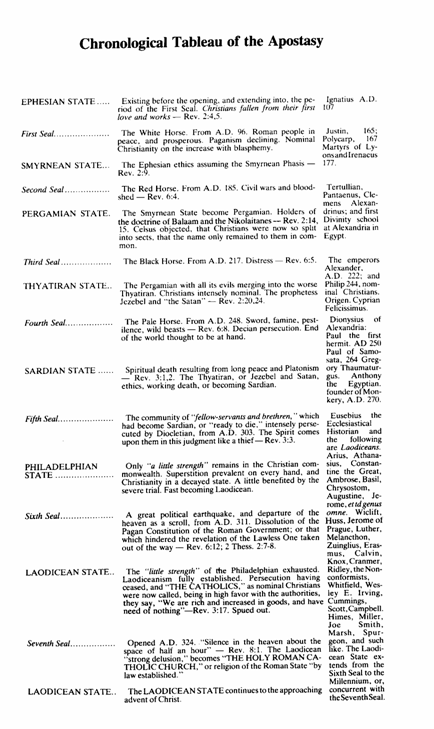
Page429
in
this world, rich in faith;” the reverse of this was the exception. When they
received the word, they received it gladly and were immersed; and then “continued
steadfastly in the apostle’s teaching and fellowship, and in breaking of bread,
and in prayers;” and while in their “first love,” “the multitude of them that
believed were of one heart and of one soul; and great grace was upon them all.”
In this primitive condition of affairs, the ecclesias were all the heritages,
(hoi kleroi), or clergy, of God, constituting “the flock;” while “the rulers”
or “elders” were its feeders under the supremacy of the Chief Shepherd at the
right hand of the majesty in the heavens. These ruling brethren took the
oversight of the flock, not by constraint, but willingly; not for filthy lucre,
but of a ready mind; and they demeaned themselves, not as lords and reverends,
but as examples to the generality of their brethren in the faith.
What
precise number of years “the heritages of the Deity,” continued in this happy
and uncorrupted condition, it is impossible to define. We know when the state
began, but cannot tell the first year when the devil, or the flesh, began to
pervert the truth. We may remark safely, that there is no well defined
chronological line between the Apostolical State and the Ephesian State, by
which it was succeeded. There was “One Body,” consisting of many ecclesias,
pertaining to the Apostolical State; and before that body could be said to have
passed into the Ephesian State, the Angel Presbyteries of the ecclesias or
heritages generally must have responded to the apocalyptical description of the
angel at Ephesus. This transition would therefore be gradual; for on the
supposition, that “men speaking perverse things to draw away disciples after
them,” first arose in the Ephesian Angel, it would have taken several years to
leaven all or a majority of the ecclesias extant with their tradition so as to
give character to the Body. The entrance of the body into a new phase would be
progressive; the process would be insidious; a change would come over it, and
be discerned, not so much in the growing from month to month, as in the growth
accomplished after a lapse of years.
Page
430
Now,
in the Apostolic State, which had not entirely passed till the destruction of
Jerusalem, A.D. 72, the ‘first love” of the Angel-Presbyteries began very early
to be impaired at different points. The
agents of this unholy enterprise emanated from Judea, and began the work of
“subverting souls” at Antioch and Syria and Cilicia. These were of the sect of
the Pharisees, who enjoyed the fellowship of the apostles, and consorted with
them in their meetings. They had, therefore, ample means and opportunities of
knowing the truth. Aware that it would be useless for them to broach dogmas in
their presence,
“they
went out from them and troubled the Gentile brethren with words.” What they
dared not teach in Jerusalem they taught in Antioch and other places; and “as
the serpent through subtlety” sought to corrupt their minds “from the
simplicity that is in the Christ.” But, although this attempt was opposed, and
apostolically denounced, the enterprise was not abandoned by the christianized
Pharisees. They determined to popularize christianity so as to make it
palatable to the Jews, in the hope that it would cause them to cease
persecuting those who believe in Jesus as the Christ. They therefore taught
that men should believe the gospel, be immersed, then be circumcised, and keep
the law of Moses, if they would be saved. This was Judaizing and “inventing a
lie.” The apostles taught no such doctrine as this; and in the decree they
published, declared all beyond believing the gospel and being baptized, was
unnecessary and vain.
The
invention of this lie was the beginning of troubles to the body of Christ. Its
inventors found their advantage in propagating it in defiance of the apostles.
They made proselytes to their tradition both among the elders and private
members of the flock; and wherever they succeeded in establishing their
influence, there, and to the same extent, the authority of the apostles was set
aside. They became the adversaries of these holy and self-denying men, and are
therefore styled in the Apocalypse “the Satan,” and their “church,” “the
Synagogue of the Satan,” of which we have spoken at large elsewhere.
But
others arose after these, and added new elements to “the lie.” Truth is fixed,
but lies never diminish in circulating, but always increase. Pious Jews began
the work of corrupting the faith; and pious Gentiles, who had been subverted,
added some of their “philosophy”’ and “gnosis,” or “science falsely so called,”
to the original stock, and in their combination, produced what Paul styles, in
2 Thess. 2 : 7, (musterion tes anomias), THE MYSTERY OF INIQUITY. This, he
says, was” already working;” and in its working through Judaizing and
philosophizing teachers, gave him all the trouble and mortification he laments
in the several epistles.
While,
then, christendom was, as we have described it in the beginning, pure and
uncorrupt in faith and practice, it had sadly degenerated at the time when the
apostles had all finished their course, except John. The Apostolical State of
the Body was not, therefore, all rose-colored, but was defaced by many
unsightly blemishes. The seeds of death and corruption had been sown in it by
the enemy; the germ of a Body of Death had been deposited in its womb; even of
that Body Ecclesiastic styled popularly in our day “THE CHURCH,” and
apocalyptically, “the Mother of Harlots and of all the Abominations of the
Earth.” A
Page
431
thoughtful
perusal of the epistles will convince the reader that by the time of the
apostles’ decease, the One Body was in a fallen or Ephesian State, and that
consequently, the Apostolical State of things was pregnant with the Ephesian,
as the Ephesian afterwards was of the Smyrnean, and the Smyrnean of the
Pergamian, and the Pergamian of the Thyatiran, and the Thyatiran of the
Sardian, and the Sardian of the Philadelphian, and the Philadelphian of the
Laodicean, and the Laodicean of vomiting, corruption, and death.
The
Mystery of Iniquity, then, had its beginning in the Apostolical State. The
seeds of it were then sown broadcast by the enemy. But they did not ripen as
soon as sown; they only began to grow. The fruit was to be “the Lawless One.”
But fruit, when first formed, is not mature. Considerable time passes from the
first appearance of the fruit to the time of ingathering because of ripeness.
So with the Lawless One, he had to appear as the fruit of the Mystery of
Iniquity; but after his appearing, he had to grow and ripen for the vintage,
when he should be “consumed with the Spirit of the Lord’s mouth, and destroyed
with the brightness of his coming.”
Now
the matter of the apocalyptical epistles in part consists of accusations,
which, when put together, form a formidable indictment against the professing
Christian community. These charges, as they increase, show also an increase in
crime, until a climax is reached, which exposes the criminal to the most
ignominious and condign punishment. The following ordinal summary will make
this apparent to the reader. The Spirit accuses the Christian Body, saying, I
have against thee-
1. That thou hast left thy first love;
2. That thou hast them that hold the
teaching of Balaam, and the teaching of the Nikolaitans, which thing I hate;
3. That thou sufferest that woman Jezebel,
who calleth herself a prophetess, to teach and seduce my servants to commit
fornication, and to eat things sacrificed to idols;
4. That thou hast a name that thou livest,
and art dead;
5. That thou hast little strength; and,
6. That thou art wretched, and pitiable,
and poor, and blind, and naked.
Paul
said that there would be “a falling away,” and here we behold it. As years
rolled on, things waxed worse and worse, until the false apostles of the
Synagogue of the Satan gained the ascendancy, and their chief, the Man of Sin,
was brought forth of their mother Jezebel, as Constantine the Great. The
falling away, or apostasy, was obviously progressive, and its progress may be
clearly traced in the writings of the men whose names occupy the third column
of the Chronological
Page
432
Tableau
of the Apostasy, already before the reader. In concluding, then, my exposition
of the seven ethical states and stages of the falling away, I shall furnish
specimens of the notions current as indicative of each. And first of the
1. Ephesian State.
Ignatius
was an elder of the ecclesia at Antioch, but possessed of a fanatical desire
for martyrdom, which was contrary to the instruction of the Lord Jesus, who
said, “when they persecute you in one city, flee to another.” But instead of
this, when the Emperor Trajan came to Antioch, about A.D. 107, in his way to
the Parthian war, Ignatius voluntarily delivered himself up to Trajan, into
whose presence he was introduced. “What
an impious spirit art thou,” said the emperor, “both to transgress our
commands, and to inveigle others into the same folly to their ruin!”
Ignatius.
Theophorus ought not to be called so, forasmuch as all wicked spirits are
departed far from the servants of God. But if you call me impious because I am
hostile to evil spirits, I own the charge in that respect. For I dissolve all
their snares, through the inward support of Christ the heavenly King.
Trajan.
Pray, who is Theophorus?
Ignat.
He who has Christ in his breast.
Trajan.
And thinkest thou not that gods reside in us also, who fight for us against our
enemies?
Ignat.
You mistake in calling the demons of the nations by the name of gods. For there
is only one God, who made heaven, and earth, the, sea, and all that is in them;
and one Jesus Christ, his only begotten son, whose kingdom be my portion.
Trajan.
His kingdom, do you say, who was crucified under Pilate?
Ignat. His who crucified my sin with ITS
AUTHOR; and has put all the fraud and malice of Satan under the feet of those
who carry him in their hearts.
Trajan.
Dost thou, then, carry him who was crucified within thee?
Ignat.
I do; for it is written, “I dwell in them, and walk in them.” Upon this Trajan
said, “Since Ignatius confesses that he carries within himself him that was
crucified, we command, that he be carried bound by soldiers to Great Rome,
there to be thrown to the wild beasts, for the entertainment of the people.”
The
brethren in Rome hearing of this sentence upon him, met him on his arrival at
Ostia, a few miles from the city. They had written
Page
433
to
him before, proposing to intercede on his behalf. But he would listen to no
such thing, but determined to be devoured at all events. Referring to this,
Milner remarks, “I fear the example of Ignatius did harm in this respect to the
church. Martyrdom was, as we know, made too much of in the third century.”
Having shown how contrary was the course of the apostles, he says of Ignatius,
“I suspect there was not an equal degree of calm resignation to the Divine
Will.”
Besides
his excessive desire of martyrdom, which was a species of suicide, Ignatius
advocated an unscriptural supremacy of one whom it had become fashionable to
style “the Bishop.” When the New Testament exhorts the faithful in relation to
their rulers, it says, “Obey them that have the rule over you;” and these are particularized
as “apostles, prophets, evangelists, pastors, and teachers;” and were all
“bishops,” or episkopoi, which means “overseers.” But Ignatius adopted a
different style in speaking of these functionaries. “Let us,” says he in
writing to the Ephesians “study obedience to the Bishop, that we may be subject
to God.” And again, “Since ye are subject to the Bishop as to Jesus Christ, ye
appear to live, not after man, but after Jesus Christ.” And, “it is not lawful,
without the Bishop, to baptize, or to make a love feast;” and lastly, “It
behooves the married to enter into that connection with the consent of the
Bishop, that the marriage may be after the will of God, and not to fulfill the
lusts of the flesh.” These passages show that in that early day one man in each
congregation had been set up above all the other elders of the presbytery, who,
in proportion as he was aggrandized, were diminished, and caused to assume the
position of his inferiors. These notions of Ignatius and his contemporaries
laid the foundation of martyrolatry, episcopal usurpation and lordship, the
invalidity of ordinances ministered by an unofficial brother, and of matrimony
as “a sacrament of the church.” A mind running in this current of ideas, had
evidently fallen a notch or two below the scriptural standard which
characterized the apostolical state in its beginning. Yet Ignatius was more
scriptural in his thinking upon religious topics, than any of the writers that
succeeded him. He belonged to the fallen Ephesian State, the works of which
were not so acceptable as the first.
2. Smyrnean State.
The
representative writers of this state were particularly Justin Martyr, and
Irenaeus. Justin, surnamed Martyr, which
signifies a witness, but in after times restricted exclusively to those whose
witness was sealed with their blood, published an Apology or defense of the
Page
434
faith
he professed, and presented it to the emperor Antoninus Pius, about A.D. 140.
He was a pagan philosopher before he was converted to christianity; but, as he
says, “having found the Divine Scriptures to be the only sure philosophy,” he
became a christian. He was put to death about A.D. 163. One would suppose that,
having testified himself that Gentile philosophy was false, he would
thenceforth have abandoned it altogether. But this he did not do. He continued
to dress in the garb of a philosopher, and to persevere in the profession of
it; “hoping,” as Mimer thinks, “to conciliate the affections of philosophers,
and allure them to christianity. To draw gentlemen and persons of liberal
education to pay attention to christianity, appears to have been his chief
employment.” A right view of things would have convinced Justin of the futility
of his expedients. It is “the poor in this world,” and the simple hearted, not
“gentlemen” and “philosophers,” that God hath chosen to be heirs of his
kingdom. In this policy Justin shows a departure from the true apostolic mind
so prominent in Paul’s writings.
Justin’s example was pernicious in giving sanction to the union of heathen
philosophy with the teaching of Christ and his apostles. There is no agreement
between them; and where the union is tolerated, it invariably results in the
corruption or extinction from the mind, of the spirit and teaching of the word.
Towards the close of his Second Apology, he declares that the doctrines of
Plato were not heterogeneous to those of Christ; but only not altogether
similar. And he seems to assert that Plato, and the Stoics, and the Pagan
writers in prose and verse, saw something of truth from the portion of the seed
of the Divine Word, which he makes to be the same as the Word, the only
begotten Son of God. But Paul never allows unconverted men to have any portion
at all of that light which is peculiarly christian. But Justin had lost sight
of the guard, which cannot be too often repeated against philosophy. Not long
after him, mystics and heretics and platonizing christians jumbled these things
together entirely; and tried to incorporate the philosophical doctrine of the
to en with the Gospel. Justin gave them a handle for this; and though
philosophy had made its inroads upon the faith in the apostolic age, Milner may
not be entirely wrong in saying, that “Justin was the first sincere christian
who was seduced by human philosophy to adulterate the gospel though in a small
degree. It should ever be remembered, that christian light stands single and
unmixed; and will not bear to be kneaded into the same mass with other systems,
religious or philosophical. We may here mark the beginning of the decay of the
first spiritual effusion among the Gentiles through false wisdom.”
Page
435
In
the year 167, the ecclesia of Smyrna in writing an account of the
martyrdom
of Polycarp to the ecclesia at Philomelium seems to reflect upon the martyrdom
of Ignatius in saying that it was “perfectly evangelical.” “He did not
precipitately give himself up to death, but waited till he was apprehended, as
our Lord himself did, that we might imitate him. We do not approve of those who offer
themselves to martyrdom; for we have not so learned Christ.” But, though right
in this, they seem to have acquired the notion that martyrdom atoned for sin;
for speaking of those who suffered, they say, “thus they despised the torments
of this world, and by one hour redeemed themselves from eternal punishment. The
fire of savage tormentors was cold to them; for they had steadily in view a
desire to avoid that fire which is eternal and never to be quenched.” In the
translation from which we quote, it reads thus; which may not express their
idea. If it does they had gone astray respecting the punishment of the wicked,
and must have been infected with immortal-soulism. But, I rather think, they had allusion to
certain apocalyptic passages in the book sent to them as one of the seven ecciesias.
The (kolasis ajonios) they refer to was probably the Aion-punishment of “the
Hour of Judgment,” which cannot be quenched till its purpose is accomplished;
and which is for the especial destruction of Babylon the Great, the conquest of
the kingdoms, and the punishment of all their adherents and supporters. This
occurs after the resurrection; and is provided also for the punishment of all
who shall be raised to suffer it-Rev. 14 : 6-li. Its effects are permanent; but
the execution of judgment does not transcend “the hour” appointed.
Polycarp
who suffered and the Smyrneans who witnessed his death did not agree in their
convictions. In his prayer Polycarp said, “0 Father, I bless thee that thou
hast counted me worthy to receive my portion in the number of martyrs, in the
cup of Christ, for the resurrection to eternal life both of soul and body in the incorruption of the Holy
Spirit; among whom may I be received this day before thee as a sacrifice well
savored and acceptable.” His mind was fixed upon the resurrection, but when
they tell the story of his death, and speak of his state after it while they
were writing, they say, “the envious, malignant, and spiteful enemy of the
just, observed the honor put upon his martyrdom and his blameless life; and knowing
that he was crowned with immortality and the prize of unquestionable victory,
studied to prevent us from obtaining his body, though many of us longed to have
communion with his sacred flesh.” They gathered up his bones, however, which
they term “more precious than gold or jewels,” and deposited them in a proper
place; “where, if it be possible,” say they, “we shall meet in gladness and joy
to celebrate the birthday of his martyrdom, both in
Page
436
commemoration
of those who have wrestled before us, and for the instruction and confirmation
of those who come after.” This was the beginning of shrine-pilgrimage and
relic-worship. The Smyrneans did not probably then visit the shrine and bones
in the spirit of idolaters; but what might be innocent in their celebration, in
after times became a grossly superstitious and idolatrous observance.
Irenaeus
belonged to the Smyrnean State of christendom. He was a presbyter of an
ecclesia at Lyons in France. He was instructed by Polycarp, who had been
personally acquainted with John. About the year 169, Irenaeus became the
“Bishop” of the congregation. “Never,” says Milner, “was any pastor more
severely tried by a tempestuous scene. Violent persecution without, and subtle
heresies within, called for the exertion at once, of consummate dexterity and
of magnanimous resolution. Irenaeus was favored with a large measure of both;
and he weathered out the storm.” His views of doctrine are of the same cast as
those of Justin, whom he quotes in his Book of Heresies. His philosophy had its
usual influence on the mind-in darkening some truths of scripture, and in
mixing the doctrine of Christ with human inventions. Now that things had not
improved at the close of Irenaeus’s career, but had become worse, may be
gathered from his letter to Florinus, in which he says, “I can witness before
God, that if that blessed apostolical presbyter had heard some of the doctrines
which are now maintained, he would have cried out, and stopped his ears, and in
his usual manner have said, “0 good God, to what times hast thou reserved me,
that I should endure these things.” And he would immediately have fled from the
place in which he had heard such doctrines.”
Irenaeus
was the author of “the epistle of the ecclesias of Vienna and Lyons to the
brethren in Asia and Phrygia,” giving an account of the persecution there. Speaking in this of (Vettius Epagathus) who
had been put to death, he says, “He was, and still is, a genuine disciple of
Christ, following the Lamb whithersoever he goeth. ”This is a quotation from
Rev. 14 : 4 ; and by the use he makes of it, would indicate that his mind had
been platonized with the dogma of immortal-soulism, which his instructor
Polycarp did not believe. The Smyrnean State was certainly a degeneration from
the Ephesian.
3. The Pergamian State.
This
state of the christian community is illustrated by the writings of Tertullian,
Pantaenus, Clemens Alexandrinus, and the Alexandrian School of “Divinity.”
Page
437
Tertullian,
the first Latin writer among christians, flourished in the latter part of the
second, and in the former part of the third century, at Carthage. But were it
not for some light which he throws on the state of christianity in his own
times, he would scarcely deserve to be distinctly noticed. Tradition with him
was authoritative, and among the customs which it sanctioned in the Roman
Africa was the very frequent signing of themselves with the sign of the cross.
He
did not approve of flight in persecution, in direct contradiction of Christ’s
instructions. He disapproved of second
marriages, and called them adultery.
Human
philosophy after the rudiments of the world formed the prominent corruption of
the times of Tertullian and his contemporaries, and immediate successors. In
the third century its effects appeared very distinctly.
Alexandria
in Egypt was at this time the most renowned seminary of learning. A sort of
philosophers appeared there who called themselves Eclectic, because they chose
what they thought most agreeable to truth from different masters and sects.
Ammonius Saccas, a famous Alexandrian teacher, reduced the opinions of this
sect to a system. Plato was his principal guide, but he invented many things of
which Plato had no idea. He was educated a christian, but of so doubtful a kind
that he was claimed by Porphyry for a pagan, and by Eusebius for a saint.
Ammonius fancied that all religions, vulgar and philosophical, Grecian and
barbarous, Jewish and Gentile, meant the same thing at bottom. He undertook by
allegorizing and subtilizing various fables and systems, to compound a
coalition of all sects and religions; and from his labors, continued by his
disciples, his followers were taught to look on Jew, philosopher, vulgar pagan,
and christian, as all of the same creed.
Our
more distinct information of christianity in this respectable city of the Roman
Habitable begins with what is evil. It is said that a christian catechetical
school was established there in the apostolic age; be this as it may, Pantaenus
is the first master of it of whom there is any account. He was much addicted to
the sect of the Stoics, a sort of romantic pretenders to perfection. The
combination of Stoicism with Christianity in the system of Pantaenus very much
debased the truth; and clouded must have been the light imparted by such an
instructor to his disciples. He always retained the title of the Stoic
Philosopher, after he had been admitted to eminent employments in the church.
For ten years he laboriously discharged the office of Catechist, and freely
taught all that desired him. He died not long after the beginning of the third
century.
Page
438
Clemens
Alexandrinus was a disciple of Pantaenus, and of a mind blasted by the same
wind of philosophy. He was of the eclectic sect. But let us hear what he says
of himself: “I espouse neither this nor that philosophy, neither the Stoic nor
Platonic, nor the Epicurean, nor that of Aristotle; but whatever any of these
sects hath said, that is fit and just; whatever teaches righteousness with a
divine and religious knowledge, all this I select; and call it philosophy.” But
what was there even of good morals in all the philosophers he could not have
learned in the New Testament; and much more perfectly, and without the danger
of pernicious adulterations. Clemens as a Christian, should have known that it
was no part of the business of philosophical writers to dictate to the
believer: “the world by wisdom knew not God,” and “Beware of Philosophy.” The christian community was gradually
learning to neglect the scriptures and their cautions; and to develop theology
into a science so called.
Clemens
succeeded Pantaenus in the catechetical school, and under him were bred the
famous, or rather infamous, Origen, and other eminent perverters of the gospel
of the kingdom of Christ. Their preparation under his tuition may be learned
from the following statement. “As the husbandman first waters the soil, and
then casts in his seed, so the notions which I derive out of the writings of
the Gentiles serve first to water and soften the earthy parts of the soul, that
the spiritual seed may be the better cast in, and take vital root in the mind
of men.”
This
was not speaking according to the oracles of God. The apostles neither placed
Gentile philosophy in the foundation, nor believed that it would at all assist
in raising the superstructure of christianity. On the contrary they looked at
the philosophical religion of their own times as so much rubbish; but in all
ages, the blandishments of mere reason on such subjects deceive us;-“vain man
would be wise.”
This
man, Clemens, besides his employment in the office of catechist, was made a
presbyter in the ecclesia at Alexandria. Little is known of his life, and the
time of his death is uncertain; and certain it is, that little else than evil
could accrue to the saints from the ministrations of such a perverted mind.
He
undertook to delineate a perfect christian, which, being the creation of his
pago-christian eclecticism was just such a christian as would please the carnal
mind, full of stoical rhapsodies, and the crotchety asceticism of the flesh.
After he had created him, he called him GNOSTIUS ; but the Spirit in the
writing to the presbytery at Pergamos, styled him Nikolaitos, or a vanquisher
of the people, like his great prototype Balaam, who loved the wages of
unrighteousness, and placed
page
439
stumblingblocks
in the people’s way, by which they were caused to fall. The Rev. Nikolaitos
Gnosticus is the beau ideal of a modern “divine.”
4. Thyatiran State.
The
apostasy from “the truth as it is in Jesus” must have progressed very far when
two such chiefs of the Roman Dragon, as the emperors Alexander and Philip,
could be recognized as christians.
Alexander,
the son of Mammaea, styled by Eusebius “a most godly and religious woman,”
although she had not received the faith, began to reign in the sixteenth year
of his age, A.D. 222. It is true, he was esteemed one of the best moral
characters in profane history; and never persecuted, but approved and
countenanced the christians, such as the multitude of them had now become; but
still he was a philosophical worshipper of the shadows of the departed great.
He had a domestic chapel, where, every morning, he worshipped those deceased
princes whose characters were most esteemed; their statues were placed among
those of the gods; and into this company he introduced Apollonius of Tyana,
Jesus Christ, Abraham, and Orpheus. He had a desire to erect a temple to
Christ, and to receive him regularly into the number of the gods.
While
residing in Antioch, A.D. 229, he and his mother sent to Origen, then teaching
his paganized christianity in the academy at Alexandria, and invited him to
visit them. He obeyed the summons, and continued with them a while, conversing
with them upon the things for which he had become famous. On returning to
Alexandria, he left them in state and views similar to his own, and
consequently with no clear and striking comprehension of the faith. “In truth,”
says Milner, “a number of christians, so called, at this time, were much of the
same religion with Alexander himself.” He seems to have learned, in some
measure, the doctrine of the Divine Unity, and by the help of the eclectic
philosophy, to have consolidated all religions into one mass. He and his mother
were assassinated, A.D. 235, by Maximin, who reigned in his stead.
Pupienus
and Balbinus, the successors of Maximin, being slain, they was succeeded by
Gordian, who, after six years, were assassinated by Philip the Arabian, who
ascended the throne A.D. 244. Eusebius, a christian of the Laodicean type, “the
bishop” of Nicomedia, and companion of Constantine the Great, tells us, that
this Philip was a christian. “That he
was so,” says Milner, “by profession, seems well attested by the concurrent
voice of antiquity.” He is said to have sub-
Page
440
mitted
to certain ecclesiastical censures by a bishop. There is no doubt but in the
fourth year of his reign, A.D. 247, he allowed and conducted the secular games,
which were full of idolatry. Origen wrote an epistle to this emperor and his
wife Severa, which was extant in Eusebius’ time. Philip was slain A.D. 248.
Origen,
who had received christianity hereditarily, became catechetical tutor at the
school in Alexandria at eighteen. He was a man of very presumptuous spirit,
which impelled him to philosophize to the destruction of the faith. He was
never content with plain truth, but ever hunting after something singular and
extraordinary. He converted the school into a theological academy, which became
the Collegiate Alma Mater of the Apostasy-the Mother of all future Divinity
Schools. He maintained himself by the
sale of the profane books which he had been wont to study. The christians of the unfallen ecclesia at
Ephesus would have burned them-Acts 19 : 19. But the times had changed; and
Origen was a Thyatiran of the house of Jezebel, and a disseminator of “the
depths of the Satan as they teach.” He was “a perfect christian” after the type
of his master’s Gnosticus. He mutilated himself for the kingdom of heaven; made
no provision for the morrow; inured himself to cold, nakedness, and poverty;
abstained from wine and in general lived so abstemiously as to endanger his
life. Many persons imitated his excessive austerities, and were at that time
honored with the name of “philosophers;” and some of them patiently suffered
death. The reader is referred to Col. 2 for a comment on the conduct of Origen
and his Alexandrian converts. One of these, a female named Potamiaena, told a
soldier who protected her from the insolence of the mob on her way to
execution, that after her departure she would entreat the Lord for him. Some
time after her death, the soldier was imprisoned on the charge of being a
christian. The Origenites visited him, and on being questioned as to the cause
of the sudden change, he declared that
Potamiaena, three days after her martyrdom, had appeared to him by
night, and informed him that she had performed her promise, and that he should
shortly die. After this he was put to death.
This
anecdote of the times, shows the prevalence of fanatical philosophy,
will-worship, and the like. The soldier, Basilides, is converted by a fiction,
is ignorant of the word, and dies without baptism; nevertheless he is called “a
christian.” We have a multitude of such christians in our day, but what are
they worth? They only illustrate a delusion, and adorn a tale.
The
Thyatiran State of the christian community was in part parallel with a long
period of peace, or absence of persecution. For the space of thirty-eight
years-from the death of Severus to the reign of Decius
Page
441
if
we except the short turbulent period of Maximin, the church enjoyed a continued
calm. During this period of tranquillity christianity was fatally paganized;
and according to Origen himself, who had been ordained a presbyter, was
followed by a great degree of lukewarmness, and much religious indecorum. Let
the reader only notice the difference between the scenes he describes and the
conduct of christians in the first century, and he will be convinced of the
greatness of the declension.
“Several,”
says he, “come to church only on solemn festivals; and then not so much for
instruction as diversion. Some go out again as soon as they have heard the
lecture, without conferring, or asking the pastors any questions. Others stay
not till the lecture is ended; and others hear not so much as a single word,
but entertain themselves in a corner of the church.” But the ability, as well
as the taste for the conquest of this careless spirit, had much declined in the
eastern part of the christian community. Origen complains elsewhere of the
ambitious and haughty manners of pastors, and of the improper steps which some
took to obtain preferments.
When
Origen was about sixty years of age, he had a discussion with certain in Arabia
who denied the inherent immortality of “the soul.” Being a professor of
paganized christianity, it was natural enough for him to oppose them, and for
both him and Eusebius to style the denial “a false opinion.” Eusebius says, that the Arabians asserted,
that “the human soul, as long as the present state of the world existed,
perished at death, and died with the body, but that it would be raised again
with the body at the time of the resurrection.” This, as we have seen, was
Ploycarp’s view also. But Polycarp was not heathenized as the contemporaries of
Origen and Eusebius were. A considerable
council was therefore held by the philosophizers, for the support and sanction
of their darling opinion; and as Origen was an expert sophist, they requested
him again to discuss the point, which he did, “and with so much force,” says
Eusebius, “that those who had been led astray, completely changed their
opinions.”
Origen
died during the Decian persecution aged Seventy; and when he was about passing
from the stage of life, that is, about five years before, the more excellent
Cyprian was converted to the faith, A.D. 246. He was a professor of elocution
in the city of Carthage, in the Roman Africa, and a man of wealth, quality, and
dignity. About twelve years comprehended the whole scene of his christian
life-from A.D. 246 to A.D. 258. He was converted under the reign of Philip, and
put to death under that of Valerian. Two years after his conversion, he became
“the Bishop” of the ecciesia in Carthage, a dignity which, through
Page
442
the
growth of superstition, was advancing to excess. Though expressions savoring of
haughtiness and asperity are to be found in his writings, excited by particular
provocations, ambition was not his vice; his zeal was fervid, and sustained by
a temper remarkably active and sanguine, yet allied with the milder qualities
of gentleness, love, and humility. He was a very different and superior
character to Origen; and a remarkable consequence of which was, that while
Origen, among the pagans, succeeded in gaining the favor of the great, and was
heard by them with patience, Cyprian could not be endured in his preaching and
writings, except by real christians.
But
my purpose in the introduction of Origen and Cyprian to the reader, is not a
biographical sketch and comparison of the men, but simply as representatives of
their times. Persecution reigned with
astonishing fury in the beginning of Cyprian’s pastorate; and he recognizes in
it a punishment upon the church for the iniquity of professors. In a treatise
of his upon “The Lapsed,” is an affecting account of the falling away of the
generality from the spirit of christianity, which had taken place before his
conversion, and which moved God to chastise them. “If the cause of our miseries,” says he, “be
investigated, the cure of the wound may be found. The Lord would have his
family to be tried. And because long peace had corrupted the discipline
divinely revealed to us, the heavenly chastisement hath raised up our faith,
which had lain almost dormant: and when by our sins we had deserved to suffer
still more, the merciful Lord so moderated all things, that the whole scene
rather deserves the name of a trial than a persecution. Each had been bent on
improving his patrimony; and had forgotten what believers had done under the
Apostles, and what they ought always to do. They were brooding over the arts of
amassing wealth. The pastors and the deacons each forgot their duty. Works of
mercy were neglected, and discipline was at the lowest ebb. Luxury and effeminacy prevailed. Meretricious arts in dress were cultivated.
Fraud and deceit were practiced among brethren. Christians could unite
themselves in marriage with unbelievers; could swear not only without
reverence, but even without veracity. With haughty asperity they despised their
ecclesiastical superiors. They railed against one another with Outrageous
acrimony, and conducted quarrels with determined malice. Even many bishops, who
ought to be guides and patterns to the rest, neglecting the peculiar duties of
their stations, gave themselves up to secular pursuits. They deserted their
places of residence, and their flocks. They traveled through distant provinces
in quest of pleasure and gain; gave no assistance to the needy brethren; but
were insatiable in their thirst for money. They possessed estates
Page.443
by
fraud, and multiplied usury. What have we not deserved for such a conduct? Even
the Divine Word hath foretold us what we might expect-‘If his children forsake
my law, and walk not in my judgments, I will visit their offenses with the rod,
and their sin with scourges.’ These things had been denounced and foretold, but
in vain. Our sins had brought our affairs to that pass, that because we had despised
the Lord’s directions, we were obliged to undergo a correction of our
multiplied evils, and a trial of our faith, by severe remedies.”
From
this testimony of Cyprian it is evident that the falling away from the
apostolic standard had become intense in the middle of the third century. It
was the very type itself of what exists in our day. Pastors and people were all
commingled in the same deep declension from the faith and morals of the gospel.
Justin and his philosophical admirers had caused them to commit fornication
with Gentilism; and the Spirit had given them space to repent of it in the long
peace they had enjoyed. But Pantaenus, and Clemens, and Origen, had only led
them on from bad to worse: and now, in the Decian persecution, they were cast into
a bed of great tribulation, in which they were killed with death; so that all
the ecclesias were brought to know, as Cyprian declares, that the Spirit is he
who was searching their reins and hearts; and giving to every one of them
according to their works-Rev. 2:21-24.
5. Sardian State.
The
state of things deplored by Cyprian was that which resulted in the Sardian,
characterized by the Spirit as a death-state. By the generation of professors
contemporary with it, it was not so considered. Peace and prosperity reigned,
as they regarded it; and they flattered themselves that they were in the
enjoyment of great spiritual life-“thou hast a name that thou livest, and art
dead.” The Deity did not see as they saw themselves. He pronounced them dead. That is,
christianity was on the verge of extinction; or, as the Spirit explains in the
next verse, “ready to die.” Very little of genuine apostolic christianity could
be found among the christians in the last half of the third century. The Platonism of the Alexandrian school had
corrupted every thing, and eaten out its vitals as a cancer; so that the
christian mind was prepared for any absurdities and follies in the name of true
religion, as in our day.
Valerian
reigned A.D. 253, and for upwards of three years was the friend and protector
of the christians. His palace was full of them,
Page
444
and
he appears to have had a strong predilection in their favor, which was not at
all promotive of spiritual health and vitality.
During
the tranquillity under this reign, a council was held in Africa by sixty-six
bishops with Cyprian at their head. They came together to consider certain
questions in agitation. In a letter to Fidus, Cyprian informs the reader of
things which will convince him how far they had now departed from the genius,
spirit, and principles of the faith. Fidus had denied that infants should be
immersed within the second or third day after birth; and maintained that the
ancient law of circumcision should be so far adhered to that they ought not to
be immersed till the eighth day. But Cyprian and the Sixty-Six were all of a
very different opinion. He calls infant
immersion “spiritual circumcision;” and says it ought not to be impeded by the
law of carnal circumcision; for that it was essential to the salvation of the
soul, which would be lost if death ensued before the second or third day. The
following is his argument, upon which the “divines” of our century have made no
advance. “If even to the foulest offenders,” says he, “when they afterwards
believe, remission of sins is granted, and none is prohibited from baptism and
grace; how much more should an infant be admitted, who, just born, hath not
sinned in any respect, except that, being carnally produced according to Adam,
he hath, in first birth, contracted the contagion of the ancient deadly nature;
and who obtains the remission of sins with the less difficulty, because not his
own actual guilt, but that of another, is to be remitted.
“Our
sentence, therefore, dearest brother, in the council was, that none, by us,
should be prohibited from immersion and the grace of God, who is merciful and
kind to all.”
In
these few lines from Cyprian, what a striking illustration of the Sardian state
of spiritual death is here! We learn from them that the leaders of the ecclesias
believed, and therefore taught,
1. The immortality of the soul according
to Plato;
2. That said soul, if but two or three
days old, would be lost, if the infant owner were not immersed;
3. That immersion and grace, without
faith, imparted remission of sins to infants;
4. That infants were damned for a sin
committed by Adam over four thousand years before;
5. That immersion and grace in the case of
infants was not for the remission of their own sins, but for that of another of
Adam. Hence, Adam must have been pardoned every time an infant was dipped and
regenerated by “grace!”
6. That infant immersion was “spiritual
circumcision.”
Page
445
Such
were the dogmata gravely affirmed by this African Council, A.D. 253, all its
members pious professors of christianity, who had recently emerged from the
horrors of the Decian trial. “They had a name to live.” We know what this means
when we look at the clergy around us, and their dupes on every side. All these believe with Cyprian and the
Sixty-Six, excepting that they think the Roman Africans used too much
water. Our Cyprianites have substituted
the sprinkling of the face for the immersion of the infants, in obedience to
the See of Rome, on the plea that a few drops of water with “grace” is as good
as an ocean; and so it is in the case before us; for water, much or little, is
of no account at all, for infant or adult, where faith exists not in the
subject; as it is written, “without faith it is impossible to please God; for
he that cometh to him must believe that he is, and that he is a rewarder of
them that diligently seek him.”
“They
had a name to live,” and are thus spoken of by a Cyprianite historian. “Here is
an assembly of sixty-six pastors, men of approved fidelity and gravity, who have
stood the fiery trial of some of the severest persecutions ever known, and who
have testified their love to the Lord Jesus Christ, in a more striking manner
than any Antipedobaptists have had an opportunity of doing in our day; and, if
we may judge of their religious views by those of Cyprian-and they are all in
perfect harmony with him ~ they are not wanting in any fundamental of
godliness.” Thus Milner commends them, and pronounces them christians of a holy
and vital sort! But the Spirit gives a very different judgment in the case; and
saith to the presbytery of the Sardian state, “I know thy works, that thou has
a name that thou livest, and art dead. I have not found thy works perfect
before the Deity. Remember therefore how thou hast received and heard, and hold
fast, and repent.” In 253, they had let slip the gospel originally preached by
the apostles. The majority of professors, as in our day, had become oblivious
of the truth; and only “a few names” in the Sardian state remained “who had not
defiled their garments” with Origenism and Cyprianism.
Another
dogma started about this time was, that “those whose weak state of health did
not permit them to be washed in water, were yet sufficiently baptized by being
sprinkled.” Cyprian observes, that “the virtue of baptism ought not to be
estimated, in a carnal manner, by the quantity of external apparatus.” All
“christendom,” now called “orthodox,” is essentially agreed with Cyprian; for
even baptists admit the christianity of Quakers who repudiate the use of water
altogether.
Dionysius
of Alexandria, a pupil of Origen, flourished at this time.
Page
446
He
opposed the truth that the Millennium is introduced after the resurrection; and
finding how much use had been made of the Apocalypse in supporting the doctrine,
he gave his thoughts upon it, and confessed, that though he reverenced its
contents, he did not understand their scope.
Paul
of Samosata was another Sardian. He flourished A.D. 264, as bishop of Antioch,
and instructor of Zenobia, the Queen of the East, in his own notions of
christianity. He taught, that Jesus Christ was by nature a common man like
others. He was artful, eloquent, deceitful, and otherwise immoral. He was
deposed A.D. 269 by a council of seventy bishops whose indictment against him argues
an awful degeneracy from the truth in this primitive arena of the labors of
Saul of Tarsus and his companions in the gospel.
By
this time Monkery, introduced by Paul the first hermit, received considerable
impetus through Anthony the Egyptian. The spirit of Paul the Hermit was first
incorporated by Anthony A.D. 270, whose biography was written by Athanasius,
who was contemporary with monasticism in full blast. Anthony’s austerities were
excessive, and the most ridiculous stories are told of his contests with the
Devil, which forcibly illustrate the self-righteous pride and vain-glory of his
disposition. But, as we are not writing a history of monkery, but only citing
examples illustrative of the ‘falling away” in the successive stages of its
development to the revelation of the Man of Sin-Power, we shall leave this
celebrated monk busily engaged in the Sardian state of Christendom propagating
the monastic disposition, and extending its influence not only into the fourth
century, but for many ages after. We therefore dismiss him with the remark,
that “the faith and love of the gospel received towards the close of this
century a fatal blow from the encouragement of this unchristian practice.”
6. Philadelphian State.
In
the apostolical state of the christian community the faith, hope, and love of
the brethren was conspicuous and strong. But after the One Body had passed
through the Ephesian, Smyrnean, Pergamian, Thyatiran, and Sardian, states, it
was greatly enfeebled in all its primitive forces; so that when it was fairly
established in the Philadelphian, its brightest examples, who had kept the word
and had not denied the name of the Spirit, constituted but “a little strength”
for the whole. This “little strength” was the succession of the “few names” of the
Sardian state which had not defiled their garments-the few grains of salt that
preserved the body from utter, or Laodicean, corruption.
Page
447
“An
open door” was set before those who constituted this little strength of the
christian community, which “no man could shut.” The emperor Valerian, who for
the first three years of his reign, had been the friend and protector of
christians, in the year 257, became their enemy. A magician, named Macrianus, a
man of diabolical wickedness and folly, having gained an ascendancy over the
mind of Valerlan, induced him to persecute them with deadly animosity. The
persecution lasted three years and a half, when Valerian was taken prisoner by
Sapor king of Persia, who detained him the rest of his life, and made use of his
neck in mounting his horse; and at last commanded him to be flayed and salted.
After
Valerian’s captivity a door was opened to the christian community, through
which entered rest and peace, which continued forty years About the year 262,
Valerian was succeeded by his son Gallienus, who proved a sincere friend to the
christians, though in other respects, an emperor of no repute. By edicts he
stopped the persecution, and gave the bishops letters of license to return to
their pastorates. One of these letters, as preserved by Eusebius, runs thus:
“The
emperor Caesar Gallienus to Dionysius the bishop of Alexandria, and to Pinna
and Demetrius, with the rest of the bishops. The benefit of our favor we
command to be published through the world:and I have, therefore ordered every
one to withdraw from such places as were devoted to religious uses; so that you
may make use of the authority of my edict against any molestation; for I have
sometime since, granted you my protection; wherefore Cyrenius the governor of
the province will observe the rescript which I have sent.” He directed also
another edict to certain bishops, by which he restored to them the places in
which they buried their dead.
Thus
the Spirit set an open door before the little strength, which no man in power
could shut for forty years. Gallienus, the instrument in the hand of Providence
through which this opening was effected, seems to have been more like a modern
than an ancient sovereign-a man of taste, indolence, and philosophy-disposed to
cherish everything that looked like knowledge and liberty of thinking; by no
means so kind and generous in his constant practice as his profession might
seem to promise; he was the slave of his passions, and led away by every sudden
feeling that seized his imagination. The christians appear to have been
considered by him as a sect of new philosophers; and as he judged it improper
to persecute philosophers of any sort, they found a complete toleration under a
prince, whose conscience seems to have been influenced by no religious
attachment whatever.
We
now behold in the full development of the Philadelphian state,
Page
448.
a
new scene-Christians legally tolerated under a pagan government for forty
years! How they must by this time have approximated in their principles to
those of the tolerating power. The tolerance of Gallienus was adopted as the
policy of the succeeding emperors to the end of the third century. It was
violated only in one instance; the effect of which was presently dissipated by
the Spirit who would not permit the door to be shut. The moral influence of
this long peace was, how-ever, exceedingly disastrous. “This new scene,” says
Milner, “did not prove favorable to the growth of grace and holiness. In no
period since the apostles was there ever so great a general decay as this; not
even in particular instances, can we discover during this interval, much of
lively christianity”-so very small was the “little strength.”
The
profession of christianity was now becoming fashionable. Dioclesian began to
reign A.D. 284. For the space of eighteen years he was extremely indulgent to
its professors. His wife Prisca, and his daughter Valeria were in some sense
christians secretly. The eunuchs of his palace and his most important officers
were also “christians;” and their wives and families openly professed the
faith. Christians, so-called, held honorable offices in various parts of the
empire; innumerable crowds attended christian worship; the old buildings could
no longer receive them; and in all cities wide and large edifices were
erected.*
If
Christ’s kingdom were “the church,” and had been of the pre-Constantinian ages;
and if its strength and beauty were to be measured by secular prosperity, the
era of its greatness might be fixed in these earlier ages of Dioclesian. But,
on the contrary, it was preeminently an era of great declension. During the
whole of this third century the work of faith in purity and power, had been in
rapid decay. The connexion with philosophers was one of the principal causes,
outward peace and secular advantages completed the corruption. Discipline was
now relaxed exceedingly; bishops and people were in a state of malice; endless
quarrels were fomented among contending parties; and ambition and covetousness
had, in general, gained the ascendancy in the christian body. Some there,
doubtless, were who mourned in secret, and strove in vain to stop the abounding
torrent of the evil. They were the “little strength, who kept the word, and
denied not the Spirit’s name;” but with this exception, all the rest called
“christian” were “of the Synagogue of the Satan who said they are Jews, and are
not, but do lie.” The hour of temptation was concurrent with this period of
forty years; a trial, from which the generation of believers in Philadelphia
contemporary with John, were kept; as well as this “little
*Eusebius Book VIII. Ch. I.
Page
449
strength”
coeval with the embryo formation of the Laodicean consummation of the Apostasy.
For the space of thirty years there was an extreme dearth of real christian
excellencies. No bishop or pastor eminent for intelligence, faith, zeal, and
labor, appears in the history of the times. But notwithstanding this decline of
zeal and principle, still christian worship was constantly attended; and the
number of nominal converts was increasing; but the faith of Christ itself was
now an ordinary business.
Eusebius,
the ecclesiastical historian, who was born about the year 259, flourished in
the transition of the Philadelphian into the Laodicean state, in which last he
died A.D. 340. He was the most learned of all the christians, whose learning
and philosophy were inimical to the simplicity which is in Christ. Plato and
Origen were the masters in the school of his divinity.
In
this Philadelphian state, which merged into the Laodicean fully developed at
the opening of the Seventh Seal, “TERMINATED, or nearly so, as far as appears,
that great first effusion of the Spirit of God which began at the day of
Pentecost. Human depravity effected throughout a general decay of goodliness;
and one generation of men elapsed,” says Milner, “with very slender proofs of
the spiritual presence of Christ with his Church.”
Eusebius
confesses this declension in the following words:-“The heavy hand of God’s judgments
began softly, by little and little to visit us after his wonted manner. The
persecution which was raised against us, took place first among the christians
who were in military service; but we were not at all moved with his hand, nor
took any pains to return to God. We heaped sin upon sin, judging, like careless
Epicureans, that God cared not for our sins, nor would ever visit us on account
of them. And our pretended shepherds, laying aside the rule of godliness,
practised among themselves contention and division.” He goes on to observe,
that “the dreadful persecution of Dioclesian was then inflicted on the church
(A.D. 303-13,) as a just punishment, and as the most proper chastisement for
their iniquities.” This persecution will be treated of in illustration of the
Fifth Seal
7. Laodicean State.
The
“little strength” of the Philadelphian state of the christian community was now
exhausted, at the end of the “little season” of ten years, during which the
“fellow-servants and brethren” were being killed by Diocletian, Galerius, and
Maximin, as foretold in the predic
Page
450
tion
of the Fifth Seal. The revolution of the Sixth Seal had taken that which
hindered the revelation of the Man of Sin out of the way, and had consequently
restored peace and worldly prosperity to “the Church,” of which the emperor
Constantine had become the Head. The Laodicean state, which had been forming
previous to and during the Diodetian persecution, was now fully inaugurated,
and emblazoned in the legislative union which Constantine decreed. Henceforth,
appears before the world, not the “One Body” of the faithful in Christ Jesus,
but a new thing, or wonder in the heaven, styled by its admirers “THE HOLY
CATHOLIC CHURCH.” In contemplating this Laodicean institution, the spirit of
pure and undefiled religion, which is unspotted by the world, is not seen.
Pompous apparatus, augmented superstitions and unmeaning forms of piety, much
show and little substance appear. This is the impression which the account
given by Eusebius leaves upon the mind.
The
following extract from Milner strikingly illustrates the Laodicean character of
the time. “If we look at the external appearance of christianity,” says he,
“nothing can be more splendid. An emperor full of zeal for the propagation of the
only divine religion, by edicts restores to the church every thing of which it
had been deprived, indemnifies those who had suffered, honors the pastors
exceedingly, recommends to governors of provinces to promote the gospel; and
though he will neither oblige them nor any others to profess it, yet he forbids
them to make use of the sacrifices commonly made by prefects; he erects
churches exceedingly sumptuous and ornamental, with distinctions of the parts
corresponding in some measure to those in Solomon’s temple; discovers with much
zeal the Sepulchre of Christ at Jerusalem, real or pretended, and honors it
with a most expensive sacred edifice. His mother Helena fills the whole Roman
world with her munificent acts in support of religion; and after erecting
churches, and traveling from place to place to evidence her zeal, dies before
her son, aged eighty years. Nor is the christian (properly the catholic) cause
neglected even out of the bounds of the Roman empire. Constantine zealously
pleads, in a letter to Sapor, king of Persia, for the christians of his
dominions; he destroys idol temples, prohibits impious pagan sights, puts an
end to the savage fights of gladiators, stands up with respectful silence to
hear the sermon of Eusebius, bishop of Caesarea, the historian; furnishes him
with the volume of the scriptures for the use of the churches; orders the
observation of the festivals of martyrs; has prayers and reading of the
scripture at his court; dedicates churches with great solemnity; makes christian
orations himself, one of which, of considerable length, is preserved by the
historian, his favorite bishop; directs
Page
451
the
sacred observance of the Lord’s day, to which he adds that of Friday also, the
day of Christ’s crucifixion; and teaches the soldiers of his army to pray by a
short form made for their use.
“It
may seem invidious,” continues Milner, “to throw any shade upon this picture;
but though the abolition of lewd, impious, and inhuman customs must have been
of great advantage to society, and though the benefits of christianity compared
with paganism, to the world, appear very strong by these means, yet all this,
if sound principle be wanting, is but form and shadow”-a mere improvement on
paganism. “As it was difficult to clear
Origen of depreciating the divinity of Christ, so it is still more difficult to
exculpate Eusebius, with whom he was a favorite author. There seems to have
been both in Eusebius and some of his friends, and probably in the emperor
himself, a disposition, of which, perhaps, they were not conscious, to lessen
the honors of the Son of God. His sermons breathe little of christianity, so
far as I have seen them; and is so rhetorical and indistinct in his theological
discourses, that it is difficult to extract any determinate propositions from
his writings.
“It
was to be expected that great defectiveness of doctrine would not fail to
influence practice. External piety flourished, monastic societies in particular
places were also growing, but faith, love, heavenly mindedness, appear very
rare; yet among poor and obscure christians there may have been more godliness
than could be seen at courts, and among bishops and persons of eminence. The
doctrine of real conversion was very much lost, or external baptism was placed
in its stead; and the true doctrine of justification by faith, and the true
practical use of a crucified saviour for troubled consciences, were scarcely to
be seen at this time. There was much
outward religion, but this could not make men saints in heart and life. The
worst part of the character of Constantine is, that as he grew older he grew
more culpable, oppressive in his own family, oppressive in the government,
oppressive by eastern superfluous magnificence; and the history of the times
shows how little true humility and charity were now known in the christian
world, while superstition and self-righteousness were making vigorous shoots,
and the real gospel of Christ was hidden from men who professed it.”
Such
was the pass at which christianity had arrived at the opening of the Sixth
Seal, A.D. 311. Laodiceanism had extinguished the “little strength” of the
Philadelphian state which preceded it. In this, the Spirit had “come quickly,”
or suddenly, upon them in the judgments of the Fifth Seal for the abominations of
the existing and previous states.
Christianity was now paganized; and as ministered by the bishops and
presbyters of the churches. was ineffectual for the salvation
Page
452
of
men. It was no longer of use in their hands for the taking out of a people from
among the Gentiles for the Name-Acts 15 :14. The time had therefore come to
spue them out of the Spirit’s mouth. As Milner says, “their external appearance
was splendid;” and they imagined that, being enriched and increased with goods
by Constantine’s munificence, “they had need of nothing;” but the Spirit
declares, that they were ignorant of their true spiritual condition; and that
they were really “miserable, and pitiable, and poor, and blind, and naked.” For
the great mass of them, he had no love. They preferred to bask in the imperial
sunshine, and to enjoy the favors of the glorious emperor. He therefore left
them to their own folly; and as they had set their affections upon things that
perish, “God sent upon them a strong delusion unto their believing in the lie;
that all might be condemned who believe not the truth, but have pleasure in the
unrighteousness”-2 Thess. 2 : 11. “As many as I love, I rebuke and chasten;”
but these Laodiceans, of what had become under Constantine’s patronage “the
Holy Roman Catholic Church,” were without chastisement, and were therefore
“bastards, and not sons.” The sons were still a people subject to tribulation;
and we see them in Rev. 12, as a fugitive woman fleeing for refuge into the
wings of the Great Eagle, far removed from the presence of the new
Imperio-Episcopal Despotism-a tyranny constituted by the unhallowed union of
church and state.
Let
the reader understand then distinctly, that the Constantinian era was that in
which the Apostasy from true christianity as originally set forth by the
apostles, was perfected; and that being perfected, the Spirit withdrew himself
from it entirely. It became as
completely separated from the Anointed Jesus and his love, as the loathsome
ejecta vomited from the stomach of the person vomiting. The Holy Catholic
Church so-called, is a mere spue; and all the churches of which she is “the
Mother,” are “the Abominations” that have effervesced from its putrefaction.
They are mere forms of Laodiceanism-the genuine progeny of the Roman Jezebel.
Since the period of the Sixth Seal, the true believers of the gospel must be
sought for in a different channel. They are not to be found among catholics,
Greek or Latin; nor among any that recognize catholics in faith, practice, and
spirit, as christians. They are not to be found among infant sprinklers of any
“name” or “denomination;” nor among adult-immersionists, who understand not
“the gospel of the kingdom” preached by Jesus and the apostles. Christians are
a separate and distinct class from all these, who are but Laodiceans in faith,
spirit, state, and practice. These have been the persecutors of the saints in
all ages; that is, from the time the Spirit vomited them out of his mouth in
the beginning of the fourth century to the
Page
453
time
in which I am now writing; and they will continue to persecute in word or deed,
or in both where they are able, “until the Ancient of Days come;” for the
Laodicean State being concurrent with the Seventh Seal, the judgments of which
have been appointed especially for the punishment and tormentation of the
Laodiceans, not for their chastisement as sons beloved, but for their
destruction as despised bastards-it does not terminate till “the wrath of God”
contained in the Seventh Vial section of the Seventh Seal, is poured out to the
last drop Rev. 15:
1,
8. In my “Chronological Tableau” I have,
in the third column, inscribed certain names which are familiar to the readers
of history.
They
are by no means all that might have been appropriately inserted there. They are
but a specimen of an immense multitude who have figured in the arena of the
Laodicean Apostasy in its internal strifes and agitations. I have inscribed
them as names illustrative of the principal genera and species of the class,
APOSTASIA; which Paul taught was to precede and extend to the epiphany of
Christ’s parousia, or manifestation of his presence. All the popes from
Constantine, and their cardinals, bishops, priests, and so forth; and all in
fellowship with them; and all the several orders of monkery; and the
hierarchies of protestantism, which is but a modification of Romanism, might
have been detailed. But such an
enumeration is unnecessary. The few we have selected will illustrate the whole,
and stand as the representative of those who boast in them as the stars, and
constellations of their pietism.
Many
of them have been useful in their day and generation. Justin, Origen, Clemens,
and others, though corrupters of the faith, were useful in transforming
paganism into Laodiceanism; which, though intrinsically contemptible and
worthless as a means of salvation, is an improvement upon paganism. So Huss,
Jerome, Luther, Calvin, Knox, and such like, all of them Romanists and ignorant
of the gospel of the Kingdom, which consequently they never obeyed, were useful
in blindly developing protestantism, which, with all its imperfections and
worthlessness as a means of eternal life, is an improvement on Romish
superstition and immorality. The last names on the list are representative of
contemporary dilutions of protestantism. Whether they be improvements upon the
original is questionable; they are at all events better than Romanism, if we
except Mormonism, which is cruel as the grave.
They
are forms of error, which, however diversified among themselves, are
essentially Laodicean; yet, are not without their use in contributing to
antagonize the rich and powerful sects; and to prevent them from coalescing
into a colossal despotism, by which the gospel of the kingdom might be utterly
suppressed. Pious faithlessness of the word is characteristic of them all. They
are without exception the exact
Page
454
counterpart
of the Laodicean Angel contemporary with John.
The characteristics of this are equally those of Laodiceans from
Constantine to the manifestation of the presence of the Christ-“miserable,
pitiable, poor, blind, and naked.” The Spirit, in the present advocacy of the
gospel of the kingdom, “counsels them to buy of him gold tried in the fire,
that they may be rich; and white raiment that they may be clothed. and that the
shame of their nakedness do not appear; and to anoint their eyes with eye-salve
that they may see.” Thus, “he stands at the door and knocks;” and ready to come
as a thief-Rev. 16 : I5. But for the most part they pay no heed. Yet, if any will
open, he will enter in, and sup with him. Who then will hearken to what the
Spirit saith to the churches?
INDEX 455
Absent
from the Lord 367 Deity........................ 405
408
Advent
of Christ, second 134139,124
Believers what they must do 23,225,281
Aerial,
the meaning of the term 146148 283,319
Caught away to meet the Lord in ....63,145
Bishop, unscriptural supremacy 433
Aholah
and Aholibah 71,323
Blasphemy, definition 229,230
All 93,98,105
Blessed.
the 117
Alon,
signification 130
Blood 278,280,283
Diagram
illustrating 131
Blue
cleansing principle signitying 171
Alon
of Alons, number of times occurring
Book ot Life 360
in the Apocalypse 127
Brass symbolic 174 181 392
Aionian
punishment and Aionian life 365
Brazen Altar 177
Alonian
fire
338
Bread
ot Life
310 311
Alexander
Severus 439
Alexandria 437
Canticles
Prophetic similitudes 392
Alpha 1~1 1~3
Car
p enters Four Zechaiiah 5 vision 55 57 83
Altar,
Brazen Altar 177 Catholics
272
Amen,
the 187 188 40~ 403 or
Holy Catholic Church 450
Ammonius
Saccas, Alexandrian teacher
Caught
in the Clouds an objectionable
third century..... 437
rendering
145
Amos,
Apocalypse In B C 787 4~
Chariots of
Cherubim Zechariah s
Anatolia 163 vision
55 57 83
Angel
of the rainbow, or Sons of Deity
Cherubim
Ezekid 5 and Zechariah 5 75 76 83
in Apocalypse 113 Christ Jesus Nature of 1~ 15 58 101 111
The
Angels of the ecclesias 163 190 191 169 171 202 203 303
219-222,26~ 317 351-356 ~
Typified
in Joshua High Priest 58 169
Anthony
the Egyptian, A.D ~70 446
Coming
in Power and Great Glory 124
Antipas ~87 ~88 335
134 139
Apocalypse
defined 9 ~4 86
Birth
276
Light of nations 2426
Blood 278
Day of 28; New Testament use ot Word 27
Exalted 352 374
When written 3640
Beginning
of the creation 151 405 408
Of Sons of Deity 111 114
The
Hidden Manna 309-314
Compared to a telescope 4’3
The
Amen 187 188 403
Rooted in the prophets Moses
Witness,
faithtul and true 124 404 405
Isaiah, Jeremiah 4’ 43
Alpha and Omega 151 153
Ezekiel 43
Head
of the Body
173
Daniel 43
Revealed
to Jews by wounds in his hands
Hosea 44 148 150
Joel 45
In Christ 366 369
370
Amos 45 His voluntary obedience 107
Obadiah 46 His flesh like ours 106
Micah 46 The free will offering of the Eternal
Nahum 48 Spint
109
Habakkuk 49 ii Ttie fellow
and equal of Deity 101
Zephaniah 51 52 Christians
real 122 270 287 422
Haggal 53 nominal Gibbon 5 & Milner’s account
Zechariah 5483 of 330 422
Malachi 83
84 Cyprians account of their declension
Apostasy,
the, its beginning ‘03 from truth 381
Chronological tableau ot 4’8 Persecutions 381 383 422
Apostles,
False 19’ 197 Church
different from true ecclesia 117 118
Apostolic
state of Christendom 4’7 122 123 165 191192
Circumcision
outward 223 224
Balaam
and Balak ‘88’90 inward of the heart 227 229
Balaamites ‘8831)9 ‘35 ‘36 Citizenship 137 138 366
Teachings identical with Clergy 5 ~ Clemens
Alexandrinus one of ecclesiasti
Opposed to Apostolic... 301 304 cal Fathers 339 438
Baptism
required by God of believers ‘3 Clement contemporary with the
Apostles358
Beast,
Dragon and False Prophet Cast into lake
of fire teaching of the 233
238 241 243 244 ‘81 ‘83 319
Clergy
origin and character 193 325 331 338
Same
as Balaamites
296
begining,
the. of the flew Creation of the Synopsis
of doctrines
342
456 INDEX
Differ from Apostles 301-304 Pergamos 265,266
Holy tone 236 Thyatira 317
Position of theResurrection . . .264,300,354 Sardis 352-356
Indictment againstthem 17 Philadelphia 372
Clothed
in pure linen,fine and white.169.170 Laodicea 401 402
356,357 Ephesian,state of 432,433
clothed upon 367
Smyrnean
state oF 433 436
Clouds 139,142-145 Pergamian, state of 36
439
Come
quickly 385 Thyatiran, state of 439 443
Coming,
He is 13~139 Sardian, state 433-446
Commonwealth,
Israel’s 365,366 Philadelphian, state of 446
449
Confess
his name 368 371 Laodicean state 449 454
Constantine
the Great 272-275
Ecclesias,
seven, where located 124,235
Christianity in the time of 450 452 of what typical 162-164
Constantinople,
throneof the Apostasy.. .............275
and typical of the complete develop-
Coronal
wreath 386 389 ment of the Apostasy 419-427
Creation,
New 406 408 Summary of falling away of the
431
Crimson
and Scarlet, the representatives Eclectics,
philosophers, third century 437
Of sin 167 Eden 211-213
Cyprian,
one of theFathers, A.D. 248. Elders,
twenty-four 113
treatise on the lapsed 333,381 Electricity
or Spirit 96
Eliakim, Ail
Yakim 375,376
Daniel,
Apocalypse in B.C. 607-534.34,35,43 Eloah 94,95,98
David,
Root of 350 Chief, Jesus of Nazareth 101
Day,
for a year 257-260 Elohim 94,95,98,101
Dead
Sea, waters healed 215 Enoch, Moses and Elijah were glorified
Death,
second 261-264 men before Christ was born 406
and the invisible 264 Ephah,
harlot of
the,Zechariah’s
vision 67-74
with wild beasts of theearth 201-208 Ephesus, city
of 189
Fourth Seal,persecutions 381-383 Eternal Life 365
Deity,
possessed of body and parts
95,96 Eureka preface
Deity,
Manifestation 87-115 Eusebius, Ecclesiastical Historian AD
259.449
Manifested in flesh 98106,l52 Ever
and Ever 12~l34
Before manifestation in flesh 89 98 Evening Time, saints Deity
manifestation...105
glorified at.. .64,186,187
Manifested in spirit 106 111 Eye,
every, shall see him 14~I5l
Symbolised in spirit 111-115 Eyes,
His, as a flame of fire 174
Recapitulation of Anoint with salve 414
Delirium
of nations 24 25 Ezekiel, Apocalypse in B.C 595- 574 43
Delusion
of nations 24,25
Demons 237-240 Faith, My 2~286
Devil,
orthodox 242-244 Fathers, the 336
Dew,
saints as 140142,312,313 Doctrines of 342
Diabolos 242,245,246,249 251 Position at the resurrection 300
Diadem
and Crown 386 387 Feet, His like unto fine
brass 17~l8l.392
Diagram,
Aion of sinand death 131-133 Fire, Aionian (c.v. Eternal) 338
Dionysius
of Alexandria,third century . . .
445 Flame,
symbolic 174
Disobedience 213 Flesh,
Sins 12-15,101-111,202,203,246250,
Divine
Name 103,104 303
Divines 10 11 27
Joshua, type of Christ 58,169
Domitian,
the Tyrant A.D. 77-92 155,253 Four:
reasons for the number used 76
Door,
I have stood at the 414,415 Free-will offering of the EternalSpirit 109
Dragon,
red 251,274 Furnace of Affliction 179,180
Dross,
Israel andGentiles 179,180
Garden of
Yahweh 211
Ear
to hear 204 Gibbon, testimony concerning Millennium
.41
Ebionites,
or Judaizers 195 Constantine 272-275
Ecclesia,
difference between church Enormities practised by nominal
and 120123,162,165,191,192 Christians in second, third, fourth and
Order of 163
seventh centuries 330
Angel of 163 Goostics,
doctrines of 19~204
Ephesian 189,190 God,
signifying good 92
Smyrna 21~222 Gold,
faith perfected by trial 172,389,413
INDEX
Page
457
Gospel,
summaries 52,105,301 Judaizers
195,430
Justification 359
Habakkuk,
Apocalypse in B.C. 626 4651 Justin Martyr, contemporary with Apostle
Haggai,
Apocalypse in B.C. 520 53 John, testimony concerning resurrec
Harlot
of the Ephah, Zechariah’s vision 67-74 lion of body, and millennial reign.. .285,434
Head,
His and the hairs 173
Heavens,
the l21,l4~145 Key, of the House of David 37~380
the new 407 of the Kingdom employed by Peter 377
Heirs
of the Kingdom 43 222 378
Heritage
or clergy of God 306 307 429 Kingdom
the promised 223
Holiness,
necessitated, not the basis of Knock, I have stood at the door, and
exaltation 107 I 414 415
Holy
and True one 37~375
Holy
Land, boundaries 216 Ladder Jacob’s vision of the 390 391
settlement by the tribes 217 Lamb
the life of the 3~368
extent 217
218 Lampstand seven branched
Zechanah’s
oblation 217 vision 60 65
Horns,
Zechariah’s vision of four 55 56 Land Holy area boundaries and settle
Horses
in the Seals 79 80 ment by tribes 21~2l8
among myrtle trees, Zechariah ‘s vision 54 Laodicean
state of the ecclesia 408-412
House
from Heaven 365 366 428 449-454
Life 277 278
~I
am that I am 98 Tree of 364 208
Ignatius,
contemporary with John 220 or of lives
his letter to Ephesian Ecclesia 220 Linen,
fine and white, nghteousness of
ditto to Smyrnean Ecclesia 256 saints 169,356,357
possessed of a desire for martyidom .432 Logos ~89,90,101,104,124,151,311,312
Immersion 282 352,
374
Immortality
of soul, dogma first taught 199 Lord’s
day, in the 15~l61
367 368 Love, definition of 197
Immortality
derived from a dead man by ‘ Lydia, seller of purple 319
natural generation the doctrine of the 342 Malachi,
Apocalypse in B.C. 397 83
clergy
Incarnation
of the Spirit in Jesus 408
Mammaea mother of Alexander Severus
439
Irenaeus,
overseer of Ecclesia in Lyons Man
with the measuring line (Zechanah 5
AD. 169 336
436 vision) 56 57
letter to Florinus 337 Manna hidden
the 30~3l4
Isaac,
type of Christ 279 Memorial Name 9~100 104 105 27~283
Israel
to repent after manner Joseph’s 150 Micah
Apocalypse in B C 75O~7l0 46
brethren Millennial
reign of Chnst, doctrines of,
Gibbon’s testimony of the belief m in
Jacob’s
vision of the Ladder.. .390 391 first and second century 41
Jerusalem,
New, signification .115 399 not originating with the Apocalypse
85 86
Jesus
(see Christ) the Yahweh-Spirit mani Milner, Chnstianity in the
time of Con
fested in flesh 29 stantine 450452
anointed or unanointed had no exis Monkery first introduced A D 270 446
tence in the era of the Adamic creation 406 Morning
Star 346351
had no human father 406 Mountain the Burnt
Chaldean Babylon 66
In what sense he is not only the created the great and stone Zechanah 5 vision 59
but the antecedent and creator of all Mountains,
two of brass, Zechariah’s
things 101
276 277 408 vision 76 83
Jews,
inwardly 223 226 Mount of Olives cleft 215
outwardly 223
224 Mouth out of his a sharp iwo
edged
Jezebel,
that woman .71,295,323,324,422,423 sword 18~185
Joel,
apocalypse in B.C ... 44 Myrtle
trees Homes among Zechariah 5
John
the Apostle 11,12 vision 54
banishment and death 40 155 156 Mystery of
Godliness 8~1I4
whence received the Apocalypse
119 recapitulation 105
Joseph,
the type of Christ ~ of iniquity 322 430 431
Joshua,
the son of Josedec, type of Christ S8
169 Nahum, Apocalypse in, B.C. 713 48
Page
460
Appendix
The
Apocalypse comprises the final message of the Lord Jesus Christ to “his
servants,” that they might understand certain matters relating to the purpose
of Yahweh that were previously hidden from them; particularly in relation to
events that were to come to pass (Rev. 1:1,19; 4:1; 22:6. The message is not
limited to prophecy, but also contains exhortation, warning and encouragement.
However, its main purpose is to reveal the significance of the “times and
seasons” which as “children of light” it is expected that we should comprehend
(1 Thess. 5:1-5).
In
Eureka, Brother Thomas has written:
“The
Apocalypse was given to the end that the servants of Deity who are keeping
their garments might be able to discern the signs of the times preceding the apocalypse
of Christ; and the real nature of things extant in their several generations.
No believer, understanding this prophecy, could be seduced into fellowship with
the clerical institutions of the world; because he w6uld see them in all their
native deformity and sin.”
Concerning
Eureka, Brother Roberts wrote:
“I,
for one, am indebted for my understanding of this most difficult part of the
testimony of God. Before reading that exposition, I understood only snatches of
it. Now I am thankful to be able to follow it in its entirety. Do not be
tempted to think that we lean upon a man’s judgment in the matter. Dr. Thomas
not only gives you his conclusions, but the reasons which led him to those
conclusions. We are able to make his conclusions our own by a process which
makes us independent of all men as to the ground on which we hold them. The
best proof of the soundness of the views advanced by Dr. Thomas lies in this,
that once a reader is directed by him to the Bible, and becomes a Bible
student, he can dispense with Dr. Thomas’ book altogether so far as
steadfastness of conviction is concerned. The Bible nourishes that conviction
from day to day.”
The
Apocalypse, therefore, comprises a most precious gift from God. One, too, in
which we can place implicit trust. Events have been fulfilling just as
predicted. Nothing has failed. Paganism disappeared; the apostasy became
enthroned; the Papacy arose and ran its cruel and unhallowed course; the
Saracenic, Turkish, and Napoleonic scourges have performed their appointed
work; the Ottoman Empire has disappeared and Turkey itself is under threat; the
way of the Kings who are out of the Sun’s rising is being prepared in the
restoration of Israel; the world is distracted by the “unclean spirits like
frogs”; a state of restlessness, antagonism and preparation for war is in
evidence; and we stand on the eve of Christ’s return. We have much indeed for
which to be grateful in the gift of The Apocalypse, and also for its
illuminating and stimulating key: Eureka.
Page
461
The
Apocalypse contains its own evidences of divine inspiration. The fulfillment of
its many predictions of course is the most powerful of these evidences. But the
structure of the book is a no less striking proof. Had man been the author of
The Apocalypse, he would have given everything in chronological order,
finishing up with the Kingdom. Not so with this divine program. The reader is
brought to the end, to the Millennium, many times over. There is an explanation
for the course adopted. Believers, whilst being cheered in the various ages by
the unfolding of the revealed events relating to their own times, have by the
Kingdom being linked with those events, been constantly reminded of the grand
consummation in view.
WHY THE APOCALYPSE SHOULD BE STUDIED
Paul
wrote that all Scripture is given by inspiration of God, and is profitable for
doctrine, for reproof, for correction, for instruction in righteousness; that
the man of God may be perfect, thoroughly furnished unto all good works” (2
Tim. 3:16-17).
All
sections of the Word, therefore, should engage our attention; all of it is
designed to equip the student for a wonderful and exciting destiny: life
eternal in the Kingdom of God.
The
Book of Revelation should not be neglected. But, unfortunately, it is neglected
by many who believe that it is beyond their comprehension to grasp. Admittedly,
it is a book that is hard to understand; but so is Scripture generally, for it
sets forth divine wisdom, which is far above human thought (Isa. 55:8-11).
The Blessings of the Book
However,
more than any other book of the Bible, divine blessings are pronounced upon
those who study the Apocalypse with understanding. Daniel was told that ‘the
wise shall understand” the prophesies delivered unto him (Dan. 12:10), John in
Patmos was told that the wise who came to understand the things revealed unto
him will be “blessed.”
In
fact, this “blessing” is pronounced seven times throughout the book. And that
is quite significant, for The Apocalypse is a book of “sevens”: seven messages
to the Ecclesias; a seven-sealed book; seven trumpeters; seven vials, and so
forth. Seven is the number of completion, the number of an oath which seals a
matter. The proclamation of seven blessings throughout the book emphasizes the
importance of its study.
Here
are the seven blessings:
(1) - A
Blessing pronounced upon the accurate study of its message:
“Blessed
is he that readeth, and they that hear the words of this
Page
462
prophecy,
and keep those things which are written therein” (Rev.
1:3).
(2) - A
Blessing pronounced upon those who will be resurrected to help fulfill it:
“Blessed
are the dead which die in the Lord, from henceforth, yea, saith the Spirit,
that they may rest from their labours; and their works do follow them” (Rev.
14:13).
(3) - A
Blessing upon those who watch and walk in the light of its teaching:
“Behold,
I come as a thief Blessed is he that watcheth, and
keepeth
his garments (Rev. 16:15).
(4) A
Blessing upon those who partake of the marriage supper of the Lamb:
“Blessed
are they which are called unto the marriage supper of the Lamb” (Rev. 19:9).
(5) A
Blessing upon those who attain unto life eternal:
“Blessed
and holy is he that hath part in the first resurrection; on such the second
death hath no power” (Rev. 20:6).
(6) A
Blessing upon those who keep the sayings of the book:
‘Blessed
is he that keepeth the sayings of the prophecy of this
book” (Rev. 22:7).
(7) - A
Blessing upon those who keep the Lord’s Commandments:
“Blessed
are they that do his commandments” (Rev. 22:14).
The
word blessed is from the Greek makarios and signifies to pronounce happy. A
cognate word is found in James 5:11: “We count them happy which endure.” The
word is used in relation to the beatitudes (Malt. 5), and there denotes the
nature of the blessing. The poor in spirit,” the “mourners,” the “meek,” the
“hungry and thirsty,” the “persecuted” are pronounced “blessed” or “happy,”
because they are enabled to look beyond their present sufferings, to the glory
of the Kingdom of God.
The
Apocalypse sets forth that hope as a reality. It makes clearer and more
substantial the joyous anticipations of the present. More than any other book
of the Bible, it enables one to look beyond the present to the joy of the
future. It enables one to appreciate better the words of Paul:
“For
all things are for your sakes, that the abundant grace might through the
thanksgiving of many redound to the glory of God. For which cause we faint not;
but though our outward man perish, yet the inward man is renewed day by day.
For our light affliction, which is but for a moment, worketh for us a far more
exceeding and eternal weight of glory; while we look not at the things which
are seen, but at the things which are not seen; for the things which are seen
are temporal; but the things which are not seen are eternal” (2 Cor 4:15-18)
Page
463
A
Message For Every Age
Throughout
the Revelation, Christ has injected personal messages to his brethren of every
age. For example, his messages to the seven Ecclesias related primarily to the
brethren of the first century; his encouraging comment recorded in Revelation
13:9-10 particularly concerned the faithful of the Middle Ages who had to
endure the bitter persecution leveled against them by the Papacy during the
time of its ascendancy; the proclamation of Revelation 16:15 is directed to
those living at the epoch of his return.
So
the book has encouragement for believers of every age, and words of warning,
exhortation and advice for every situation. Above all else, it directs
attention to the time when “God shall wipe away all tears from their eyes; and
there shall be no more death, neither sorrow, nor crying, neither shall there
be any more pain; for the former things are passed away” (Rev. 21:4).
The
book, therefore, comprises Christ’s personal message to “his servants” whom he
treats as “his friends” (John 15:15). As his friends, let us heed the words he
has directed for our learning and admonition, and particularly the powerful
exhortation that is inserted in the prophecy of Chapter 16 for the benefit of
believers of this Age.
A
Blessing Or A Curse?
The
Apocalypse pronounces a blessing upon those who come to understand its message
accurately.
There
are three main schools of interpretation of this book. They are: the Immediate,
the Futurist, and the Historist.
The
Immediate sees it all fulfilled prior to the destruction of the Jewish State by
the Romans in A.D. 70. According to this interpretation, the seven kings of
Revelation 17:10, are the seven emperors: Augustus, Tiberias, Gaius, Claudius,
Nero, Galba, Otho. The number of the beast
666 - is the total numerical value of Nero Caesar spelled in Hebrew
letters, and so on.
The
Futurist understands the major part of the book as referring to what is still
future, that is, to the end-epoch of the present age, and onwards. The theory
introduces a confused jumble of events unlike anything else in Scripture; so
that Christ is pictured as returning to the earth to wage war, and then
ascending to heaven again, to finally return to complete his labours. The
saints go forth to fight, only to be slain, and their bodies to remain for
three days in the street of the great city (Rev. 11), to be resurrected, and
“ascend into heaven.”
The
Historist, taking Rev. 1:3,19 as a guide, sees the book as a prophetic program
covering the whole of history from apostolic days to the end of time. The book
thus becomes divinely predepicted history, from about A.D. 96 when John was
persecuted in Patmos (Rev. 1:9) to the present time and beyond, depicting
political and
page
464
ecclesiastical
events in cipher, figure or code. In this view, the book is unfolding itself
throughout history, even through the present age.
That
is the interpretation set forth by Brother Thomas in Eureka. We fail to see how
any other view can be accepted in view of the statements of the Revelator:
‘”The
time is at hand” (Rev. 1:3); ‘Write the things which thou hast seen, and the
things which are, and the things which shall be hereafter” (Rev. 1:19).
These
statements surely indicate that the Apocalypse relates to things that then
shortly would begin to come to pass, and would continue on until the Kingdom is
established. How can the Immediate theory be sustained in view of such
requirements as “God shall wipe away all tears, and there shall be no more death”
(Rev. 21:4)? How can the Futurist view be sustained in view of the Revelator’s
explicit claim that the prophecies set down ‘must shortly come to pass”? We
have read the theories advanced in support of this Futurist view, have given
them consideration, but have been compelled to set them aside, not merely
because we consider them an incorrect interpretation, but because that very
form of interpretation would undermine basic doctrines of the Truth when taken
to their logical conclusion. For example, a theory that demands that Christ
returns twice; that the saints suddenly become belligerent and fight against
the powers that be in a losing battle, to die, be raised and ascend to heaven,
conflicts with basic teaching of the Gospel, and must be set aside.
We
do not believe, therefore, that we can ‘agree to differ” regarding the
interpretation of the Apocalypse. Whilst we can sympathize with brethren who
may be hazy about its meaning, and therefore in need of instruction which they
are prepared to receive, we believe that those who set out to destroy the line
of interpretation set down in Eureka do a veritable disservice to the Truth;
even though they do not intend this.
The
matter is quite important. If a blessing is attached to those who “know
accurately” the significance of the message; what are we to say of those who
would set forth an interpretation that would distort its meaning’? Obviously
their theory conveys a curse; and as such should be opposed even though they
might be quite sincere in their propagation of it. Certainly, we cannot remain
indifferent to such expositions. When the basic doctrines of the Truth are
challenged we are expected to defend them, and show the fallacy of the error
advanced in their stead. In similar manner we should defend the truth
concerning the interpretation of this book, particularly when the Lord Jesus
himself has proclaimed a special blessing upon those who attain unto its true
understanding. With many Christadelphians, we believe that though Eureka is not
inspired as the Scriptures are inspired, its author was divinely guided in
Page
465
the
interpretation set forth. That does not mean that we necessarily endorse every
detail of it; but it does mean that by and large, we accept it as the true meaning
of the Revelation. We are convinced that an unbiased examination of the
evidence will demonstrate the soundness of what is therein set forth.
PUBLICATION OF EUREKA
The first
volume of Eureka was published in 1862, but long before then, the attention of
its author had been directed towards the study of The Apocalypse. Indeed, for
over twelve years he had pondered its message, and had written extensively on
its contents in the pages of his various Journals. Eureka represents his major
work, and in our opinion, the most valuable piece of writing outside the
inspired Scriptures themselves.
Of
the three volumes of Eureka, the first, in expounding the messages of Christ to
the Ecclesias, must rank very high in importance. Exposition and exhortation
are blended in the explanations of the symbols used by the Spirit and their
application to the saints. Dr. Thomas had a sound grasp of Scriptural
principles, and the study of his principles of interpretation provides the
student with a key that unlocks the mysteries of the Word, and allows him to
build on that which it reveals. As a medical doctor he had a mind free of human
theological tradition, so that when he gave himself to the study of the word,
he was very susceptible to its guidance. Concerning him, the late John Carter
wrote:
“His
educational and professional training combined to give him keen perception. His
natural qualities of fearlessness and steadfastness led him to hold as at which he perceived to be the Truth. Like
Paul the apostle, he had one consuming purpose, to respond to God’s commands.
Such a strong motive is an unifying force in life, and it gave zest to the
study of the Oracles, earnestness in preaching, endurance in opposition,
courage in disappointment; it enabled him to put aside worldly gain, and to
toil in bringing God’s truth to others.”
The
apex of his literary work undoubtedly is found in Eureka.